Blessed Vincenc Prennushi: Franciscan Archbishop, Poet and Martyr of Albania
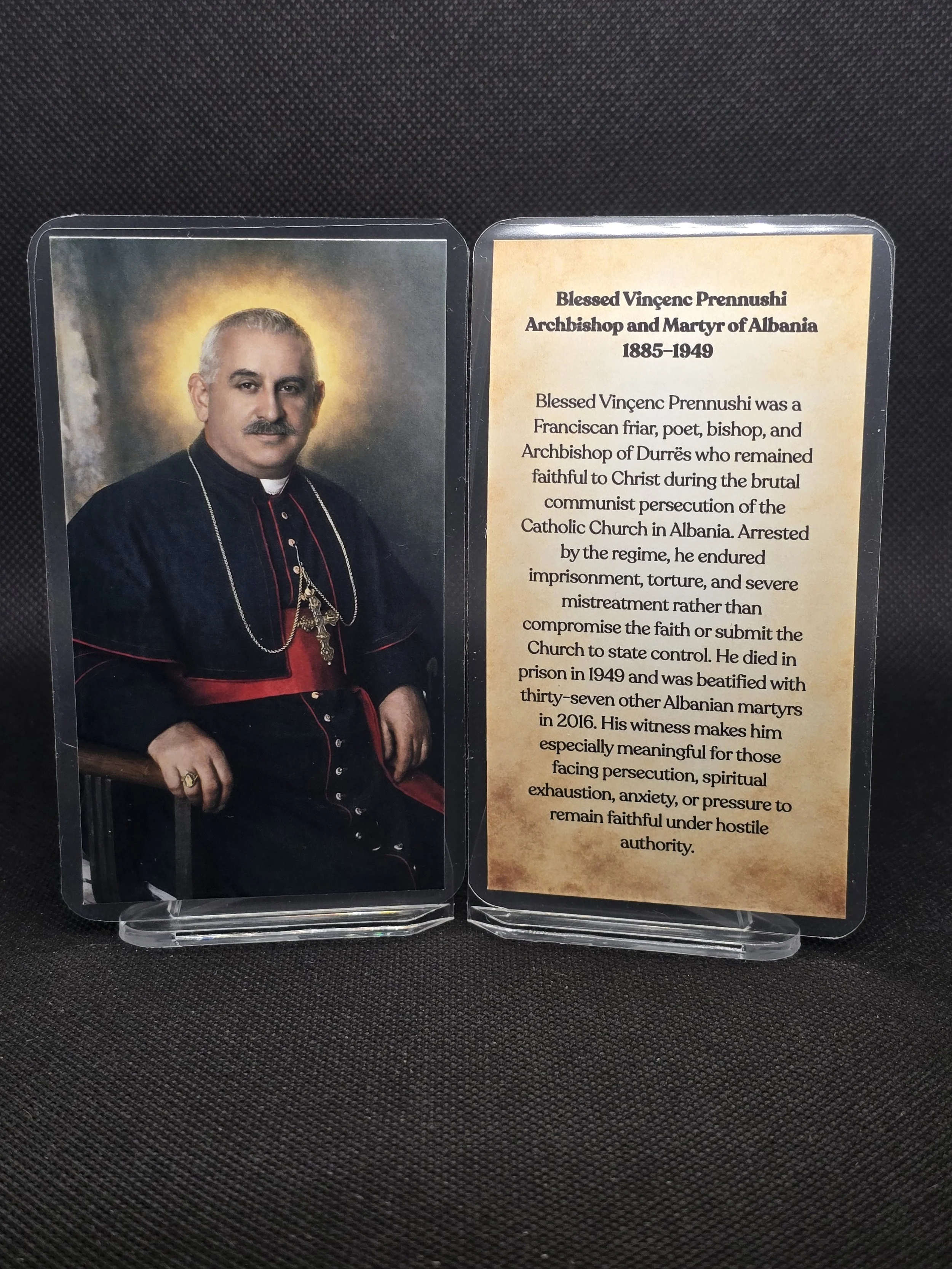
A Franciscan friar, poet and archbishop of Durres who refused a state controlled church and died in a communist prison in 1949.
At a Glance
- Also known as
- Vincenc Prenushi; Vincent Prennushi; baptized Kole (Nicholas)
- Lived
- September 4, 1885 in Shkoder until March 19, 1949 in Durres prison, Albania
- Offices
- Franciscan friar; Bishop of Sape from 1936; Archbishop of Durres from 1940
- Beatified
- November 5, 2016 in Shkoder, with 37 companion martyrs
- Commemoration
- November 5 with the Albanian martyrs; March 19, the anniversary of his death, is also kept locally
- Known for
- Refusing a church cut off from Rome; poetry and folklore; death after imprisonment under Enver Hoxha
Who Was Blessed Vincenc Prennushi?
Blessed Vincenc Prennushi was an Albanian Franciscan friar, a poet and scholar, and from 1940 the Archbishop of Durres. He died in the prison of Durres on March 19, 1949, after he was arrested by the communist government of Enver Hoxha and sentenced to twenty years. The Catholic Church recognizes him as a martyr, and he was beatified in Shkoder on November 5, 2016, together with thirty seven other Albanian martyrs.
He was a Latin Catholic and not an Eastern bishop, yet his story belongs to the wider history of Christians in Eastern Europe who were forced to choose between their faith and the demands of the state. He is also remembered as one of the important Albanian writers of the early twentieth century, and as a man whose friendliness to Orthodox and Muslim neighbors is still remembered in Albania.
This article follows the documents where they exist, and it marks as UNCERTAIN the details that rest on later memories or that the sources give differently.
Early Life and Family
Vincenc was born on September 4, 1885, in Shkoder, then part of the Ottoman Empire and an important center of Albanian Catholic life. He was baptized Kole, the Albanian form of Nicholas. According to the Albanian Franciscan records his father was Gjon Prennushi and his mother was named Drande, and he was confirmed on October 30, 1892.
He went to the Franciscan school in Shkoder and received more formal education in the Franciscan system, including time at the seminary in Troshan. He entered the novitiate at Rubik on October 10, 1900, made his first vows on October 19, 1901, and made perpetual profession in Salzburg on December 12, 1904, taking the religious name Vincenc. His later studies took place in Austria, in the region of Salzburg and the Tyrol, although the sources do not agree on all the places.
UNCERTAIN: published sources say very little about his home life, his parents' work or the first sign of his vocation. An honest article should not invent stories of family poverty or childhood visions.
From Priest to Provincial
There is no conversion in his story. He was born Catholic and grew into the life of a friar. He was ordained a priest on March 19, 1908, and the Franciscan record and the Vatican support that date. Some Albanian articles give March 25, which is the date a biographical source gives for his first Mass.
On his return to Albania he worked in teaching, publishing and church administration, and he became part of the cultural revival of his country. His abilities led him into Franciscan leadership, and he served as provincial minister of the Albanian Franciscans from 1929 to 1935.
In 1936 he was named Bishop of Sape and was consecrated on March 19 of that year. The sources give January 27 or February 27 for the appointment, and the consecration date is not in doubt. On June 26, 1940, he was moved to the archdiocese of Durres, where he became responsible for a large Catholic community during war, occupation and, soon after, the beginning of communist rule.
Poet, Editor and Pastor
Prennushi was an educator, poet, playwright, translator, editor and collector of Albanian folklore. In 1911 he published Gheg Folk Songs in Sarajevo, a collection of traditional songs of northern Albania. His best known book of poems, Gjeth e Lule, which means Leaves and Flowers, appeared in 1924, and a second edition followed in 1931. The National Library of Albania confirms both editions, which corrects references that give 1925.
He also wrote plays, religious studies and meditations. His works include From Captivity to Freedom, In the Fields of True Democracy of 1922 and a life of Saint Francis of Assisi published in 1927. He translated or adapted works by writers such as Henryk Sienkiewicz and Silvio Pellico. As a bishop he wrote pastoral letters, among them letters on Catholic Action in 1939, on the pope and peace in 1941, on unity in Christ in 1942 and on trust in God in 1944. The poet and scholar Arshi Pipa, who later shared his imprisonment, described his poetry as gentle and compassionate and close to the oral tradition.
He directed the Franciscan college, edited Catholic periodicals including Hylli i Drites, and served the Franciscan Third Order. As archbishop he visited parishes and kept in touch with his priests. A priest writing in 2016, Gjergj Meta, reported local memories of Prennushi walking publicly with an Orthodox priest and a Muslim imam. This is later testimony and not a contemporary record, but it fits the picture of a pastor with friendly relations across religious lines. We found no order or congregation that he founded himself.
A Church Cut Off from Rome
After the Second World War the government of Enver Hoxha tightened its control over all religion. Catholic clergy were especially suspect, because of their loyalty to Rome. Restrictions grew on religious education, publishing and administration, and the persecution began long before the official campaign against all religion in 1967.
The Vatican's account says that Prennushi refused a proposal tied to the regime to lead an Albanian national church separated from the Holy See. A scholarly article of 2026 also discusses attempts to create national Catholic churches under communist governments and names him among the Albanian bishops who faced such demands. His refusal is seen as central to his persecution.
This was the decisive turning point of his life. As a poet he had loved Albania, and he had no objection to Albanian language and culture in the Church. What he would not accept was a church whose head was the state.
Arrest and Trial
According to the Albanian Franciscans, he was arrested on May 19, 1947. A military court in Durres tried him and sentenced him to twenty years in prison. UNCERTAIN: the Franciscan biography gives the sentencing date as December 24, 1947, while another account that draws on court records gives December 20. The original judgment should be seen before anyone fixes the date.
His degree of political involvement is also debated. A memory project called Century of Martyrs links him with an anti communist resistance group, while Arshi Pipa's early testimony stresses his distance from politics. UNCERTAIN: we cannot tell whether he took part in organized resistance or only opposed communist policy openly. Charges in a coercive court cannot be accepted as proof, and yet his opposition to the regime should not be erased from the story.
The Church's conclusion that he is a martyr concerns the religious nature of the persecution that led to his death. It does not settle every later anecdote or every political question about his life.
Death in Prison
Prennushi died in the prison of Durres on March 19, 1949, which was also the anniversary of his priestly ordination and his episcopal consecration. The Albanian Franciscan biography says that the immediate cause was a heart attack that followed torture, mistreatment and harsh conditions. Arshi Pipa, who shared the imprisonment, described beatings, forced labor and exposure to cold, and he recalled that other prisoners tried to ease his pain by rubbing his feet and keeping a small fire in the cell.
His remains are kept at the church of Saint Lucy in Durres. They were moved to a municipal cemetery under the communist regime and later brought back. UNCERTAIN: sources give 1967 or 1970 for the transfer, so the year is not settled.
The martyrdom of Prennushi and his companions was recognized by a decree approved by Pope Francis on April 26, 2016. Because the cause was one of martyrdom, no miracle was needed for beatification. The group includes bishops, priests, religious and laypeople who died between 1945 and 1974.
Devotion and Tradition
We found no healing or other miracle attributed to him that the Church has recognized. Vatican News invites the faithful to ask for his intercession and to report extraordinary graces to the vice postulator of the cause, which shows that devotion goes on, though no miracle has yet been judged.
TRADITION: accounts connected with Arshi Pipa and later Church writers say that, as he lay dying, he spoke of light. Father Meta gives the words as More light, and the Vatican's biography links the saying with Goethe and spiritual illumination. UNCERTAIN: the exact wording, and whether these were truly his last words, cannot be confirmed.
TRADITION: later accounts describe him lying barefoot on the cold floor, in the spirit of Saint Francis' poverty. It is a recognized devotional picture, though not every detail can be checked. The strongest evidence of devotion is not folklore. It is the care for his remains, the yearly commemorations and the formal recognition of his martyrdom.
A Witness for Freedom of Conscience
Prennushi's life asks what it costs to say no to a government that wants control of the Church. He was a gentle poet and not a revolutionary, and he was prepared to die before he would give the state what belonged to God.
His beatification along with other Albanian martyrs, including Catholics, religious and laypeople of many walks of life, recalls that the Albanian church suffered terribly in the twentieth century. For people today who live under pressure because of their faith, his example is one of quiet steadiness.
Blessed Vincenc, poet and shepherd, you loved your people and your Church, and you chose prison before a church ruled by the state. Pray for all who suffer for their faith, for those who are held in prison, and for the peace of Albania. Make us gentle in speech and firm in truth. Amen.
This short prayer was written for this page and is not an official liturgical text. A devotional prayer for his cause has been published by Vatican News.
Prennushi and the Eastern Churches
Prennushi was a Latin Catholic Franciscan and not a Byzantine Catholic or Orthodox bishop. His connections with Eastern Christianity are real but indirect. One of the Albanian martyrs beatified with him is Blessed Josif Papamihali, a Byzantine rite priest, so their cause links the story of the Latin church in Albania with that of the small Albanian Greek Catholic community.
Historians also compare the pressure placed on him with the communist campaigns against Byzantine Catholics in Ukraine, Romania and nearby lands, where governments tried to cut the Catholic communities off from Rome. His reported friendship with an Orthodox priest in Durres is a small sign of respect across the divide. No Eastern Orthodox church has glorified him, and Orthodox Christians can honor his courage without making any claim about canonization.
Frequently Asked Questions
Blessed Vincenc Prennushi, Poet and Martyr
Vincenc Prennushi shows the strength of a gentle man who would not bow to a false church. Keep his prayer card near you as a sign of solidarity with persecuted Christians.
View Prayer Card