Saint Verena of Zurzach: Egyptian Hermit, Healer and Patron of Switzerland
A holy virgin traditionally said to have come from Egypt to the Alps, remembered for fasting, prayer and care for the sick, and honored by Catholic, Orthodox and Coptic Christians.
At a Glance
- Born
- Traditionally Thebes in Upper Egypt, date UNCERTAIN
- Died
- Zurzach, Switzerland, traditionally the 4th century (the date 344 is a later calculation)
- Feast Day
- September 1 (Roman Martyrology and Orthodox calendars that keep her); 4 Thout in the Coptic Synaxarium
- Titles
- Virgin, ascetic, hermit and healer
- Patronage
- Diocese of Basel, the poor, millers, fishermen, boatmen and parish housekeepers; invoked for eye troubles and for couples hoping for children
- Shrine
- Verenamünster (Saint Verena Minster), Bad Zurzach, Switzerland
- Who Was Saint Verena?
- Early Life and Egyptian Origins
- Journey to the West: Milan and Agaunum
- The Hermit near Solothurn
- Imprisonment, Vision and Wonders
- Zurzach: Healer and Servant of the Poor
- Death and Burial at Zurzach
- Relics, Shrine and Devotion
- Historical Questions and Honest Limits
- Verena and the Eastern Churches
- Frequently Asked Questions
Who Was Saint Verena?
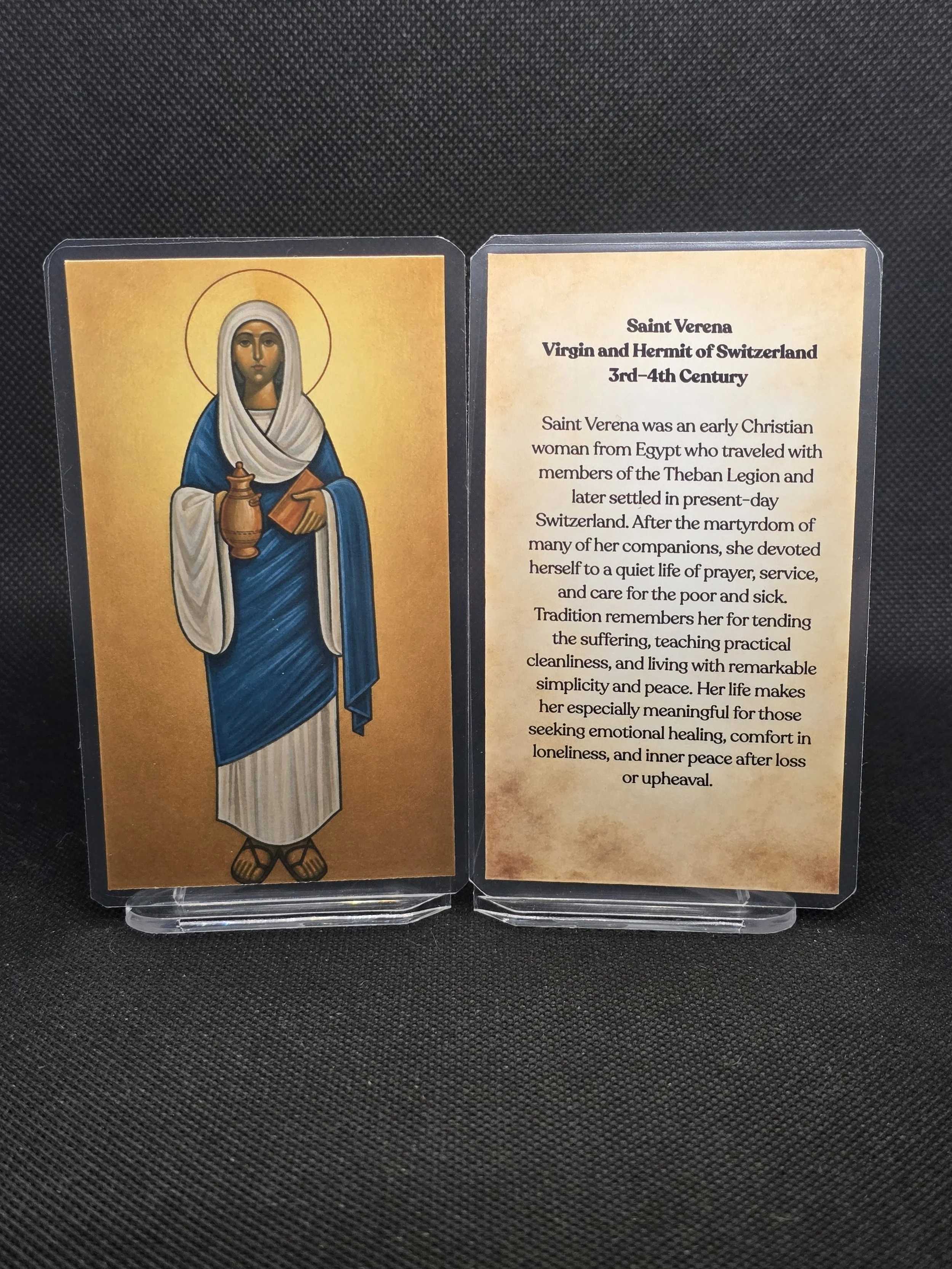
Saint Verena is one of the best loved saints of Switzerland, and one of the most interesting bridges between Egyptian Christianity and the Christian West. In her traditional story she is a young woman from Thebes in Upper Egypt who follows Christian soldiers to Europe, lives as a hermit near Solothurn, and spends her last years at Zurzach on the Rhine, washing and feeding the poor and the sick. Her symbols, a comb and a water jug, point to that humble service.
It is important to say at once how much we know and how much we do not. Verena has no surviving writings. The oldest full biography, the Vita prior, was composed around 888 to 890, probably by Abbot Hatto of Reichenau, several centuries after the age in which she is said to have lived. A longer Vita posterior and a collection of twenty one miracles at her tomb came later still. Because of this, this article marks every story as TRADITION and every doubtful point as UNCERTAIN.
What stands on firmer ground is her cult. Archaeologists have found an early Christian church and burial area at Zurzach that goes back to about the 5th century, and pilgrims have prayed at her tomb for well over a thousand years. Verena may therefore be understood as a real object of ancient devotion whose life reaches us mostly through the memory of the Church.
Early Life and Egyptian Origins
TRADITION says that Verena was born in Thebes, in Upper Egypt, to respected parents, and that she was entrusted to a bishop named Chaeremon for baptism and Christian teaching. The Vita prior presents her as a Christian from her youth, so there is no story of a dramatic conversion from paganism. Her path is better described as a deepening vocation to a life given to God.
The name of the bishop is intriguing. Eusebius of Caesarea, quoting a letter of Dionysius of Alexandria, tells of an aged Bishop Chaeremon of Nilopolis who fled into the Arabian mountains during the persecution under Decius, around 250, and was never found. The biography of Verena says her bishop died as a martyr, which is not quite the same account, and Eusebius does not mention her at all. Whether the hagiographer borrowed a known Egyptian name or really preserved a memory of the same man is UNCERTAIN.
Nothing reliable is known of Verena's parents, her brothers or sisters, her native language or her education. The popular picture of a well educated girl from a prosperous family is plausible for Roman Egypt, but it is a picture, not a record. Even the meaning of her name has been debated, with some suggesting a link to Berenice, and none of these suggestions settles anything.
For readers it is enough to hold the tradition lightly and gratefully: the Church remembered her as one who came from the old Christian land of Egypt, bringing its love of prayer and fasting to the cold valleys of the north.
Journey to the West: Milan and Agaunum
According to TRADITION, after the loss of her teacher Verena travelled north along the Nile and met Christians who belonged to the army later called the Theban Legion, led by Saint Maurice. She then went to Italy and came to Milan, where, the Vita prior says, she visited imprisoned Christians and the places where martyrs were honored, offering simple works of mercy. A holy man named Maximus is said to have received her there.
The next turning point came when she heard that Maurice and his companions had been put to death at Agaunum, now Saint-Maurice in the Swiss Valais. Verena is said to have crossed the Alps to pray at the place of their martyrdom. Some later versions describe a soldier named Victor as her close friend or even her fiancé, and some call Maurice a relative. None of this is firmly documented and all of it is UNCERTAIN.
The setting itself is historical enough. The route from Milan over the Alpine passes to Agaunum and on to the region of Solothurn follows real Roman roads and real places. The oldest account of the martyrs of Agaunum, written by Eucherius of Lyon around 440 to 450, says nothing about Verena, and scholars still debate how far the story of a whole legion is literally true. So her place in that story, even as a follower, cannot be proven.
What the tradition does teach is the shape of her vocation. She did not go to the martyrs to be a warrior or a preacher, but to pray, to serve and to remember.
The Hermit near Solothurn
TRADITION places Verena next in the region of Solothurn, a town honoring the martyrs Ursus and Victor. There she withdrew into a cell or a cave and gave herself to fasting, psalms and prayer. The Vita prior says her spiritual reading included Saint Cyprian of Carthage on the dress of virgins, which fits the author's wish to show her as a model of humble Christian virginity. It does not prove that she herself owned the book.
She is also described as working with her hands. A kindly older Christian woman is said to have sold what Verena made and brought her what she needed. In this picture of poverty, work and prayer, readers who know the Desert Fathers will feel at home, although there is no evidence that Verena ever studied under a particular Egyptian monastic master.
The account adds that young women began to gather near her, drawn by her example, and that she taught them humility, purity and devotion. Some writers therefore call her a founder of a women's community. That claim should be handled with care. The text describes a circle of disciples, not a monastery with a rule or a charter, and a formal foundation is UNCERTAIN.
A word of gentle caution belongs here. Stories of severe fasting are part of this tradition, and modern readers should not treat them as a pattern to copy. The wise guides of both East and West have always taught that prayer, charity and obedience to a spiritual father matter far more than harsh bodily practices.
Imprisonment, Vision and Wonders
The Vita prior reports that a hostile Roman official imprisoned Verena because of her Christian life. In prison, TRADITION says, she saw Saint Maurice, who told her to stay faithful. When the official later fell gravely ill with fever, Verena prayed for him, he recovered, and he set her free. The story is a lesson in forgiveness: the prisoner heals her jailer. No independent record of the event exists.
The biography also tells of healings of blindness and of people troubled by evil spirits through her prayers, and of a time when her little household had no food. After she prayed, according to the tale, forty sacks of flour appeared at the door. These accounts were meant to teach trust in God, and the writer was careful to place them within a framework of humility.
The reader should remember that medieval saints lives follow patterns. Imprisonment, a vision of a martyr and miraculous provision appear in many such texts, and a modern historian cannot say which details come from memory and which from literary custom. Even the Bollandist editors of the Acta Sanctorum, writing in the 18th century, separated her well established veneration from legends they found weak.
None of this prevents a believer from receiving the stories as signs of what the Church saw in her: a woman whose strength was mercy.
Zurzach: Healer and Servant of the Poor
Verena's last home, in TRADITION, was Zurzach. The longer Vita posterior says that a local priest took her into his house and entrusted her with household duties. She cared for the poor, above all for people suffering from leprosy, bringing them food and drink, washing them and binding their wounds. This is the source of her comb and water jug, signs of care for the dignity of the sick.
Some later popular tales gather around these symbols. In one, she is accused of wrongly taking wine from the priest's cellar, and when her jug is examined its contents are found to be changed, proving her innocent. In another, a precious ring thrown into the Rhine is found by fishermen inside a fish. A further legend says that she drove snakes from an island near the meeting of the Aare and the Rhine. These are all TRADITION, and the Vita posterior was written long after the events it describes, perhaps between 1000 and 1150.
It would be a mistake to call Verena a nurse in the modern sense. She had no medical training, and the earliest evidence does not give her a profession. Yet the picture of a woman who washes the sores of the sick is one of the most moving in Christian hagiography, and it explains why hospitals, housekeepers, millers and fishermen came to think of her as their friend.
Death and Burial at Zurzach
According to the Vita prior, Verena died peacefully after a long illness. TRADITION adds that the Virgin Mary appeared to her with holy virgins, that she departed in peace, and that her dwelling was filled with a sweet fragrance. As always, such details can be received as pious testimony but cannot be checked.
The year of her death is unknown. Many sources print 344, but that figure is a later calculation and not a documented date. All that can be said safely is that tradition assigns her to the 4th century and that no contemporary writer mentions her.
Archaeology gives firmer ground. Excavations at Zurzach have uncovered Roman graves and an early Christian church built around the 5th century over a cemetery, and the placement of the church suggests that a particular grave was honored. Later buildings grew up around it, and the present Verenamünster combines Romanesque and Gothic work from several periods. Whether the original burial can be named as Verena's is UNCERTAIN, but the long continuity of worship at the site strongly supports the antiquity of her cult.
Relics, Shrine and Devotion
After her death, Zurzach became a pilgrimage place. A medieval collection called the Miracula sanctae Verenae records twenty one wonders at her tomb. Scholars date its writing to roughly 1005 to 1032, with the events spread from the early 10th century to the early 11th. It is valuable for the history of pilgrimage and local piety, though it is not a modern investigation of cures.
Her veneration spread through parts of Switzerland and southern Germany. Noble families, including the Habsburgs, honored her, and pilgrims came to ask for healing, for help with eye troubles and for the gift of children. She became patron of the diocese of Basel, and traditionally of the poor, millers, fishermen, boatmen and parish housekeepers.
Her feast is September 1, and the Roman Martyrology names her as a virgin, not a martyr. She was never canonized by a papal process, because her recognition arose from ancient local devotion before such procedures existed. Today the Verenamünster remains a place where Catholics and visitors come to pray, and Verena is a loved figure in Swiss church life.
Historical Questions and Honest Limits
The scholarly picture can be summed up in three points. First, the cult at Zurzach is old and well supported. Second, the written life is medieval and written for edification, partly for Richgard, the widow of Emperor Charles III. Third, almost every detail of her biography, from her Egyptian birth to her relation with the Theban Legion, cannot be confirmed from sources near her own time.
Some writers have suggested that the legend grew from real memories of Christian women who served the martyrs, and that the Egyptian setting reflects the wide reach of the Theban legend. Others see more literary invention. Both views are possible and the evidence does not decide between them.
For a reader, the best attitude is neither credulity nor dismissal. A saint can be truly loved and truly prayed to even when the biographer cannot give a date. The Church asks us to learn from her pattern of life, prayer, hospitality and mercy, while honestly saying where the record ends.
The best known authorities for further study include the Latin Vita prior, Adolf Reinle's 1948 study of the legend and cult, Guy Philippart's article on the Latin legends in the Analecta Bollandiana of 1985, and the entry in the Coptic Encyclopedia.
O Lord Jesus Christ, who gave to your servant Verena a heart of mercy and a love of silence, grant us by her prayers to serve the poor and the sick with gentle hands. Heal our eyes to see you in every neighbor, and bring us, with all your saints, to your kingdom. Amen.
This prayer was written for this page and is not an official liturgical text.
Verena and the Eastern Churches
Verena belongs to the shared Christian world before the great medieval divisions, so she is honored by many streams of Eastern Christianity today. Her Egyptian roots make her especially dear to the Coptic Orthodox Church, whose Synaxarium commemorates her on 4 Thout, which falls on September 14 in the current civil calendar. Some Orthodox communities in Switzerland also keep her feast and use a troparion in Tone 3 in her honor. Its author and date are not known, so it should not be called an ancient hymn.
The modern link between Zurzach and Egypt is well documented. In 1986 a delegation from Zurzach gave a relic attributed to Verena to Pope Shenouda III of the Coptic Orthodox Church, and Coptic churches in Egypt and elsewhere have since been dedicated to her, including, according to Coptic church records, a church of Saint Maurice and Saint Verena in Cairo consecrated in 1994. Coptic devotion in its present form seems to have grown in the 20th century, so it should not be taken as proof of an unbroken Egyptian cult from her own age.
There is no evidence of an ancient feast of Verena in the Byzantine rite, and she is not found in every Eastern Orthodox or Eastern Catholic calendar. Even so, her fasting, her quiet manual work and her care for the sick will seem familiar to anyone who loves the Desert Fathers. For Eastern Catholics and Orthodox readers she stands as a reminder that Egypt and the West once shared one faith and one kind of mercy.
Frequently Asked Questions
Learn From Saint Verena
Verena shows that holiness can be quiet: a comb, a jug of water and a patient hand for the sick. Keep her prayer card near you as a reminder to serve the people in front of you.
View Prayer Card