Saint Severus of Antioch: Patriarch, Theologian and Teacher of the Oriental Orthodox
A scholar, monk and Patriarch of Antioch who defended the one incarnate Christ after Chalcedon, died in exile in Egypt, and is honored as a saint by the Syriac and Coptic Orthodox Churches.
At a Glance
- Born
- Sozopolis in Pisidia, about 459 to 465 (UNCERTAIN)
- Died
- February 8, 538, in Egypt, traditionally at Sakha (UNCERTAIN)
- Feast Day
- February 8 in the Syriac Orthodox tradition; 14 Amshir in the Coptic Synaxarium
- Titles
- Patriarch of Antioch, Mor Severus the Great, Crown of the Syrians
- Recognition
- Saint in the Syriac and Coptic Orthodox Churches; no formal canonization date is known
- Burial
- Traditionally the Enaton monastic area west of Alexandria
- Who Was Saint Severus of Antioch?
- Early Life and Education
- Baptism and the Monastic Life
- Patriarch of Antioch
- Theology: One Incarnate Christ
- Exile and Controversy
- Death and Burial in Egypt
- Tradition, Legend and Devotion
- What Remains for the Churches Today
- Severus and the Eastern Churches
- Frequently Asked Questions
Who Was Saint Severus of Antioch?
Severus of Antioch was a lawyer turned monk, a monk turned bishop, and a bishop who spent his last twenty years in exile. Born in Asia Minor and educated in Alexandria and Beirut, he became Patriarch of Antioch in 512. When the emperor changed course in 518 he fled to Egypt, where he kept teaching, writing and guiding his followers until his death in 538. He is the most important theologian of the Churches that did not accept the Council of Chalcedon of 451, and the Syriac and Coptic Orthodox Churches honor him as a saint and teacher.
This is a sensitive subject, and it should be told with honesty. The Catholic Church and the Eastern Orthodox Church of the Byzantine tradition accept Chalcedon, and a synod at Constantinople condemned Severus in 536. Neither Church includes him in its calendar of saints. The Oriental Orthodox Churches, which include the Syriac, Coptic, Armenian, Ethiopian and Malankara Churches, remember him as a faithful defender of Saint Cyril of Alexandria. This article explains what he taught and how he is remembered without pretending that those differences do not exist.
The best evidence for his life is unusually good for his age. His fellow student Zacharias Scholasticus wrote an early biography, a second anonymous life survives, and about two hundred of his own letters, a large body of sermons and several theological treatises have come down to us, mostly in Syriac translation. What the later Synaxarium adds, including prophecies and miracles, is marked TRADITION below.
Early Life and Education
Severus was born in Sozopolis, a city of Pisidia in what is now Turkey, into a wealthy Greek speaking family. The Syriac Orthodox Patriarchate gives about 459 for his birth, while the scholar Volker Menze gives about 465. The exact year is UNCERTAIN. Later tradition says that he was named for a grandfather who had been a bishop and who was present at the Council of Ephesus in 431. That detail needs caution, because it is known to be chronologically confused in some accounts.
His family could afford the best schooling. Severus studied rhetoric, literature and philosophy in Alexandria, and then went to Berytus, modern Beirut, to study Roman law. Beirut was the leading law school of the eastern empire, and a legal training led to a career in government and public life.
In Beirut he became close to Zacharias Scholasticus, who later wrote his first biography, and to a Christian circle of students who combined study with prayer and disciplined living. Whether he was raised a pagan or only grew up distant from the Church is debated among scholars, and the sources do not allow a firm answer. Nothing reliable says that he ever married.
The picture that results is of a gifted young man whose gifts could have made him a rich official, but who was drawn instead toward the Church, toward scripture, and toward the poor and silent life of monks.
Baptism and the Monastic Life
The Syriac Orthodox tradition places Severus's baptism in 488 at Tripoli. A reference work such as the New Catholic Encyclopedia gives the same year but names a different place, so the year is widely repeated while the location is UNCERTAIN. His conversion was gradual and shaped by study, friendships and the lives of ascetics, and not by a single dramatic event.
After baptism he took up strict self discipline and travelled to Palestine, where monasteries around Gaza and Maiuma formed a lively center of prayer and theology. He joined the Monastery of Saint Romanus near Maiuma, in an area long linked with Peter the Iberian and with monks who rejected the decisions of Chalcedon. He later lived as a solitary and founded his own community near Gaza. He was ordained a priest, according to the tradition by Epiphanius of Magydos.
The decisive change came when disputes with Chalcedonian authorities in Palestine took him to Constantinople. According to the Syriac Patriarchate he arrived with a large group of monks around 508 and remained for several years, speaking in the capital for the cause he believed in. There he came to the notice of Emperor Anastasius I.
A gentle caution is useful here. Early monastic life of this kind could be very severe, and modern readers should not take its fasts and vigils as a model. The Fathers themselves warned that love, humility and obedience are the real measure of a monk.
Patriarch of Antioch
In 512 the emperor and many bishops chose Severus to replace Flavian II, who had been deposed. He was enthroned as Patriarch of Antioch on November 6, 512. For six years he governed one of the great sees of Christianity, preaching to the people of the city, appointing bishops and correspondents, and writing against the Chalcedonian definition.
His cathedral homilies from this period are among his most valuable works. A collection of one hundred and twenty five sermons survives, preached in Antioch mainly between 512 and 518. They deal with scripture, the saints, Christian behavior and the doctrinal disputes of the day, and they give a rare picture of a bishop's preaching in late antiquity.
Severus did not rule without opposition. Many Chalcedonians in Syria rejected his appointment, and his support depended on the imperial court. He lived at the center of a divided Church, and his years in office were marked by quarrels as well as by pastoral work.
It is worth remembering that he was also a pastor. His letters to monks, ladies, doctors and officials show a man who answered questions about illness, marriage, prayer and daily conduct with patience, and who wrote as often to ordinary believers as to bishops.
Theology: One Incarnate Christ
Severus believed that he was defending the teaching of Saint Cyril of Alexandria, above all Cyril's phrase about the one incarnate nature of God the Word. For him, Jesus Christ is truly God and truly man, with a real human body and a rational human soul, and these are united in one person in such a way that it is the same Lord who works miracles and who suffers on the cross. He rejected any teaching that seemed to divide Christ into two acting persons.
This position is usually called Miaphysitism. It should not be confused with Eutychianism, which taught that Christ's humanity was absorbed into his divinity and which Severus himself attacked. The Chalcedonian Churches, however, held that his language did not guard against a confusion of the natures, and they in turn defended their own language of two natures in one person.
His chief works include the Philalethes, an answer to a collection of quotations used by a Chalcedonian opponent, and the work Against the Impious Grammarian, directed against John the Grammarian. He also wrote against Julian of Halicarnassus, who held that Christ's body was incorruptible from the moment of the Incarnation. Severus argued that Christ truly took on the mortal condition of humanity, without sin, so that he could redeem it.
Most of his works were written in Greek, but after their condemnation in Chalcedonian lands they survived chiefly in Syriac translation. His letters were edited and translated by E. W. Brooks in the early 20th century. Some hymns and prayers in the West Syriac tradition are also attributed to him.
Exile and Controversy
When Emperor Anastasius died in 518, he was followed by Justin I, who supported the Council of Chalcedon. Severus lost his see and fled to Egypt. A popular mistake in some devotional biographies names Justinian as the emperor who removed him, but Justinian came to the throne later.
In Egypt he was received by monks and clergy who shared his teaching, and he continued to write and to direct the Churches that followed him. This period also brought a bitter dispute with Julian of Halicarnassus over the nature of Christ's body. The quarrel split the opponents of Chalcedon into factions and lasted long after both men were dead.
Around 535 and 536 the emperor Justinian tried to reach an agreement with the non Chalcedonian leaders, and Severus came to Constantinople for talks. They failed. In 536 a synod led by Patriarch Mennas condemned Severus and other leaders, and imperial orders forbade his writings and ordered them destroyed.
Historians explain the conflict as more than a simple argument over words. It involved the authority of earlier fathers, the demands of imperial politics, regional loyalties and genuine fears on both sides that the unity of Christ or the reality of his humanity was being lost.
Death and Burial in Egypt
Severus died in Egypt in 538, traditionally on February 8, after about twenty years in exile. The Syriac sources and the Coptic Synaxarium name Sakha as the place of his death, in the house of a pious supporter named Dorotheos, while the New Catholic Encyclopedia names Xois, so the exact place is UNCERTAIN. His death is understood as natural. Some devotional writers call him a confessor or even a martyr, but there is no reliable evidence that he was executed.
According to the Coptic tradition, Dorotheos arranged to carry his body to the Monastery of El Zugag, linked with the Enaton, the great monastic area west of Alexandria. Scholars accept that his tomb was in the Enaton and that it became a place of devotion for centuries. The Coptic calendar also keeps a remembrance of his arrival in Egypt and of the transfer of his relics.
Which relics may be authentic today cannot be said with confidence. The history of the monastery's names and buildings is complicated, and no continuous account of the remains can be traced to the present day.
Tradition, Legend and Devotion
The Coptic Synaxarium and Syriac devotional lives add several stories that belong to TRADITION. One says that his grandfather received a vision foretelling that a grandson of his name would defend the right faith. Another says that a hermit came out of his cave and greeted the young Severus as a future Patriarch of Antioch, long before he held any office.
The best known tale tells of Severus attending the Liturgy in the Egyptian desert disguised as an ordinary monk. The priest found that the bread on the paten had vanished, and an angel revealed that a patriarch was among the worshippers. When Severus was found and honored, the bread returned. The story honors his humility and episcopal dignity.
A fourth account describes the boat carrying his relics stranded in shallow water, and moving on after prayer to him. Scholars such as Lois Farag distinguish the historical importance of his cult from such legends. The Synaxarium also contains a plain historical error, since it places Severus at the Council of Ephesus in 431, before he was born.
The strongest evidence for his veneration is liturgical. The Syriac Orthodox Church celebrates him on February 8, with a movable commemoration after the Fast of Nineveh, and the Coptic Church honors him on 14 Amshir, which falls on February 21 in the civil calendar today. A Coptic doxology invokes him together with Dioscorus of Alexandria.
What Remains for the Churches Today
The old quarrel has been softened in the last century by careful dialogue. In 1973 Pope Paul VI and Pope Shenouda III of the Coptic Orthodox Church signed a common Christological declaration affirming that Jesus Christ is truly God and truly man. In 1984 Pope John Paul II and Syriac Orthodox Patriarch Ignatius Zakka I Iwas issued a further declaration, recognizing a common faith in the Incarnation and explaining that differences of wording come from history.
These agreements are not a canonization of Severus, an approval of all of his polemical writings or a restoration of full communion. They do show why many scholars now read him with respect, and why Catholic, Eastern Orthodox and Oriental Orthodox students can study the texts for themselves rather than relying on old polemics.
Readers who wish to go deeper may begin with the early lives edited by Sebastian Brock and Brian Fitzgerald, with the study by Pauline Allen and C. T. R. Hayward, and with the work of Yonatan Moss on his quarrel with Julian of Halicarnassus.
Lord Jesus Christ, true God and true man, you are one Lord and one Savior. By the prayers of your servants who taught and suffered for the faith, free us from pride and from suspicion. Teach your Church to speak with charity, to listen with humility and to confess you in one heart. Amen.
This prayer was written for this page and is not an official liturgical text. A traditional Coptic doxology that invokes Severus is used in Coptic worship.
Severus and the Eastern Churches
For the Syriac Orthodox Church, Severus is a great father whose homilies and hymns still shape worship, and the title Crown of the Syrians expresses that debt even though he was born in Asia Minor. For the Coptic Orthodox Church, he is a defender of the Alexandrian faith of Cyril and a link between Antioch and Egypt, where his tomb became a place of prayer.
Eastern Catholics and Eastern Orthodox readers of the Byzantine tradition will find that he is not on their calendars, and that their Churches condemned him in his lifetime. His importance for them is mainly historical and theological, since he belongs to the Syriac and Greek Christian world from which both traditions draw. Nothing in this article asks a Catholic or Byzantine Orthodox reader to venerate him.
It is nonetheless good to know him. His life is a reminder that a deep love of Christ can lie on both sides of an old division, and that patient reading and prayer can heal what anger once broke.
Frequently Asked Questions
Learn From Saint Severus
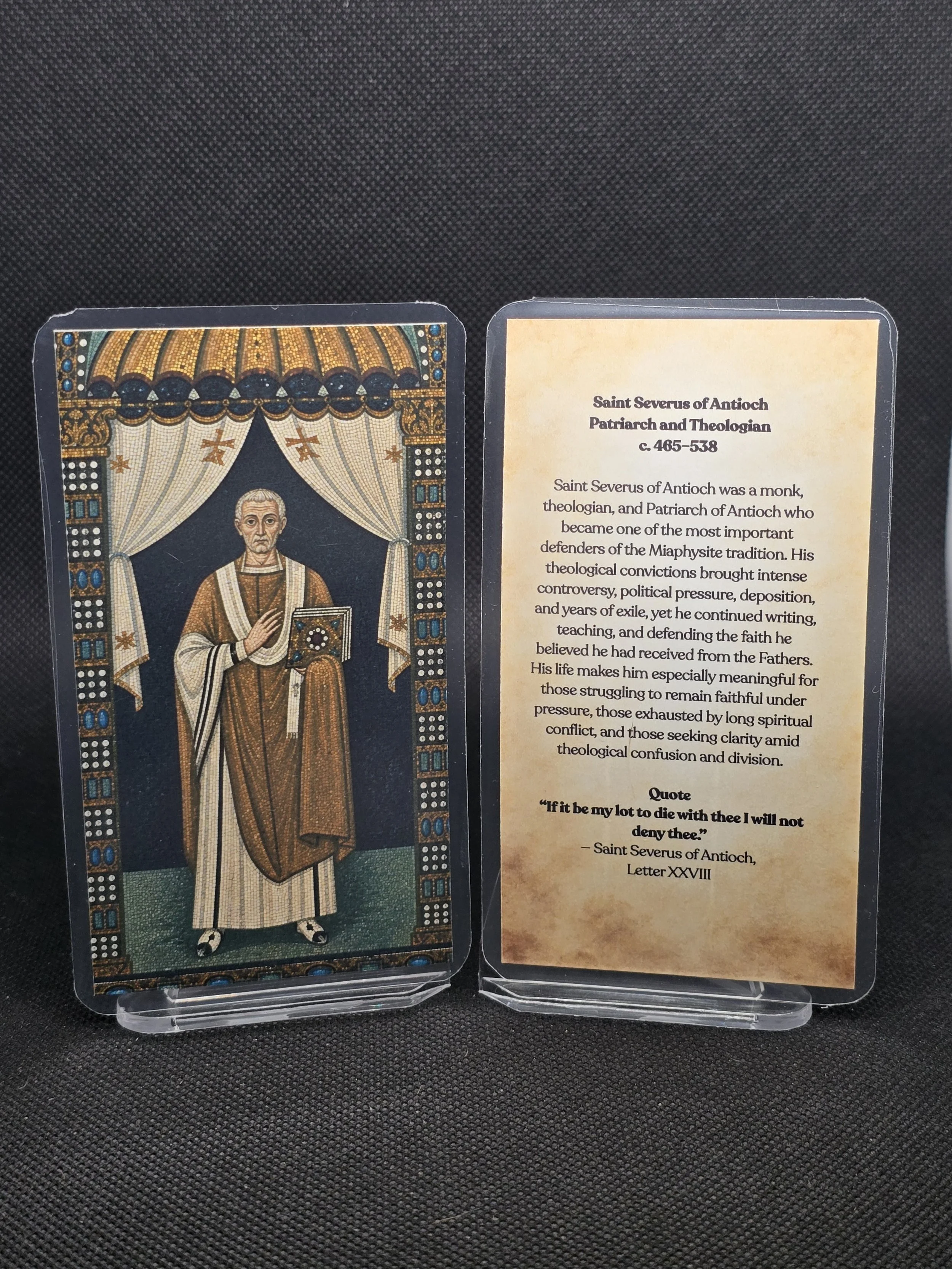
Severus spent his life thinking, writing and praying for the unity of Christ's Church. Keep his prayer card near you as a reminder to speak the truth in charity.
View Prayer Card