Saint Gebre Menfes Kidus: Ethiopian Hermit and Friend of Wild Beasts
The desert father of Ethiopian and Eritrean Christianity, remembered as a hermit surrounded by lions, whose Life is rich in wonders and whose true history is very hard to recover.
At a Glance
- Born
- Traditionally Nehisa in Lower Egypt; date UNCERTAIN
- Died
- Traditionally commemorated on Megabit 5; year UNCERTAIN (the 562 year lifespan is TRADITION)
- Feast Day
- Megabit 5 (death), Tikimt 5 (covenant), and the fifth day of each Ethiopian month
- Titles
- Abune (Our Father), Abbo, Star of the Desert, Chief of the Anchorites
- Recognition
- Saint in the Ethiopian and Eritrean Orthodox Tewahedo Churches; no canonization date is known
- Place
- Zeqwala monastery on Mount Zeqwala, south of Addis Ababa
- Who Was Saint Gebre Menfes Kidus?
- Birth and Family
- Called to the Desert
- The Journey to Ethiopia
- The Monastery of Zeqwala
- Lions, Hair and Wonders
- Death and Burial
- Feasts and Devotion
- What History Can Say
- Prayer and Spiritual Lessons
- Gebre Menfes Kidus and the Eastern Churches
- Frequently Asked Questions
Who Was Saint Gebre Menfes Kidus?
Saint Gebre Menfes Kidus, whose name means servant of the Holy Spirit, is one of the most loved holy men of Ethiopian and Eritrean Christianity. Believers call him Abbo, a tender word for father, and picture him as a wild haired old hermit surrounded by lions and leopards. His monastery at Zeqwala, on an old volcano south of Addis Ababa, is still a place of pilgrimage, and his feast on the fifth of the month is kept by many families.
Almost everything that is said about him comes from his Ge'ez Life, from miracle collections and from the Ethiopian Synaxarium. These are medieval and later devotional works, and they are full of figures that cannot be taken literally, such as a lifespan of 562 years. Because of this, this article marks the stories as TRADITION and the doubtful points as UNCERTAIN. What can honestly be said is that a real ascetic cult grew up around a figure remembered as an Egyptian born hermit who became a spiritual father of Ethiopia.
The learned work of Paolo Marrassini, who published the critical edition of his Life in 2003, shows that several versions of the text exist and that the dates proposed for their writing rest on weak ground. The man behind the legend, if there is one man, cannot be placed with certainty in any century.
Birth and Family
TRADITION says that Gebre Menfes Kidus was born in a town called Nehisa in Lower Egypt, to noble and devout parents named Simeon and Aklesya. They are said to have had no child for thirty years before he was granted to them. Marrassini connects the Nehisa of the Life with an ancient place that matches the modern Bahbit al Hagara, and notes that it is sometimes wrongly identified with Oxyrhynchus. Naming the town does not prove that he was born there.
Other traditions add that his mother was of the tribe of Benjamin and so a relative of Saint Paul, and that his father was of Roman origin and connected to the court. These claims resemble themes found in other Ethiopian saints' Lives, and no outside record supports them. The Synaxarium also says that the infant stood up and praised the Trinity soon after birth, and one version says that the emperor attended his baptism.
A modern Church account gives his birth as Tahsas 29 in the year 829 of the Ethiopian calendar, which is roughly the year 837 in the Western count. This too is a traditional chronology and not a verified record, and it sits uneasily with older claims that put him in the 4th or 5th century. The sources do not allow us to say which is right.
The safest statement is a short one. Ethiopian Christians remember him as an Egyptian born ascetic. His parents, rank and childhood are matters of pious tradition.
Called to the Desert
The Life gives no story of a conversion from another faith. In TRADITION he is a Christian from his cradle, set apart for God. At about the age of three, it says, the archangel Gabriel carried him into the Egyptian desert and placed him with monks. There a monk named Zamada Berhan became his teacher and taught him the Scriptures, prayer and the discipline of the monastic life.
He is then said to have been ordained a priest by a bishop named Abraham. Marrassini notes that this bishop cannot be identified with any certainty, though Abraham of Manuf has been suggested, and that suggestion is only a guess.
The center of his vocation was the life of a hermit, or anchorite. Instead of living inside a busy community, an anchorite goes apart for long years of prayer, fasting and repentance. The story of Gebre Menfes Kidus pushes this idea to its limit. He goes deeper into the desert, and gives up even the small comforts that monks usually keep.
Readers should treat the stories of extreme fasting and exposure with care. They express a spiritual ideal and are not a program for anyone to follow. Teachers of both East and West have always said that prayer, love and obedience to a wise guide count for more than bodily hardship.
The Journey to Ethiopia
According to TRADITION, after a long time in Egypt Gebre Menfes Kidus received a divine command to go to Ethiopia. He came to Mount Zeqwala, the volcanic mountain with a crater lake near the town of Debre Zeyit, and to a place called Medre Kebd. These two sites became the main centers of his cult.
Some Church accounts connect his arrival with a king named Harbay and his later work with King Lalibela, the ruler remembered for the rock churches that bear his name. Such links help us see how the legend was set in the medieval Ethiopian world, but they do not provide dated meetings. Later additions to the Life especially stress these royal links.
The hermit's calling in Ethiopia is not mainly to found institutions or to preach. He prays for sinners, for the Church and for the country. His Life repeatedly shows him begging God's mercy for people who have fallen, which is a sign that his solitude was not cold. Withdrawal gave him a deeper love for others.
The Life claims that he spent three hundred years in the wilderness of Egypt and two hundred and sixty two years in Ethiopia, which produces the figure of 562 years. These numbers vary among the manuscripts and cannot be used as history. They are better read as a way of saying that his devotion was beyond ordinary measure.
The Monastery of Zeqwala
The most important foundation linked to him is the monastery of Zeqwala Abbo, also known as Debre Kewakibt, on Mount Zeqwala. It stands on an extinct volcano south of Addis Ababa, and it is still a center of pilgrimage and monastic life. The Hill Museum and Manuscript Library records twenty seven manuscripts from the monastery, which proves that there was a real community and a real manuscript tradition, though it does not prove his own role in founding it.
The mountain also appears in historical records. The Encyclopaedia Aethiopica notes that it is shown on Fra Mauro's map of 1460, and connects its Christian history with the medieval kingdom of Shewa. The monastery suffered destruction in the sixteenth century wars of Ahmad ibn Ibrahim al Ghazi and was later rebuilt, and it was attacked from the air by Italian forces in 1937. These belong to the later history of the site and not to the life of the saint.
The crater lake is part of its devotion. Local tradition links the lake's holiness with his prayers, and pilgrims come for blessing and water. This is a living practice, which shows that the reverence is not only literary.
No writings that he himself composed are known. The works that bear on him are about him, including the Life, a homily on his childhood, and collections of miracles. A nineteenth century manuscript catalogued by the Hill Museum and Manuscript Library, for instance, contains a Ge'ez Life followed by thirteen miracle stories.
Lions, Hair and Wonders
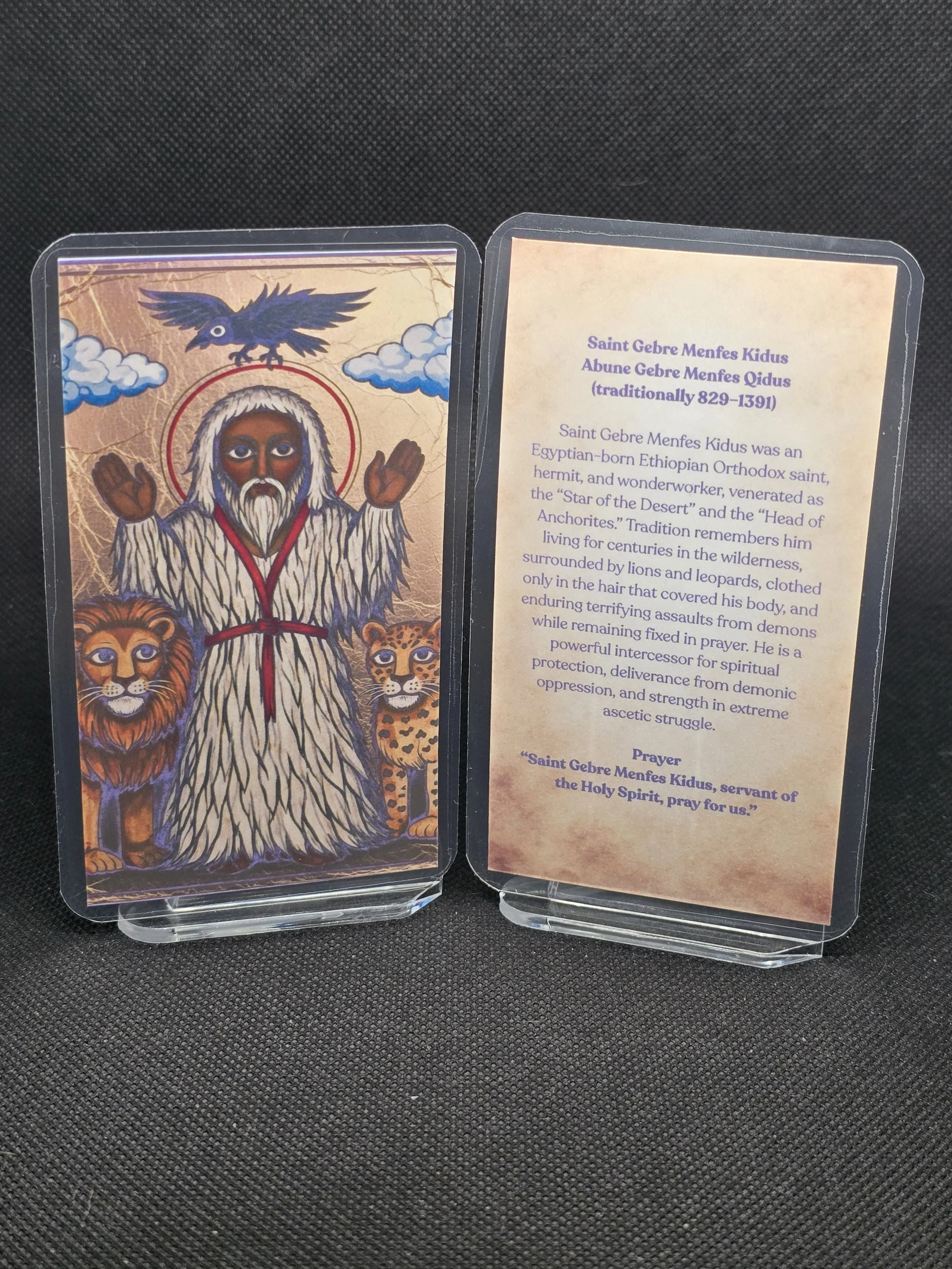
The Life of Gebre Menfes Kidus is among the most picturesque in Christian hagiography. TRADITION says that sixty lions and sixty leopards lived around him and obeyed his word. The image recalls Daniel in the lions' den, and it has become the standard way of painting him in Ethiopian icons.
Another account says that he gave up ordinary clothing and was covered in long hair that sheltered him from cold and sun, which is why icons show him with a very long white beard and hair. Yet another story tells that Satan, as a black raven, put out his eyes, and that after a long blindness the archangels Michael and Gabriel restored his sight. The narrative is meant to show endurance under attack and has no outside confirmation.
The Synaxarium also tells of visiting monks who came with lions that were killed and eaten by other lions, until the saint commanded the remains to be given back and prayed, and the animals came to life. Tales of this kind show the power of intercession as the tradition understood it.
Marrassini distinguishes three versions of the Life. One is full of miracles, including the lions and leopards, another stresses monastic and theological teaching and is probably older, and a third combines the two. Many of the best loved wonders therefore belong to a version that grew over time, which is a reason to hold them lightly.
Death and Burial
TRADITION says that Gebre Menfes Kidus died after finishing his long struggle in the Ethiopian wilderness. His death is commemorated on Megabit 5, which falls on March 14 in the current Western calendar. The Synaxarium tells that he became gravely ill, was helped by fellow hermits, and died with his arms stretched out like the crucified Christ, while angels and visions surrounded him.
The accounts of his burial do not agree. The written Life says that holy men carried his body to Jerusalem. Local memory at Zeqwala says that one of his ribs remained beneath the church after his body was taken away. That is a relic tradition and not proof of an authenticated relic, and nothing allows us to follow his remains through the centuries.
There is also no documented date of canonization. As with many saints of the early and medieval Church, he was recognized through the worship, monastic books and calendars of his people. The Ethiopian and Eritrean Orthodox Churches include him among their saints today, and his feast is kept widely.
Feasts and Devotion
He is honored on the fifth day of every Ethiopian month. The two greatest days are Megabit 5, the day of his death, and Tikimt 5, which falls on October 15 in the current Western calendar and recalls the covenant that God is said to have made with him. According to TRADITION, God promised mercy to those who remember his name and seek his help.
Believers invoke him for forgiveness, for protection from evil and for strength in fasting and prayer. Pilgrims climb to Zeqwala, drink the water of the lake and light candles. His icon, with its lions and long white hair, is found in many Ethiopian and Eritrean homes and churches.
The strongest historical proof of his cult is in the manuscripts. Libraries in the United States and elsewhere hold Ge'ez copies of his Life and miracles, and the Catholic University of America preserves an Ethiopian image of him, showing how widely his picture was loved.
What History Can Say
Scholars see the saint as part of a literary family of Egyptian born holy men in Ethiopian tradition, whose Lives stress desert struggle, the battle with demons and renunciation. This suggests that Ethiopian monks wanted to link their own spirituality to the deserts of Egypt, whose Church had long supplied Ethiopia with its bishops.
The difficulty is that we do not know whether a single historical hermit lies behind the Life, or when he lived. The traditional date of 829 in the Ethiopian calendar and the claims of an early Christian era cannot both be true, and the stories mention rulers from different periods. Marrassini concludes that the proposed dates for the writing of his Life lack a firm base.
This honest uncertainty need not trouble the believer. The Church has always received holy people whose lives are known mostly through the love of those who followed them. What is certain is the long and living devotion at Zeqwala, and the call to prayer and mercy that this devotion carries.
Prayer and Spiritual Lessons
The lions and leopards of the Life are a picture of peace between creatures, and perhaps of the peace that comes to a heart that has been healed. His story invites a simple reflection: the one who prays long and alone is not far from others, because the same prayer carries them.
His life also reminds us to value silence. In busy days it is easy to forget that a few quiet minutes of attention to God can be a real offering. Gebre Menfes Kidus is remembered as a man of repentance, who sought mercy not only for himself but for sinners everywhere.
O Lord Jesus Christ, who gave your servant Gebre Menfes Kidus a heart of prayer and of peace, grant us by his intercession the grace of silence and repentance. Calm what is wild within us, forgive our sins, and keep us under your gentle care, now and always. Amen.
This prayer was written for this page and is not an official liturgical text. The Ethiopian Synaxarium preserves a traditional salutation to him, which speaks of lions made peaceful.
Gebre Menfes Kidus and the Eastern Churches
For the Ethiopian and Eritrean Orthodox Tewahedo Churches, Gebre Menfes Kidus is a true father, and the Eritrean Orthodox Church of North America lists him among its righteous saints. His veneration is securely documented in these Churches, which belong to the Oriental Orthodox family.
His legend also shows how Egyptian desert spirituality was received in the highlands of Ethiopia. The Egyptian setting, the angelic guide, the battle with demons and the bond with animals all carry echoes of the Desert Fathers, and the story helps us see the long bond between Coptic and Ethiopian Christians.
For Eastern Catholics of the Ge'ez tradition, the Catholic Bishops' Conference of Ethiopia confirms that a Ge'ez calendar exists alongside the Latin one. We could not confirm that he has a formal commemoration in the Catholic ordo, so no such claim is made here. The Byzantine Orthodox and Roman Catholic Churches do not list him in their general calendars. Even so, his picture of repentance, silence and mercy is part of the shared heritage of Eastern Christian prayer, and readers of every tradition may admire it.
Frequently Asked Questions
Learn From Saint Gebre Menfes Kidus
His life asks for a little silence and a great deal of mercy. Keep his prayer card near you as a reminder to pray for others.
View Prayer Card