Saint Tekle Haymanot: Ethiopian Monk, Missionary and Founder of Debre Libanos
The best loved monk of Ethiopia, remembered as founder of the monastery of Debre Libanos, a teacher of the faith in Shewa, and the saint who prayed so long that, as the story goes, he received six wings.
At a Glance
- Born
- About 1214 or 1215, at Zorare in Shewa, Ethiopia (UNCERTAIN)
- Died
- About 1313, at Debre Asbo, later Debre Libanos (UNCERTAIN)
- Feast Day
- 24 Nehase (principal feast, death); also the 24th of every Ethiopian month; 24 Mesra in the Coptic calendar
- Titles
- Abune (Our Father), monk, and honored as the New Apostle of Ethiopia
- Recognition
- Saint in the Ethiopian Orthodox Tewahedo Church and the Coptic Orthodox Church; no canonization date is known
- Foundation
- Debre Asbo, now Debre Libanos monastery in Shewa
- Who Was Saint Tekle Haymanot?
- Family and Early Years
- Priesthood and Vocation
- The Wings of Debre Damo
- Founding Debre Asbo and Debre Libanos
- Politics, Damot and Controversy
- The Leg and Seven Years of Prayer
- Death, Relics and Feasts
- Pilgrimage and Devotion Today
- Tekle Haymanot and the Eastern Churches
- Frequently Asked Questions
Who Was Saint Tekle Haymanot?
Saint Tekle Haymanot, whose name is often explained as Plant of the Faith, is one of the most widely honored saints of the Ethiopian Orthodox Tewahedo Church. He is remembered as a monk and missionary who lived in the 13th and early 14th centuries, who trained in the monasteries of the north, and who founded the community of Debre Asbo in Shewa, later known as Debre Libanos. Believers call him Abune, our father, and sometimes the new apostle of Ethiopia, which honors his missionary work and does not suggest that he first brought Christianity to the country.
His story reaches us mainly through the Gadla Tekle Haymanot, the Life, which survives in several versions, and through the Synaxarium of the Ethiopian and Coptic Churches. These works were written or reshaped long after his death and carry miracles, dramatic scenes and the interests of later monasteries. This article therefore marks the stories as TRADITION and the uncertain points as UNCERTAIN.
Historians such as Taddesse Tamrat, Gianfrancesco Lusini and Denis Nosnitsin agree that there was a real monk behind the legend and that his monastic network became central to Ethiopian Christian history. Beyond that, many details of his family, dates and deeds are held lightly.
Family and Early Years
Tekle Haymanot was born about 1214 or 1215 at Zorare in Selalesh, in the region of Shewa, a place traditionally linked with present day Etisa. The exact years are UNCERTAIN. Taddesse Tamrat names his parents as Saga Ze'ab and Egzi'e Haraya, and describes his father as a priest from a family of long Christian standing, although the genealogy of many generations has not been independently proved.
According to TRADITION, the couple had no child and prayed for a son, vowing to give him to God. The archangel Michael is said to have announced his birth. Another story says that his mother was carried off in a raid by a ruler named Motalami of Damot and was brought back to her husband through Michael's help. The identification of this ruler with a particular historical person is uncertain.
His first name is also unsettled. The tradition of Debre Libanos calls him Fesseha Siyon, meaning joy of Zion, while a version of the Synaxarium gives Zara Yohannes. Each name belongs to its own text. His father is said to have taught him the Psalms, which is a likely start for a future monk, though the detail comes from the Life.
Priesthood and Vocation
The Life gives no story of a conversion from another religion. He grew up a Christian and his path led from boyhood to the diaconate, which he is said to have received from a bishop named Cyril, also called Qerelos, and then to the priesthood.
TRADITION says that while he was hunting he received a revelation that told him to stop chasing animals and to gather people for Christ, and that he took the name Tekle Haymanot in connection with this call. This is a vocation story in the usual sense, and no outside record confirms it.
The Life then takes him north for study, and this part is among the better supported. He is said to have gone to the monastery of Abba Iyasus Mo'a at Lake Hayq, where he studied Scripture and monastic life for nine or ten years, and then to Debre Damo in Tigray, where he learned under Abba Yohanni. Lusini considers the account of northern training historically meaningful, though its dates are uncertain.
He then returned to Shewa. This return marks the start of his major work, which was not the work of a wandering preacher alone, but of a founder who built a community able to train others.
The Wings of Debre Damo
One of the best known tales about him concerns Debre Damo, the flat topped mountain in Tigray that could only be reached by a rope. TRADITION says that as he was descending, the rope failed, and that God gave him six wings, which carried him safely to the ground. Other devotional accounts connect the wings more broadly with his holiness and strict asceticism. These explanations should not be combined into a single historical report.
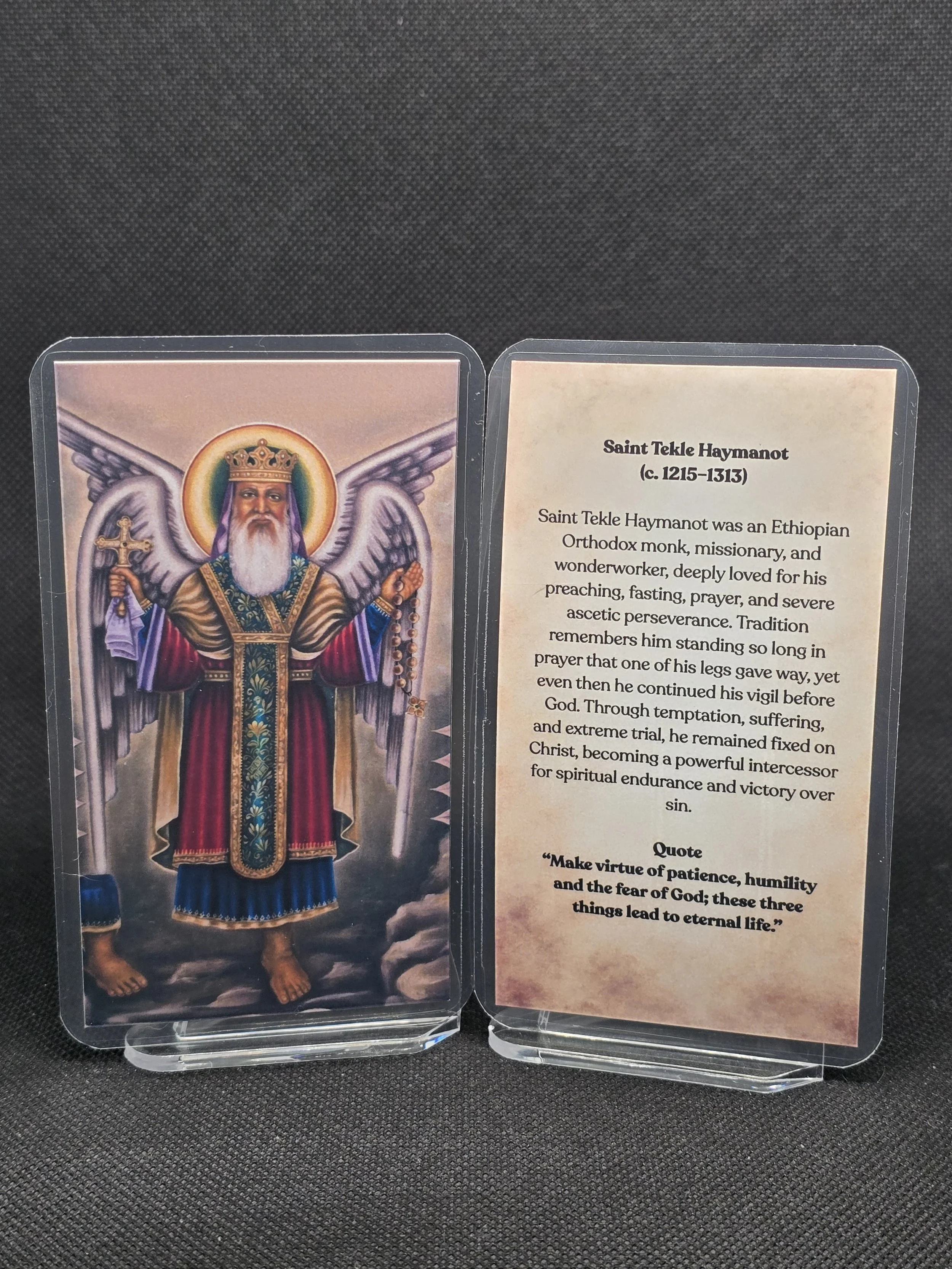
The wings are the reason that Ethiopian icons of Tekle Haymanot often show a winged monk with a cross. The image expresses the Church's belief that he was lifted by grace above the ordinary limits of human strength, and it has made him easy to recognize.
Whether the Life reports a real fall or a symbolic scene cannot be determined. For a reader, the picture of a monk saved from a fall and carried to the ground is a teaching on trust, and it speaks to anyone who has felt the rope give way.
Founding Debre Asbo and Debre Libanos
His principal achievement is the monastery that began as Debre Asbo in Shewa and later became Debre Libanos. Its foundation is often dated to about 1284, but Lusini places it in the first years of the 14th century, so the exact year is UNCERTAIN. The name Debre Libanos was adopted in the 15th century.
The community became a center of monastic training, biblical teaching and mission. His disciples carried its influence across Shewa and neighboring regions, and the network of daughter houses became known as the house of Tekle Haymanot. Names often linked to his school include Ar'ayana Saggahu, Madhanina Egzi and Bartalomewos, though the exact ties depend partly on later monastic records.
In time the abbot of Debre Libanos held the title Echege, a leading office in Ethiopian monastic life, and Lusini ties the formal recognition of this authority to developments in the 15th century. It would be wrong to suggest that Tekle Haymanot himself held all the powers that later abbots exercised.
No substantial theological work can be shown to be his own. The writings associated with him are mainly about him, including the Life in the early Waldabba version and the longer Debre Libanos version, which grew into the 16th and 17th centuries. A text called the Book of the Riches of Kings, published by E. A. Wallis Budge in 1906, bears his name, but this does not prove that he wrote it.
Politics, Damot and Controversy
Tekle Haymanot lived in a time of change. The Zagwe dynasty lost power when Yekuno Amlak established the restored Solomonic line in 1270, and in central and southern Ethiopia Christian monastic growth met Muslim and local religious communities, and was linked with the spread of royal power.
His Life shows him confronting religious specialists of the kingdom of Damot. TRADITION says that he challenged the ruler Motalami, defeated hostile magicians, performed wonders in his presence and led him to baptism. Scholars see in this the memory of real conflict and conversion, but the dramatic episodes cannot be verified.
The most debated question is his part in the return of the Solomonic kings. Later writings credit him with helping Yekuno Amlak to the throne and describe a special pact between the monarchy and the monastery. Taddesse Tamrat regards the more elaborate versions as legendary, and the Encyclopaedia Aethiopica sees parts of the story as later literary growth that served monastic interests. This does not rule out that he supported the new dynasty, but his personal responsibility for the change cannot be treated as fact.
A related quarrel set Debre Hayq, linked with Iyasus Mo'a, against Debre Libanos over which house had greater rank. Denis Nosnitsin has shown how accounts of his monastic dress and formation were used in this contest.
The Leg and Seven Years of Prayer
TRADITION tells that in his last decades he prayed standing for such a long time that one leg was damaged and fell away, and that he went on praying on the other for seven years. This explains why Ethiopian icons often show him on one leg with the lost limb beside him. There is no outside evidence for the event.
Stories of this kind are meant to convey perseverance, and readers should not take them as a pattern. Teachers of both East and West have warned that extreme physical hardships can harm body and spirit, and that charity and humility are the true signs of a holy life.
His Life also credits him with healings, exorcisms and the raising of the dead, and with a covenant in which Christ promised blessing to those who honor his name. No contemporary record allows any single event to be authenticated, but they show how highly his followers esteemed him as an intercessor.
Death, Relics and Feasts
Tekle Haymanot is generally thought to have died around 1313. The Synaxarium describes severe asceticism in his last years, and one version mentions an illness described as plague. He died peacefully, according to TRADITION, and was buried in the cave or rocky enclosure where he had lived as a hermit. The exact cause of death cannot be established.
His relics became the focus of devotion at Debre Libanos. A translation of his body is placed about 56 or 57 years after his death, commonly linked with about 1370, though several translations are reported in later sources and the sequence is complicated. Denis Nosnitsin has studied these competing accounts. His memory of the translation is kept on 12 Ginbot.
His chief feast is 24 Nehase, which falls on August 30 in the current civil calendar, and he is remembered on the 24th of every Ethiopian month, including 24 Hamle. His birth is kept on 24 Tahsas. The Coptic Synaxarium commemorates his death on 24 Mesra. No canonization ceremony is documented, and his sanctity was recognized through liturgy and popular devotion.
Pilgrimage and Devotion Today
Debre Libanos remains an important place of pilgrimage. Believers come on the monthly commemoration and on his main feast, light candles and ask his prayers for healing, protection and perseverance. His icon, with its wings, cross and one raised leg, hangs in many Ethiopian homes and churches.
The strongest historical proof of his cult is the continuing life of the monastery and the many manuscripts of his Life, which show that monks copied and read the story for centuries. As the Hungarian scholar Istvan Ormos has argued, even a miracle story can teach us about the religious life of a time without being taken as plain reporting.
O Lord Jesus Christ, who raised up your servant Tekle Haymanot to plant the faith in a faraway land, give us his patience in prayer and his love for those who do not yet know you. Hold us when our strength fails, and carry us safely to your kingdom. Amen.
This prayer was written for this page and is not an official liturgical text. The Coptic Synaxarium closes its commemoration of him with a brief request that his prayers be with us.
Tekle Haymanot and the Eastern Churches
For Ethiopian Orthodox Christians he is a spiritual father and national saint. His life shows an Ethiopian form of monasticism rooted in Scripture, fasting, prayer and mission, and the Coptic Orthodox Church also honors him in its Synaxarium on 24 Mesra, which shows that his cult spread beyond Ethiopia. The link between the Ethiopian and Alexandrian Churches, including the supply of bishops from Egypt, forms part of his story.
Readers should know that the Ethiopian Orthodox Tewahedo Church belongs to the Oriental Orthodox family and is different from the Eastern Orthodox Churches of the Byzantine tradition. For Eastern Catholics, especially those of the Ge'ez tradition in Ethiopia, his life helps explain the shared heritage of the Alexandrian rite, which the Catholic Bishops' Conference of Ethiopia confirms is still used.
We could not verify a formal Catholic canonization or a universal feast in the Roman calendar. His importance for Catholic readers is mainly historical, and his picture of faith carried by a quiet monk can be admired by Christians of any tradition.
Frequently Asked Questions
Learn From Saint Tekle Haymanot
His life shows how patient prayer and a small community can change a land. Keep his prayer card near you as a reminder to keep praying when your strength is gone.
View Prayer Card