Saint Yared: Ethiopian Hymnographer and Founder of Zema Chant
The traditional father of Ethiopian sacred music, remembered for the caterpillar that taught him to persevere, the three birds of Paradise, and the chant that still fills the churches of Ethiopia and Eritrea.
At a Glance
- Born
- Traditionally about 501 or 505, in or near Aksum (UNCERTAIN)
- Died
- Traditionally about 571 or 576; some accounts speak of a disappearance (UNCERTAIN)
- Feast Day
- 11 Ginbot in the Ethiopian calendar, usually May 19
- Titles
- Saint, hymnographer, Yared the Melodious, father of Ethiopian chant
- Recognition
- Saint in the Ethiopian and Eritrean Orthodox Tewahedo Churches; no canonization date is known
- Associated With
- Zema chant, the Deggwa hymn books and the three modes Ge'ez, Ezel and Araray
- Who Was Saint Yared?
- Family and Early Years
- The Caterpillar
- Deacon and Composer
- Zema, Deggwa and the Three Modes
- Notation and Historical Context
- The King, the Spear and the Birds of Paradise
- Retreat, Death and Feast
- Devotion and Lessons Today
- Yared and the Eastern Churches
- Frequently Asked Questions
Who Was Saint Yared?
Saint Yared is the saint of song in Ethiopian and Eritrean Christianity. Tradition remembers him as a gifted deacon and teacher of Aksum who, in the 6th century, was given the melodies and the hymns that the Ethiopian Orthodox Tewahedo Church still sings. The chant he is said to have founded is called Zema. It is sung by trained cantors, often with drums and sistra, and is learned through years of memory and practice.
Honesty is needed about the sources. His full Life comes from manuscripts that are much later than the 6th century, and the written tradition that presents him as the creator of Ethiopian chant seems to arise between about the 15th and 16th centuries. His feast appears in a revised Synaxarium of 1581. This does not show that he never lived, but it means that his biography cannot be taken as an eyewitness record. This article marks the stories as TRADITION and the doubtful matters as UNCERTAIN.
The scholars Marilyn Heldman and Kay Kaufman Shelemay, Antonella Brita in the Encyclopaedia Aethiopica, and Taddesse Tamrat all stress that the chant tradition developed over centuries. Yared may best be seen as its traditional personal embodiment, the singer in whose name a whole worship was handed down.
Family and Early Years
Yared is placed in or near Aksum, the old capital of the Christian kingdom that had accepted the faith in the 4th century and kept close ties with the Church of Alexandria. Tradition gives his birth as about 501 or 505, but neither date can be checked.
His family is also uncertain. The Encyclopaedia Aethiopica lists several conflicting names for his father, including Abyud, Yeshaq, Gamaliel and Adam, and for his mother, including Kristina and Tawkelia. The Dictionary of African Christian Biography records still other names. None of these combinations can be treated as settled.
TRADITION says that his father died when he was young and that his mother placed him with a relative, a priest named Abba Gideon, at the church of Aksum. Some versions call Gideon his maternal uncle. Other traditions link his schooling with Za Mikael Aragawi, one of the Nine Saints who are honored in Ethiopia as teachers of the faith.
These accounts show how the Ethiopian Church imagined his youth: a boy brought up among the clergy, steeped in the Psalms, and shaped by the care of an older priest.
The Caterpillar
The best loved story of Yared's childhood tells how he struggled to memorize the Psalter. TRADITION says that his teacher grew impatient and punished him, and that the boy ran away from his lessons.
Resting under a tree, he saw a caterpillar trying again and again to climb the trunk. Each time it fell, and each time it started up once more, until it reached the top. Another version tells of an ant. Inspired by its persistence, Yared went back to his teacher, and the Synaxarium says that with divine help he learned the sacred writings with great speed.
The tale has the shape of a parable, with lessons of patience, humility and trust that a gift can grow. It should not be treated as a recorded event. For generations of Ethiopian students and singers, the caterpillar has been a way to say that no one is too slow to learn.
Deacon and Composer
The Life does not tell of a conversion from another faith. Yared was raised a Christian, and his turning point was a vocation in learning and song. After his progress in the Scriptures he was ordained a deacon, according to the Synaxarium. The later Life also describes him as a priest in some versions, and his rank varies between sources.
The longer, later Life adds a sorrowful story from his adult years, in which a family quarrel almost led him to harm, and grace turned him instead toward prayer. This belongs to hagiographical material and cannot be checked.
Ethiopian tradition holds that he received divine inspiration for a new kind of Christian singing. The chant is not a decoration but a way of preaching, since it carries Scripture, the cycle of the liturgical year and the interpretation of the Christian mysteries into the ear of the whole congregation.
Zema, Deggwa and the Three Modes
Yared is traditionally credited with founding or organizing Zema, the system of sacred chant of the Ethiopian Church. The Church names three principal modes associated with him, called Ge'ez, Ezel and Araray. Ge'ez is linked with ordinary liturgical chant, Ezel with solemn and penitential moods, and Araray with more elaborate and festive forms. These are broad associations and not strict rules for every piece.
Five great collections are traditionally attributed to him. The Deggwa is a large book of hymns for the church year, the Tsome Deggwa belongs to the fasting seasons, the Me'eraf serves the cycle of services, the Zemmare is used in celebrations and the Mewasit is a book of antiphons used especially at memorials and burials.
The authorship of every piece is UNCERTAIN. The Ethiopian Church itself accepts that later composers added hymns to the Deggwa over the centuries, and Taddesse Tamrat concluded that its present form grew by slow accumulation. The scholar Tedros Abraha has shown that the books are full of quotations and echoes of the Church Fathers, which gives them a deep theological base, though this cannot prove that Yared wrote each passage.
He is also linked with Qene, the learned tradition of religious verse, and with the schools where cantors are trained. How much he did personally in these areas is not known.
Notation and Historical Context
Ethiopian chant uses a system of musical signs called melekket, which help trained singers recall the melodies they have learned by ear. Research by Kay Kaufman Shelemay, Peter Jeffery and Ingrid Monson shows that the tradition depends on a living interplay of memory, written signs and years of training.
Tradition says that Yared invented the notation. The evidence shows otherwise, since Heldman and Shelemay point to a major development of the notation in the 16th century, many centuries after his supposed lifetime. He can be honored as the traditional father of the chant without crediting him with the final written system.
The wider history is one of exchange. Taddesse Tamrat observes similarities between Ethiopian and Coptic liturgical music and suggests a long process of growth. The 16th century wars under Ahmad ibn Ibrahim al Ghazi destroyed many manuscripts, and later efforts to preserve and order the music may have shaped the form that has come down to us. These events came long after Yared and were no part of his own trials.
The King, the Spear and the Birds of Paradise
TRADITION tells that God sent three birds from Paradise to Yared, and that they spoke with him and led him up to the heavenly Jerusalem, where he heard the praise of the angels. The story links his music with the worship of heaven described in the Book of Revelation, and it gives the chant a holy origin.
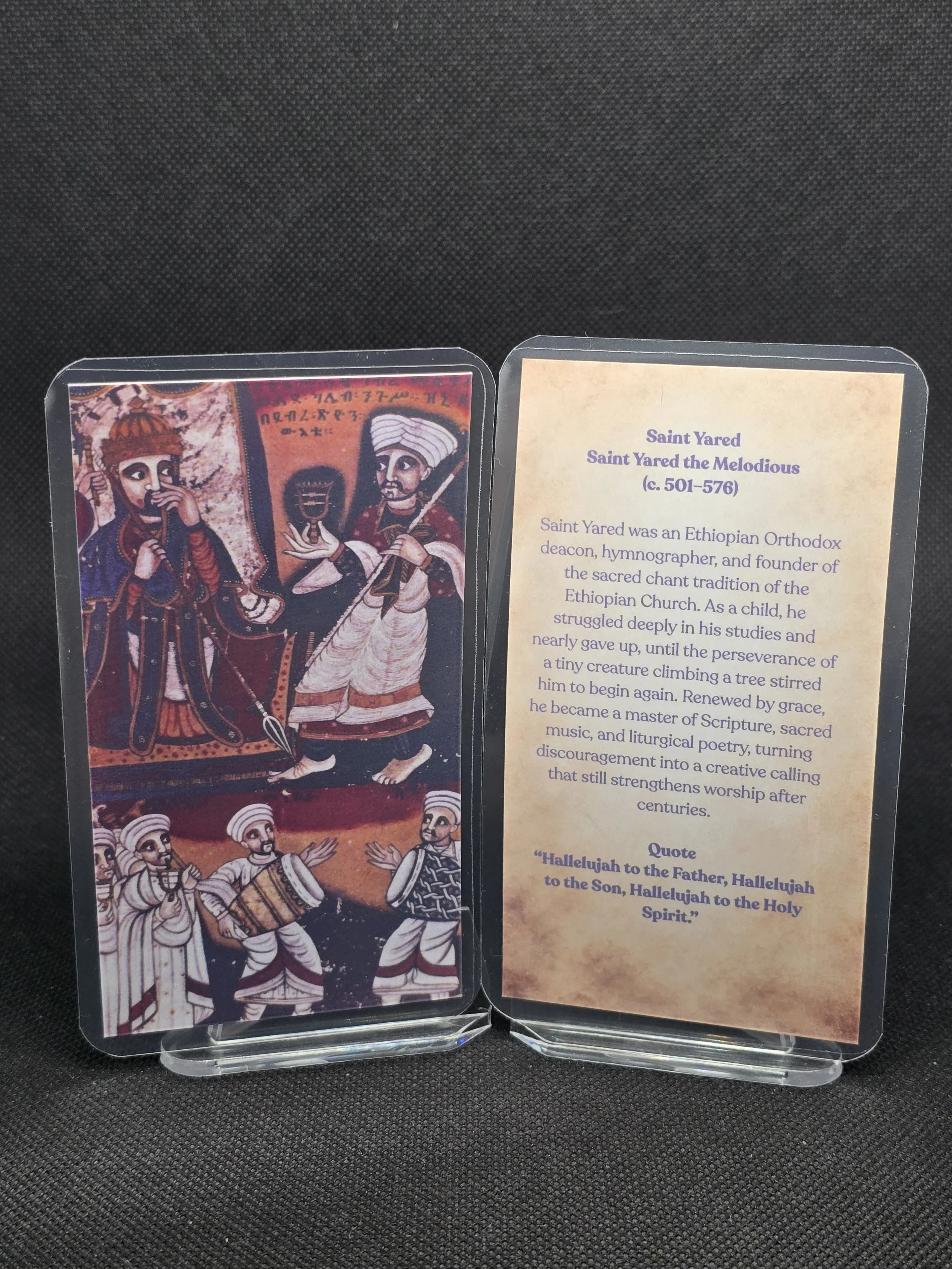
Another tale is placed in the court of King Gebre Meskel. Yared was singing before the king, who was so absorbed that he leaned on his spear and drove it through the saint's foot. Yared kept singing, unaware of the wound. The king offered him a reward, and Yared asked leave to withdraw into solitude. The scene is a favorite subject in Ethiopian religious art.
According to the Life, Yared rose from the ground in prayer before leaving the court. Taken together, these scenes show a man whose song carried him beyond pain and honor, and into silence with God.
Retreat, Death and Feast
TRADITION says that with the king's permission Yared left the court and lived as a hermit in the mountains. Some accounts place his retreat in the Semien Mountains, others in the region of Sallamt beyond the Takkaze River. His last years were given to prayer, fasting and the teaching of his disciples.
The end of his life is uncertain. The Synaxarium describes a peaceful death, while later accounts speak of a mysterious disappearance and compare it with Enoch and Elijah. The Ethiopian Church, in its own publications, acknowledges these differing accounts and does not claim to settle them. The Encyclopaedia Aethiopica notes a tradition of burial in the eastern Semien, with the exact place unknown. No authenticated tomb or relics are known.
His feast is kept on 11 Ginbot, which falls on May 19 in the current civil calendar. His name appears in the revised Synaxarium of 1581. No separate canonization date is known, and his sainthood has been expressed through the Church's liturgy, writings, icons and devotion.
Devotion and Lessons Today
Churches are dedicated to Yared, his picture is painted in many places, and the Ethiopian and Eritrean communities abroad honor him as a sign of their spiritual identity. Church choirs and music schools often remember him on his feast, and singers ask for his help in prayer.
His story teaches that gifts are often slow in coming. The caterpillar speaks to anyone who has felt discouraged, and the spear that did not stop his song speaks to anyone who has had to sing through pain. It also shows how deeply music can serve faith, by carrying words of Scripture into the memory of a whole people.
O Lord, who gave your servant Yared a voice to praise you and a heart to learn patiently, teach us to sing your praise with attention and with love. Give us the perseverance of the caterpillar, and let our worship rise to your throne with the prayers of your saints. Amen.
This prayer was written for this page and is not an official liturgical text. The Ethiopian Church closes its commemoration of him with a brief request that his prayer and intercession be with us.
Yared and the Eastern Churches
For the Ethiopian and Eritrean Orthodox Tewahedo Churches, Yared is a father of worship, and Zema chant is central to their liturgy. These Churches belong to the Oriental Orthodox family and are distinct from the Eastern Orthodox Churches of the Byzantine tradition.
There is also a link with Eastern Catholics. Thomas Landy, writing for Catholics and Cultures, notes that Zema is a main form of liturgical music among both Ethiopian Orthodox and Ethiopian Catholic communities. In May 2025 Vatican News reported the presentation of a new Ge'ez language Missal for the Ethiopian and Eritrean Eastern Catholic Churches, and the report discussed the care of their chant and heritage.
These sources show a shared Ethiopian liturgical heritage. They do not establish a Catholic canonization or an approved Catholic feast of Saint Yared, and we make no such claim. For readers of any tradition, he stands as a reminder that praise sung well is one of the oldest ways of prayer.
Frequently Asked Questions
Learn From Saint Yared
His life teaches patience in learning and joy in praise. Keep his prayer card near you as a reminder to keep trying and to sing your prayers.
View Prayer Card