Saint Gregorios of Parumala: Bishop, Monk and Educator of Kerala
The young Metropolitan of Niranam, remembered in Kerala as Parumala Thirumeni, a monk and bishop of the Malankara Orthodox Syrian Church who combined prayer, teaching and care for the poor.
At a Glance
- Born
- June 15, 1848, Mulanthuruthy, Kerala, India
- Died
- November 2, 1902, Parumala, Kerala, aged 54
- Office
- Metropolitan of Niranam, consecrated December 10, 1876
- Church
- Malankara Orthodox Syrian Church (Oriental Orthodox, West Syriac tradition)
- Declared a saint
- November 2, 1947, by the Holy Episcopal Synod under Catholicos Baselios Geevarghese II
- Feast
- November 2; celebrations at Parumala usually include November 1 and 2
- Who Was Saint Gregorios of Parumala?
- Family and Childhood in Mulanthuruthy
- Early Ordinations and Studies
- Monastic Life at Vettickal Dayara
- Consecrated Metropolitan of Niranam
- Parumala, Schools and the Training of Clergy
- The Jerusalem Pilgrimage and His Writings
- Controversy and the Church of His Day
- Death, Tomb and Declaration of Sainthood
- Why He Matters to the Eastern Churches
- Frequently Asked Questions
Who Was Saint Gregorios of Parumala?
Saint Gregorios of Parumala, born Geevarghese, was a bishop of the Malankara Orthodox Syrian Church in Kerala, in south-western India. He is also called Geevarghese Mar Gregorios, Parumala Thirumeni and, from his youth when he became a bishop, Kochu Thirumeni, a Malayalam phrase meaning roughly the young lord bishop. He lived from 1848 to 1902 and served as Metropolitan of Niranam from 1876 until his death.
His church belongs to the Oriental Orthodox family and follows the West Syriac liturgical tradition, which Kerala's ancient Saint Thomas Christians have kept for centuries alongside their Malayalam language and Indian culture. He was a monk as well as a bishop. He prayed, fasted and taught, helped to form a generation of clergy, encouraged schools, and made a pilgrimage to Jerusalem about which he later wrote a book.
He is venerated above all at Parumala, on the bank of the Pamba River, where he is buried. The Malankara Church formally declared him a saint on November 2, 1947. This article keeps to what church records and scholars support, and marks devotional stories as TRADITION and open questions as UNCERTAIN. It is also plain about one point that matters for Catholic readers: he is a saint of the Malankara Orthodox Church, not a canonized saint of the Catholic Church.
Family and Childhood in Mulanthuruthy
Geevarghese was born on June 15, 1848, at Mulanthuruthy, a town near present-day Kochi. According to the Malankara Orthodox Church's biography, his father was Kochu Mathai and his mother Mariam, of the Chathuruthy family. He was the youngest of five children, with two brothers and two sisters. As a small boy he was called Kochaippora, an affectionate family nickname.
His mother died when he was about two years old, and his eldest sister, also named Mariam, did much to raise him. The family was devout. Church biographies describe a home shaped by prayer, fasting, the reading of Scripture and respect for the Syriac liturgy. Readers should know that these descriptions come largely from later church biographies and not from surviving records written during his childhood.
One relative stands out. His uncle, Geevarghese Malpan, was a priest and a teacher of Syriac. The word malpan means a teacher or scholar, and in Kerala it describes a priest who trained others in the language and rites of the Church. Under this uncle the boy learned Syriac, the Scriptures and liturgical chant. Accounts agree that he showed unusual skill in Syriac hymnody even as a young man.
Early Ordinations and Studies
The official Malankara chronology says that Geevarghese was ordained a korooyo, a reader-deacon, on September 14, 1858, at Karingachira Church, by Mathews Mar Athanasios. UNCERTAIN: some sources give an earlier date, September 26, 1857, and English accounts vary in how they describe this first rank. The 1858 date is the one favored by the Church's own account.
A smallpox epidemic marks the best-known turning point in the traditional story. His uncle and teacher is said to have died of the disease, and the young deacon himself fell gravely ill. TRADITION: while ill he is said to have seen a vision of the Virgin Mary, who promised his recovery and urged him to give his life to God. His recovery was afterwards understood as a miracle. The illness and the death of his teacher belong to the established biography. The vision is a matter of devotion and cannot be checked by outside evidence.
After this, Geevarghese continued his studies under Konat Geevarghese Malpan at Pampakuda and came under the guidance of Yuyakim Mar Coorilos, a Syrian bishop then active in Kerala. The official account says that Mar Coorilos ordained him to further ranks, including the priesthood and the dignity of corepiscopos, in 1865. UNCERTAIN: other sources place part of this sequence in late 1864 and say he was about eighteen at his priestly ordination. The exact order and dates should not be tightened beyond what the evidence allows.
Monastic Life at Vettickal Dayara
Gregorios was not a convert from another faith or another Christian body. He was baptized as an infant into the Syriac Christian community of Kerala, and his path is better described as a vocation that grew over time than as a conversion.
Church biographies say that he turned to an ascetic life at Vettickal Dayara, a monastic house near Mulanthuruthy. A dayara is a monastery in the Syriac tradition. The accounts describe long hours of prayer, fasting and withdrawal from needless worldly business, and they often compare his ideals to those of Saint Anthony of Egypt, the model of Christian monastic life. As with the stories of his childhood, these details come from devotional biographies written after his death.
In 1872 Metropolitan Pulikkottil Joseph Mar Dionysius appointed him a ramban, a monastic priest who takes on particular duties in the Church. The step joined his prayer life to practical work. From this point he was no longer only a student of Syriac and a monk but a priest trusted with the training of others.
A word of caution may be useful for modern readers. The ascetic practices described in church biographies belong to a particular tradition of spiritual guidance and are not a pattern for anyone to copy alone. Fasting, sleep and prayer disciplines should be taken up, if at all, with the advice of a confessor or spiritual father and with attention to health.
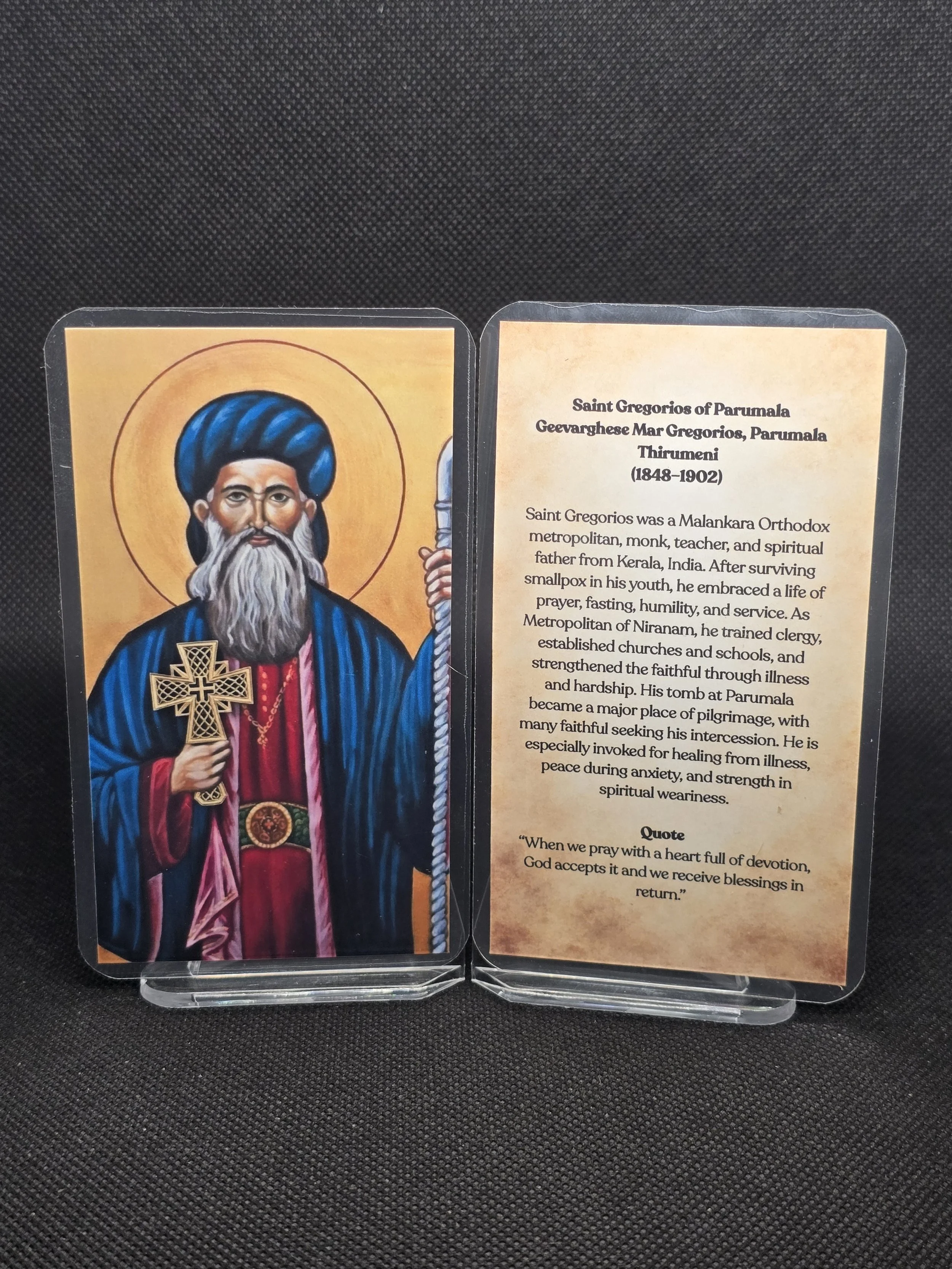
Consecrated Metropolitan of Niranam
The decisive change came with the visit to India of the Syriac Orthodox Patriarch Ignatius Peter. Gregorios served the Patriarch as secretary and translator, since he knew Syriac and Malayalam well, and he helped with important proceedings of the Church during the visit.
On December 10, 1876, Gregorios was consecrated a bishop at Saint Thomas Church in North Paravur and given responsibility for the Niranam diocese. He was twenty-eight and the youngest of those consecrated on that occasion, which is why he came to be known as Kochu Thirumeni.
The consecration also produced a document of historical value. Sarah Knight, in her 2019 doctoral thesis at the School of Oriental and African Studies in London, discusses the Shalmootho, an oath of allegiance he composed for his consecration, in which he declared fidelity to the Patriarch of Antioch. This shows that Gregorios stood firmly within the Antiochian Syriac tradition from the start of his episcopate, and that the point was not simply read back into his life by later writers.
His duties grew over time and came to include areas beyond Niranam, among them Thumpamon and Kollam. A bishop in Kerala at that time had to travel, to settle disputes among parishes, to confirm and ordain, and to keep the faith of scattered communities during a period of great pressure on the Church.
Parumala, Schools and the Training of Clergy
The name of Gregorios is tied most closely to Parumala. Metropolitan Joseph Mar Dionysius had arranged for land to be given for a seminary and had set up the first building. Gregorios then took responsibility for its life and its teaching and made it a centre of formation. It is fair to say that he developed and led the Parumala seminary. It would be too strong to call him its sole original founder.
At Parumala he taught candidates for the priesthood Syriac, liturgy, theology, the interpretation of Scripture and the discipline of prayer. The church at Parumala was rebuilt under his direction and consecrated in 1895.
The Malankara Church also credits him with encouraging or founding schools in places such as Kunnamkulam, Mulanthuruthy, Niranam, Thumpamon and Thiruvalla. His aim, as the Church describes it, included basic schooling and teaching in English for children beyond the narrow circle of those headed for the clergy.
Church scholarship, including the historian Jacob Kurian Onattu, also records his pastoral care for people on the edge of society in Kerala, his opposition to caste discrimination, and his part in forming worshipping communities at Chennithala and Kalikunnu. These are important claims, and a fuller picture would need more study of local records from the time.
He also supported better organization among the clergy and is linked with the founding of the Malankara Syrian Clergy Association. Among his students were Vattasseril Geevarghese, later the Metropolitan Geevarghese Mar Dionysius, and Kallasseril Geevarghese, who became Catholicos Baselios Geevarghese II, the Church leader who later declared him a saint.
The Jerusalem Pilgrimage and His Writings
His best-known surviving book is Oorslem Yathra Vivaranam, sometimes spelled Ursalem Yatra Vivaranam, an account of his pilgrimage to Jerusalem and the Holy Land in 1895. The catalog of the Kerala University Library records the work and its later republication. The book shows a Kerala bishop meeting other Christian communities and the holy places, and it is useful to historians as a primary source.
It is sometimes called the first Malayalam travelogue. That needs care. Kerala's tourism department points to the eighteenth-century Varthamanapusthakam of Paremmakkal Thomman Kathanar as an earlier narrative of travel. His claim is better put as being among the earliest, and possibly the first, separately printed Malayalam travel books.
Other writings are attributed to him, including pastoral letters. Copies of letters dated March 10, 1892, and February 3, 1897, appear in a Syriac Christian historical collection that cites a biography by Professor P. N. Chacko. UNCERTAIN: the original source of these copies and the accuracy of their text still need checking, so this article quotes none of them. No full critical edition of his letters in English was found.
Controversy and the Church of His Day
Gregorios lived in a time of sharp conflict among Kerala's Syriac Christians. Anglican missionaries had arrived and pressed for changes in worship, doctrine and Church government. Questions arose about prayers for the departed, the veneration of saints, the place of the Syriac liturgy and the authority of the Patriarch of Antioch. Sarah Knight's study traces these disputes through local declarations, letters and later court records.
The Synod of Mulanthuruthy in 1876, held under Patriarch Ignatius Peter, was a landmark. It tied the traditional Syriac party more closely to Antioch, and Gregorios took part as assistant and interpreter to the Patriarch. The disputes should not be told as a simple contest between good Christians and bad ones. Honest people differed about how inherited tradition, local independence, doctrine and the pressures of colonial rule were to be weighed.
The later split between the Malankara Orthodox Syrian Church and the Jacobite Syrian Christian Church, and the quarrels over the Catholicate, came after his death in their present form. They should not be read back into his own lifetime.
Some of his work was unusual and is still discussed. Malankara Orthodox records link him with the consecration of Alvares Mar Julius, formerly a Roman Catholic priest in Goa, and of Rene Vilatte, a Western cleric whose episcopal claims were controversial. Professor Onattu places the consecration of Vilatte at Colombo in 1892. The Catholic Church did not approve these acts, and the episodes should not be presented as if it did. In his later years Gregorios was also in poor health. Church accounts name a chronic bowel illness, abdominal pain or ulcers, and some mention typhoid. UNCERTAIN: no firm diagnosis can be drawn from these later and differing accounts.
Death, Tomb and Declaration of Sainthood
Gregorios died at Parumala on November 2, 1902, at the age of fifty-four. Biographies describe a time of growing weakness when clergy and lay people gathered to pray for him, and some record his last words and his arrangements for his disciples. These accounts are valued as devotional testimony, and their more dramatic conversations should be treated with care unless a contemporary record supports them. His funeral was held on November 3 and he was buried at the church beside his seminary.
TRADITION: the faithful soon spoke of prayers answered at his grave, and the Church itself says these reports drew more and more pilgrims to Parumala. Healings and other favors are reported by devotees, and some biographies say he foretold the time of his death. Such reports are part of the life of the Church, but each would need separate study before being claimed as a verified miracle.
On November 2, 1947, Catholicos Baselios Geevarghese II and the Holy Episcopal Synod of the Malankara Orthodox Syrian Church formally declared Gregorios a saint. The Catholicos had been a pupil of the saint. The declaration confirmed a veneration that already existed and did not begin it. Readers sometimes see the year 2008 given for his canonization. That is wrong. By then he had been recognized as a saint for more than sixty years, and the Catholicos in 2008 was a different man.
Terms deserve care. He is often called the first canonized saint of the Malankara Church. More exactly, he is the first Indian-born person formally declared a saint by it. Baselios Yeldho, an earlier Syriac hierarch, was also declared a saint by the Malankara Church in 1947. An apostolic bull of October 20, 1987, under Patriarch Ignatius Zakka I Iwas, is reported to have authorized his commemoration in the liturgical diptychs of the Syriac Orthodox Church in India.
His tomb is in the church of Saint Peter and Saint Paul at Parumala. The present building was designed by the architect Charles Correa and consecrated in October 2000, so the burial place is older than the building. UNCERTAIN: no documented exhumation, translation or division of his remains was found, and claims that his body is incorrupt should not be repeated without evidence.
Lord Jesus Christ, shepherd of your people, you gave your servant Gregorios a heart for prayer, for the young and for the poor. Through his intercession, teach us to pray without losing heart, to serve the weak with patience, and to hold fast to the faith in times of division. Saint Gregorios, Parumala Thirumeni, pray for us. Amen.
This prayer was written for this page and is not an official text of any Church. A well-known short invocation, Parumala Thirumeni, pray for us, appears on the website of Saint Gregorios Indian Orthodox Cathedral in London.
Why He Matters to the Eastern Churches
For Oriental Orthodox Christians, Saint Gregorios is a modern saint rooted in the Syriac liturgy, in priestly formation and in the old Christianity of India. He shows that the ascetic ideals of the desert fathers shaped episcopal life far from Egypt and Syria, and that a bishop could be a monk, a teacher and a pastor at once.
For Eastern Catholics, particularly those of the Syro-Malankara Catholic Church, whose roots lie in the same Malankara Christian tradition, his life gives insight into the shared heritage of that tradition. The Syro-Malankara Catholic Church came into communion with Rome in 1930, and many families still have members in both Churches.
There is a sound basis for ecumenical respect. In June 1990 a joint commission of the Catholic Church and the Malankara Orthodox Syrian Church issued an agreed statement on the faith in Jesus Christ. In September 2013 Pope Francis received the Catholicos of the Malankara Orthodox Church and spoke of the apostolic heritage of his Church. Neither event is a Catholic canonization of Gregorios. No Vatican document was found that endorses his veneration or places him on the Syro-Malankara calendar, and this article makes no such claim. Catholics who admire him may ask his prayers as they would those of any holy Christian, while remembering that his formal glorification belongs to the Malankara Church.
Frequently Asked Questions
Remembering a Bishop of Parumala
Saint Gregorios of Parumala shows how prayer, learning and care for ordinary people can mark the life of a bishop. His Prayer Card gives you a quiet way to remember him and to ask his prayers.
View Prayer Card