Saint Nicholas of Myra: Bishop, Wonderworker and Protector of the Poor
The fourth century bishop of Myra in Lycia, loved by East and West alike, whose secret charity, defense of the innocent and care for sailors made him one of the most beloved saints in all Christendom.
At a Glance
- Born
- About 270 AD at Patara in Lycia (UNCERTAIN)
- Died
- December 6, traditionally 343 AD, at Myra (year UNCERTAIN)
- Office
- Bishop of Myra in Lycia, in present-day Turkey
- Feast days
- December 6 (December 19 for Churches using the Julian calendar); May 9, translation of relics to Bari
- Relics
- Basilica of San Nicola, Bari, Italy, since 1087 (crypt altar consecrated 1089)
- Patronage
- Sailors, travelers, children, merchants, students, prisoners and the falsely accused
- Who Was Saint Nicholas of Myra?
- Birth, Family and Early Years
- The Secret Gift of the Three Dowries
- Vocation and Election as Bishop
- Ministry and Writings
- Did Nicholas Attend the Council of Nicaea?
- Death and the Relics at Bari
- Wonders, the Manna and Devotion
- Two Nicholases and What Can Be Said with Confidence
- Why He Matters to the Eastern Churches
- Frequently Asked Questions
Who Was Saint Nicholas of Myra?
Saint Nicholas of Myra is remembered as a bishop who lived in the fourth century in Lycia, a region on the southern coast of what is now Turkey. Christians of East and West have loved him for sixteen hundred years. He is called the Wonderworker, Nicholas of Bari and Nicholas of Lycia, and his name day is kept in nearly every Christian country. Orthodox, Byzantine Catholic and Roman Catholic Churches all honor him.
He is also one of the saints about whom the least can be proved. No letter, sermon or treatise from his hand survives, and no biography was written in his own time. The familiar stories about him come from Greek lives composed centuries later. This article therefore follows a plain rule. What is documented is stated as documented. What comes from the old lives is marked TRADITION, and what is disputed is marked UNCERTAIN.
This does not make him less worth knowing. The historian's honest summary is that his veneration is very well established, while much of his personal biography is not. The stories explain why Christians came to love and invoke him: a bishop who gave in secret, who stood up for the unjustly condemned, and who watched over those in danger at sea.
Birth, Family and Early Years
TRADITION: Nicholas was born at Patara, a busy Lycian seaport, around the year 270 into a Christian family. Orthodox hagiography names his parents as Theophanes and Nonna and says that they had long been childless and saw their son as an answer to prayer. UNCERTAIN: neither the names nor the occupations of his parents can be checked. No birth record or family document survives, and the year of his birth cannot be fixed.
TRADITION: the old lives describe a child of unusual piety. They say that as an infant he stood upright in the baptismal font and that he would not nurse on the days the Church kept as fasts. Stories of this kind are common in the literature about saints and express the belief that a holy person was given to God from the start. They are not observations written down at the time.
The earliest complete life is attributed to Michael the Archimandrite. Its date is disputed. Some scholars place it around the year 700, others in the ninth century. That long distance from the events limits what it can prove about Nicholas's childhood.
TRADITION: his parents died while he was still young and left him a large inheritance. Rather than keep it, he is said to have given it to the poor. The best known example is told in the next section.
The Secret Gift of the Three Dowries
TRADITION: the most famous story about Nicholas appears in Michael the Archimandrite's life. A poor man in his city had three daughters and no means to provide a dowry. In that world a young woman without a dowry could not marry, and the family faced ruin or worse. Nicholas, learning of the need, secretly threw a bag of gold into the house on three nights, so that each daughter could be married. The father tried to discover his benefactor and found Nicholas, who asked him to tell no one.
The story is not historically verified, but it shaped the whole picture of the saint. It lies behind his image as the secret giver and behind the custom of anonymous gifts on his feast. It is a story about the dignity of the poor. The gold is given quietly, so that the family does not have to bear the shame of receiving charity.
Readers may notice that the story says little about miracle. It is a story about attention to the real needs of neighbors and about the Christian teaching that giving should be done without display. That is probably why it has lasted so well.
Vocation and Election as Bishop
There is no recorded conversion in the life of Nicholas. He is described as raised in the faith, and a dramatic turn from paganism would find no support in the sources. His vocation, according to the lives, grew through study of Scripture, prayer, fasting and service. Later Orthodox accounts add that an uncle, also named Nicholas, was a bishop who ordained him.
UNCERTAIN: some lives say that he made a pilgrimage to Palestine and Egypt before becoming a bishop. The journey belongs to the received tradition and cannot be confirmed from any record or testimony.
TRADITION: he is said to have been chosen as bishop of Myra after the local clergy received a sign. In the best known version they were told to choose the man named Nicholas who would enter the church at a certain hour, and it was he. The story presents his election as the work of providence and not of personal ambition. No record of his consecration survives, so the date, the consecrating bishops and the circumstances are all unknown.
TRADITION: he is also said to have been imprisoned during the persecution under the Emperor Diocletian and released after Constantine came to power. Both the Catholic Encyclopedia and Vatican News repeat the episode. UNCERTAIN: no contemporary record confirms it. For this reason he is honored as a confessor, a witness who suffered for the faith, and not as a martyr, since the tradition holds that he died a natural death.
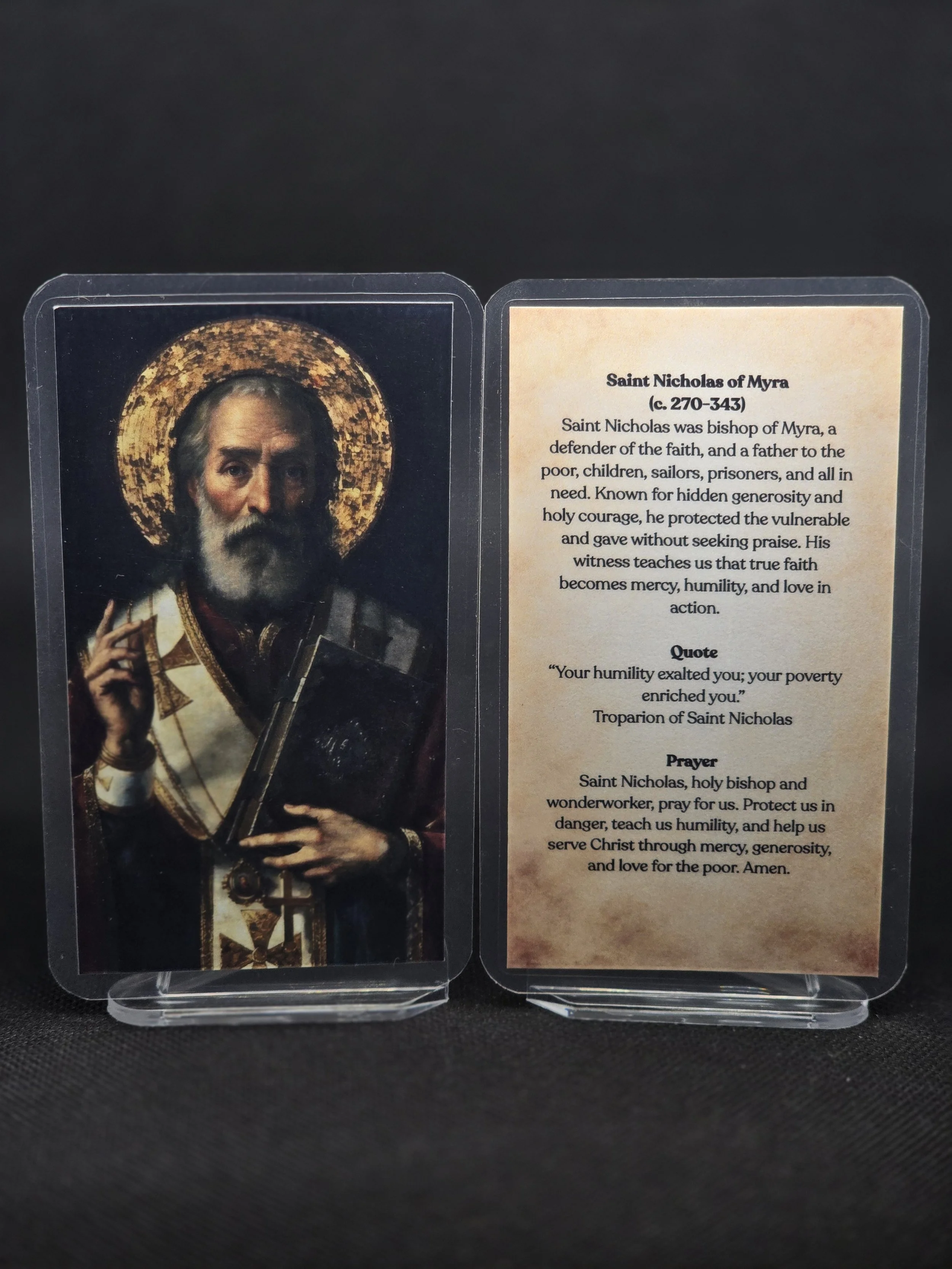
Ministry and Writings
No pastoral letter, treatise, sermon or administrative document that can safely be attributed to Nicholas survives. Claims that he wrote particular doctrinal works or founded a named monastery, hospital or orphanage cannot at present be supported. This matters, because some medieval writers borrowed stories from Nicholas of Sion, a different Lycian abbot and bishop who died in 564, and attached them to Nicholas of Myra.
The picture of his ministry in the early narratives is nevertheless consistent. It centers on charity, on care for the people of his city, and on action against injustice. One of the oldest stories, known as the Praxis de Stratelatis, or the story of the army commanders, tells how Nicholas stopped the execution of innocent men and later appeared in a dream to the emperor on behalf of officers who had been unjustly condemned. Scholars disagree about its date. A form of it was known by the sixth century, when Eustratios of Constantinople referred to it, and some researchers propose an earlier origin. Its detailed Lycian geography has made it important for reconstructing the earliest tradition.
Other stories describe him winning a share of grain for the starving people of Myra from sailors passing through, and helping ships in danger on stormy seas. These are TRADITION. They show a bishop responsible for the bodily as well as the spiritual welfare of his flock, but no single episode can be treated as an eyewitness report.
Did Nicholas Attend the Council of Nicaea?
TRADITION: Byzantine tradition places Nicholas at the First Council of Nicaea in 325, which met to answer Arius, who taught that the Son of God was a creature. UNCERTAIN: the early lists of bishops who took part do not securely include his name. The Catholic Encyclopedia questions his presence, while later Greek tradition counts him among the bishops there.
The most famous story says that Nicholas was so angry at the teaching of Arius that he struck him, that he was then disciplined by being stripped of his episcopal marks, and that Christ and the Virgin Mary restored them. This episode is historically weak. Roger Pearse, who has studied the manuscripts, finds no ancient account of Nicholas striking Arius. The recognizable story appears in much later medieval writing, with evidence from the late fourteenth century on. It should be treated as TRADITION and not as a recorded event at Nicaea.
A further caution concerns a praise speech, or encomium, ascribed to the fifth century Patriarch Proclus of Constantinople. It is usually classed among works of doubtful or false attribution and should not be used as a contemporary witness.
The honest conclusion is that his presence at Nicaea and any quarrel with Arius are unproved. His place among the defenders of the faith rests on the tradition of the Church and on the long devotion of those who honor him as a teacher of right belief and gentleness.
Death and the Relics at Bari
Nicholas is traditionally held to have died peacefully at Myra on December 6. The year is UNCERTAIN. Tradition gives 343, while the Catholic Encyclopedia mentions 345 or 352. A shrine grew up around his tomb at Myra, and his cult was established there by late antiquity.
The history of his relics is much better documented than his life. In 1087 sailors and merchants from Bari entered the church at Myra and removed relics attributed to Nicholas. An account of the removal written near the time, the narrative of Nicephorus, survives. Western tellings sometimes describe the act as a rescue of the relics from danger, but it was not a gift. The Orthodox account says that the guardians were overpowered and the local people protested.
The sources differ slightly on the arrival date. The Archdiocese of Bari-Bitonto gives May 7, while the Orthodox Church in America describes an arrival on May 8 and a solemn procession on May 9, 1087. The commemoration is kept on May 9. The relics were placed beneath the altar of the crypt of the Basilica of San Nicola, which Pope Urban II consecrated in 1089.
Nicholas was never canonized by a formal procedure of the kind used later. His recognition grew from ancient veneration, liturgical commemoration and acceptance by the Churches, so no canonization date can be defended. The Basilica of San Nicola in Bari became a major place of pilgrimage for Christians of the West and the East. In 1966 an Orthodox chapel was established in its crypt, so the shrine is a place of worship for both traditions.
Wonders, the Manna and Devotion
TRADITION: his devotional history includes several famous stories. Besides the dowries and the rescue of the condemned, there are accounts of protection of sailors, which helped establish his patronage of mariners and travelers. A medieval Western story tells how Nicholas restored murdered children to life. It developed in several versions and became prominent in Western European art. A sculpture of about 1500 in the Metropolitan Museum of Art depicts the episode.
A liquid called the manna of Saint Nicholas is associated with his tomb at Bari, and devotees have attributed healing to it. The presence of the liquid is documented. Its supernatural origin is not established. An analysis by the University of Bari in 1925 is reported to have identified the substance as water, and natural explanations such as condensation have been proposed. The religious meaning that the faithful give to it is a matter of faith, and individual claims of healing would each need separate judgment.
The long-standing association with gifts comes from the story of secret generosity. The Dutch Sinterklaas tradition, which brought his feast into European gift-giving, helped form the later figure of Santa Claus. The saint behind these customs is a fourth century bishop and not the modern figure of folklore, and many Christians use his December feast as a chance to give quietly to the poor.
His title Wonderworker, in Greek Thaumatourgos, reflects the Christian tradition that miracles were done through his prayers during his life and after his death. It is a title of devotion and not a historical verification of each reported wonder.
Two Nicholases and What Can Be Said with Confidence
Maria Gwyn McDowell, writing in The Encyclopedia of Eastern Orthodox Christianity, has pointed out that the lives of Nicholas of Myra and Nicholas of Sion became tangled together. Nicholas of Sion lived much later and died in 564. His relatively early biography contains extraordinary childhood events and healings that later influenced the received life of Nicholas of Myra. A story found in a medieval Greek life should therefore not be assumed to concern the bishop of Myra.
Several points can be stated with confidence. A bishop named Nicholas was venerated at Myra from a very early time. A shrine stood at his tomb. His feast was kept widely in both East and West long before the break of 1054. His relics were carried to Bari in 1087. And the early stories that gathered around him consistently show concern for the poor, protection of the innocent and care for seafarers.
Several other points cannot be stated with the same confidence. They include the year of his birth, the names of his parents, his imprisonment under Diocletian, his presence at Nicaea and most of the miracle stories. Writers who care about accuracy can respect both the history and the devotion by keeping the two clearly apart. The standard scholarly works include Gustav Anrich's collection of the Greek tradition, Charles W. Jones on the growth of the legend, and the studies by Nancy Patterson Sevcenko and Ihor Sevcenko.
Lord Jesus Christ, shepherd and bishop of our souls, you made your servant Nicholas a lover of the poor and a defender of the innocent. Through his prayers, teach us to give without display, to speak for those who have no voice, and to keep the faith with gentleness. Protect travelers and all who are in danger at sea, and have mercy on us. Holy Father Nicholas, pray to God for us. Amen.
This prayer was written for this page and is not an official text of any Church. The Byzantine troparion of Saint Nicholas in the fourth tone, found in the Menaion for December 6, may be read in the liturgical books of your own Church.
Why He Matters to the Eastern Churches
Nicholas belongs to the ancient Christian inheritance that Catholics and Orthodox share. He lived long before the break between East and West, and both traditions honor him as a saint. To call him exclusively Catholic or Orthodox would mislead.
His feast is kept on December 6 in the Roman Catholic Church, in the Byzantine Catholic Churches and in Orthodox Churches that follow the Revised Julian calendar. Churches that keep the Julian calendar for fixed feasts observe December 6 on what is December 19 in the civil calendar. It is the same commemoration and not a different saint. The translation of his relics, on May 9, is kept especially in Bari and in the Russian tradition, and for Julian calendar Churches May 9 falls on May 22.
The Byzantine liturgical books honor him as Wonderworker and Archbishop of Myra, and Byzantine Catholic liturgical resources, such as those of the Metropolitan Cantor Institute, supply the same festal texts used by the Orthodox, including his troparion, kontakion and Divine Liturgy readings. The hymns praise him for a life that showed the rule of faith, gentleness and self control, and for the humility through which he was raised up.
In Byzantine hymnography Nicholas is a model of the bishop in whom sound teaching and compassionate service belong together. The shrine at Bari, where both Catholic and Orthodox pray, makes his memory a quiet place of meeting between the Churches, and requires no acceptance of every legend.
Frequently Asked Questions
Remembering a Bishop Who Gave in Secret
Saint Nicholas teaches that real charity is quiet, attentive and unashamed of the poor. His Prayer Card gives you a simple way to keep his memory and to ask his prayers.
View Prayer Card