Saint David the Invincible: Armenian Philosopher and Holy Translator
David Anhaght, honored by the Armenian Church among the Holy Translators, whose name is bound to some of the most influential philosophical texts in Armenian, and whose true identity scholars still debate.
At a Glance
- Name
- David the Invincible, also David Anhaght or David the Philosopher
- Lived
- Fifth to sixth century AD; dates and identity UNCERTAIN
- Church
- Armenian Apostolic Church (Oriental Orthodox)
- Known for
- Philosophical works in the Armenian tradition and the title Invincible
- Veneration
- Honored with the Holy Translators, whose feast falls on a Saturday in autumn
- Sainthood
- Recognized through Armenian Church tradition; no formal canonization date known
- Who Was Saint David the Invincible?
- A Saint Whose Identity Is Disputed
- Birth, Family and the Traditional Account of His Education
- Why He Is Called the Invincible
- The Writings Linked to His Name
- A Christian Philosopher or a Pagan One?
- The Holy Translators and His Feast
- Death, Relics and What Remains Unknown
- Why He Matters to the Eastern Churches
- Frequently Asked Questions
Who Was Saint David the Invincible?
Saint David the Invincible, known in Armenian as David Anhaght, is honored by the Armenian Apostolic Church as a philosopher, a teacher and one of the Holy Translators. The word Invincible, in Armenian anhaght, is a title of praise for his skill in argument. It does not refer to any military victory. His name is attached to a body of philosophical writing that became important in Armenian education and in the history of how Greek thought reached the Armenian language.
David is also one of the most puzzling figures in this series. The Armenian Church venerates him as a saint of its own early golden age, a companion of the men who gave Armenia its alphabet and its Bible. Modern scholars, however, note that the Greek philosophical lectures that bear the name David come from sixth century Alexandria, a generation or two later. Whether these are the same man is a question that has not been settled.
This article keeps the two things apart. It tells what the Armenian Church holds, it explains what scholars have found in the texts, and it says plainly where evidence is missing. TRADITION marks what the Armenian historical memory preserves. UNCERTAIN marks what cannot be confirmed. Some of the missing facts are basic ones, including when he was born and when he died.
A Saint Whose Identity Is Disputed
The central problem of David's biography is one of identity. The Armenian tradition presents him as a Christian intellectual linked to the earliest Armenian scholars of the fifth century. The Greek manuscripts attributed to a philosopher named David point to a later setting, the Alexandrian schools of the sixth century.
The Stanford Encyclopedia of Philosophy warns that identifying the Armenian saint with the author of the Greek lectures is highly precarious. The Greek works mention Olympiodorus, who taught at Alexandria in roughly the years 530 to 565, so the author cannot have lived much earlier than that. Armenian traditions that make David a pupil of Mesrop Mashtots, the inventor of the Armenian alphabet, place him in a much earlier generation. The Armenian Church's own historical materials recognize the confusion of two philosophers named David.
More recently, Silva Petrosyan, in a 2025 article in the Bulletin of Yerevan University, has argued that scholars have not fully disproved the older Armenian chronology, and has suggested that a priest named David mentioned in early Armenian literature may be relevant. This is a scholarly hypothesis and not an accepted conclusion. The honest summary is that the question is open.
Birth, Family and the Traditional Account of His Education
UNCERTAIN: almost nothing about David's early life can be recovered from contemporary records. Armenian tradition connects him with Daron, also called Taron, a district of historic Armenia, and some accounts name the place Nergin. None of this can be checked against a birth record. His parents, family, social standing and the possible existence of brothers or sisters are all unknown.
TRADITION: medieval Armenian accounts count him among the pupils of Saint Mesrop Mashtots and of the Catholicos Saint Sahak, the founders of Armenian Christian literature. Other accounts make him a pupil of Moses of Khoren. These traditions tie him to the origin of Armenian letters, but they meet serious difficulty in the matter of dates, as the previous section explained.
Later tradition also links his education with Athens and Alexandria. The Alexandrian link has some scholarly support, because the Greek works under his name mention Olympiodorus. That supports an Alexandrian setting for those texts. It does not prove where the Armenian saint was born, who his parents were, or how far he traveled.
Why He Is Called the Invincible
TRADITION: the title Invincible is explained in Armenian memory by his skill in debate. Some accounts say that he met opposing philosophers in places such as Athens or Constantinople and defeated them in argument. The stories explain the honorific, but no specific contest, opponent, date or result can be verified.
There is also no record of how or when he received the title. It may be a later honor given by admirers, as with many titles in the Christian East. What the title tells us is how the Armenian Church wished to remember him: as a Christian who could meet the learned world of his time on its own ground and hold his place there.
The same caution applies to the claim, found in the historian Stepanos Orbelian, that David took part among the Armenian scholars who defended their Church at the Council of Chalcedon in 451. This is a later Armenian tradition and not a contemporary report. It is hard to square with the dating of the Alexandrian texts.
The Writings Linked to His Name
David's lasting importance rests on the philosophical texts passed down under his name, rather than on any story of his life. They belong to the Neoplatonic tradition of commenting on Aristotle's logic, which grew up in the Alexandrian schools.
The best known of them in Armenian is Definitions and Divisions of Philosophy. It is an introduction to the study of philosophy, covering what philosophy is, how its branches are arranged and how a student should approach it. The Greek introductory text that corresponds to it consists of twenty-four lectures, recorded in the manner of Alexandrian teaching. The Armenian version had a wide influence on philosophical education. It was translated into English by Bridget Kendall and Robert Thomson in 1983. Whether the Armenian saint wrote, translated or oversaw the Armenian version remains disputed.
The Commentary on the Isagoge of Porphyry explains the five basic terms of logic that Porphyry set out for beginners: genus, species, difference, property and accident. These terms were needed for any careful definition. The commentary is among the stronger candidates for attribution to the Alexandrian lecturer named David. A critical edition with an English translation was published by Gohar Muradyan in 2015.
The Armenian tradition also connects David with commentary on Aristotle's Categories and Prior Analytics. UNCERTAIN: scholars separate the traditional attribution from the actual authorship. The Greek commentary on the Categories once linked to David is now thought to be closer to the work of Elias. An Armenian commentary on the Prior Analytics remains part of the body of texts under David's name, and Aram Topchyan published a critical edition with translation in 2010.
A Christian Philosopher or a Pagan One?
A second controversy concerns the religion of the author of the Greek lectures. The Stanford Encyclopedia of Philosophy points out that they contain ideas from pagan Neoplatonism, such as the eternity of the world and the divinity of the heavenly bodies. A man who taught these things cannot simply be assumed to be a Christian because the texts later circulated under a Christian name.
Against this, Petrosyan's 2025 study argues that teaching Greek philosophy did not by itself rule out a Christian identity. Many Christian teachers of late antiquity taught the philosophy of their time, as the Cappadocian Fathers and others had done. Both positions deserve a hearing, and neither settles the question for good.
The Armenian Church has also attributed to David some religious writings, including a homily on the Holy Cross, and a letter ascribed to the Catholicos Giwt addressed to David. UNCERTAIN: being printed in a collected edition does not prove authorship. These texts need independent checking before anyone quotes them as David's own teaching.
Nothing in the sources shows that David was imprisoned, tortured, exiled or put to death for the faith. To call him a persecuted confessor would go beyond the evidence. No monastery, church, school building or charitable foundation can be attributed to him, and no record of his ordination exists, so it cannot be said that he was a priest, a monk, an abbot or a bishop. His influence is better understood through manuscripts, teaching and the growth of Armenian philosophical vocabulary.
The Holy Translators and His Feast
David has no separate feast of his own that can be verified. The Armenian Church honors him with the Holy Translators, the scholars who gave Armenia its Scripture, its liturgy and its learning. They include Saint Mesrop Mashtots and Saint Sahak, and the group is commemorated by the Church at an autumn celebration that falls on a Saturday in October. In 2026 the Armenian dioceses in America gave October 10 as the date. Armenian calendars also have another commemoration of the Holy Translators in the summer, and that is not a separate feast of David.
Calendar practice is movable. Some Armenian parish materials speak of the second Saturday of October, while others describe a wider period that reaches into November. October 10, 2026 is a verified observance, but it should not be taken as a fixed date in every year or every calendar.
In the Armenian understanding a translator is more than someone who moves a book from one language to another. The word includes the commentator, the philosopher and the teacher who interprets learning for the faithful. David fits that wider meaning. The Church honors him because careful study and interpretation helped to establish a lasting Christian intellectual culture.
Death, Relics and What Remains Unknown
UNCERTAIN: the date and circumstances of David's death are unknown. There is no secure account of a last illness, last words, place of death or burial. Claims that his tomb or relics lie at a particular Armenian monastery would need documentary or archaeological confirmation. No reliable chain of identification for bodily relics could be found.
No formal date of canonization or glorification is known either. His sainthood rests on the continuing recognition of the Armenian Church, which includes him among the Holy Translators. It would be a mistake to give him a date in the manner of a modern canonization.
No miracles of healing, prophecy or apparition have been authenticated for David. This sets him apart from many saints whose stories are full of wonders. His place in the Church is honored for the work of the mind and the preservation of learning, which is a quieter kind of holiness and one that deserves respect in its own right.
Lord Jesus Christ, eternal Wisdom of the Father, you gave your servant David a mind to seek the truth and a voice to teach it. Through his prayers, grant us humility in our study, honesty in our questions and love for those we teach. Keep us from pride in knowledge, and lead us to you, who are the way, the truth and the life. Holy David, pray for us. Amen.
This prayer was written for this page and is not an official text of any Church. No authenticated prayer addressed to David alone was found. The Armenian Church sings a hymn for the Holy Translators as a group, Vork Zardaretseen, attributed to Vardan Areveltsi, which is a better place to find the Church's own words of praise.
Why He Matters to the Eastern Churches
David matters directly to Armenian Apostolic Christians, whose Church formally honors him among the Holy Translators. He stands for the idea that faith and learning belong together, and that the study of the great minds of the past can serve the Church.
For Armenian Catholics, his significance is part of the shared Armenian Christian inheritance across the divisions of the Churches. The Mekhitarist monks, an Armenian Catholic congregation, have long been important in editing and printing Armenian learning, including texts that circulate under David's name. That scholarly tradition does not mean there is an official Armenian Catholic feast for him, and none was found.
His writings also show how learning passed between the Greek and the Armenian world, carrying logic, metaphysics and a technical vocabulary that Armenian theologians could use. Studies of Armenian manuscripts show that the works of David came to be read alongside later Latin material, which is evidence for a wider history of exchange between Armenian and Western Christians.
For readers in the Byzantine Orthodox Churches, his relevance is mostly historical and philosophical. His corpus belongs to the Alexandrian tradition through which Aristotle and the Neoplatonists influenced medieval thought. There is not enough evidence to claim that he has a feast across the Eastern Orthodox Churches, and his veneration should be described as Armenian.
Frequently Asked Questions
Remembering a Teacher of the Armenian Church
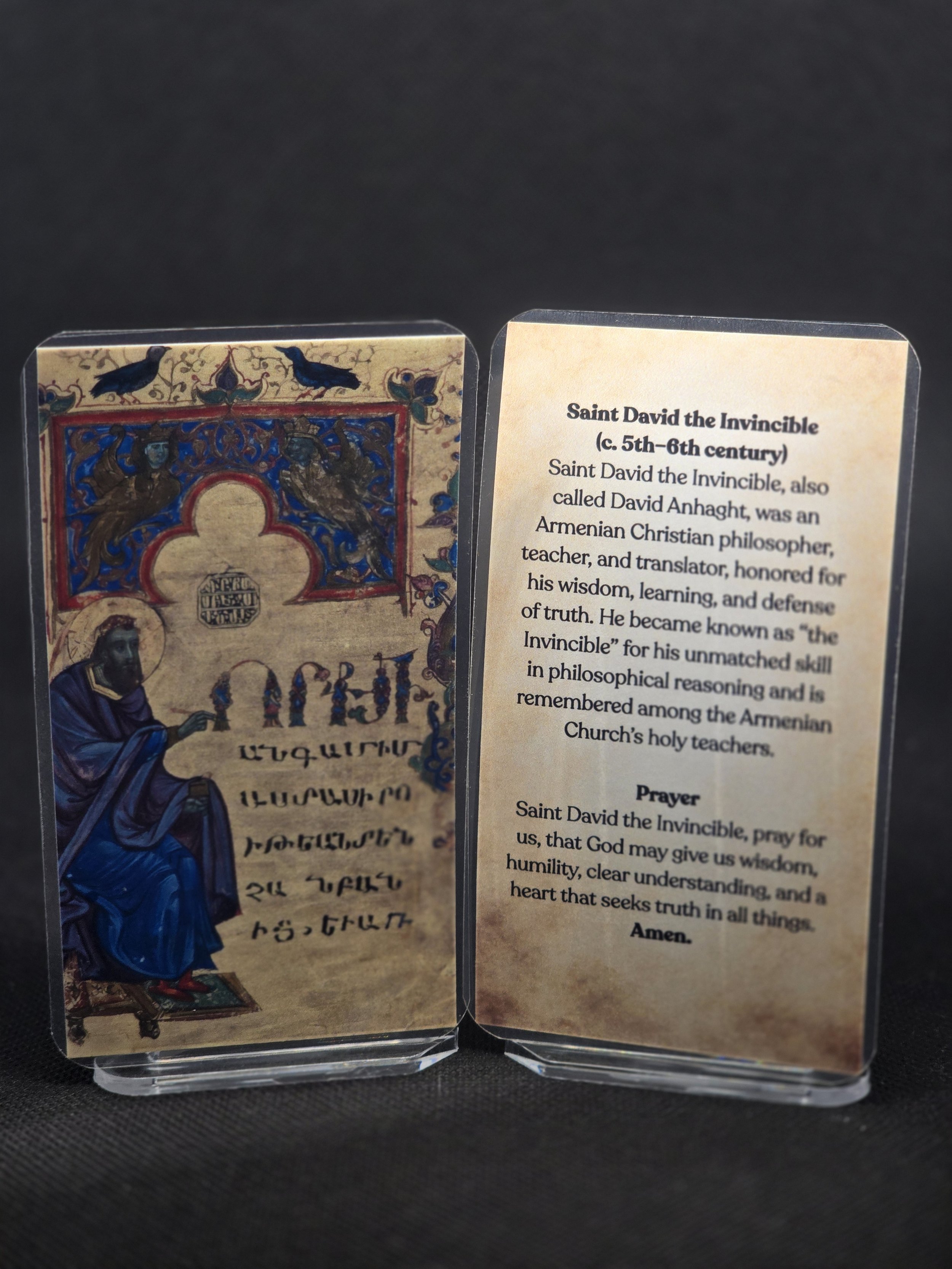
Saint David the Invincible reminds us that careful thought can serve the faith. His Prayer Card offers a quiet way to remember him and to pray for wisdom and humility in study.
View Prayer Card