Saint Tiridates III the Great: King Who Brought Armenia to Christianity
The Arsacid king who, with Saint Gregory the Illuminator, led Armenia to become the first kingdom to make Christianity its public religion, remembered with his wife Ashkhen and his sister Khosrovidukht.
At a Glance
- Name
- Tiridates III the Great, also Trdat III, king of Armenia
- Born
- About the mid third century (UNCERTAIN)
- Died
- Early fourth century, conventionally about 330 AD (UNCERTAIN)
- Conversion
- Traditionally 301 AD; many historians prefer about 314 (UNCERTAIN)
- Church
- Armenian Apostolic Church; also remembered in some Orthodox calendars
- Feast
- Movable Armenian commemoration with Queen Ashkhen and Princess Khosrovidukht; 2026 date June 27
- Who Was Saint Tiridates III the Great?
- Family and Background
- Gregory in the Pit and the Martyrs of Armenia
- The King's Affliction, Healing and Baptism
- When Did Armenia Become Christian?
- A King's Work for the Church
- Politics, Faith and Coercion
- Death, Burial and Feast
- Prayer, Devotion and Remembering the Royal Saints
- Why He Matters to the Eastern Churches
- Frequently Asked Questions
Who Was Saint Tiridates III the Great?
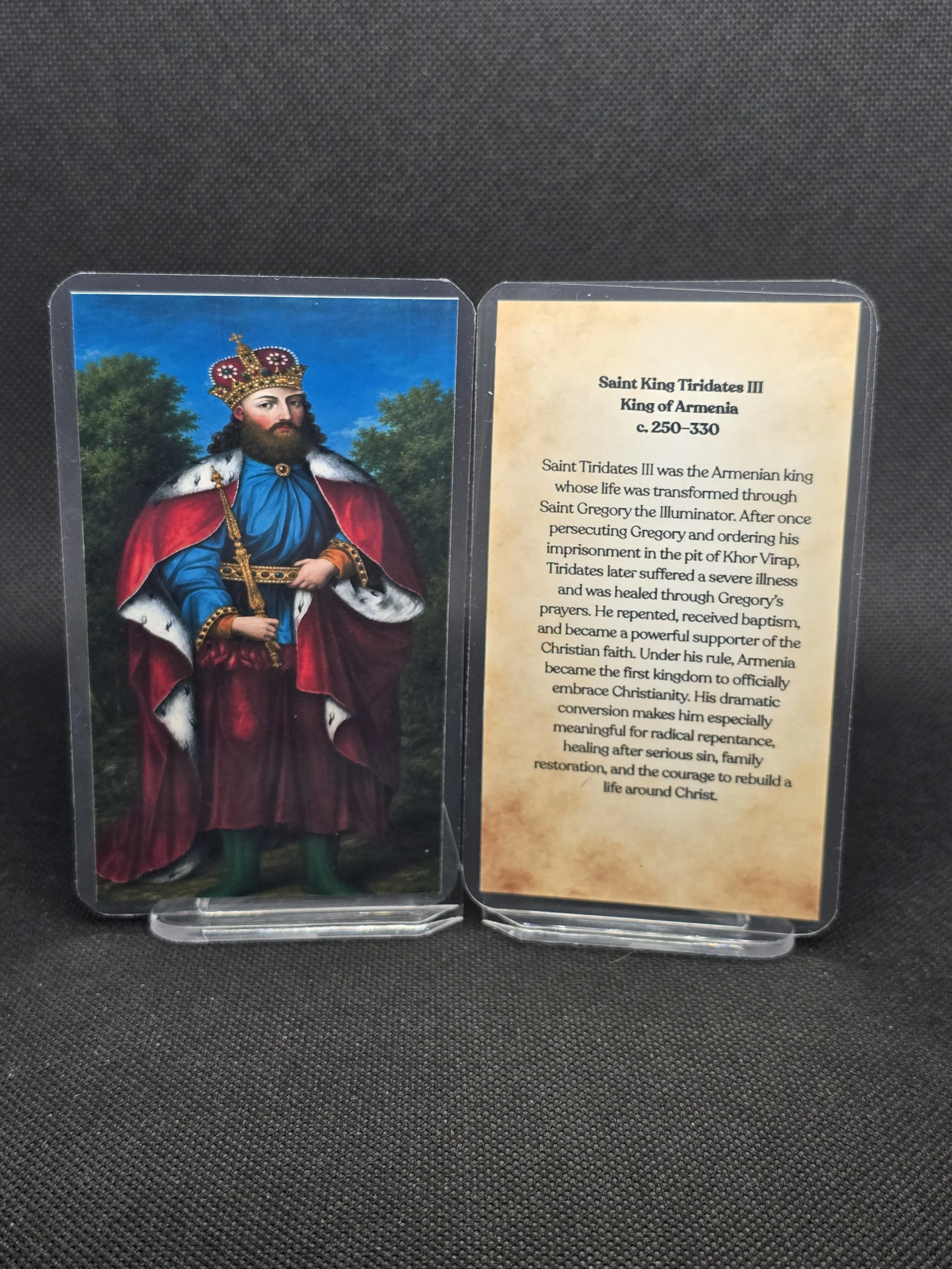
Saint Tiridates III, called Trdat in Armenian and known as the Great, was king of Armenia in the late third and early fourth centuries. He is remembered by the Armenian Church as the king who, together with Saint Gregory the Illuminator, led his country to Christianity. Armenia is often called the first kingdom to take Christianity as its public religion, and Tiridates stands at the center of that story.
He is a figure of the sort who is hard to place exactly. The main account, the History of Agathangelos, was written down long after the events and contains miracles, dreams and legend. The king's birth, his reign and even the date of his conversion are disputed. Some scholars number him as Tiridates IV, because the count of Armenian kings is itself uncertain.
This article sets out what is reasonably well founded, what is tradition, and what remains unknown. TRADITION marks what the Armenian historical memory preserves without independent proof. UNCERTAIN marks matters on which the evidence does not allow a firm answer. One theme needs to be stated at the start. The conversion of Armenia was not entirely peaceful, and an honest biography has to say so.
Family and Background
Tiridates belonged to the Arsacid royal house of Armenia, also called the Arshakuni dynasty, a branch of the family that had ruled Parthia. When the Sasanians overthrew the Parthian Arsacids in 224, the political position of Armenia changed sharply. The kingdom lay between Rome and Persia, and its rulers had to choose their friends carefully.
UNCERTAIN: Armenian religious tradition places his birth around the year 250, but neither the date nor the place can be established. TRADITION: according to the Armenian histories, his father, King Khosrov, was murdered by a nobleman named Anak, acting for the Persian ruler Ardashir. Anak's surviving son was Gregory, later called the Illuminator. The young Tiridates is said to have been carried to safety in Roman territory while Gregory was raised as a Christian in Cappadocia. The story brings together the son of a murdered king and the son of the man held responsible. The scholar Robert Thomson has warned that this tale compresses decades of political history. The hostility between the Armenian Arsacids and the Sasanian shahs is real, but the details of the childhood flight cannot be accepted without caution.
His family, as the tradition names it, includes Queen Ashkhen, whom Armenian sources call a princess of the Alans, and his sister Khosrovidukht, who is remembered for helping Gregory. His son and successor was Khosrov III Kotak. Ashkhen and Khosrovidukht share the king's commemoration in the Armenian Church. Little can be said with certainty about his education, his languages or his early campaigns, since the fullest narratives were composed later.
Gregory in the Pit and the Martyrs of Armenia
The king's return to power depended on Rome. Armenian Church tradition dates his accession to 287, while modern reconstructions stress the Roman victory over the Persian king Narseh in 298 as the moment that secured his position. Either way, he came to the throne as a ruler who owed much to the Roman world.
TRADITION: Gregory came back to Armenia with Tiridates but refused to offer sacrifice to the goddess Anahit. When the king learned that Gregory was the son of Anak, he had him thrown into a deep pit at Artashat. The place is remembered today at the monastery of Khor Virap. Agathangelos says Gregory was held for about thirteen years, although versions of the story differ, and the length of the imprisonment cannot be confirmed from outside sources.
TRADITION: a community of Christian women, among them Hripsime and Gayane, fled persecution in Roman lands and came to Armenia. The king tried to take Hripsime as his wife. She refused, and the women were put to death. Their martyrdom has a central place in the Armenian memory of the conversion, but the story reaches us through Agathangelos, and it contains legendary elements and difficulties of dating.
These episodes show Tiridates at the start of his career as a persecutor. The Church remembers him as a saint because of what came after, and the tradition does not hide his earlier actions. That honesty is one reason the story has held its power.
The King's Affliction, Healing and Baptism
TRADITION: after the martyrdoms the king suffered a terrible affliction. Agathangelos describes it as a madness in which he behaved like a wild beast, and later art sometimes shows him with the head of a boar. Scholars note the likeness to the story of Nebuchadnezzar in the Book of Daniel, and the literal transformation cannot be established. It is best read as a story with a biblical pattern, in which a proud king is humbled and then restored.
TRADITION: his sister Khosrovidukht received a dream in which she was told that only Gregory could heal the king. Gregory was brought out of the pit, prayed over Tiridates and restored him. The king repented, and the tradition adds a long period of instruction, fasting and prayer before baptism. Gregory then baptized the king, Queen Ashkhen, Khosrovidukht and members of the court. Later accounts place the baptism by a river, the eastern Euphrates, and expand it into a baptism of a great part of the nation. The size of that event and its order cannot be checked.
The historical core is firmer than the miraculous details. The fifth century historian Sozomen already knew of the conversion of Tiridates and of his promotion of the Christian faith, so the tradition of a royal conversion was well established early. How the king came to this step, and in what way, belongs to the tradition.
When Did Armenia Become Christian?
The date of the conversion is one of the best known puzzles of early Church history. The Armenian Apostolic Church holds the traditional year 301. Pope John Paul II spoke in 2001 at the time of the celebration of the seventeen hundredth anniversary and the Vatican took part in the commemoration, which recognized the traditional chronology as the Armenian people's own tradition.
Many modern historians favor a later date, around 314 or 315. Marie-Louise Chaumont thinks this probable but admits that it cannot be proved, and Robert Thomson and A. E. Redgate also lean toward about 314. A 2026 article by Aleksan Hakobyan argues for 311, linking the release of Gregory with the edict of toleration of the emperor Galerius, and a consecration of Gregory in 314. This is an argued reconstruction and not a settled view.
The safest statement is that Tiridates promoted the conversion of Armenia in the early fourth century. To present 301 as an established date would go beyond the surviving evidence. To dismiss it would ignore its centuries of use in the life of the Armenian Church. The honest course is to give the traditional year with the word traditional and to say that the question is open.
A King's Work for the Church
Tiridates was a king and not a bishop, priest or monk, so his service to the Church was political, institutional and material. After his conversion he supported Gregory's mission across the kingdom. The Armenian histories describe him authorizing the destruction of pagan sanctuaries, transferring temple property to the new Church and supporting worship and teaching. Agathangelos describes him helping Gregory to remove old shrines and set up Christian places of worship, and A. E. Redgate treats these grants as important in building the Church's institutional strength.
He also arranged for Gregory to be consecrated bishop at Caesarea in Cappadocia. This is historically significant, because it connected the young Armenian Church with the established episcopal structure of the Roman world.
TRADITION: Tiridates, Ashkhen and Khosrovidukht helped to build the first Christian sanctuary at Vagharshapat, which Armenian tradition links with the Mother See of Holy Etchmiadzin. Church accounts say the royal family carried stones for it. This expresses the family's devotion and patronage. Thomson cautions that linking Gregory's first episcopal seat with Vagharshapat reflects later developments, and that the early bishop's center at Ashtishat should not be forgotten.
No authentic writing, letter or edict of Tiridates survives. Agathangelos presents his History as written at the king's request, but that claim is not reliable. What remains of the king is a portrait drawn by others.
Politics, Faith and Coercion
The conversion cannot be understood apart from the struggle between Rome and Sasanian Persia. Armenia's old royal house had cultural and political ties with Iran, and the adoption of a new religion set the Armenian court apart from the Persian religious order and drew it closer to Rome.
Historians disagree on the king's motives. One view stresses political calculation, since Christianity bound Armenia to Rome and loosened ties that Persia could use. Another stresses a real personal conversion and a firm will to establish the new faith against resistance. A. E. Redgate cautions that the evidence cannot show whether sincere conviction or political interest counted for more, and the two explanations need not exclude each other.
The conversion was not simply peaceful. The Armenian histories speak of resistance from the old religious communities and from noble families, and Movses Khorenatsi portrays Tiridates using persuasion and force. The destruction of temples and the suppression of older worship raise real questions about religious coercion, even when told through the devotional literature of a Christian country. A serious biography should not leave these questions out.
An outside witness is the church historian Eusebius of Caesarea, who in his Ecclesiastical History tells how the emperor Maximinus Daia made war on the Armenians, who were Christians. This is usually placed around 311 or 312. UNCERTAIN: whether Eusebius means the subjects of Tiridates or other Armenian communities cannot be decided. The passage is nevertheless early evidence that Christians existed in the Armenian world and that they mattered politically.
Death, Burial and Feast
The circumstances of Tiridates's death are poorly documented. UNCERTAIN: the death is conventionally placed around 330, but Chaumont notes arguments for a date no later than 320, and other historians have proposed dates as late as 337. TRADITION: Movses Khorenatsi says that the king left royal life for an ascetic existence, following Gregory's example, and also that he was poisoned, which presents him as a ruler whose Christian reforms angered part of the nobility. Thomson observes that neither claim appears in earlier surviving sources, so they are better described as later traditions than as events.
Armenian tradition connects his burial with Thordan, also written Tordan, in the district of Daranali, which is linked with the memory of Gregory the Illuminator. No securely authenticated relics of Tiridates have been identified, and a burial tradition should not be mistaken for a verified tomb.
No formal date of canonization can be given. His veneration grew within the liturgical life of the Armenian Church, and his standing is shown by his place in the Armenian calendar and by the naming of Tiridates among the Christian kings in the Armenian Divine Liturgy. The Armenian feast is movable. It commemorates him together with Queen Ashkhen and Princess Khosrovidukht in early summer, and the date published for 2026 was June 27. Armenian descriptions differ slightly in how they count the Saturdays after Pentecost, so the yearly calendar should be followed. Some Eastern Orthodox calendars, drawing on the Prologue from Ohrid, list him on November 29.
Prayer, Devotion and Remembering the Royal Saints
Armenian devotion honors Tiridates mainly as one of the royal saints, remembered together with Ashkhen and Khosrovidukht, and as a figure whose story is bound to that of Gregory the Illuminator. No separate series of well documented miracles through his intercession was found in the sources examined.
In the Armenian Divine Liturgy, the deacon's intercession remembers the Christian kings and names Tiridates among them. This is a modest and sound witness to how the Church regards him. It prays for him, and for the faithful rulers of every age, in the same breath in which it prays for the living.
His life carries a lesson that is useful to readers today. It tells of a powerful man who did harm, who was humbled, who asked forgiveness and who then put his power at the service of the faith. The tradition does not ask anyone to admire the early cruelty. It asks us to notice that repentance was thought possible even for a king, and that it was shown in works, in stones carried and churches raised, and not only in words.
Lord Jesus Christ, King of kings, you humbled the proud and raised up the repentant. Through the prayers of Saint Tiridates, Saint Gregory, Saint Ashkhen and Saint Khosrovidukht, grant wisdom to those who govern, mercy to those who hold power, and a spirit of repentance to us all. Make us builders of your Church in our own time. Holy Tiridates, pray for us. Amen.
This prayer was written for this page and is not an official text of any Church. The Armenian Divine Liturgy remembers the Christian kings, naming Tiridates among them, in its intercessions.
Why He Matters to the Eastern Churches
For Armenian Christians, Tiridates is inseparable from Gregory the Illuminator, from the growth of the Armenian episcopate and from the rise of a distinct Christian culture in their land. His commemoration, with that of Ashkhen and Khosrovidukht, is part of the Church's yearly memory of its beginnings.
For Eastern Catholics, especially those of the Armenian Catholic Church, the same early history is part of a shared Armenian heritage. Pope John Paul II's participation in the commemorations of 2001 showed that this history is also part of the common ground between the Catholic Church and the Armenian Apostolic Church.
Eastern Orthodox readers will find him in some calendars and in the Prologue from Ohrid, which shows that certain Armenian saints came to be honored beyond the Armenian Church. A distinction is needed. The Armenian Apostolic Church belongs to the Oriental Orthodox family, which is not the same as the Eastern Orthodox communion, and shared respect does not mean the same liturgical recognition in every Church.
His story raises a lasting question about conversion, political power, religious freedom and national identity. Armenian Christians have answered it with deep loyalty to the faith across many centuries, while an honest reading also admits that the road to that faith was marked by both courage and compulsion.
Frequently Asked Questions
Remembering a King Who Repented
Saint Tiridates tells of power that was humbled and turned toward good. His Prayer Card gives you a simple way to remember him and to pray for those who govern.
View Prayer Card