Saint Edward the Confessor and Queen Edith: Anglo-Saxon King and Queen of England
The last king of the House of Wessex, canonized in 1161, and the queen who shaped his court, his memory and the abbey at Westminster.
At a Glance
- Born
- Between 1002 and 1005, traditionally at Islip, Oxfordshire (exact date UNCERTAIN)
- Died
- 4 or 5 January 1066, at Westminster; Edith died in December 1075
- Reign
- King of England from 1042 to 1066, crowned at Winchester at Easter 1043
- Canonized
- 1161 by Pope Alexander III; Edith was never canonized
- Feast
- 13 October, the anniversary of the 1163 translation of his relics; 5 January is the day of his death
- Shrine
- Westminster Abbey, London
- Who Was Edward the Confessor?
- A Prince in Exile
- Return to the Throne and Marriage
- Westminster Abbey and Royal Piety
- Queen Edith of Wessex
- The Crisis of 1051 and the Question of the Succession
- Death, Burial and Canonization
- Relics and the Shrine at Westminster
- Miracles and Legends
- Why Edward Matters to Eastern Christians
- Frequently Asked Questions
Who Was Edward the Confessor?
Edward the Confessor was King of England from 1042 until his death in January 1066. He was the last ruler of the old West Saxon royal line to sit on the throne for any length of time, and his death opened the crisis that ended with the Norman Conquest. The Church later honored him as a saint.
The title Confessor does not mean that he heard confessions. In the language of the early and medieval Church, a confessor was a holy person who bore witness to the faith by the way he lived, without being put to death for it. Edward earned the title through the memory of his piety, his generosity to the poor and his patronage of the monastery at Westminster.
This article separates what the sources document from what later tradition added. The main facts are secure: his family, his exile, his reign, his marriage to Edith, the rebuilding of Westminster and the date of his death. The more famous stories, such as the ring given to a beggar, are marked TRADITION. Queen Edith is treated fairly here as a remarkable woman and a patron of the Church, but she was not canonized and should not be called a saint.
Edward lived across the line of the great split between Rome and Constantinople traditionally dated to 1054, but his canonization came a century later in the Latin Church. That detail shapes how Eastern Christians relate to him, and the last section of this article returns to it.
A Prince in Exile
Edward was the son of King Æthelred II and his second wife Emma, a sister of Duke Richard II of Normandy. He was born between 1002 and 1005, and tradition names Islip in Oxfordshire as his birthplace. UNCERTAIN: neither the year nor the place can be fixed from contemporary records.
His childhood fell in the years when Danish armies repeatedly attacked England. Renewed Danish conquest drove the royal family abroad around 1013. After Æthelred died in 1016 and Edward's half-brother Edmund Ironside died the same year, Cnut took the whole kingdom, and Emma later married him. Edward spent most of the years from 1016 to 1041 in Normandy, a guest of his mother's relatives, while others ruled the land he would later govern.
The exile shaped his reign. He knew Norman customs and Norman people, and he grew up as a king without a kingdom, a position that tends to produce caution and a dependence on friends. His full brother Alfred was killed in 1036 after returning to England. The exact roles of Earl Godwin and others in that killing are disputed, and Edward's later relationship with the Godwin family cannot be understood without it.
Edward returned to England in the early 1040s at the invitation of his half-brother Harthacnut, who was then king. When Harthacnut died in 1042, Edward was accepted as king, with the support of powerful nobles, above all Earl Godwin of Wessex.
Return to the Throne and Marriage
Edward was crowned at Winchester on Easter Day in 1043. There is no dramatic conversion story in his life. He was born into a Christian dynasty and raised in a Christian court, and his reputation for holiness grew through steady religious observance and patronage rather than through a single turning point.
The most important political event of his early reign was his marriage to Edith, the daughter of Earl Godwin and his wife Gytha, on 23 January 1045. The marriage tied the king to the most powerful family in England. It also placed enormous weight on one question: would the couple have a child?
They had none. UNCERTAIN: the reason is not recorded. Later writers, beginning with accounts composed for the cult of the saint, said that the king and queen lived together chastely by choice. That is tradition, and it was clearly useful to the promoters of his sainthood. Against it stands the plain fact that a royal marriage of this kind was meant to produce an heir. Honest history should say that the childlessness is documented and the explanation is not.
The king also kept a religious ideal in view. His court was pious in the manner of its time, and he turned his attention to the monastery of Saint Peter at Westminster, the project that would define his lasting reputation.
Westminster Abbey and Royal Piety
Edward's greatest work was the rebuilding of the Benedictine monastery of Saint Peter at Westminster, west of the City of London. Monastic life at the site already existed, and Westminster Abbey itself traces earlier links to King Edgar and Saint Dunstan in the tenth century. Edward restored and enlarged it rather than creating it from nothing.
The new church was built in the Romanesque style associated with Normandy and was consecrated on 28 December 1065. The king was too ill to attend. Almost nothing of his building survives above ground, because the abbey was rebuilt in the Gothic style under Henry III in the thirteenth century, but parts of the monastic complex, including the Pyx Chamber, still stand. The Bayeux Tapestry shows the church and the king's funeral procession, which gives us rare early visual evidence.
TRADITION: a later story says Edward vowed in exile to make a pilgrimage to Rome and that the pope released him from the vow on condition that he support a monastery to Saint Peter. The tale was told by medieval writers to explain Westminster, and it cannot be verified from contemporary sources.
Edward left no authenticated theological writings or personal devotions. Anything attributed to him as an author should be treated with caution. His surviving memory comes through charters, chronicles, the Bayeux Tapestry and biographies written after his death, most of them with a purpose.
Queen Edith of Wessex
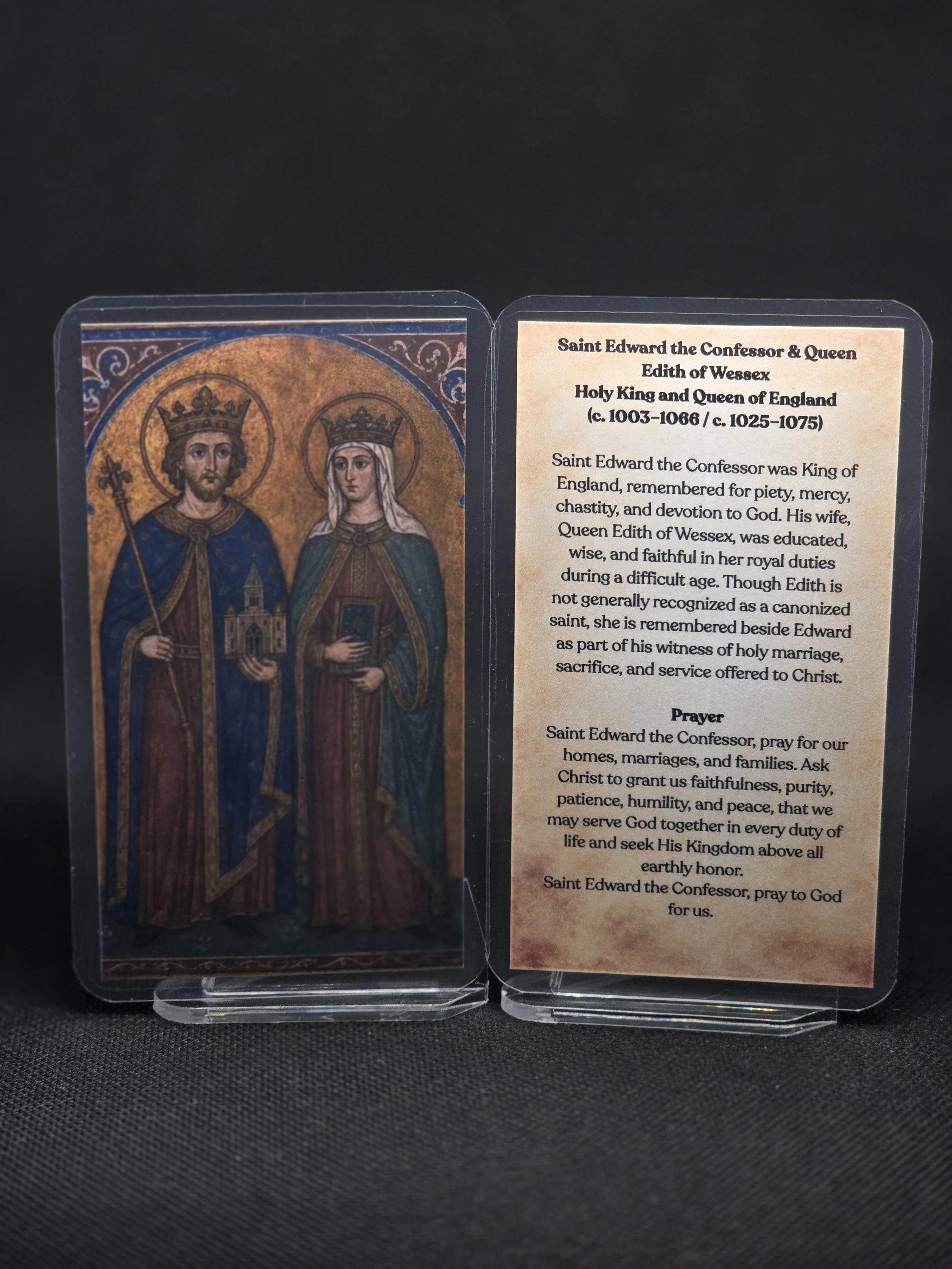
Edith was educated at Wilton Abbey, a leading center of learning for aristocratic women, and sources describe her as literate and cultured. The year of her birth is not recorded, though it is usually placed in the early eleventh century. She was the sister of Harold Godwinson, who would succeed her husband as king, and of Tostig, Gyrth and Leofwine.
Historians such as Pauline Stafford have stressed that she was a political figure, not simply a pious companion. She held large estates, and Westminster Abbey records that she was the wealthiest woman in England at the time of her husband's death. She rebuilt the church at Wilton and was a patron of religious houses.
She also commissioned the Vita Ædwardi Regis, the Life of King Edward, an early account of the king and of the Godwin family. UNCERTAIN: its author is anonymous, and scholars debate when it was written, though the work reflects the events of 1065 to 1067. It is valuable and also slanted, because it was written in the circle of the queen and presents her family favorably.
Edith survived the fall of her own family at Hastings. She kept her lands and her position under William the Conqueror and spent her widowhood chiefly at Winchester and Wilton. She died in December 1075; sources differ between 18 and 19 December (UNCERTAIN), and she was buried at Westminster beside her husband. No Church authority has canonized her. She should not be confused with Saint Edith of Wilton, an earlier royal saint of the tenth century.
The Crisis of 1051 and the Question of the Succession
Edward's reign was not peaceful. His dependence on Earl Godwin created friction over land, influence and appointments to the Church, especially when the king favored clergy with Norman connections. In 1051 the quarrel reached a crisis. Godwin and his sons were exiled, and Edith was removed from court and placed in a religious house. The next year Godwin returned in force, and the queen was restored. These events show how closely the marriage was bound up in politics.
After Godwin died in 1053, his son Harold became the dominant figure in the kingdom, with the military and political weight of an uncrowned deputy. Edward's childlessness meant that, as he aged, the question of the succession became urgent.
The leading candidates were Harold Godwinson, William of Normandy and Edgar Ætheling, a young member of the old royal house. William claimed that Edward had promised him the throne, and Norman writers supported that claim. English sources point to Harold. UNCERTAIN: the evidence does not show clearly who the king intended, and the report that Edward named Harold on his deathbed is disputed. A fair account will not blame Edward alone for what followed, but the unresolved question helped make war likely.
Edward died during the night of 4 to 5 January 1066. Harold was crowned on 6 January, the day of the funeral, and was killed at the Battle of Hastings on 14 October 1066. The crown passed out of the House of Wessex and into the hands of William.
Death, Burial and Canonization
Edward was buried on 6 January 1066 before the high altar of his new church at Westminster. Reports of healing at the tomb began soon afterward, and a cult developed. In 1102 the tomb was opened, and a later account by Osbert of Clare describes the body as sound and the opening as marked by a sweet fragrance. TRADITION: medieval writers treated this as a sign of incorruption. These are religious testimonies, not forensic findings, and Westminster Abbey itself notes that the aromatic materials used in burial could explain the scent.
The effort to have Edward recognized as a saint was led by the monks of Westminster, and it received the backing of King Henry II. Pope Alexander III canonized him in 1161 by a bull issued at Anagni, and the date is traditionally given as 7 February. The case drew on a Life written by Osbert of Clare and later reshaped by Aelred of Rievaulx.
There was no separate beatification in the modern sense, because the process of the twelfth century was different. His canonization was a papal act that confirmed an existing cult and extended it to the Latin Church. It should be remembered that the canonization took place after the traditional date of the break between Rome and Constantinople, so it was not an act of the undivided Church.
The memory of Edward became bound up with the identity of the English monarchy. For some generations he was regarded as the patron saint of England, until Saint George gradually took on that role. Westminster Abbey connects the shift to the fourteenth century.
Relics and the Shrine at Westminster
On 13 October 1163 Edward's body was moved to a new shrine in the abbey. Thomas Becket, then Archbishop of Canterbury, took part, and King Henry II was present. That translation is the origin of the main feast day on 13 October, and it is why the Roman calendar keeps the saint on that day rather than on the day of his death.
A second translation took place on 13 October 1269 under Henry III, who rebuilt the abbey in the Gothic style and commissioned a magnificent shrine decorated with Cosmati mosaic by Italian craftsmen under Peter of Oderisio. The king himself took part in carrying the coffin into the new shrine.
The shrine was damaged and stripped of its treasures when the monastery was dissolved in 1540. Under Queen Mary I it was rebuilt, and the coffin was returned to it by April 1557. Westminster Abbey records that the coffin was opened without permission in 1685 and a gold crucifix and chain were removed. The wooden coffin remains within the shrine today.
Visitors can still stand in the sanctuary of Westminster Abbey at the shrine, which remains a place of Christian prayer. The Abbey commemorates the translation each October, and reports that an icon of the saint by the Russian Orthodox iconographer Archimandrite Zinon was installed there in 2019.
Miracles and Legends
Much of what people know about Saint Edward comes from stories written after his death. They deserve to be told, and each is marked here as TRADITION, because none of them can be proven by contemporary evidence.
TRADITION: the ring and Saint John. According to the story, a beggar asked Edward for alms, and the king, having no money, gave him a ring. Later two English pilgrims in the Holy Land met an old man who said he was Saint John the Evangelist, and he gave them the ring to carry back to the king, with the message that Edward would soon die. The scene appears in medieval art at Westminster. It shows how the king was remembered as a man of charity, not that the apparition took place.
TRADITION: healing. Medieval authors credit Edward with curing the sick by touch and by water in which he had washed his hands. The English kings later practiced a ritual touch for scrofula, called the King's Evil, and the cult of Edward gave it a saintly origin. The existence of the custom does not prove any single cure.
TRADITION: the vision of the green tree. In one account, Edward foresaw a time of trouble for England in the image of a tree cut from its trunk and later made green again. Writers of later centuries connected the vision with the Reformation and with hopes of reunion. These readings came long after the king and cannot be traced to his own words.
Lord Jesus Christ, King of kings, you gave your servant Edward a crown and taught him to honor your Church and care for the poor. Bless all who hold authority, that they may rule with justice and humility. Bless husbands and wives, that their love may be patient and faithful in joy and in trial. Through the prayers of your servant Edward, grant us peace in our time and a place in your kingdom. Amen.
This short prayer was written for this page. It is not an official liturgical text. The traditional Latin collect for his feast on 13 October asks that those who honor him on earth may reign with him in heaven.
Why Edward Matters to Eastern Christians
Edward is first of all a saint of the Western Church. He was an English king, he supported a Benedictine house, and Pope Alexander III canonized him. He should not be presented as an Eastern Catholic or Byzantine saint by origin or by liturgical tradition.
There are still real points of contact. Western Rite Orthodox communities keep his feast on 13 October, which is documented. That does not mean that every Orthodox jurisdiction recognizes his canonization or includes him in the Byzantine calendar, and no such universal observance has been shown. The icon painted by an Orthodox iconographer for his shrine in 2019 is one visible sign of interest among Orthodox Christians in the saints of the British Isles.
For Eastern Catholics, Edward is part of the shared Catholic heritage, although we found no evidence that he appears in the calendars of the Eastern Catholic Churches in general. A reader from the East will also notice the familiar themes of a holy ruler, a monastery under royal protection, relics honored in a shrine and a feast tied to a translation.
The most honest reason to remember him in an Eastern setting is simply that he was a Christian king whose life shows the strengths and limits of royal holiness. A king who built a church and cared for the poor was also a ruler caught in rivalry, and the Church remembers him with gratitude, not as a flawless figure.
Frequently Asked Questions
Keep the Memory of a Holy King
Saint Edward the Confessor and the queen at his side remind us that holiness and government can meet, and that history is more honest when it admits what it does not know. Visit the prayer card page to bring his intercession into your home.
View Prayer Card