Saint Clotilde and King Clovis: The Queen Who Led the Franks to the Catholic Faith
A Burgundian princess, a Frankish warlord and a baptism at Reims that shaped the Christian history of France, told with care about what is documented and what is legend.
At a Glance
- Clotilde
- Born about 474, probably in the Burgundian kingdom (UNCERTAIN); died 3 June, traditionally 545, at Tours
- Clovis
- Born about 466 (UNCERTAIN); King of the Franks from about 481; died 27 November 511 at Paris
- Baptism of Clovis
- Traditionally Christmas 496 at Reims by Saint Remigius; some scholars argue for 508 (UNCERTAIN)
- Recognition
- Clotilde is a saint by ancient veneration with no recorded canonization; Clovis has no established canonization
- Feast
- 3 June for Clotilde, kept on 16 June by Churches that use the Julian calendar
- Burial
- Both were buried at the church of the Holy Apostles in Paris
- Who Were Clotilde and Clovis?
- A Burgundian Princess and a Frankish King
- Marriage and the Children's Baptisms
- The Battle and the Baptism
- Churches, Foundations and Councils
- Widowhood, Violence and the Fate of Her Grandsons
- Death, Burial and Veneration
- Is Clovis a Saint?
- Legends and Devotion
- Why Clotilde Matters to Eastern Christians
- Frequently Asked Questions
Who Were Clotilde and Clovis?
Clotilde was a Burgundian princess who became queen of the Franks around the year 493. Her husband Clovis I was a pagan warrior king who built a large Frankish kingdom in Gaul and who accepted baptism as a Catholic Christian. The two stand together in the story of how the Franks came to share the Nicene faith of Rome, at a time when many Germanic rulers followed the Arian teaching that denied the full equality of the Son with the Father.
Their story is told above all by Saint Gregory of Tours, a bishop who wrote the History of the Franks about fifty years after Clotilde died. Gregory is invaluable and also partisan, and he wrote to teach as well as to record. Other early evidence exists, including a letter from Bishop Avitus of Vienne to Clovis and a letter from Bishop Nicetius of Trier to a granddaughter of Clotilde, and those sources let us confirm the central facts without relying on Gregory alone.
This article keeps a clear line between three kinds of material. What the sources document is stated plainly. What is disputed, such as the exact year of the baptism, is marked UNCERTAIN. What belongs to later pious or political storytelling, such as the dove with the holy oil, is marked TRADITION.
One point should be stated at the start. Clotilde is honored as a saint. Clovis is remembered as a baptized king whose conversion mattered enormously, but no canonization of Clovis can be shown, and nothing here should suggest that her sanctity is simply shared with him.
A Burgundian Princess and a Frankish King
Clotilde was born around 474, probably in the Burgundian kingdom in southeastern Gaul. UNCERTAIN: neither the year nor the place can be fixed with confidence. Her father was Chilperic, a Burgundian royal, and her mother is usually named Caretena. The family lived in a land where Roman Christianity, Germanic politics and rival theological loyalties lived side by side. Some Burgundian kings, including Gundobad, held the Arian faith, while Clotilde was raised as a Nicene Christian.
UNCERTAIN: Gregory of Tours says that Gundobad killed Clotilde's father and drowned her mother, and he presents that crime as part of her motive for later revenge. Modern historians question this story. The epitaph of a Burgundian queen from about 506 does not fit it well, and the nineteenth century scholar Godefroid Kurth argued that legend had grown around the family quarrel. The truth about her parents' deaths remains unclear.
Clovis was the son of King Childeric I and Queen Basina, according to Gregory. He inherited a small Frankish kingdom centered on Tournai, traditionally in 481, and he expanded it by war. His defeat of the Roman commander Syagrius at Soissons is traditionally dated to 486, though the details rest heavily on Gregory.
Around 492 or 493 Clovis married Clotilde. The alliance joined the Franks to the Burgundian royal family, and it joined a pagan king to a Christian queen. Gregory names their children as Ingomer, Chlodomer, Childebert, Chlothar and a daughter, also called Clotilde. Clovis also had an older son, Theuderic, from an earlier relationship.
Marriage and the Children's Baptisms
Clotilde's great work was the long effort to bring her husband to the faith. Gregory describes her urging Clovis to give up the old gods, whom she told him were powerless, and to accept the God who made heaven and earth. Clovis resisted, saying that the gods had made him victorious and that they had made everything.
The first test came with the birth of their son Ingomer. Clotilde insisted that the child be baptized, and Clovis permitted it. The infant died soon afterward, and the king concluded that the new God had been to blame. Clotilde answered with grief and faith, saying that she thanked God for taking to his kingdom a child born of her womb and baptized in his name. A second son, Chlodomer, was also baptized and fell ill, but he recovered, and Clovis was disarmed again.
These scenes come from Gregory, who composed the words of the conversations himself in the manner of ancient historians. They show the way he and his readers understood a queen's patient witness, and they cannot be checked by independent testimony. Even so, the picture of a Christian wife who held her ground through grief fits what a bishop of the next generation said of her.
That bishop was Nicetius of Trier. In a letter written between about 559 and 570 to Chlodosind, a granddaughter of Clotilde who had married the Lombard king Alboin, Nicetius praised Clotilde as the woman who led Clovis to the Catholic faith and urged the young queen to do the same for her own husband. This is valuable evidence because it is independent of Gregory.
The Battle and the Baptism
Gregory says that Clovis, in a hard fight against the Alamanni, saw his army begin to give way and called on Christ, promising to be baptized if given victory. The Alamanni fled, and their king was killed. Tradition names the battle Tolbiac and places it in 496. UNCERTAIN: Gregory does not name Tolbiac as the site of the conversion battle, and the usual identification with Zülpich is a later inference. Cassiodorus, writing in Italy, points to Frankish victories over the Alamanni around 506, so the sequence is debated.
The story also echoes the vision of Constantine before the Milvian Bridge, and Gregory himself compares Clovis with Constantine. That does not make the vow false, but it is one reason historians read the narrative with care as both memory and literary shaping.
Gregory then describes Clotilde calling on Bishop Remigius of Reims to instruct the king. Clovis accepted baptism, and Gregory says that more than three thousand of his warriors were baptized with him. The figure comes only from Gregory.
Bishop Avitus of Vienne wrote a letter of congratulation to Clovis after the baptism, and it proves that the baptism took place and was understood as a Catholic baptism. Avitus connects it with Christmas but does not name the year. UNCERTAIN: the traditional date is Christmas 496, but Ian Wood and Danuta Shanzer have argued for 508, and no surviving document fixes 25 December 496 as the day.
Whatever the year, the consequence was large. A Frankish king who was a Catholic rather than an Arian could count on the support of the Gallo-Roman bishops, and the Franks became the leading Catholic power in the West.
Churches, Foundations and Councils
Clotilde ministered as a queen, not as a cleric. Her work was exercised through patronage, charity and family influence. Gregory credits the royal couple with building the church of the Holy Apostles in Paris, later associated with Saint Genevieve, and it became the burial place of the dynasty.
Tradition also credits Clotilde with founding a women's monastery at Les Andelys in Normandy, around 511. UNCERTAIN: the local tradition is old, but no contemporary record of the foundation survives, and its date and circumstances cannot be confirmed.
After Clovis died she lived mostly at Tours, near the shrine of Saint Martin, and Gregory remembers her there as generous to the poor, watchful in prayer and humble in manner. He says she gave her wealth to churches and monasteries and kept a quiet life as a widow.
Clovis, for his part, took part in organizing the Church in his kingdom. He called the First Council of Orléans, which ended on 10 July 511, and modern study of its signatures finds thirty-two bishops. The canons dealt with discipline, church property, the right of sanctuary and the relationship between the king and the bishops.
Neither Clotilde nor Clovis left authenticated theological writings. The speeches that Gregory gives to the queen are literary reconstructions, and any prayer or sermon attributed to her should be handled with caution.
Widowhood, Violence and the Fate of Her Grandsons
Clotilde's later years were darkened by the violence of Merovingian politics. When Clovis died in 511 his kingdom was divided among his surviving sons, and the division bred rivalry. Gregory says that Clotilde urged her sons to attack Burgundy to avenge the deaths of her parents, and that the war cost the life of her son Chlodomer in 524. UNCERTAIN: this account depends on the story of her parents' murder, which is itself doubted, so the charge that she demanded revenge should be neither accepted as fact nor left out.
The worst episode followed. Chlodomer's young sons were taken into Clotilde's care. According to Gregory, her sons Childebert and Chlothar feared that the boys would claim a share of the kingdom, and they killed the two older children. The youngest, Clodoald, escaped, became a monk and is honored as Saint Cloud.
Gregory also reports a terrible moment in which Clotilde, pressed for a choice between her grandsons' deaths and their loss of royal power, said words that her sons took as consent. The text presents her reply as anguish, not as a deliberate order, and the incident shows how little control a queen mother might have over armed sons.
Her daughter Clotilde, married to the Visigothic king Amalaric, also suffered, and Gregory and later writers describe religious conflict and mistreatment in that marriage. UNCERTAIN: the exact details of the daughter's death are not clear.
Clovis himself is a hard case for the moralist. Gregory records the removal of rival Frankish kings even after his baptism. A baptism does not wash out a record of killing, and a fair biography cannot present the king's later conduct as a model of Christian life.
Death, Burial and Veneration
Clovis died at Paris on 27 November 511 and was buried in the church of the Holy Apostles. Gregory says that he was forty-five and had reigned thirty years, figures that belong to Gregory's own reckoning and are not exact measurements.
Clotilde died at Tours on 3 June, traditionally in 545, though some references give 544. UNCERTAIN: the year cannot be settled. Her body was brought to Paris and laid next to her husband in the church they had built.
She has no recorded papal canonization. Her cult grew from early local veneration, long before the later formal processes, and an anonymous Life of the saint, generally dated to the tenth century, helped to shape her memory. Her feast is 3 June.
Her relics were later divided among French churches. Tradition names Les Andelys, Vivières and Paris as places that held parts of them. The original royal burial church was eventually destroyed, so the history of every reliquary cannot be traced, and the claims of individual relics should be treated as devotional tradition.
Is Clovis a Saint?
Medieval French writers came to treat Clovis as the sacred founder of the French monarchy, and his memory was honored in some places. That is a different thing from canonization. There is no established papal canonization date for Clovis and no universal Catholic feast for him that can be verified.
The distinction matters. A king's baptism can be a hinge of history without making him a saint, and the Church has not asked the faithful to treat him as one. Clotilde's sanctity rests on her life of prayer, patience and charity. Clovis is honored in history for the turning he made, and he is remembered by Christians as a convert whose life asks for sober judgment.
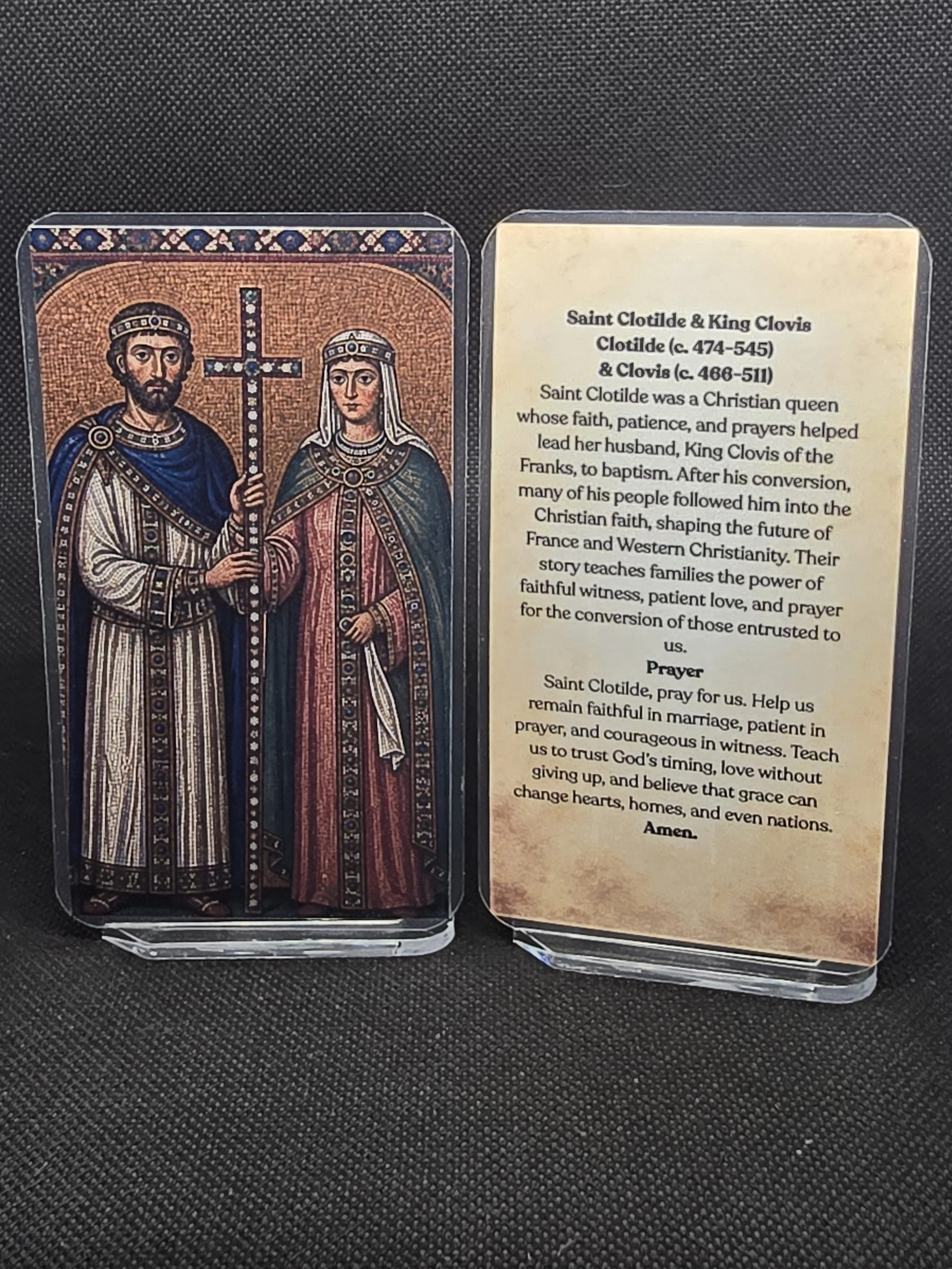
Readers who see both names on a prayer card should therefore read it as a devotion to Clotilde with the memory of her husband, whose conversion she sought. It should not be read as an announcement that the Church has canonized them as a pair.
Legends and Devotion
Many things said about this couple come from later centuries. Each is marked TRADITION.
TRADITION: the Holy Ampulla. A famous story says that at the baptism a dove came down from heaven bearing a vial of holy oil for the anointing of Clovis. It appears in neither Gregory's account nor the letter of Avitus. It is associated with Archbishop Hincmar of Reims in the ninth century, and it later tied the baptism of Clovis to the coronation of the kings of France at Reims. The legend is an important part of French religious and political history, but its heavenly origin cannot be established.
TRADITION: the victory over the Alamanni. Gregory's narrative of the vow and the sudden victory is an early Christian account, not a miracle that history can demonstrate. It may preserve a real battlefield memory, but its details cannot be tested.
TRADITION: Clotilde's prayer and the storm. Gregory tells how a quarrel between two of her sons nearly led to battle, and how a violent storm separated the armies after Clotilde prayed at the tomb of Saint Martin at Tours. The tale shows her remembered role as a peacemaker, though its cause cannot be verified.
TRADITION: the spring at Les Andelys. Local belief says that a spring appeared through her prayers during her religious work there. It belongs to regional devotion, and the existence of the story does not prove the event.
Lord Jesus Christ, you called the queen Clotilde to pray and wait for her husband, and you were with her in joy and sorrow. Strengthen all who pray for the faith of a husband, a wife, a child or a friend. Give them patience when the answer is slow and peace when the family is divided. Heal our houses of anger and revenge, and teach us to forgive. Through the prayers of your servant Clotilde, bring all our loved ones to the light of your truth. Amen.
This short prayer was written for this page. It is not an official liturgical text. The traditional Latin collect for her feast on 3 June asks God to give the Franks, to whom he gave the gift of faith through her labors, the sincere practice of Christian piety.
Why Clotilde Matters to Eastern Christians
Clotilde lived about five centuries before the break between Rome and Constantinople that is traditionally dated to 1054, so she belongs to the shared heritage of East and West. Her commemoration in the East is documented. She appears on 3 June in the Orthodox calendar in the Russian Menaion, and Churches that use the Julian calendar keep that date on 16 June by the civil calendar.
Her witness has points that Eastern readers will recognize. She stood for the Nicene faith in a Germanic world where Arian kings held power, and the dispute was about the divinity of Christ, which is central to Catholics and Orthodox alike. She is also an example of the strength of Christian women in royal houses, as the letter of Nicetius shows.
Her devotion to Saint Martin of Tours places her in a tradition of charity and prayer that both East and West honor. And her widowhood is an honest picture of holiness lived inside violence and grief, with no easy victory.
We did not find an authenticated ancient Byzantine troparion composed for her, and none is given here. The prayer on this page is a modern devotional text, written for the site and not taken from any liturgical book.
Frequently Asked Questions
A Queen Who Prayed and Waited
Saint Clotilde teaches patience in the long work of praying for someone else's faith, and her life reminds us that holiness can be found in the midst of grief and family conflict. Visit the prayer card page to bring her intercession into your home.
View Prayer Card