Saint Olga and Saint Vladimir the Great: Equal to the Apostles and Enlighteners of Rus
A regent grandmother and her grandson, the Grand Prince of Kyiv, whose baptisms opened the Christian history of the lands of Rus.
At a Glance
- Olga
- Born about 890 (UNCERTAIN); died 11 July 969 at Kyiv; baptized Helena
- Vladimir
- Born between about 956 and 963 (UNCERTAIN); Grand Prince of Kyiv from about 980; died 15 July 1015 at Berestovo
- Conversions
- Olga about 955 to 957, place disputed; Vladimir about 987 to 989, traditionally 988
- Recognition
- Both are saints by medieval veneration; the exact dates of their formal recognition are UNCERTAIN
- Feasts
- Olga on 11 July and Vladimir on 15 July (24 July and 28 July on the civil calendar for Churches that use the Julian calendar)
- Titles
- Equal to the Apostles; Vladimir is called Enlightener of Rus
- Who Were Olga and Vladimir?
- Princess, Regent and Grand Prince
- Olga at Constantinople
- Vladimir's Choice
- Baptizing Rus and Building in Kyiv
- Violence, Coercion and Honest History
- Death, Relics and Burial
- The Revenge Stories and Other Legends
- Saints Without a Canonization Date
- Why Olga and Vladimir Matter to Eastern Christians
- Frequently Asked Questions
Who Were Olga and Vladimir?
Olga of Kyiv and Vladimir the Great are two of the most important figures in the Christian history of Eastern Europe. Olga ruled Kyiv as regent after the death of her husband Igor in 945 and became the first ruler of the Kyivan state whose Christian faith is securely attested. Vladimir, her grandson, was a Grand Prince of Kyiv who accepted baptism around 988 and made Christianity the religion of his state. Both are honored as Equal to the Apostles, a title the Eastern Churches give to those who spread the faith among a whole people.
The lands they ruled were the medieval state of Kyivan Rus, not the modern Russian Federation or the modern Ukrainian state. Today Orthodox and Eastern Catholic Christians in several countries trace their Christian beginnings to this period, and the story of the two saints belongs to all of them. This article avoids projecting modern national claims onto tenth century evidence.
Most of what is known comes from the Primary Chronicle, a history of Rus that took its main surviving shape in the early twelfth century. It is precious and also literary. It gathers older stories, folk memories and Christian teaching, and it was written by monks who wanted to show how the people of Rus came to the faith. Other evidence, such as the Byzantine book of court ceremonies attributed to Emperor Constantine VII, helps to check it.
We will mark three kinds of material. What the sources document is stated plainly. What is disputed, such as the date and place of Olga's baptism, is marked UNCERTAIN. What belongs to chronicle legend, such as the revenge stories and the choice of religion, is marked TRADITION.
Princess, Regent and Grand Prince
Olga's early life is obscure. Her name is commonly linked to the Norse name Helga, and her family is often placed in the Pskov region, but historians cannot establish her ancestry or her birthplace with confidence. UNCERTAIN: a birth around 890 is a common estimate and no more.
She married Igor, ruler of Kyiv, and bore a son, Sviatoslav. According to the Primary Chronicle, Igor was killed in 945 by the Drevlians after he tried to collect additional tribute from them. Sviatoslav was a small child, and Olga governed on his behalf. The chronicle describes her as a capable and hard ruler who defended her dynasty and brought order to the collection of tribute.
Sviatoslav grew up to be a war leader and remained a pagan, in spite of his mother's wishes. His son Vladimir was born to Malusha, a woman in Olga's household whose exact standing is not clear. Vladimir was therefore Olga's grandson.
Vladimir's early career was violent. He ruled in Novgorod, and after the death of Sviatoslav he fought his half-brothers Oleg and Yaropolk. He went into exile among the Varangians, came back with soldiers, took Kyiv and had Yaropolk killed. By about 980 he held the capital. In these years he supported the old pagan worship, including the cult of Perun, and built a reputation as a warrior and a ruler of many wives. Later Christian writers set this earlier life against his baptism in order to show how great the change was.
Olga at Constantinople
Olga's turn to Christianity is the first great moment in this story. DOCUMENTED: she traveled to Constantinople and was received at the imperial court. The Byzantine book of ceremonies records two receptions, on 9 September and 18 October, usually assigned to the year 957, though some scholars have proposed 946. It lists her entourage, including a Christian priest named Gregory, but it does not describe a baptism.
UNCERTAIN: scholars argue for three possibilities. She may have been baptized at Constantinople during the visit. She may have been baptized earlier at Kyiv. Or she may have been baptized after her return. The Primary Chronicle places the event around 955, and a writer called Jacob the Monk gives a date near 954. Dimitri Obolensky argued against a baptism at Constantinople during the visit, while Michael Featherstone defended the traditional view of 957. The question has not been settled.
TRADITION: the chronicle says that she took the baptismal name Helena, apparently after Saint Helena, the mother of Constantine the Great, and that the emperor proposed marriage. She is said to have escaped by asking him to be her godfather, since that relationship forbade a marriage. The story is best read as a literary tribute to her wisdom, not as a record of an imperial proposal.
Olga's conversion did not change the realm at once. Sviatoslav refused to follow her, and the chronicle says that he feared the mockery of his soldiers. But a Christian ruler now sat in Kyiv, and the dynasty had a precedent. Olga also looked westward for help. In 959 her embassy asked the German king Otto I for clergy. The mission linked to Adalbert did not establish a lasting church at Kyiv, but it shows that she sought Christian contacts beyond Byzantium.
Vladimir's Choice
Vladimir began as a pagan prince. His turn to Byzantine Christianity came in the middle of a diplomatic crisis. The Emperor Basil II was threatened by the rebellion of Bardas Phokas and asked for help. Vladimir sent soldiers, and in return he was promised the hand of the emperor's sister Anna, on condition that he accept baptism. The broad outline is generally accepted. The exact order of baptism, military help, marriage and the seizure of Cherson, known in Slavic as Korsun, is debated.
TRADITION: the Primary Chronicle tells how Vladimir sent envoys to study the religions of the Muslim Bulgars, the Latin Christians of the West, the Jewish Khazars and the Byzantine Greeks. The envoys who returned from Constantinople said of the liturgy that they did not know whether they were in heaven or on earth. The tale is a famous part of Russian and Ukrainian memory. Scholars such as Sean Griffin have shown that the chronicle combines several conversion narratives and shapes Vladimir as a new Constantine, so the embassy cannot be accepted as a verified inquiry.
TRADITION: another account places his baptism at Korsun after a siege, where he was struck blind and recovered his sight at the font. The chronicle itself mentions other places, including Kyiv and Vasyliv. UNCERTAIN: the place of the baptism and the sequence of events are not established.
What stands firm is the result. Vladimir accepted baptism, took the Christian name Basil, married Anna and brought the Byzantine form of Christianity to Kyiv. The conventional date of the Baptism of Rus is 988, though the years 987 to 989 are all possible.
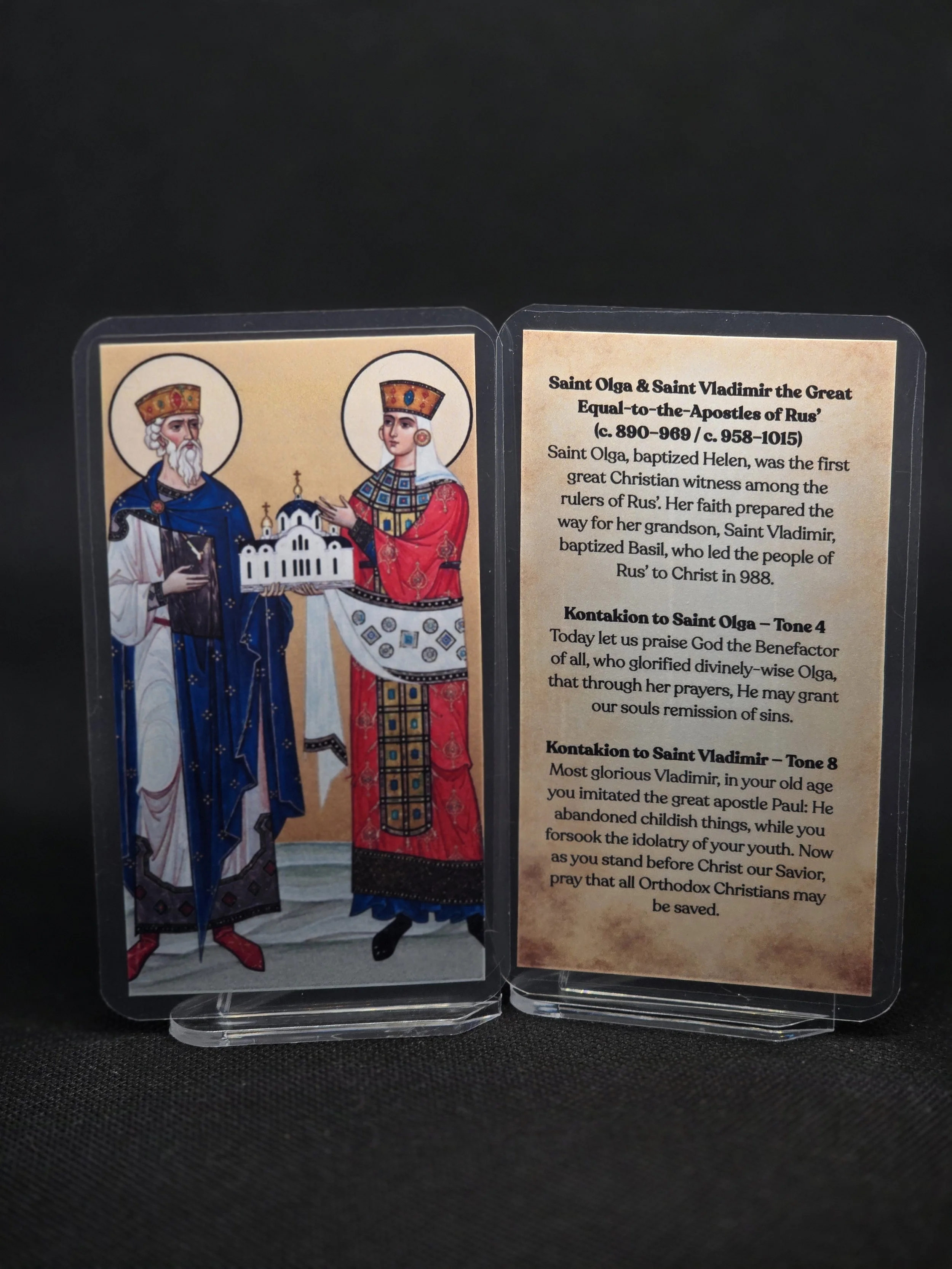
Baptizing Rus and Building in Kyiv
The Primary Chronicle says that Vladimir ordered the pagan idols thrown down, sent the people of Kyiv to be baptized in the Dnieper, appointed priests and founded churches. It also says that he took children from good families to be taught to read. The details come from a Christian chronicler with a purpose, but the broad picture of a state-sponsored conversion is secure.
The Church of the Tithes in Kyiv, dedicated to the Mother of God, was built between 989 and 996, according to the Encyclopedia of Ukraine. Vladimir gave a tenth of his income to support it, and it became a center of worship and a burial place for the dynasty. The church was destroyed in the Mongol conquest of Kyiv in 1240.
The new faith tied Kyiv to Constantinople. It brought clergy, church music, icons and the Slavonic books that became the base of a Christian literature in the region. Within a generation of Vladimir's death, Metropolitan Hilarion was preaching a sermon in praise of him as the baptizer of the land.
Olga's work was different. Her best attested achievement was administrative. The chronicle credits her with fixing tribute and setting up collection centers called pogosts, so that the dangerous raids that had killed her husband were replaced by a more orderly system. Later accounts credit her with building churches and giving to the poor, but individual foundations cannot be verified. No writings by either saint have been authenticated, and the prayers and speeches in the chronicles are literary transmissions.
Violence, Coercion and Honest History
A fair account cannot make these two into plaster saints. Olga's rule began in bloodshed, and the chronicle presents her as ruthless in defending her dynasty. The revenge stories belong to the account of her life before baptism, and they are not the source of her later reputation for holiness.
Vladimir also used violence before his baptism. The record includes the war against his half-brothers, the killing of Yaropolk and, in the chronicle tradition, the forced marriage of Rogneda. His later Christian policy does not erase these deeds, and the saint's life is better understood as a conversion from them than as a life that never had them.
There was coercion in the conversion of Rus. The chronicle stresses the willingness of the people of Kyiv, but it also has Vladimir warning that anyone who failed to come to the river would be an enemy of the prince. In the wider lands, the new faith spread slowly, and not always peacefully. Pagan customs lasted for generations and mixed with the new religion.
The political setting also matters. The conversion happened within a web of interests that included the Byzantine emperor, the trade routes of eastern Europe and the rivalry of the princes. To say so does not deny the sincerity of the saints. It simply keeps their story attached to the world in which they lived.
Death, Relics and Burial
Olga died on 11 July 969. The chronicle says that she was buried as a Christian. Later accounts state that Vladimir moved her remains to the Church of the Tithes. TRADITION: Jacob the Monk says that her body was found incorrupt and could be seen through an opening in the tomb by believers. This is early evidence of devotion, but it is not a scientific confirmation. After the destruction of the church in 1240, her original relics can no longer be firmly identified.
Vladimir died on 15 July 1015 at Berestovo near Kyiv and was buried at the Church of the Tithes. His death was followed by a bitter struggle among his sons, in which Saints Boris and Gleb were killed.
TRADITION: relics attributed to Vladimir were said to have been recovered in the excavations connected with Metropolitan Petro Mohyla in 1635. Their identification cannot be considered established, and a reader should treat any particular relic with care.
In both cases the physical record is thin. The saints live in the memory of the Churches that sing their feasts, and not in a chain of documented relics.
The Revenge Stories and Other Legends
Several of the best known stories about Olga and Vladimir come from the chronicle and are marked TRADITION here.
TRADITION: Olga's revenge on the Drevlians. After the murder of Igor, the chronicle tells of Olga burying one embassy alive in its boat, burning another delegation in a bathhouse and arranging the killing of a great number of men at a funeral feast. At the siege of Iskorosten she is said to have asked for pigeons and sparrows as tribute and to have tied burning material to them so that they set the town on fire. Historians find a plausible core in Igor's death and the subjection of the Drevlians, but they read the episodes as a mixture of folklore, pagan funeral rites and dynastic storytelling, not as eyewitness history.
TRADITION: Olga's incorrupt body, as described above, belongs to the devotional literature and not to contemporary independent testimony.
TRADITION: Vladimir's blindness and healing at Korsun is told as a sign of both bodily cure and spiritual enlightenment, and it cannot be verified as a historical event.
The chronicle also says that after his baptism Vladimir became generous to the poor and ordered food and drink to be carried through the city for those who could not come. These stories are meant to present a model Christian prince. They may reflect real charity, but they should be read in the light of the chronicler's aims.
Saints Without a Canonization Date
Neither Olga nor Vladimir was recognized through the modern process of beatification followed by canonization. Their veneration grew in the medieval Church of Kyiv. The Encyclopedia of Ukraine dates the recognition of Olga to the first half of the thirteenth century and places the canonization of Vladimir after 1240, with an established feast by 1263. UNCERTAIN: no formal decree or ceremony has been identified for either, and scholars such as John Fennell have stressed how weak the surviving evidence is for the date of Olga's recognition.
Early writers helped to prepare the way. Metropolitan Hilarion praised Vladimir in the eleventh century, and Jacob the Monk wrote of Olga with warmth. Over time their commemorations entered the liturgical calendar of the Church of Kyiv.
Both are honored in the Orthodox Churches and in the Eastern Catholic Churches. The Ukrainian Greek Catholic Church includes both in its calendar. In 1988, in the apostolic letter Euntes in Mundum for the millennium of the Baptism of Kyivan Rus, Pope John Paul II recalled the place of Olga and Vladimir in the common Christian heritage. Their feasts are not a universal observance of the Roman Rite.
Their patronage has grown through use. They are invoked by converts, by widows, by Christian rulers and by those who pray for the peace of the lands that came from the baptism of Rus.
Lord Jesus Christ, you called Olga and Vladimir out of darkness and made them lights for the people of Rus. Turn the hearts of all who are far from you, as you turned theirs. Heal the lands that share their baptism, and give peace to rulers and to peoples. Teach the strong to use power with mercy, and teach the weak to hope in you. Through the prayers of your holy servants, Equal to the Apostles, lead us all to your kingdom. Amen.
This short prayer was written for this page. It is not an official liturgical text. The traditional troparia for these saints are found in the liturgical books of the Orthodox and Eastern Catholic Churches.
Why Olga and Vladimir Matter to Eastern Christians
For Orthodox and Eastern Catholics, Olga and Vladimir stand near the source of their Christian life. Olga is remembered as the first great Christian witness among the rulers of Kyiv, and Vladimir as the prince who opened the way for the faith of a whole people. The two feasts, on 11 July and 15 July, fall within days of each other and are kept with hymns that call them Equal to the Apostles.
There are authentic liturgical hymns for both. A troparion in the first tone is sung for Olga and a troparion in the fourth tone for Vladimir, and English translations are published by the Orthodox Church in America. We do not reprint them here, and readers are urged to take them from the Church's own books.
The Ukrainian Greek Catholic Church links its own identity with the baptism of Rus and counts Olga and Vladimir among its saints. Pope Benedict XVI also spoke of this heritage in his 2006 letter to the Ukrainian Greek Catholic Church. Orthodox Christians in Ukraine, Belarus and Russia likewise honor the two as the founders of their Christian history.
The story also carries a warning. A Christian heritage that begins in baptism and in the decisions of a ruler is mixed with politics, force and human weakness, and the Church remembers it with gratitude and also with honesty. Olga and Vladimir are saints not because their lives were gentle, but because the Lord brought them from violence to faith and used them to bring many others to him.
Frequently Asked Questions
Equal to the Apostles
Olga and Vladimir remind us that the Gospel can reach a people through the conversion of one grandmother and one prince, and that God can use even a violent past. Visit the prayer card page to bring their intercession into your home.
View Prayer Card