Servant of God Fabijan Abrantovich: Marian Priest and Archimandrite of the Harbin Mission
A Belarusian priest and Marian Father who led a Byzantine rite Catholic mission among Russian exiles in China, was arrested by the Soviets in 1939, and died in Moscow's Butyrka Prison in 1946.
At a Glance
- Born
- September 14, 1884, near Navahrudak, then in the Russian Empire (now Belarus). The exact birthplace and an alternative date of November 14 are UNCERTAIN.
- Died
- January 2, 1946, in Butyrka Prison, Moscow, according to his congregation
- Status
- Servant of God. He has not been beatified, so the title Blessed is not correct.
- Role
- Priest, philosophy professor, Marian Father, archimandrite and head of the Russian Byzantine rite Catholic mission in Harbin
- Commemoration
- January 2 is the anniversary of his death. No approved liturgical feast exists.
- Cause
- Approved in an expanded Marian cause on February 9, 2021, with four companions
- Who Was Fabijan Abrantovich?
- Early Life and Education
- Priest and Professor in Saint Petersburg and Minsk
- Entering the Marian Fathers
- Appointed to Harbin
- Building the Harbin Mission
- Return to Europe and Arrest
- Prison, Sentence and Death
- His Cause for Beatification
- Fabijan Abrantovich and the Eastern Churches
- Frequently Asked Questions
Who Was Fabijan Abrantovich?
Fabijan Abrantovich, often written Fabian Abrantowicz, was a Belarusian Catholic priest of the twentieth century. He taught philosophy, helped to rebuild Catholic church life after the Russian Revolution, joined the Marian Fathers of the Immaculate Conception, and then spent more than a decade leading a small Catholic mission for Russian exiles in the Chinese city of Harbin. That mission used the Byzantine Slavonic liturgy, even though he himself had been raised and ordained in the Latin tradition.
In 1939 he left Harbin for what was meant to be a visit to Europe. The outbreak of the Second World War and the Soviet occupation of eastern Poland trapped him. He was arrested by the NKVD in October 1939, held in Lviv and later in Moscow, and died in Butyrka Prison on January 2, 1946, after years of interrogation and confinement.
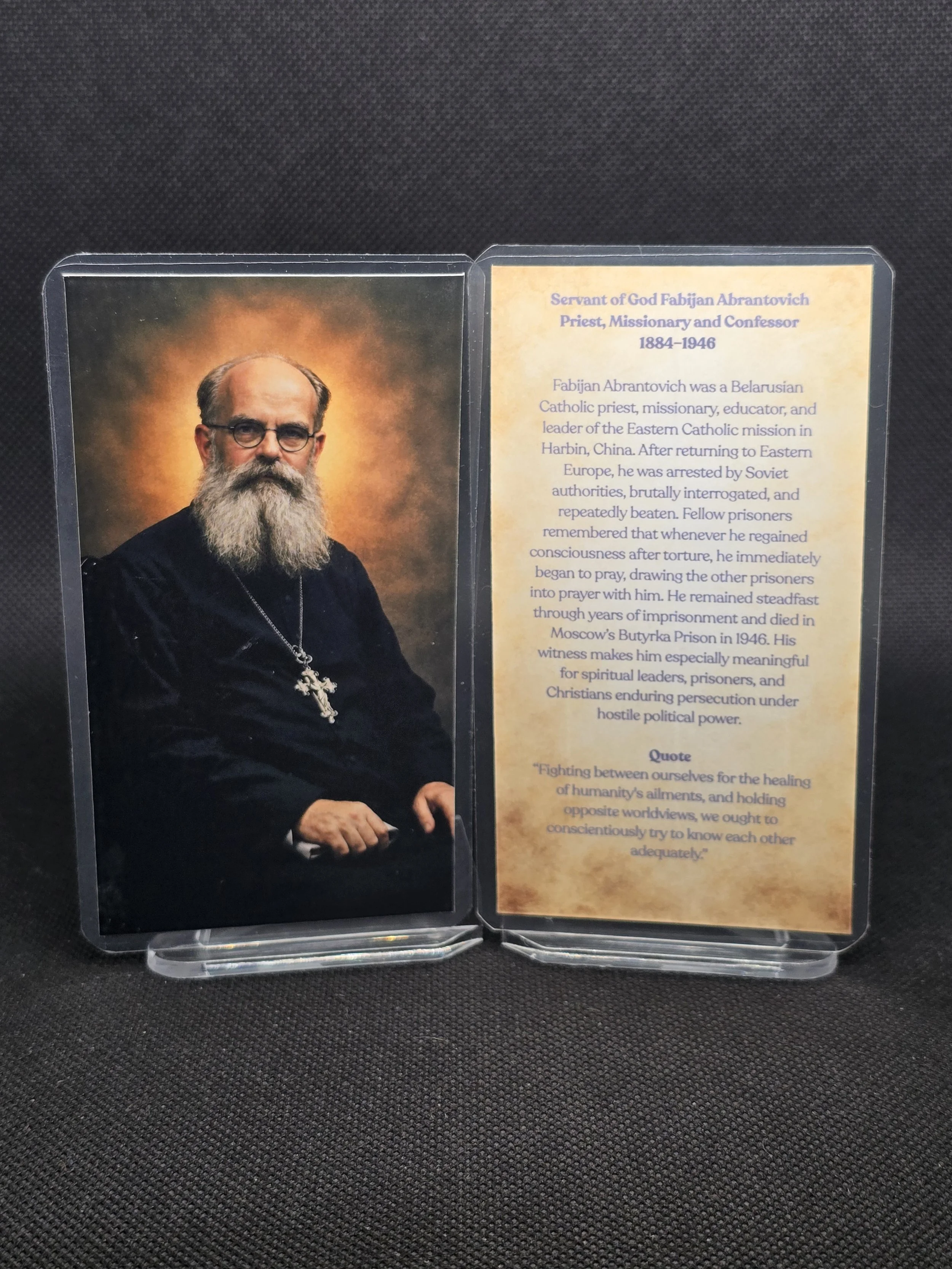
The Church officially calls him a Servant of God. This means his cause for beatification has been opened and accepted for study. It does not mean he has been declared Blessed or Saint. The prayer card in our collection uses the older wording, but this article follows the documented status and uses Servant of God throughout.
Early Life and Education
Abrantovich was born on September 14, 1884, into a Belarusian Catholic family in the region around Navahrudak, which was then part of the Russian Empire. Some sources name the town of Navahrudak itself, while a Polish martyrological record points to a settlement called Wereszkowszczyzna nearby. The exact place is UNCERTAIN. That same record gives November 14 as an alternative birth date, but September 14 is the date used by his congregation and by most reference works. His father is recorded as Jan. Little else is reliably known about his parents, his siblings or his childhood.
His formal education took place in the Catholic institutions of Saint Petersburg, the capital of the empire and the center of Catholic higher studies for the Russian lands. According to the Book of Remembrance published by the University of Notre Dame, he finished the theological seminary in 1906 and was ordained a priest on November 9, 1908. He then completed studies at the Saint Petersburg theological academy in 1910 with a master's degree in theology.
He continued abroad at the Catholic University of Louvain in Belgium, where he earned a doctorate in philosophy in 1914. This training prepared him for a life of teaching and church administration, and it shows that he was one of the better educated Belarusian priests of his generation.
Priest and Professor in Saint Petersburg and Minsk
After his ordination Abrantovich worked in Saint Petersburg, including at the parish of Saint Catherine, and taught philosophy at the theological academy. These were difficult years. The Russian Empire placed legal limits on Catholic life, the First World War scattered clergy and students, and the revolution of 1917 soon brought a government openly hostile to religion.
In 1918 Bishop Zygmunt Lozinski entrusted him with the leadership of the newly established seminary of the Diocese of Minsk. The seminary was meant to prepare priests for Belarus at a moment when the region was divided by war between Russia, Poland and several short lived national governments. Its work was repeatedly interrupted by the instability of the time.
During the early 1920s he served in the Navahrudak and Pinsk areas in a series of administrative roles. His congregation records that he acted as a tribunal judge, examiner, censor of religious publications, diocesan administrator and vicar general. These offices gave him wide experience of how a diocese actually functions, and that experience mattered later when he had to build a new church jurisdiction from almost nothing.
Entering the Marian Fathers
In 1926 Abrantovich entered the Congregation of Marian Fathers of the Immaculate Conception at Druya, a house that was important for Belarusian Catholic intellectual and pastoral life. The Marians were then a small community that had survived near extinction and was being renewed in the years after the First World War.
A detailed Polish martyrological compilation dates his first vows to August 3, 1927, and his perpetual vows to August 3, 1930. These profession dates come from that secondary source and we have not seen the original registers, so readers should treat them with some care.
Entering religious life was a significant step for a man who already held senior diocesan offices. It suggests that he wanted a more disciplined communal life, and it placed him under the obedience of superiors who would soon ask him to leave his homeland for a very different task.
Appointed to Harbin
Harbin, in Manchuria, had become one of the main centers of Russian emigration after the revolution and the civil war. Thousands of Russians lived there, with their own Orthodox churches, schools and newspapers. The Holy See wished to provide a Catholic pastoral structure for those Russians who were Catholic or who might come into communion with Rome, and it wished this structure to follow the Byzantine Slavonic liturgical tradition rather than the Latin rite.
In 1928 Pope Pius XI named Abrantovich archimandrite and ordinary of this jurisdiction. The sources give slightly different dates. The Marian Fathers report a nomination on May 5, 1928, while Catholic-Hierarchy lists the erection of the jurisdiction on May 20 and his appointment on May 31. This is UNCERTAIN until the original Roman documents are consulted. It is important to note that an archimandrite is an Eastern monastic and clerical title. He was a priest and not a bishop.
A historical study of Bishop Ceslaus Sipovich suggests that Abrantovich had reservations about the appointment, and that Belarusian Marians disagreed with their superiors about whether their small community should serve Belarusians or Russians. Some interpretations go further and see church politics behind the choice. That is an interpretation of letters, not an established fact. What is clear is that he accepted the task and carried it out.
Building the Harbin Mission
The mission began with very little. Money was short and communication with Rome was slow. According to the Marian Fathers, an orphanage and school for Russian boys was started about a year after his appointment, and it later grew into the Saint Nicholas school. He also supported the work of the Ursuline Sisters and the Franciscan Sisters, and a minor seminary dedicated to Saint Charles Borromeo.
His ministry was not limited to Byzantine rite Catholics. The Marian Fathers state that he also cared for Orthodox Russians, many of whom first met the mission through its schools and charities. From about 1930 to 1932 he additionally had responsibility for Latin rite Catholics in the area. He supported Catholic publishing, and Notre Dame records that he issued a periodical, although the precise bibliographic details of each publication need further checking.
Notre Dame also lists two philosophical and theological writings attributed to him under titles translated as God and Man. We have not been able to verify their original titles or editions, so we do not describe them as published books. Scholarly work on the Harbin exarchate, for example a 2024 study by Nikolai Chirkov, treats it as a distinctive religious, educational and charitable institution among the Russian emigration. After Abrantovich, the mission passed to his fellow Marian Andrzej Cikoto, and it was closed by the communist authorities in 1948, long after his arrest.
Return to Europe and Arrest
In April 1939 Abrantovich travelled to Rome and took part in a general chapter of the Marian Fathers. Later that year he went to Poland to visit relatives. The German invasion on September 1 and the Soviet entry into eastern Poland a few weeks later made it impossible to return to Harbin.
He went to Lviv, where he sought contact with Metropolitan Andrey Sheptytsky and Josyf Slipyj of the Ukrainian Greek Catholic Church. After a period of illness and hospital care, he tried to cross into the German occupied zone. German border guards detained him near Rawa Ruska and handed him over to the Soviets.
On October 22, 1939, the NKVD arrested him and took him to Lviv for interrogation. He was accused of espionage and anti Soviet activity. The sources do not substantiate the espionage charge. His earlier Belarusian public involvement and his opposition to communism are documented, and these appear to have been treated as evidence against him. Notre Dame summarizes his investigative file and reports that he complained of physical pressure and of statements signed under coercion. The file records that he refused to admit guilt.
Prison, Sentence and Death
In January 1941 he was moved to Moscow and held in Butyrka Prison, where he faced further interrogation. The date of his sentence is disputed. The Marian circular letter of 2021 gives April 23, 1942, and describes a sentence of ten years of forced labor in Kazakhstan. Notre Dame and the Polish martyrological record give September 23, 1942. The later date is more consistent with the rest of the file, but the original proceedings should be consulted before the question is closed.
He was assigned to the labor camp system at Karaganda, but there is no reliable evidence that he ever reached it. Why he remained in Moscow is UNCERTAIN. Failing health is one suggested reason.
The Marian Fathers, Catholic-Hierarchy and Notre Dame agree that he died on January 2, 1946, in Butyrka Prison. His congregation describes the death with the Latin phrase ex aerumnis carceris, meaning from the hardships of prison. The immediate medical cause has not been established from any authenticated certificate. His burial place is unknown, and no relics have been identified. Some older statements place his death in Marijampole, Lithuania, or in a Kazakh camp. These are not supported by the sources we have examined.
His Cause for Beatification
On May 31, 2003, Abrantovich was included in a collective investigation opened in Saint Petersburg for victims of communist persecution, together with other Marian priests. On January 4, 2019, the Marians decided to withdraw their candidates from that process so that their causes could proceed separately under the Archdiocese of Warsaw. On February 9, 2021, the Congregation for the Causes of Saints approved the expanded cause that covers Abrantovich and four companions: Andrzej Cikoto, Eugeniusz Kulesza, Janis Mendriks and Vladislovas Mazonas.
The Marian Fathers regard him as a martyr and are working toward a formal recognition of his martyrdom. We have found no decree that grants this recognition and no beatification. No miracle has been documented, though a miracle is not required when the Church recognizes martyrdom itself. For this reason the correct title is Servant of God, and Church law reserves public veneration for those who have been formally declared Blessed or Saint. Private prayer for his beatification is encouraged by his congregation.
Stories of his last conversations or of marvels in prison circulate in some places, but we have found no identifiable contemporary testimony for them. We mark them UNCERTAIN and do not repeat them here.
Lord Jesus Christ, shepherd of the scattered, you were with your servant Fabijan in the schools of Harbin and in the cells of Lviv and Moscow. Give us a share of his patience and fidelity when we are far from home, misunderstood or unjustly judged. Comfort all who are held in prison for their faith. Bring us to your peace, and if it is your will, let your Church recognize the witness of your servant. Amen.
This is a short original prayer written for this page. It is not an official prayer of the Church. The Marian Fathers publish their own prayer for the beatification of Abrantovich and his companions.
Fabijan Abrantovich and the Eastern Churches
Abrantovich was born into the Latin tradition and was never a convert from Orthodoxy. His connection to the Eastern Churches came through his mission. In Harbin he led a Catholic community that used the Byzantine Slavonic liturgy and served Russians in their own church culture, which shows that communion with Rome does not require Latin worship. For Eastern Catholics he is an example of a small and often forgotten Russian Byzantine Catholic tradition, one that existed far from its homeland.
Orthodox readers should know that the mission was part of a Catholic effort to bring Russians into communion with Rome, and many Orthodox understandably saw this as a rivalry. He was not an Orthodox hierarch, and Orthodox Churches have never recognized him as a saint. It is fair to add that he and many Orthodox Christians of his time suffered under the same Soviet system, which persecuted all religion. We do not claim any formal Eastern liturgical commemoration for him. January 2 is simply the anniversary of his death.
Frequently Asked Questions
Remember the Prisoners
Fabijan Abrantovich lived across borders, rites and prisons, and kept to his vocation. Keep his prayer card as a reminder to pray for Christians who suffer for their faith.
View Prayer Card