Saint Isidore the Farmer and Blessed Maria de la Cabeza: Married Saints of Madrid and Patrons of Farmers
A laborer and his wife in medieval Madrid, remembered for prayer, charity and honest work, and honored by the Church as models of holiness in marriage and in the fields.
At a Glance
- Isidore born
- About 1070 to 1082 in Madrid. The exact year is UNCERTAIN.
- Isidore died
- Traditionally May 15, 1130, in Madrid. Some accounts give the 1170s, which is UNCERTAIN.
- Feasts
- Isidore, May 15. Maria de la Cabeza, September 9 in Madrid.
- Recognition
- Isidore beatified May 2, 1619 and canonized March 12, 1622. Maria's cult was confirmed August 11, 1697.
- Patronage
- Farmers, agricultural workers and the city of Madrid. Invoked for rain and good harvests.
- Maria's title
- Blessed in the Holy See's records, though often called Saint in Madrid. Her status is explained below.
- Who Were Isidore and Maria?
- Early Life and Family
- A Life of Prayer at Work
- Work, Charity and Daily Life
- Trials and Historical Context
- Death, Relics and Canonization
- Miracles and Traditions
- Patrons of Farmers and of Madrid
- Prayer, Marriage and Work Today
- Isidore, Maria and the Eastern Churches
- Frequently Asked Questions
Who Were Isidore and Maria?
Isidore the Farmer, known in Spanish as San Isidro Labrador, was a married Christian farm worker who lived in Madrid in the eleventh and twelfth centuries. He had no office in the Church and wrote nothing. He is honored because he joined constant prayer to ordinary labor, treated the poor and even animals with kindness, and kept a faithful household. Pope Gregory XV canonized him on March 12, 1622, and he is the patron of Madrid and of farmers.
His wife is remembered as Maria Toribia, and the people of Madrid call her Santa Maria de la Cabeza. She shared his life of charity and, according to tradition, tended a chapel dedicated to the Virgin Mary near the Jarama River. The Church confirmed her long public veneration in 1697.
Both stories reach us through writers who lived much later than the couple. The oldest long account, the Latin Life of San Isidro, is usually dated to the later thirteenth century. This article tells what the sources say and marks anything uncertain or legendary, so the reader can see where history ends and devotion begins.
Early Life and Family
Madrid is the traditional birthplace of Isidore, but the exact year is UNCERTAIN. The Dicastery for the Causes of Saints gives about 1070, Vatican City State gives about 1080, and local Madrid tradition names 1082. The fuller name Isidro de Merlo y Quintana appears in later writings, and its authenticity is UNCERTAIN as well. He is described as the child of poor Christian workers, and some writers call the family Mozarabic, meaning Christians who had lived under Muslim rule in the Iberian peninsula.
According to the received biography, Isidore lost his parents young and began to work the land early. We cannot confirm these details from documents of his own time. Tradition also says that military unrest, linked by later authors to the Almoravid campaigns, led him to move for a time to Torrelaguna north of Madrid. This is plausible for the period, but his movements cannot be reconstructed.
There he is said to have married Maria Toribia. The medieval Life clearly describes Isidore as a married man who supported his household, but it does not give his wife's name. The firm identification of that wife as Maria Toribia appears in writers of the late sixteenth century such as Alonso de Villegas and Lope de Vega. This does not prove the name was invented, only that the earliest surviving text is less specific than later biographies. Their son is traditionally called Illan, and little else about him is certain.
A Life of Prayer at Work
There is no conversion story in the sources. Isidore is presented as a Christian from childhood, and his calling was neither priestly nor monastic. He pursued holiness through farming, marriage, charity and regular worship. He is said to have visited church before beginning his day, and the medieval Life records that other workers accused him of arriving late to the fields because of his prayers.
The account does not praise idleness. Isidore answers patiently and offers to repay his employer for any loss. The point of the story is that a hard working Christian can be misunderstood for his devotion. The author also ties his labor to the words of Genesis about earning bread by the sweat of one's brow.
Maria is remembered for her service to the poor, her devotion to the Virgin Mary and her care for the household. A later tradition holds that the couple lived apart for a time by mutual agreement while Maria looked after the chapel near the Jarama. The circumstances and dates of this are UNCERTAIN. It does not mean that the marriage ended or that Maria joined a religious order. Neither of them founded a community or held a Church office.
Work, Charity and Daily Life
Isidore worked on an estate near Madrid. Tradition names his employer as Juan de Vargas, but the oldest Life describes him only as a knight and landowner, so the name is a long standing tradition and not a proven fact. Some Madrid historians also call Isidore a well digger, which fits a city that depended on reliable water, though no particular well can be documented.
The medieval Life shows his character through small scenes. He shared grain with hungry birds on the way to the mill. He gave food to the poor, and he belonged to a religious confraternity. These stories were written to teach generosity, and they were later told again in sermons and art. Maria is shown helping with the same charity, and a story of food appearing in an empty pot belongs to the earliest layer of the tradition.
No writings by Isidore or Maria are known, and no foundation can be credited to them. Their witness lies in how they lived. They show that sanctity does not require a cloister, and that a poor couple with a small household and a hard job can be great in the eyes of God.
Trials and Historical Context
Isidore lived on a frontier. Madrid was then a small town in a region where Christian kingdoms and Muslim dynasties struggled for control, and borders and rulers changed several times in the period linked to his life. This is the background for later stories about his move to Torrelaguna.
The main trial in the oldest Life is personal. A suspicious employer, and coworkers who resented his piety, tested his patience. The story stresses that he kept doing his work well and answered without bitterness.
Maria's trial comes from later writers. They tell that gossip made people doubt her faithfulness and that she proved her innocence by crossing the flooded Jarama on her cloak. TRADITION: this story appears in Alonso de Villegas's Vida de Isidro Labrador in 1592 and Lope de Vega's El Isidro in 1599, according to the Archdiocese of Madrid. It does not show that the couple actually quarreled, and it is not found in the thirteenth century Life. A wider question for historians is how closely the detailed later biographies match the real medieval couple, since the earliest sources are short.
Death, Relics and Canonization
The Life says that Isidore received the sacraments, arranged his few possessions, advised his family and died peacefully. He was buried in the cemetery of the church of Saint Andrew in Madrid. The traditional date is May 15, 1130, which is the date favored by the Dicastery for the Causes of Saints. Other sources give 1170 or 1172, so the year is UNCERTAIN. TRADITION: about forty years after his burial his body was found unusually preserved, and it was moved into the church.
In November 2022 the Archdiocese of Madrid announced the results of a forensic study of remains traditionally identified as his. The study estimated that the man died between about thirty five and forty five years of age. That is much younger than the age of about ninety found in later biographies, and it fits better with the earlier death date. It does not by itself prove the identity of the remains.
Pope Paul V beatified Isidore on May 2, 1619. On March 12, 1622, Pope Gregory XV canonized him at Saint Peter's in Rome, on the same day as Ignatius of Loyola, Francis Xavier, Teresa of Avila and Philip Neri. Maria's path was different. Pope Innocent XII confirmed her long standing cult on August 11, 1697, and Pope Benedict XIV later allowed a Mass and Office in her honor in 1752. The sources disagree on the exact date of that second decree. The Holy See lists her as Blessed, while Madrid usually calls her Saint. We know of no separate canonization ceremony for her, so Blessed is the safest title. Their relics are traditionally kept in Madrid, and the church of San Isidro has long been the center of devotion.
Miracles and Traditions
The stories below belong to tradition. They show how the faithful understood the couple, but they cannot be tested by history. TRADITION: the oldest Life tells that Isidore's employer saw extra white oxen and helpers plowing beside him, and that they vanished when he came near. The English translation by Kenneth Baxter Wolf speaks of divine help without naming angels. The familiar picture of angels guiding the plow is the later reading of the story.
TRADITION: the best known tale in Madrid is that their son Illan fell into a deep well, that the parents prayed, and that the water rose and carried the boy up alive. It appears in later devotional books and in paintings, but it is not in the medieval Life we examined, so its historicity is UNCERTAIN.
TRADITION: food in an empty pot, flour that did not run out after Isidore shared grain with doves, and a spring of water from dry ground are also told. The Life also records processions with his relics in times of drought, including one in 1275, which shows genuine medieval devotion even though it does not prove a miracle. Maria's cloak crossing of the river belongs to the later literature, as noted above.
Patrons of Farmers and of Madrid
Isidore is the patron of Madrid, and his feast on May 15 is the great festival of the city. He is also honored by farmers and by agricultural communities around the world, and people invoke him for rain in drought and for a good harvest. Rural Catholic organizations have long used the Litany of Saint Isidore, published in The Rural Life Prayerbook in 1956 by the National Catholic Rural Life Conference.
In Spain and in many Spanish speaking countries, farmers still carry his image in processions and bless their fields on his feast. Maria is invoked for families, for rural households and, in some places, for rain. Her feast is kept in Madrid on September 9. September 8 is the traditional date of her death in some accounts, and it is also the feast of the Nativity of the Virgin Mary, which is why the two should not be confused.
The couple speaks to anyone who thinks the spiritual life belongs to monks and priests. They were poor, they worked hard and they raised a family, and the Church holds them up as proof that ordinary work and married love can be the road to heaven.
Prayer, Marriage and Work Today
A reader can learn three simple things from the couple. First, work becomes prayer when it is offered to God and done well. Second, charity is not limited by poverty, since both spouses gave what little they had. Third, a marriage is a shared path to holiness, with each person helping the other toward God.
In practice, many Catholic families use the feast of Saint Isidore to bless seeds, tools or gardens. Farmers and gardeners often keep an image of him in the barn or the kitchen. Couples sometimes pray to the two together for patience with each other, and for the grace to be generous at home.
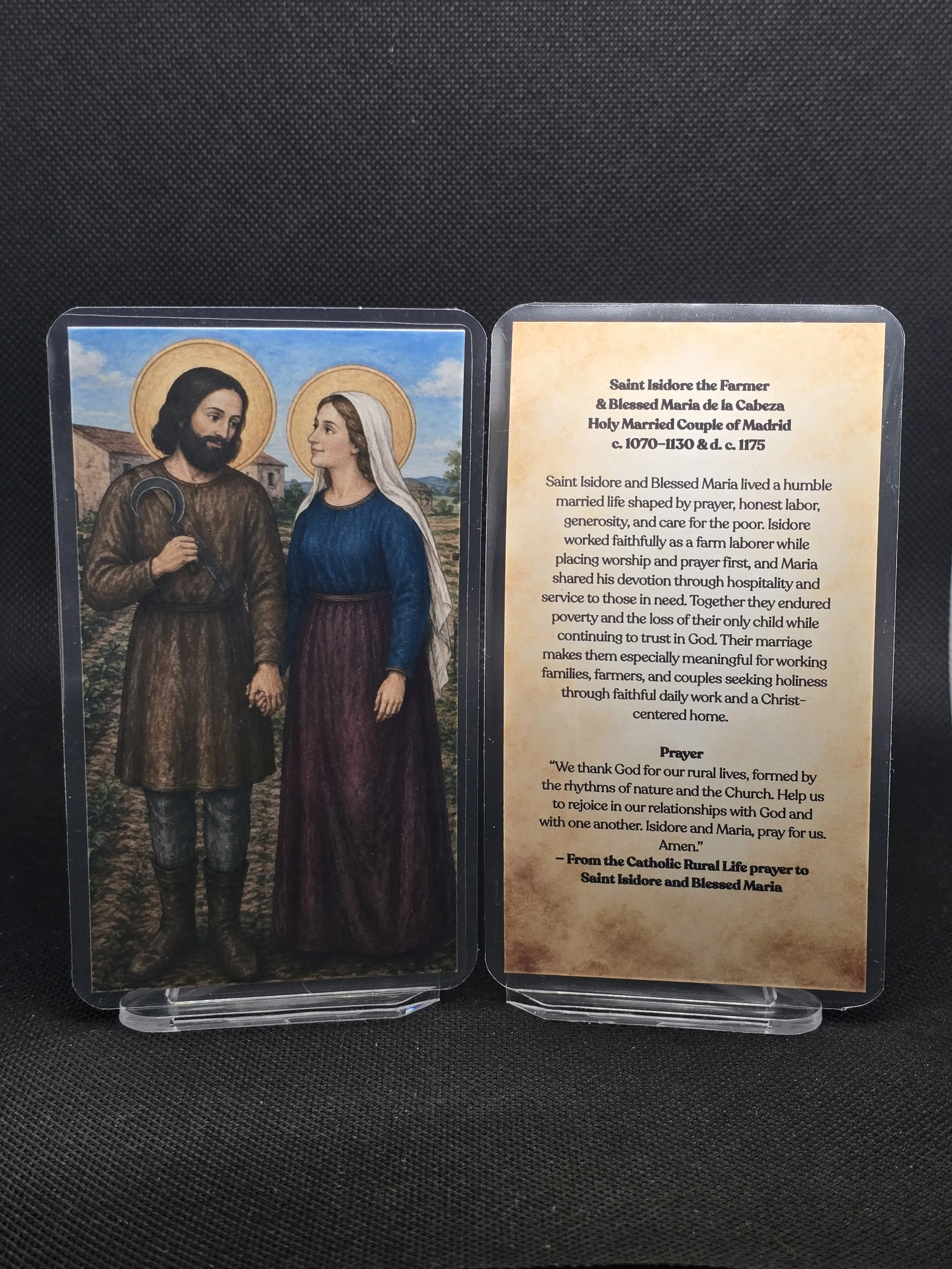
The prayer card on this page is made for that kind of daily devotion, and it can be placed in a farm office, a family kitchen or a prayer corner at home.
Lord God, giver of the harvest, you taught Saint Isidore and Blessed Maria to find you in prayer, in labor and in kindness to the poor. Bless the fields and the hands that work them. Give rain in time of drought and patience in time of loss. Make our homes places of generosity, and make our work an offering to you. Through the prayers of your servants, bring us to the table of your kingdom. Amen.
This is a short original prayer written for this page. It is not an official prayer of the Church. A traditional Litany of Saint Isidore appears in The Rural Life Prayerbook.
Isidore, Maria and the Eastern Churches
Isidore and Maria are Latin saints of Spain. We found no official Orthodox glorification of either of them, no established Byzantine troparion and no shared feast in an Orthodox calendar, so we do not claim one. Eastern Catholics may honor Isidore as a canonized saint of the Catholic Church, though his feast is not found in every Eastern Catholic calendar.
Even so, the themes of their lives are familiar to Eastern Christians. The Eastern tradition has long honored married saints, the blessing of fields and the idea that ordinary labor can be offered to God. A reader from the Eastern Churches can appreciate the couple as an example of Christian marriage and honest work, while remembering that their veneration belongs to the Latin tradition.
Frequently Asked Questions
Work and Pray
Isidore and Maria show that holiness can grow in a field, a kitchen and a small house. Keep their prayer card where you work or pray.
View Prayer Card