Saint Chrysanthus and Saint Daria: Roman Martyrs and Married Couple of the Early Church
Two ancient Roman martyrs, remembered as a husband and wife who shared one faith, whose cult is certain even though their famous story comes from a much later account.
At a Glance
- Lived
- Late third century Rome, traditionally. The date, about 283 or later, is UNCERTAIN.
- Died
- As martyrs at Rome. The method, burial alive in a sand pit, is TRADITION.
- Feasts
- October 25 in the Roman Martyrology. March 19 in the Byzantine calendar.
- Recognition
- Ancient martyr cult. No formal canonization date exists.
- Relics
- Venerated at Bad Munstereifel in Germany since 844, and claimed at Reggio Emilia in Italy.
- Patronage
- Associated with Reggio Emilia and Bad Munstereifel, and invoked as models of Christian marriage.
- Who Were Chrysanthus and Daria?
- Early Life and Family
- Conversion and the Chaste Marriage
- Teaching and Witness in Rome
- The Problem of the Date
- Martyrdom and Burial
- Pope Damasus, Gregory of Tours and the Relics
- Legends and Devotion
- Marriage as a Path to Holiness
- Chrysanthus and Daria in the Eastern Churches
- Frequently Asked Questions
Who Were Chrysanthus and Daria?
Chrysanthus and Daria are two martyrs of ancient Rome, honored together for more than fifteen hundred years. Their tomb on the Via Salaria Nova was a place of pilgrimage in late antiquity, and the Roman Martyrology and the Byzantine calendar both commemorate them. The Church remembers them as a husband and wife who helped one another toward Christ and died for the faith.
Their familiar biography comes from a text called the Passio of Chrysanthus and Daria, a martyrdom narrative written long after their deaths. Scholars regard it as a literary work whose details cannot be trusted as plain history. The existence of the martyrs and of their cult is much better supported than the details of their marriage, conversion, imprisonment and execution.
This article therefore keeps two things apart. What is historical is their veneration at a known burial site and in early records. What is tradition is the story of their lives. Where a detail belongs to the Passio or to later devotion, it is marked as TRADITION, and where the sources disagree it is marked UNCERTAIN.
Early Life and Family
TRADITION: the Passio says that Chrysanthus was the son of a wealthy pagan named Polemius, a senator or noble who came from Alexandria in Egypt and settled in Rome. The young man received a fine education in philosophy, literature and rhetoric, and he was restless with the answers that pagan thinkers gave about God.
TRADITION: Daria is described as an educated young woman brought from Athens to Rome. Some versions call her a priestess of Minerva, and others call her a Vestal virgin. These are different offices in Roman religion, and the disagreement is one reason scholars handle the account with care. The safe statement is that the tradition shows her as a learned woman connected with pagan worship.
UNCERTAIN: no Roman record, inscription or early biography confirms Polemius, his rank or the family origins in Alexandria and Athens. These details belong to the literary tradition. Likewise no document of the marriage survives, and no source proves that the couple had children.
Conversion and the Chaste Marriage
TRADITION: while studying in Rome, Chrysanthus found Christian writings and sought a teacher. He met a man named Carpophorus, who is called a priest in some accounts and a bishop in others, and who lived in hiding during a time of persecution. Carpophorus taught him and baptized him, and Chrysanthus began to profess the faith openly.
TRADITION: his father tried to bring him back to the old religion by confinement, argument and temptation, and failed. Polemius then arranged a marriage with Daria, hoping she would draw his son away from the faith. The Passio says the opposite happened. Chrysanthus explained the Gospel to Daria and she believed.
TRADITION: the couple agreed to live as brother and sister in Christ, and some versions say they later lived in separate houses while continuing to teach. Scholars note that this story fits familiar themes in late antique Christian writing, such as learning, debate and voluntary chastity. A 2015 study by Annelies Bossu and Danny Praet, titled A Marriage of Equals, examines how the Passio presents the two as spiritual and intellectual partners. The conversion story is spiritually coherent, but no independent source confirms it.
Teaching and Witness in Rome
TRADITION: after their conversion, the couple became active witnesses to the faith in Rome. Chrysanthus taught young men about purity and the rejection of idol worship, while Daria gathered women who wished to live a Christian life. The Passio says their influence became so great that the authorities feared the effect on young people and on traditional marriage.
TRADITION: during a punishment of Chrysanthus, a Roman tribune named Claudius is said to have seen signs of divine protection and to have become a Christian. His wife Hilaria and his sons Jason and Maurus are also said to have believed, and the narrative joins their martyrdoms to the larger story. The number of soldiers who suffered with them differs from text to text, so it should not be treated as a count.
These accounts do not show that the couple founded a monastery or a religious community, and later retellings that use monastic language should not be taken literally. No letters, sermons or other writings by Chrysanthus or Daria are known. The Passio is a text about them, and not a text by them.
The Problem of the Date
The traditional narrative places their deaths under the Emperor Numerian, who reigned from 283 to 284. This causes difficulties. Numerian was not in Rome during his short reign, and there is no secure evidence of a general persecution of Christians under him, in contrast to the persecutions under Decius, Valerian and Diocletian.
Some historians have suggested that Numerian's name entered the story by mistake and that the martyrdom belongs to the persecution of Valerian, which began in 257 and grew harsher in 258, as described by Eusebius in his Church History. That is a proposal and not a finding. Eusebius says nothing about Chrysanthus and Daria. Other scholarly reference works give a looser date near the end of the third century. The honest summary is that they were Roman martyrs of uncertain date, traditionally assigned to the late third century.
The Passio itself survives in Greek and Latin forms. The Catholic Encyclopedia of 1908 places its writing in the fifth century or later, while the New Catholic Encyclopedia suggests a Roman author in the sixth or seventh century. The exact date is still debated. The Bollandist scholars who edited the Acta Sanctorum saw these problems and still defended the ancient veneration of the martyrs themselves.
Martyrdom and Burial
TRADITION: after a series of torments, Chrysanthus and Daria were taken to an abandoned sand pit beside the Via Salaria and buried alive under earth and stones. Other versions speak of stoning. Reference works preserve the sand pit story as part of the Passio without presenting it as proven history.
The evidence for the burial place is stronger than the evidence for the execution. The martyrs were venerated on the Via Salaria Nova near the cemetery of Thraso, in a place linked to an arenarium, which was a sand quarry. The word does not mean a monastery, and it should not be confused with the whole system of Roman catacombs. Early pilgrim guides list their resting place.
TRADITION: the Passio and Gregory of Tours, in the sixth century, tell that Christians who gathered at the tomb to celebrate the Eucharist were trapped and killed when the entrance was sealed. The priest Diodorus and the deacon Marianus are named among them in the Orthodox account. Archaeology has not confirmed this, so it remains UNCERTAIN.
Pope Damasus, Gregory of Tours and the Relics
Pope Damasus, who led the Roman Church from 366 to 384, adorned many martyr shrines in Rome. Gregory of Tours reports in his Glory of the Martyrs, Book I, chapter 38, that Damasus decorated the shrine of Chrysanthus and Daria with an inscription. A text of such an inscription survives in manuscripts, but modern epigraphers, including Dennis Trout, think the transmitted poem was probably composed after the shrine was damaged and replaced an earlier Damasian one. For that reason we do not quote it as the work of Damasus. Gregory also tells of an opening through which pilgrims could look at the sacred remains, which shows the importance of the shrine in his day.
In 844, according to a translation narrative in the Acta Sanctorum, Abbot Markward of Prum obtained relics of the martyrs in Rome during the pontificate of Sergius II. They were taken to Prum and then to Munstereifel, now Bad Munstereifel, where a great church was dedicated to them. Regional German historical sources confirm the importance of this translation. The cathedral of Reggio Emilia in Italy also keeps relics traditionally identified with the saints and honors them as patrons of the city.
UNCERTAIN: how the relics in Germany and Italy relate to one another has not been settled. A record of a relic translation does not by itself prove the identity of every set of remains.
Legends and Devotion
The stories that follow come from hagiography and should be read as tradition. TRADITION: Daria was sentenced to a brothel to break her faith, and a lion came to guard her. In one version the beast subdued a man who approached her, and she taught him the faith. The story speaks of God's protection of purity and of the chance of repentance.
TRADITION: Chrysanthus was thrown into a pit of filth and was surrounded by light and a sweet fragrance instead of by decay. The episode is a picture of spiritual purity overcoming corruption. These miracles belong to the Passio and have no independent witness from the time of the martyrs.
The cult itself spread widely. Their veneration is especially tied to Bad Munstereifel in Germany and to Reggio Emilia in Italy, and people have long invoked them as models of Christian marriage. Their feast on October 25 appears in the Roman Martyrology. Medieval calendars preserve other dates too, such as August 12 and November 29 in some versions of the old martyrology, and the reason for the differences is not clear.
Marriage as a Path to Holiness
Whatever one decides about the details of the Passio, the couple stand for an idea that Christians have always valued. A husband and wife can help each other toward God, and they can bear witness together. The story shows Chrysanthus and Daria as equals who teach, console and strengthen one another, with neither one made a mere helper of the other.
The tradition of a chaste marriage should be marked as tradition. It reflects the ideals of virginity and renunciation that were strong in late antique Christian literature, and it is not meant to be a rule for married couples today. What remains useful is the picture of two people who share a faith, speak of Christ at home and are not afraid to suffer for him.
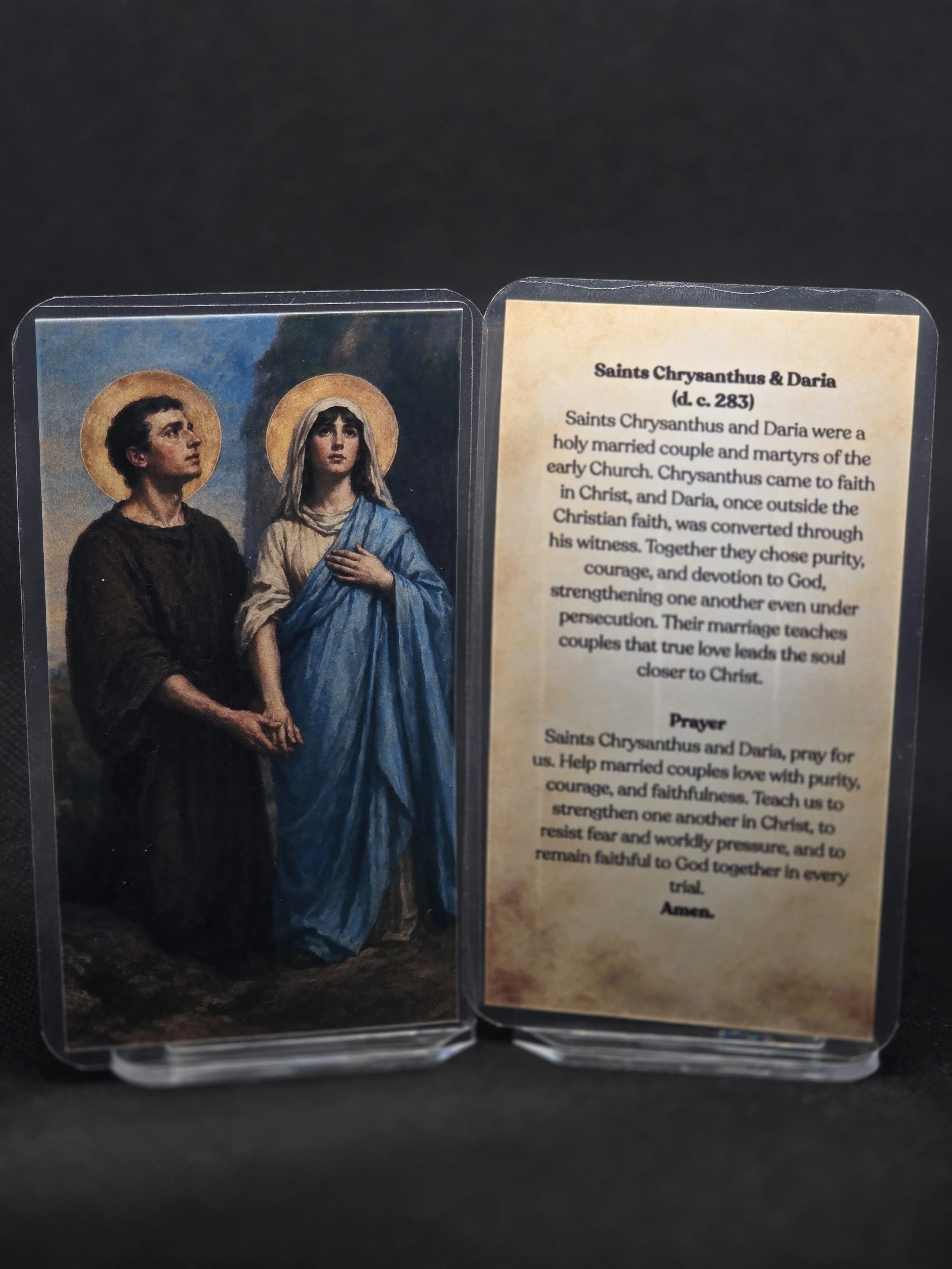
Families who keep their prayer card often place it near the marriage icon or a family prayer corner, and some couples ask the two martyrs for unity and courage in their married life.
Lord Jesus Christ, you gave your holy martyrs Chrysanthus and Daria courage to confess you together. Strengthen every husband and wife in faith, honesty and mutual love. Help them to pray at home, to forgive quickly and to stand firm in trials. Protect our families from fear and division. By the prayers of your martyrs, lead us all to your peace. Amen.
This is a short original prayer written for this page. It is not an official prayer of the Church. The Orthodox Church in America publishes the Byzantine troparion for March 19, and the Roman Missal has a collect for October 25.
Chrysanthus and Daria in the Eastern Churches
These martyrs belong to the shared heritage of the first centuries, before the division between East and West. The Roman Martyrology keeps them on October 25, and the Byzantine tradition keeps them on March 19. The Orthodox Church in America and the Greek Orthodox Archdiocese both preserve their memory with an account of their lives and with liturgical hymns for that day. The Eastern hymns honor the couple together, and Daria is not treated as a minor figure.
The difference between the two dates comes from separate developments in the Latin and Byzantine calendars, and not simply from the gap between the Julian and Gregorian calendars. Their marriage and chastity are tradition in both East and West. Readers can use their story to reflect on Christian marriage without being asked to take each episode of the Passio as literal history.
Frequently Asked Questions
Faith Shared at Home
Chrysanthus and Daria stand for a shared faith that begins in the home and faces trial together. Keep their prayer card as a reminder to pray with those you love.
View Prayer Card