Saint Dismas the Good Thief: The Penitent Thief Who Received the Promise of Paradise
The condemned man crucified beside Jesus, who asked to be remembered in his kingdom and heard the words that made him the patron of prisoners and the dying.
At a Glance
- Name
- Dismas is a later tradition from the Gospel of Nicodemus. The Gospels do not name him.
- Source
- Luke 23:39 to 43. Matthew and Mark mention the two men more briefly.
- Died
- By crucifixion beside Jesus at Golgotha, about 30 to 33 AD. The exact year is disputed.
- Feast
- March 25 in the Roman Martyrology. Eastern worship remembers him chiefly on Great and Holy Friday.
- Recognition
- No formal canonization. His holiness rests on the promise of Jesus in Luke 23:43.
- Patronage
- Prisoners, the condemned, repentant sinners and the dying
- Who Was Saint Dismas?
- What We Know of His Early Life
- The Conversion on the Cross
- His Witness in the Teaching of the Fathers
- Problems and Questions in the Gospel Accounts
- The Names Dismas, Gestas and the Others
- Feast Days, Relics and Recognition
- Patron of Prisoners and the Dying
- Prayer, Mercy and the Last Hour
- Dismas in the Eastern Churches
- Frequently Asked Questions
Who Was Saint Dismas?
Saint Dismas is the traditional name of the penitent thief crucified beside Jesus on Golgotha. The Gospel of Luke tells his story in five short verses. He rebuked the man who mocked Jesus, admitted that he and his companion were suffering justly, declared that Jesus had done nothing wrong, and asked to be remembered when Jesus came into his kingdom. Jesus answered that he would be with him that day in Paradise.
The Gospels do not give his name, and everything else the legends add is much later. The strongest biography of Dismas begins and ends with Luke. This article keeps three layers apart: what Scripture says, what the Fathers of the Church taught about it, and what later apocryphal books imagined. The last layer is marked as TRADITION, and details no source can support are marked UNCERTAIN.
Dismas matters because he is a picture of mercy at the last hour. He had no time for good works, a period of instruction or a sacrament, yet Christ received his faith. For that reason Catholics and Orthodox have long honored him, and prisoners and the dying look to him with special hope.
What We Know of His Early Life
Almost nothing can be said about Dismas before his execution. Luke calls the two men criminals. Matthew and Mark use a Greek word that can mean robbers, bandits or even insurgents, which leaves open violent theft or political resistance. There is no evidence that he was a Zealot or a leader of any rebellion. His birthplace, parents, family, occupation and religious upbringing are UNCERTAIN.
Luke 23:41 records his own confession that the punishment was deserved, so within the story he accepts responsibility for serious wrongdoing. The Gospel does not say what the crime was. Later accounts speak of theft, murder or raids on the Temple, and none of them can be verified.
TRADITION: the apocryphal Narrative of Joseph of Arimathea names the penitent thief Demas and describes him as a Galilean innkeeper who robbed the rich and helped the poor. Such details are not in the Gospels and should not be read as biography. There is also no reliable evidence that he ever met Jesus before Calvary.
The Conversion on the Cross
The turning point is in Luke 23. One of the criminals mocks Jesus and challenges him to save himself and them. The other answers by reminding him to fear God, since both are under the same sentence, and says that Jesus has done nothing wrong. Then he says to Jesus, in the words of the New American Bible, Revised Edition, "Jesus, remember me when you come into your Kingdom." Jesus replies, "Amen, I say to you, today you will be with me in Paradise."
The brief exchange contains four things. The man owns his guilt without excuses. He recognizes the innocence of Jesus. He calls the crucified Jesus a king with a kingdom beyond death. And he asks for remembrance and not for rescue from pain. Luke does not mention a baptism, a confession or any earlier contact with the disciples. The whole emphasis falls on his response to Jesus in the moment of death.
Pope Francis spoke on this passage at a general audience on October 25, 2017, and stressed the thief's honesty, his trust in the goodness of Jesus and the promise he received. The passage is therefore a teaching about repentance, faith and divine mercy rather than a conventional life story.
His Witness in the Teaching of the Fathers
Dismas left no writings and founded no community. He did not preach or work miracles in his life. His influence is therefore theological and devotional. His few words became an example that preachers used again and again.
Saint Cyril of Jerusalem, in the fourth century, used the thief in his Catechetical Lectures. In Lecture 5 he encourages those preparing for baptism by saying that Christ who received the repentant criminal can receive any sinner who comes in faith. In Lecture 13 he compares Adam, who was shut out of Paradise because of a tree, with the thief who entered through the wood of the Cross. This early reading, which presents the thief as the first to enter Paradise through Christ, became very important in the East.
Saint John Chrysostom, in his homilies on the Gospel of John, presents the thief as a sign that the Cross is already Christ's victory, since a condemned man is brought into Paradise at the very moment of apparent defeat. These readings are older than the medieval legends about Dismas and give a firm base for his devotion.
Problems and Questions in the Gospel Accounts
Crucifixion was a Roman punishment used for slaves, rebels and serious criminals. All four Gospels place Jesus between two condemned men, and John 19 adds that the soldiers broke the legs of the two men while Jesus, who was already dead, was spared. Luke gives no trial or sentence for Dismas, so the nature of his offense remains UNCERTAIN.
The Gospels also differ in a small but noticeable way. Matthew 27 and Mark 15 say that those crucified with Jesus insulted him, while Luke distinguishes between one who mocked and one who repented. Saint Augustine, in his Harmony of the Gospels, answered that Matthew and Mark use a general plural that does not require both men to have joined in. Another old explanation holds that both mocked at first and one later changed his mind. The Gospels do not describe that sequence, so we cannot reconstruct the moment of his change of heart.
The tradition that Dismas hung on the right hand of Jesus comes from later writing and art, and Luke says only that Jesus was between them. His religion and ethnicity are also UNCERTAIN. His words about God and judgment fit a Jewish background, but the Gospel does not say so.
The Names Dismas, Gestas and the Others
The name Dismas, also written Dysmas, comes from the Acts of Pilate, which is included in the Gospel of Nicodemus. That book is an apocryphal text with several forms, and it names the other criminal Gestas. In the Latin version Dismas is on the right. Other books use other names. The Narrative of Joseph of Arimathea calls the penitent Demas, and the Arabic Infancy Gospel calls him Titus. Some traditions list Zoatham or other names. None of these is independently verified, and the real name of the man is unknown.
TRADITION: the Arabic Infancy Gospel tells that the Holy Family met two robbers on the way to Egypt. The kind robber, Titus, persuaded his companion Dumachus to let them pass and offered forty drachmas for their safety. Mary blessed Titus, and the child Jesus foretold that the two robbers would be crucified beside him. This is a charming story that links Bethlehem to Calvary, but Matthew's account of the flight into Egypt mentions no robbers, and the story is a later literary expansion.
Because the Gospel of Nicodemus is not eyewitness testimony, its names and tales cannot be treated as history, even though they show how deeply Christians wished to know more about the penitent thief.
Feast Days, Relics and Recognition
The Roman Martyrology commemorates the Good Thief on March 25, naming him through his confession on the cross and not through the apocryphal name. March 25 is also the Solemnity of the Annunciation, and the date is a liturgical tradition connected with the old belief that Christ's conception and death fell on the same day. It does not prove the actual date of the crucifixion. It is not a separate universal feast on the General Roman Calendar.
Eastern calendars vary. The remembrance of the Wise Thief that is most firmly established is not a feast day at all, but the singing about him on Great and Holy Friday and the prayers before Holy Communion. Some Orthodox calendars and devotional books list a separate day in March or at other times, and we cannot say that any one date is kept everywhere, so that point is UNCERTAIN.
Dismas was never canonized by an investigation of virtues and miracles. His holiness rests on the promise of Jesus in Luke 23:43. Calling him the first saint canonized by Christ is devotional language. No secure tomb or bodily relic is known. TRADITION: the Basilica of Santa Croce in Gerusalemme in Rome venerates a piece of wood said to belong to the cross of the Good Thief. The basilica shows it among its Passion relics, but its identification cannot be proved.
Patron of Prisoners and the Dying
Dismas is the patron of prisoners, the condemned, repentant sinners and the dying. The connection is obvious. He was a condemned man facing execution who turned to Christ and received a promise of Paradise. Catholic and Orthodox prison ministries use his example to show that repentance and faith still matter to those serving heavy sentences. Several dioceses have prison ministries under his name. Some Western devotional calendars also associate him with funeral directors, but this is a custom and not a formal patronage.
The words of the thief, "remember me," are also used as a prayer for those who are near death. Chaplains and families sometimes pray them at a bedside. There is no collection of documented miracles by Dismas, and prayers answered in his name should be judged case by case.
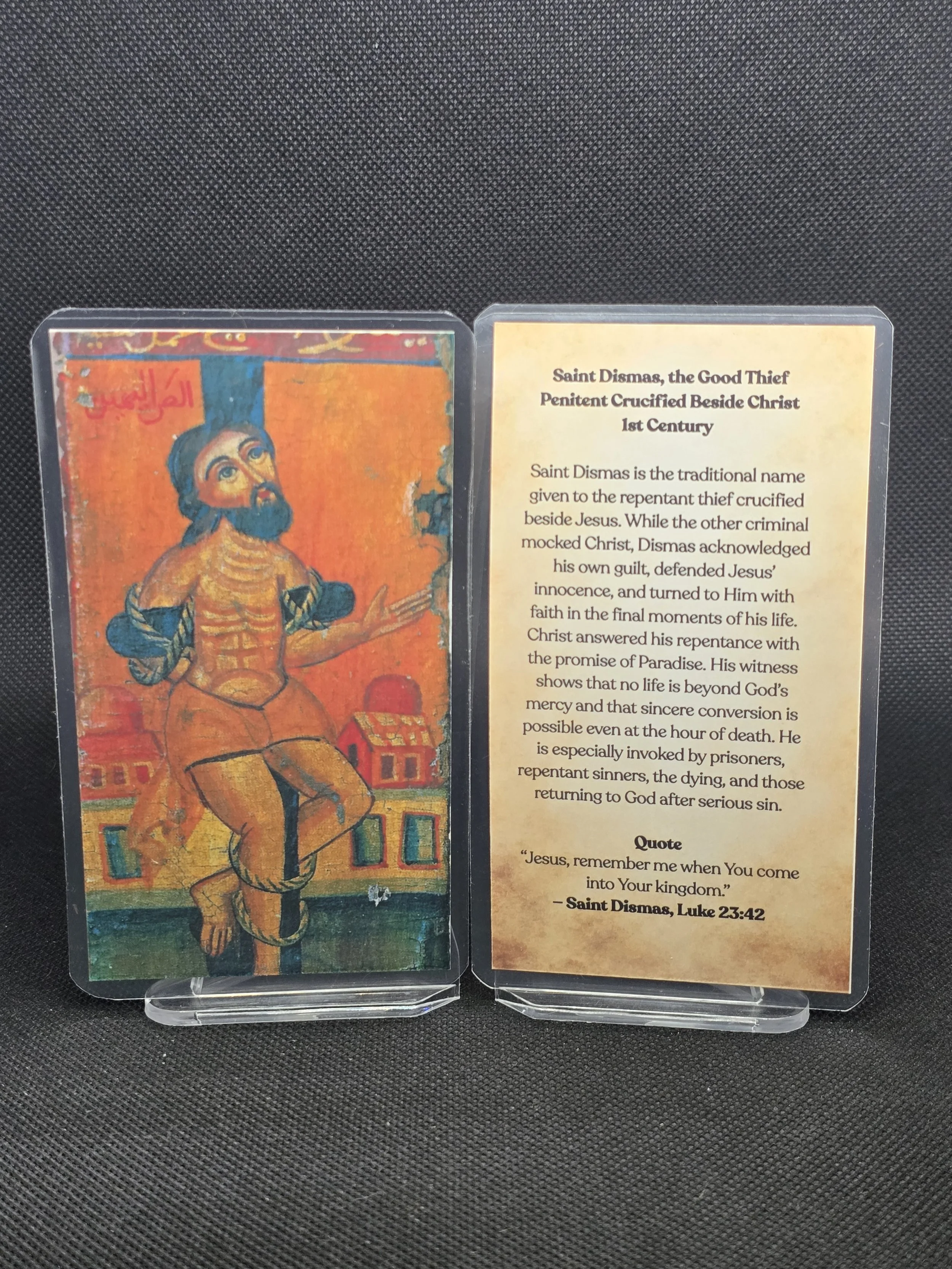
The picture of Dismas teaches that the door of mercy is not closed to the person who comes honestly to Christ, even late, and that no past is too heavy for forgiveness.
Prayer, Mercy and the Last Hour
The story of Dismas can be a guide for every Christian who has failed. It invites us to name our sins plainly, to look at Christ and to ask for his mercy. It also warns against despair, since the thief was received, and against presumption, since the other criminal was beside the same Lord and still refused him.
Families who have a loved one in prison often keep a card or an icon of Dismas and pray for them. Others pray to him for a good death for themselves and those they love. A simple way to pray is to say the words of Luke slowly, as the thief did, and to leave the rest to God.
The prayer card on this page is made for that kind of quiet devotion.
Lord Jesus Christ, on the Cross you opened Paradise to a repentant man. Look with mercy on all who are in prison, in shame or in fear of death. Give them honest hearts, true sorrow and a hope that does not fail. Comfort their families, and give those who serve them wisdom and patience. Remember us, Lord, in your kingdom, and by the prayers of Saint Dismas bring us to your peace. Amen.
This is a short original prayer written for this page. It is not an official prayer of the Church. The words of the thief come from Luke 23:42.
Dismas in the Eastern Churches
The Wise Thief has a deep place in Byzantine worship. On Great and Holy Friday the Church sings of how Christ opened Paradise to him in a single moment and asks that the worshipper also be enlightened through the Cross. The Orthodox Church in America lists the hymn among the Holy Friday services. Byzantine Catholics share the same liturgical inheritance.
The prayer before Holy Communion in the Divine Liturgy of Saint John Chrysostom also borrows the thief's confession. The communicant says, in effect, that like the thief he confesses Christ and asks to be remembered in his kingdom. We have no right to say that every Eastern Catholic or Oriental Orthodox Church uses the same hymns or observes the same day, and the details differ by tradition.
Frequently Asked Questions
Remember Me, Lord
The Good Thief shows that it is never too late to turn to Christ. Keep his prayer card near anyone who needs courage, mercy or a last hope.
View Prayer Card