Saint Lydia of Thyatira: Seller of Purple, First Named Convert in Europe and Patron of Dyers
A businesswoman from Asia Minor who opened her heart and her home to Saint Paul at Philippi, and whose household became one of the first Christian gathering places in Europe.
At a Glance
- Born and died
- Unknown. Acts says only that she came from Thyatira in Asia Minor.
- Time of conversion
- About 49 to 51 AD, during Paul's second journey. The year is UNCERTAIN.
- Source
- Acts 16:11 to 15 and 16:40
- Feast
- August 3 in older Western calendars. May 20 in Greek Orthodox usage. Some other dates are UNCERTAIN.
- Title
- Equal to the Apostles in Orthodox tradition
- Patronage
- Dyers, cloth workers and merchants. Women in business also honor her, as a modern custom.
- Who Was Saint Lydia?
- Thyatira, Purple and Her Family
- The Conversion by the River
- Hospitality and the House Church
- Philippi and the Trials of the Mission
- Her Death, Relics and Commemoration
- Tradition and Devotion
- Icons and Imagery
- Faith, Work and an Open Door
- Lydia in the Eastern Churches
- Frequently Asked Questions
Who Was Saint Lydia?
Lydia appears in only a few verses of the Acts of the Apostles, yet she is one of the most vivid women of the New Testament. She came from the city of Thyatira, she sold purple goods, and she was in Philippi in Macedonia when Saint Paul arrived there on his second missionary journey. She listened to Paul by a river, she was baptized with her household, and she urged the missionaries to stay in her home.
She is usually called the first named convert of Paul's mission in Macedonia, and in popular speech the first Christian in Europe. The second description is a tradition, since Acts does not claim that no one had believed in Europe before her, and Christians may have reached the continent earlier. What Acts does show is a woman of independent work and decision who became a firm support of the new community.
This article follows Acts closely. Where later tradition adds details, it is marked TRADITION, and where we cannot know, it is marked UNCERTAIN. A short Scripture account, honestly read, is a better foundation than a longer story that cannot be checked.
Thyatira, Purple and Her Family
Acts 16:14 calls Lydia a seller of purple goods from the city of Thyatira, and a worshiper of God. Thyatira lay in the Roman province of Asia, in what is now Akhisar in Turkey. Ancient inscriptions show that the city had organized trades, including dyers and workers in wool and cloth, so her occupation fits the place. The name Purpuraria, used in Latin, simply describes her trade and is not a family name.
Whether she was born in Thyatira, whether she had moved permanently to Philippi or acted as an agent for merchants of her home city, is UNCERTAIN. Philippi was a Roman colony, a proud and busy city on the great road across Macedonia.
Acts says nothing of a husband, children, parents or brothers and sisters. Some writers guess she was a widow because she seems to lead her own household, and others think she was unmarried or a freed slave. These are only guesses. That she could host travelers shows that she had a house and some means, but it does not prove great wealth. Purple goods were costly, yet those who made and sold them were not always of the highest rank.
The Conversion by the River
After a vision calling him to Macedonia, Paul sailed from Troas by way of Samothrace and Neapolis to Philippi. On the Sabbath he and his companions went outside the city gate to the riverside, where they expected to find a place of prayer. They found a gathering of women, and Lydia was among them.
Acts calls her a worshiper of God. The Greek phrase usually describes a Gentile who was attracted to the worship and moral teaching of Judaism without being fully converted. So the term God-fearer is well supported for Lydia, but the claim that she was a Jewish proselyte is UNCERTAIN.
Acts says that the Lord opened her heart to listen to what Paul was saying. She and her household were baptized. Acts does not say who baptized her or where. TRADITION: Orthodox accounts name Paul as the one who baptized her and place the event at the Zygaktis River near Philippi. Saint John Chrysostom, in his homily on this passage, notes that the opening of her heart was God's work, while her attention was her own response, a balance that Eastern Christians have long prized.
Hospitality and the House Church
After the baptism, Lydia asked the missionaries to stay with her, and Acts adds that she prevailed upon them. Her insistence shows a woman who knew her own mind. Her house became their base in the city.
Later in the same chapter, Paul and Silas were arrested and beaten, and an earthquake opened the prison. When they were released, Acts 16:40 says they went to Lydia's house, met the believers and encouraged them before leaving. This strongly suggests that her home had become a meeting place for the Christians of Philippi. Acts does not call it a church building, and it gives Lydia no office.
Some writers call her the founder of the church of Philippi. A more careful description is that she was an early convert and a major supporter of the community that grew from Paul's preaching. Claims that she was ordained a deaconess have no support in the New Testament and are UNCERTAIN. There is no record of her traveling as a missionary, and no writing by her survives.
Philippi and the Trials of the Mission
Philippi was a Roman colony, and its public life was shaped by Roman law, rank and religion. Acts 16 tells how Paul freed an enslaved girl from a spirit of fortune telling. Her owners lost their income and dragged Paul and Silas before the magistrates, who had them beaten and jailed. During the night an earthquake opened the doors, and the jailer and his household were baptized.
Lydia takes no part in these scenes. Acts does not say that she was arrested, harmed or driven out, and the fact that Paul and Silas went to her house afterward shows that the community survived. Whether she suffered persecution later is UNCERTAIN.
Her story also shows how early Christianity spread through households. A household could include relatives, workers and slaves, so we do not know how many were baptized with her or who they were. Paul's Letter to the Philippians does not mention her by name. Some have guessed that she had died or moved, and others that she is hidden among the women named in chapter 4. Neither idea can be proved, and silence in a letter proves nothing.
Her Death, Relics and Commemoration
The New Testament says nothing about her death, her age or her burial. No early evidence shows that she was a martyr, and she should not be called one unless a later tradition is clearly named. No authenticated relics are known. A Greek Orthodox baptistery near ancient Philippi, beside the Zygaktis stream, commemorates her baptism and is used for baptisms today, but it is a place of devotion and not proof of the exact spot or of a grave.
Her cult grew slowly. Chrysostom preached on her conversion in his Homilies on Acts. In the West, Cardinal Baronius placed her in the Roman Martyrology on August 3 in the sixteenth century, and that date remains common in Catholic books. Some modern calendars and translations of the revised Roman Martyrology are reported to list her on May 20, so the current Western date is UNCERTAIN and should be checked against a given calendar.
In the East, her commemoration was absent from older Byzantine calendars. Orthodox sources report that the Church of Constantinople formally included her, with the title Equal to the Apostles, in 1972, and her feast is kept on May 20 in Greek usage. This is recent liturgical recognition and does not mean that devotion to her began then. Do not confuse her with the martyr Lydia, wife of Philetus, who is remembered on March 23 under the Emperor Hadrian.
Tradition and Devotion
Very little legend has gathered around Lydia, which is itself notable. TRADITION: modern Orthodox services describe her as a holy woman who went on living by the Gospel and whose life ended in a way worthy of the apostolic community. This is a devotional summary and not an ancient biography. Hymns composed in modern times praise her faith and her household, and these should not be mistaken for early prayers.
She is invoked as patron of dyers and cloth workers and of merchants and traders. Her honor for women entrepreneurs is a modern and fitting application, though it is not an ancient or official designation. Many Christians who run businesses ask her to help them work honestly and to keep their doors open to others.
Icons and Imagery
Icons usually show her holding a cross, wearing fine clothing, or standing in a baptism scene. The cross in her hand does not mean she was martyred. It represents her confession of Christ.
In scenes of the baptism at Philippi, Lydia is often shown kneeling or standing at the water with Paul beside her, and her household gathered behind. Painters have also pictured her at her loom or among bolts of dyed cloth, which recalls her trade. Such images come from the artists' reading of Acts, and not from any ancient description of how she looked.
The color purple has a natural place in her imagery. In the ancient world it came from costly dye, and it points to her work and to the dignity of honest labor. Christians who hang her image in a shop or a workroom are asking that their own work be done well and in the presence of God.
Faith, Work and an Open Door
Lydia's story gathers three lessons. First, faith begins when God opens the heart, and we respond by listening. Second, ordinary work, such as selling cloth, is not a barrier to faith, and a merchant can be a leader in the Church. Third, an open door is a form of ministry. Her home sheltered missionaries and believers when they most needed it.
Modern readers can take this practically. A person in business can pray for honest dealing, fair wages and generosity to employees. A family can use its table as a place of welcome. A parish can look for those who quietly give a house, a meal or a room to the work of the Gospel.
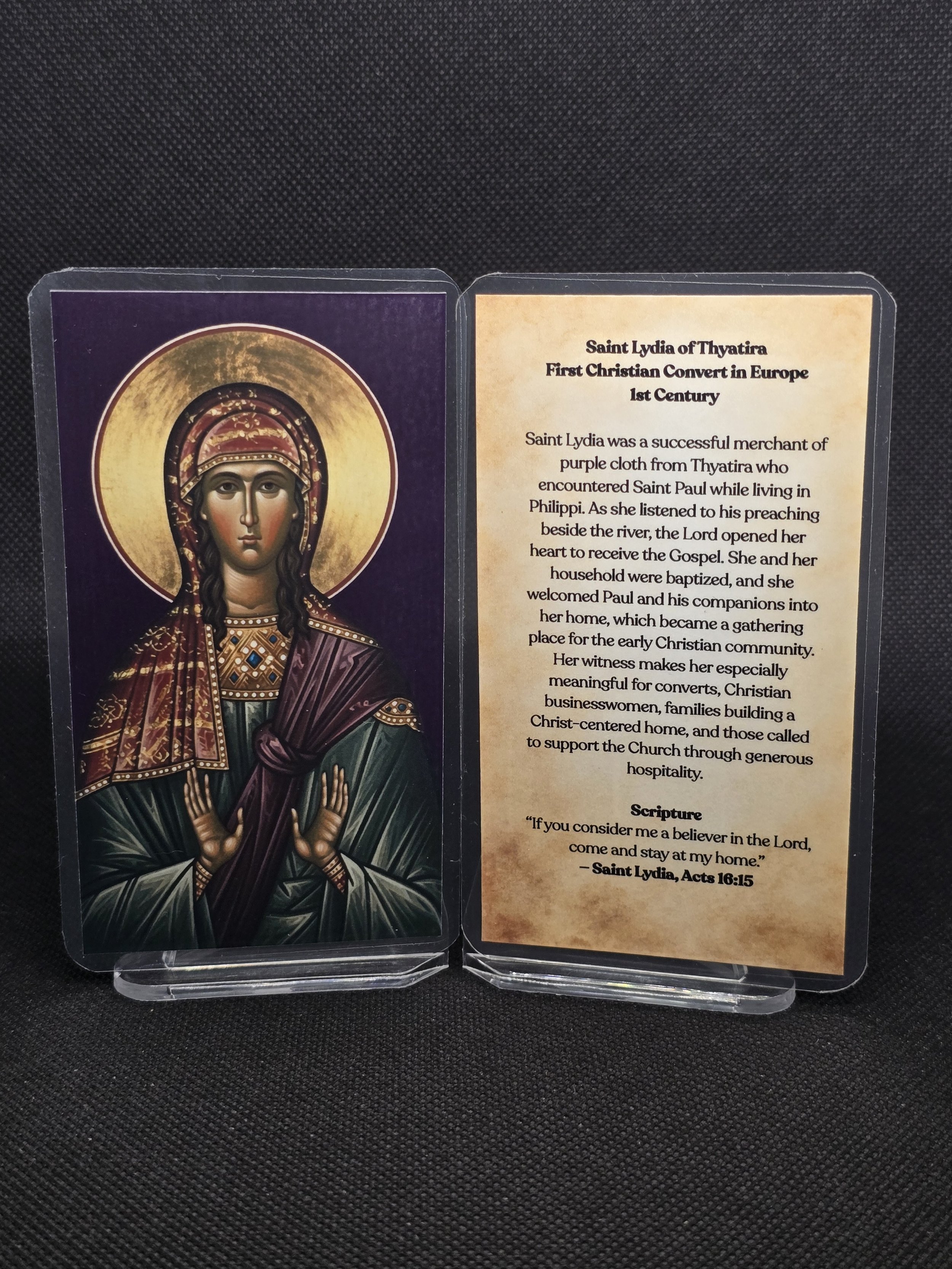
The prayer card on this page is suited to an office, a shop or a home where hospitality is practiced.
Lord Jesus Christ, you opened the heart of Lydia to hear your Word by the river at Philippi. Open our hearts as well. Bless the work of our hands and keep us honest in business. Give us the courage to welcome strangers, to shelter the weary and to support those who carry your Gospel. Through the prayers of Saint Lydia, make our homes places of faith and peace. Amen.
This is a short original prayer written for this page. It is not an official prayer of the Church. Orthodox churches use a modern service and hymns in honor of Saint Lydia.
Lydia in the Eastern Churches
Lydia holds a distinct place in Orthodox life, where she is honored as Equal to the Apostles, a title that praises her reception of the Gospel and her support of the apostolic mission without suggesting that she was one of the Twelve. Her feast is kept on May 20 in Greek usage. Some Slavic sources give other dates, but those are complicated by the other Lydia of March 23, and we found no firm support for March 20 or January 4.
Eastern readers also value her as an example of grace and cooperation, drawing on Chrysostom's comment. For Eastern Catholics she offers a direct link to the shared apostolic and patristic heritage of East and West, since she is a New Testament figure honored in both traditions.
Frequently Asked Questions
Open Hearts, Open Doors
Lydia listened, believed and opened her home. Keep her prayer card where you work or welcome guests.
View Prayer Card