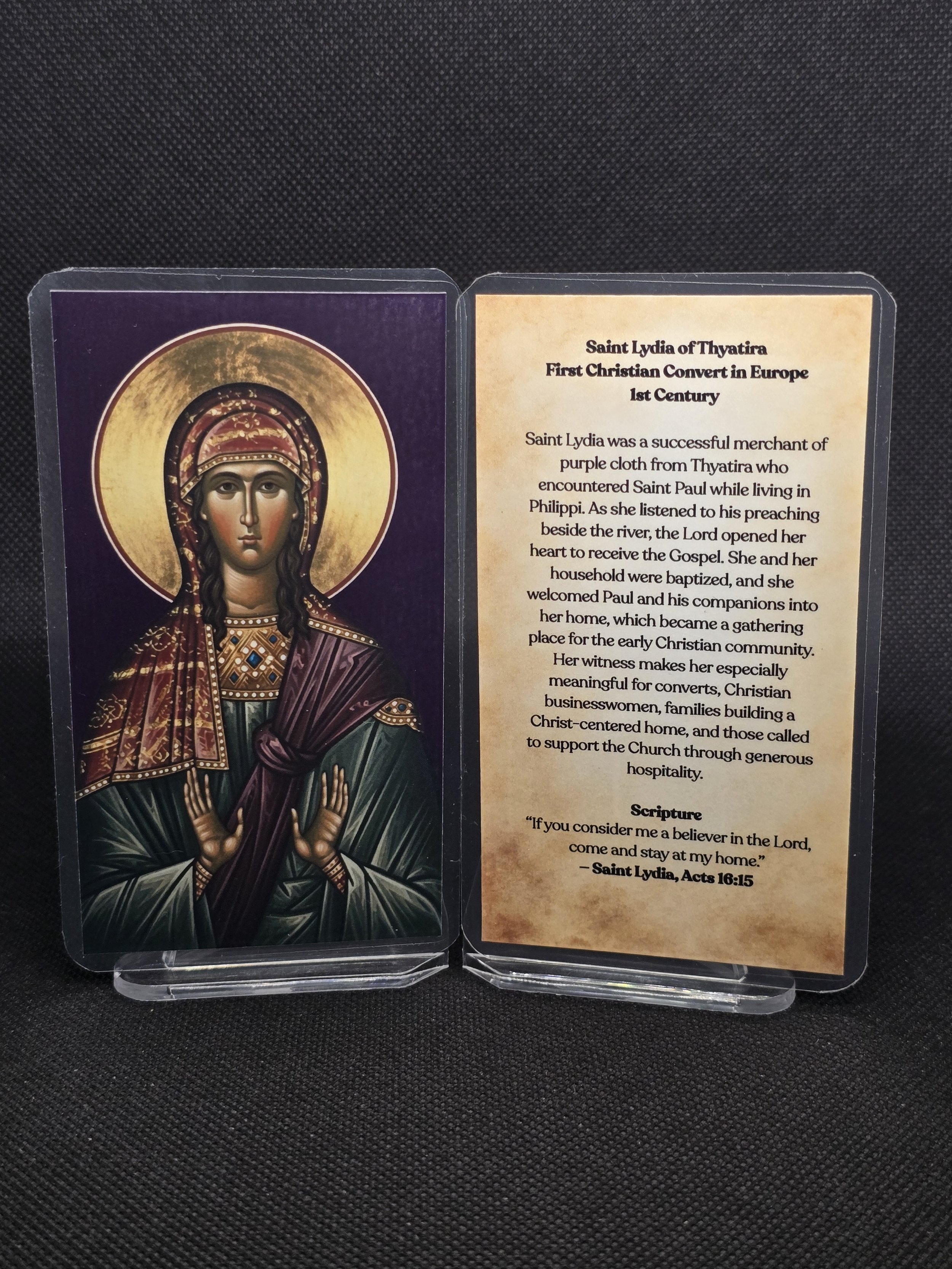
 Image 1 of 1
Saint Lydia of Thyatira - Prayer Card
Saint Lydia of Thyatira is one of the earliest and most beautiful examples of Christian entrepreneurship, hospitality, and faithful service in the New Testament. She appears in Acts 16 as a seller of purple cloth, a valuable and prestigious trade connected with dye, color, beauty, wealth, and skilled craftsmanship. She was a woman of business, a woman of influence, and a woman whose work and home became instruments of the Gospel.
Because of her connection to trade, color, beauty, skilled work, and Christian hospitality, Saint Lydia is especially meaningful as the unofficial patron saint of women entrepreneurs and hairstylists. Her life speaks powerfully to salon owners, hair colorists, beauty professionals, makers, merchants, and women who carry the responsibility of building a business while trying to keep their hearts open to God.
Scripture tells us that Lydia was already a worshiper of God when Saint Paul came to Philippi. As Paul preached by the river, the Lord opened her heart to receive the Gospel. She believed, was baptized with her household, and then opened her home to Paul and his companions. Her conversion did not remain private; it immediately became hospitality, generosity, and support for the early Church.
Saint Lydia reminds us that business can become ministry, beauty can become service, and ordinary work can become holy when offered to Christ. A salon chair can become a place of kindness. A home can become a refuge. A skill can become a gift. Her story is a powerful reminder that God can use what is already in a person’s hands when the heart is open to Him.
This prayer card is created for women entrepreneurs, hairstylists, salon owners, colorists, beauty professionals, converts, homemakers, and all those seeking openness to God, courage in vocation, blessing over their work, holy hospitality, and the grace to receive Christ fully and share Him generously.
Saint Lydia’s unofficial patronage includes women entrepreneurs, hairstylists, salon owners, hair colorists, beauty professionals, businesswomen, merchants, dyers, textile workers, cloth makers, seamstresses, hospitality, homemakers, converts, Christian homes, women seeking vocation, and those who want to use their work for Christ.
Each card is handmade in Austin, TX and created to order. We do not keep stock, because every prayer card is treated as a unique devotional offering. They are printed on museum-quality photo paper, not cardstock. Every card is made slowly, during prayer, with intentional reverence for the saint or holy image and for the person who will receive it. Names are lifted before Christ. Intentions are held carefully. Each piece is handled multiple times in prayerful silence, asking God for mercy and asking the saint to intercede for the soul it is being made for. This is not production work. It is devotional craftsmanship shaped with patience, care, and spiritual responsibility, because every soul and every prayer matters.
THE LIFE & STORY
Saint Lydia of Thyatira is known from the Acts of the Apostles, where she appears during Saint Paul’s missionary journey into Macedonia. Paul and his companions had come to Philippi, a leading city of the district, and on the Sabbath they went outside the city gate to a river where people gathered for prayer. There, among the women listening, was Lydia.
Lydia was from Thyatira, a city known for its guilds, dyes, textiles, and skilled trades. Scripture identifies her as a seller of purple, meaning she worked with one of the most valuable and prestigious products of the ancient world. Purple cloth was associated with wealth, honor, and status, and those involved in its trade were often connected to influential circles. Lydia was not portrayed as helpless or passive; she was a capable working woman with responsibility, skill, and means.
The most important thing Scripture tells us about Lydia, however, is not merely what she sold, but what God did in her heart. She was a worshiper of God, already seeking the Lord before she fully knew Christ. When Saint Paul preached the Gospel, the Lord opened her heart to pay attention to what was said. Lydia received the message, believed, and was baptized with her household.
Her faith immediately became action. After her baptism, Lydia urged Paul and his companions to stay in her home, saying that if they judged her faithful to the Lord, they should come and remain with her. She did not offer a vague kindness or polite encouragement. She opened her actual home, her table, her resources, and her life to the servants of Christ.
Later, after Paul and Silas were beaten, imprisoned, and released, they returned to Lydia’s house before leaving Philippi. This shows that her home had become an important place of gathering, encouragement, and Christian fellowship. The first Christian community in Philippi was strengthened by the hospitality and courage of a woman whose heart had been opened by God.
Saint Lydia is often remembered as the first recorded Christian convert in Europe. She stands at the beginning of the Church’s mission in that region, not as someone seeking attention, but as a woman whose faith transformed her work, home, and influence. Her life shows that the Gospel does not ignore ordinary responsibilities; it sanctifies them when they are offered to Christ.
For women in business today, Lydia’s story is deeply powerful. She shows that entrepreneurship can be holy, that skilled work can serve God, and that beauty-related labor can carry spiritual dignity. For hairstylists, colorists, salon owners, and beauty professionals, her connection to color, dye, beauty, service, trade, and hospitality makes her a deeply fitting unofficial patron. She is a saint for the woman building something with her hands, serving people face to face, and asking God to make her work more than work.
MIRACLES & PATRONAGE
Saint Lydia is not remembered for dramatic public miracles in the way some saints are. Her miracle is quieter, but no less important: the Lord opened her heart. That is one of the greatest miracles any soul can receive. She heard the Gospel, received grace, believed, and allowed her life to be changed.
Her story is also a miracle of vocation. Lydia did not have to abandon her trade, her home, or her responsibilities in order to belong to Christ. Instead, those very parts of her life became useful to the Kingdom of God. Her business gave her influence, her home gave shelter, her resources gave support, and her hospitality helped strengthen the early Church.
For this reason, Saint Lydia is a meaningful intercessor for women entrepreneurs, hairstylists, salon owners, hair colorists, beauty professionals, merchants, dyers, textile workers, seamstresses, homemakers, converts, and those who want their work to become an offering to Christ. She is especially fitting for women who create beauty, serve clients, manage responsibility, lead teams, welcome others, and desire to remain faithful while carrying the weight of practical daily work.
Saint Lydia’s unofficial patronage of hairstylists is especially fitting because of her connection to purple dye, color, beauty, trade, and skilled craftsmanship. A hairstylist’s work is not merely technical; it is personal, creative, and often deeply relational. People sit in a stylist’s chair during moments of transition, grief, celebration, reinvention, and vulnerability. Saint Lydia reminds beauty professionals that their work can become a place of dignity, kindness, encouragement, and Christian love.
Her unofficial patronage of women entrepreneurs is also deeply fitting. Lydia was a woman of trade who used her business, influence, and household in service to Christ. She shows that Christian women in business do not need to separate faith from work. A business can be built with honesty, generosity, excellence, hospitality, and prayer. A workplace can become a place where people are treated with dignity. A skill can become a ministry when the heart belongs to Christ.
People ask Saint Lydia’s intercession when beginning a business, opening a salon, changing careers, serving clients, working with beauty or color, welcoming guests, praying for family conversion, or trying to build a Christian home. She is also a powerful saint for women who feel unseen in their labor, overburdened by responsibility, or uncertain whether their ordinary work matters to God.
Saint Lydia teaches that ordinary work can become holy when it is offered to Christ. Her life reminds us that God can use a business, a home, a table, a skill, a conversation, and an open heart to build His Church.
PRAYERS
A simple invocation may be prayed often: Saint Lydia of Thyatira, pray for us.
For an open heart, one may pray: Saint Lydia, whose heart the Lord opened to the Gospel, pray that my heart may be opened fully to Christ. Help me listen when God speaks, receive grace with humility, and respond with faithful action.
For women entrepreneurs, one may pray: Saint Lydia, faithful woman of trade and hospitality, pray for women who are building businesses, carrying responsibility, serving others, and trying to honor Christ through their work. Ask the Lord to bless their labor with honesty, wisdom, courage, provision, and peace.
For hairstylists and beauty professionals, one may pray: Saint Lydia, woman of color, beauty, skill, and service, pray for hairstylists, colorists, salon owners, and beauty professionals. Help them use their gifts with excellence, kindness, patience, and love, so their work may bring dignity, encouragement, and peace to those they serve.
For a home, one may pray: Saint Lydia, holy woman of hospitality, pray that my home may become a place of peace, welcome, prayer, and Christian love. Help me receive others with generosity and recognize Christ in those He sends to me.
For family conversion, one may pray: Saint Lydia, who was baptized with your household, pray for my family. Ask the Lord to open our hearts, strengthen our faith, and draw every member of our household closer to Christ.
For work and vocation, one may pray: Saint Lydia, pray that my work may become an offering to God. Help me serve with integrity, create with beauty, welcome with love, and use what has been placed in my hands for the glory of Christ.
FAQ
Who is Saint Lydia of Thyatira?
Saint Lydia of Thyatira is a New Testament saint mentioned in Acts 16. She was a seller of purple cloth from Thyatira, a worshiper of God, and one of Saint Paul’s first converts in Philippi. After receiving the Gospel, she was baptized with her household and opened her home to Paul and his companions.
Why is Saint Lydia important?
Saint Lydia is important because she is often remembered as the first recorded Christian convert in Europe. Her faith, hospitality, business, and home helped support the early Church in Philippi. She shows how an open heart, a faithful household, and ordinary work can become instruments of the Gospel.
What does it mean that Lydia was a seller of purple?
A seller of purple was someone involved in the trade of purple cloth or dye, which was valuable and associated with wealth, royalty, honor, and beauty. This suggests that Lydia was a capable woman of business who worked in a skilled and respected trade connected to color, textiles, and commerce.
Is Saint Lydia officially the patron saint of women entrepreneurs and hairstylists?
Saint Lydia is best described as an unofficial patron saint of women entrepreneurs and hairstylists. Her biblical connection to trade, purple dye, color, beauty, skilled work, hospitality, and Christian business makes her a meaningful intercessor for women in business, salon owners, hair colorists, hairstylists, and beauty professionals.
Why is Saint Lydia a good patron for women entrepreneurs?
Saint Lydia was a woman of trade who used her resources, home, and influence in service to Christ. She is a strong example for women who own businesses, lead others, manage responsibility, and want their work to reflect faith, integrity, generosity, and hospitality.
Why is Saint Lydia connected to hairstylists and beauty professionals?
Saint Lydia’s work with purple cloth connects her to color, beauty, dye, skilled craft, and service. While she was not a hairstylist historically, her life makes her a fitting unofficial patron for hairstylists, hair colorists, salon owners, and beauty professionals who use creativity, color, and personal service in their daily work.
What is Saint Lydia the patron saint of?
Saint Lydia is commonly associated with dyers, textile workers, cloth makers, merchants, businesswomen, converts, hospitality, homemakers, and Christian homes. Devotionally, she is also a meaningful unofficial patron of women entrepreneurs, hairstylists, salon owners, colorists, and beauty professionals.
Is Saint Lydia honored in both Catholic and Orthodox tradition?
Yes. Saint Lydia is honored by Christians in both East and West. In the Orthodox Church, she is especially honored as Equal-to-the-Apostles because of her role in receiving and supporting the spread of the Gospel.
When is Saint Lydia’s feast day?
Saint Lydia is commemorated on different dates in different Christian traditions. She is commonly honored on May 20 in the Greek Orthodox tradition, March 23 in some Slavic Orthodox usage, and August 3 in some Western calendars.
Why should someone pray to Saint Lydia?
People ask Saint Lydia to intercede for open hearts, conversion, Christian homes, hospitality, business, entrepreneurship, beauty work, hairstylists, salon owners, and women seeking to use their gifts for Christ. She is especially meaningful for those who want their work and home to become places of grace.
Is Saint Lydia a good saint for salon owners?
Yes. Saint Lydia is a beautiful unofficial patron for salon owners because her life connects business, beauty, color, skilled work, hospitality, and faith. A salon can become more than a workplace; it can become a place where people are welcomed, encouraged, served with dignity, and treated with Christian love.
Is Saint Lydia a good saint for converts?
Yes. Saint Lydia is a powerful saint for converts because Scripture describes the Lord opening her heart to receive the preaching of Saint Paul. Her conversion brought her household into the life of the Church and immediately led to hospitality and service.
Is Saint Lydia a good saint for homemakers?
Yes. Saint Lydia’s home became a place of welcome and Christian gathering. She is a meaningful intercessor for anyone who wants their home to become a place of prayer, peace, generosity, hospitality, and faith.
What is the main message of Saint Lydia’s life?
The main message of Saint Lydia’s life is that an open heart can change everything. When Lydia received the Gospel, her work, home, resources, and relationships became part of God’s mission. Her life teaches that business can become ministry, beauty can become service, and ordinary daily labor can become holy when offered to Christ.
Saint Lydia of Thyatira is one of the earliest and most beautiful examples of Christian entrepreneurship, hospitality, and faithful service in the New Testament. She appears in Acts 16 as a seller of purple cloth, a valuable and prestigious trade connected with dye, color, beauty, wealth, and skilled craftsmanship. She was a woman of business, a woman of influence, and a woman whose work and home became instruments of the Gospel.
Because of her connection to trade, color, beauty, skilled work, and Christian hospitality, Saint Lydia is especially meaningful as the unofficial patron saint of women entrepreneurs and hairstylists. Her life speaks powerfully to salon owners, hair colorists, beauty professionals, makers, merchants, and women who carry the responsibility of building a business while trying to keep their hearts open to God.
Scripture tells us that Lydia was already a worshiper of God when Saint Paul came to Philippi. As Paul preached by the river, the Lord opened her heart to receive the Gospel. She believed, was baptized with her household, and then opened her home to Paul and his companions. Her conversion did not remain private; it immediately became hospitality, generosity, and support for the early Church.
Saint Lydia reminds us that business can become ministry, beauty can become service, and ordinary work can become holy when offered to Christ. A salon chair can become a place of kindness. A home can become a refuge. A skill can become a gift. Her story is a powerful reminder that God can use what is already in a person’s hands when the heart is open to Him.
This prayer card is created for women entrepreneurs, hairstylists, salon owners, colorists, beauty professionals, converts, homemakers, and all those seeking openness to God, courage in vocation, blessing over their work, holy hospitality, and the grace to receive Christ fully and share Him generously.
Saint Lydia’s unofficial patronage includes women entrepreneurs, hairstylists, salon owners, hair colorists, beauty professionals, businesswomen, merchants, dyers, textile workers, cloth makers, seamstresses, hospitality, homemakers, converts, Christian homes, women seeking vocation, and those who want to use their work for Christ.
Each card is handmade in Austin, TX and created to order. We do not keep stock, because every prayer card is treated as a unique devotional offering. They are printed on museum-quality photo paper, not cardstock. Every card is made slowly, during prayer, with intentional reverence for the saint or holy image and for the person who will receive it. Names are lifted before Christ. Intentions are held carefully. Each piece is handled multiple times in prayerful silence, asking God for mercy and asking the saint to intercede for the soul it is being made for. This is not production work. It is devotional craftsmanship shaped with patience, care, and spiritual responsibility, because every soul and every prayer matters.
THE LIFE & STORY
Saint Lydia of Thyatira is known from the Acts of the Apostles, where she appears during Saint Paul’s missionary journey into Macedonia. Paul and his companions had come to Philippi, a leading city of the district, and on the Sabbath they went outside the city gate to a river where people gathered for prayer. There, among the women listening, was Lydia.
Lydia was from Thyatira, a city known for its guilds, dyes, textiles, and skilled trades. Scripture identifies her as a seller of purple, meaning she worked with one of the most valuable and prestigious products of the ancient world. Purple cloth was associated with wealth, honor, and status, and those involved in its trade were often connected to influential circles. Lydia was not portrayed as helpless or passive; she was a capable working woman with responsibility, skill, and means.
The most important thing Scripture tells us about Lydia, however, is not merely what she sold, but what God did in her heart. She was a worshiper of God, already seeking the Lord before she fully knew Christ. When Saint Paul preached the Gospel, the Lord opened her heart to pay attention to what was said. Lydia received the message, believed, and was baptized with her household.
Her faith immediately became action. After her baptism, Lydia urged Paul and his companions to stay in her home, saying that if they judged her faithful to the Lord, they should come and remain with her. She did not offer a vague kindness or polite encouragement. She opened her actual home, her table, her resources, and her life to the servants of Christ.
Later, after Paul and Silas were beaten, imprisoned, and released, they returned to Lydia’s house before leaving Philippi. This shows that her home had become an important place of gathering, encouragement, and Christian fellowship. The first Christian community in Philippi was strengthened by the hospitality and courage of a woman whose heart had been opened by God.
Saint Lydia is often remembered as the first recorded Christian convert in Europe. She stands at the beginning of the Church’s mission in that region, not as someone seeking attention, but as a woman whose faith transformed her work, home, and influence. Her life shows that the Gospel does not ignore ordinary responsibilities; it sanctifies them when they are offered to Christ.
For women in business today, Lydia’s story is deeply powerful. She shows that entrepreneurship can be holy, that skilled work can serve God, and that beauty-related labor can carry spiritual dignity. For hairstylists, colorists, salon owners, and beauty professionals, her connection to color, dye, beauty, service, trade, and hospitality makes her a deeply fitting unofficial patron. She is a saint for the woman building something with her hands, serving people face to face, and asking God to make her work more than work.
MIRACLES & PATRONAGE
Saint Lydia is not remembered for dramatic public miracles in the way some saints are. Her miracle is quieter, but no less important: the Lord opened her heart. That is one of the greatest miracles any soul can receive. She heard the Gospel, received grace, believed, and allowed her life to be changed.
Her story is also a miracle of vocation. Lydia did not have to abandon her trade, her home, or her responsibilities in order to belong to Christ. Instead, those very parts of her life became useful to the Kingdom of God. Her business gave her influence, her home gave shelter, her resources gave support, and her hospitality helped strengthen the early Church.
For this reason, Saint Lydia is a meaningful intercessor for women entrepreneurs, hairstylists, salon owners, hair colorists, beauty professionals, merchants, dyers, textile workers, seamstresses, homemakers, converts, and those who want their work to become an offering to Christ. She is especially fitting for women who create beauty, serve clients, manage responsibility, lead teams, welcome others, and desire to remain faithful while carrying the weight of practical daily work.
Saint Lydia’s unofficial patronage of hairstylists is especially fitting because of her connection to purple dye, color, beauty, trade, and skilled craftsmanship. A hairstylist’s work is not merely technical; it is personal, creative, and often deeply relational. People sit in a stylist’s chair during moments of transition, grief, celebration, reinvention, and vulnerability. Saint Lydia reminds beauty professionals that their work can become a place of dignity, kindness, encouragement, and Christian love.
Her unofficial patronage of women entrepreneurs is also deeply fitting. Lydia was a woman of trade who used her business, influence, and household in service to Christ. She shows that Christian women in business do not need to separate faith from work. A business can be built with honesty, generosity, excellence, hospitality, and prayer. A workplace can become a place where people are treated with dignity. A skill can become a ministry when the heart belongs to Christ.
People ask Saint Lydia’s intercession when beginning a business, opening a salon, changing careers, serving clients, working with beauty or color, welcoming guests, praying for family conversion, or trying to build a Christian home. She is also a powerful saint for women who feel unseen in their labor, overburdened by responsibility, or uncertain whether their ordinary work matters to God.
Saint Lydia teaches that ordinary work can become holy when it is offered to Christ. Her life reminds us that God can use a business, a home, a table, a skill, a conversation, and an open heart to build His Church.
PRAYERS
A simple invocation may be prayed often: Saint Lydia of Thyatira, pray for us.
For an open heart, one may pray: Saint Lydia, whose heart the Lord opened to the Gospel, pray that my heart may be opened fully to Christ. Help me listen when God speaks, receive grace with humility, and respond with faithful action.
For women entrepreneurs, one may pray: Saint Lydia, faithful woman of trade and hospitality, pray for women who are building businesses, carrying responsibility, serving others, and trying to honor Christ through their work. Ask the Lord to bless their labor with honesty, wisdom, courage, provision, and peace.
For hairstylists and beauty professionals, one may pray: Saint Lydia, woman of color, beauty, skill, and service, pray for hairstylists, colorists, salon owners, and beauty professionals. Help them use their gifts with excellence, kindness, patience, and love, so their work may bring dignity, encouragement, and peace to those they serve.
For a home, one may pray: Saint Lydia, holy woman of hospitality, pray that my home may become a place of peace, welcome, prayer, and Christian love. Help me receive others with generosity and recognize Christ in those He sends to me.
For family conversion, one may pray: Saint Lydia, who was baptized with your household, pray for my family. Ask the Lord to open our hearts, strengthen our faith, and draw every member of our household closer to Christ.
For work and vocation, one may pray: Saint Lydia, pray that my work may become an offering to God. Help me serve with integrity, create with beauty, welcome with love, and use what has been placed in my hands for the glory of Christ.
FAQ
Who is Saint Lydia of Thyatira?
Saint Lydia of Thyatira is a New Testament saint mentioned in Acts 16. She was a seller of purple cloth from Thyatira, a worshiper of God, and one of Saint Paul’s first converts in Philippi. After receiving the Gospel, she was baptized with her household and opened her home to Paul and his companions.
Why is Saint Lydia important?
Saint Lydia is important because she is often remembered as the first recorded Christian convert in Europe. Her faith, hospitality, business, and home helped support the early Church in Philippi. She shows how an open heart, a faithful household, and ordinary work can become instruments of the Gospel.
What does it mean that Lydia was a seller of purple?
A seller of purple was someone involved in the trade of purple cloth or dye, which was valuable and associated with wealth, royalty, honor, and beauty. This suggests that Lydia was a capable woman of business who worked in a skilled and respected trade connected to color, textiles, and commerce.
Is Saint Lydia officially the patron saint of women entrepreneurs and hairstylists?
Saint Lydia is best described as an unofficial patron saint of women entrepreneurs and hairstylists. Her biblical connection to trade, purple dye, color, beauty, skilled work, hospitality, and Christian business makes her a meaningful intercessor for women in business, salon owners, hair colorists, hairstylists, and beauty professionals.
Why is Saint Lydia a good patron for women entrepreneurs?
Saint Lydia was a woman of trade who used her resources, home, and influence in service to Christ. She is a strong example for women who own businesses, lead others, manage responsibility, and want their work to reflect faith, integrity, generosity, and hospitality.
Why is Saint Lydia connected to hairstylists and beauty professionals?
Saint Lydia’s work with purple cloth connects her to color, beauty, dye, skilled craft, and service. While she was not a hairstylist historically, her life makes her a fitting unofficial patron for hairstylists, hair colorists, salon owners, and beauty professionals who use creativity, color, and personal service in their daily work.
What is Saint Lydia the patron saint of?
Saint Lydia is commonly associated with dyers, textile workers, cloth makers, merchants, businesswomen, converts, hospitality, homemakers, and Christian homes. Devotionally, she is also a meaningful unofficial patron of women entrepreneurs, hairstylists, salon owners, colorists, and beauty professionals.
Is Saint Lydia honored in both Catholic and Orthodox tradition?
Yes. Saint Lydia is honored by Christians in both East and West. In the Orthodox Church, she is especially honored as Equal-to-the-Apostles because of her role in receiving and supporting the spread of the Gospel.
When is Saint Lydia’s feast day?
Saint Lydia is commemorated on different dates in different Christian traditions. She is commonly honored on May 20 in the Greek Orthodox tradition, March 23 in some Slavic Orthodox usage, and August 3 in some Western calendars.
Why should someone pray to Saint Lydia?
People ask Saint Lydia to intercede for open hearts, conversion, Christian homes, hospitality, business, entrepreneurship, beauty work, hairstylists, salon owners, and women seeking to use their gifts for Christ. She is especially meaningful for those who want their work and home to become places of grace.
Is Saint Lydia a good saint for salon owners?
Yes. Saint Lydia is a beautiful unofficial patron for salon owners because her life connects business, beauty, color, skilled work, hospitality, and faith. A salon can become more than a workplace; it can become a place where people are welcomed, encouraged, served with dignity, and treated with Christian love.
Is Saint Lydia a good saint for converts?
Yes. Saint Lydia is a powerful saint for converts because Scripture describes the Lord opening her heart to receive the preaching of Saint Paul. Her conversion brought her household into the life of the Church and immediately led to hospitality and service.
Is Saint Lydia a good saint for homemakers?
Yes. Saint Lydia’s home became a place of welcome and Christian gathering. She is a meaningful intercessor for anyone who wants their home to become a place of prayer, peace, generosity, hospitality, and faith.
What is the main message of Saint Lydia’s life?
The main message of Saint Lydia’s life is that an open heart can change everything. When Lydia received the Gospel, her work, home, resources, and relationships became part of God’s mission. Her life teaches that business can become ministry, beauty can become service, and ordinary daily labor can become holy when offered to Christ.