Blessed Estephan El Douaihy: Maronite Patriarch, Historian and Father of Maronite History
A scholar of Ehden who studied in Rome, led the Maronite Church through hard years under Ottoman rule, and wrote the books that preserved its memory and its worship.
At a Glance
- Born
- August 2, 1630, in Ehden, Lebanon
- Died
- May 3, 1704, at Qannoubine, Lebanon, aged 73
- Office
- Maronite Patriarch of Antioch and All the East, 1670 to 1704
- Recognition
- Declared Venerable in 2008. Beatified August 2, 2024. Not canonized.
- Feast
- May 3 in the Maronite calendar
- Known as
- Father of Maronite History. Patronage is not formally designated (UNCERTAIN).
- Who Was Blessed Estephan El Douaihy?
- Childhood in Ehden and Years in Rome
- Priest, Teacher and Bishop of Cyprus
- Patriarch of Antioch
- The Books That Preserved a Church's Memory
- Suffering, Flight and the Lebanese Maronite Order
- Death, Burial and Beatification
- The Healing of Rosette Karam and Other Traditions
- Learning in the Service of Prayer
- Douaihy in the Eastern Churches
- Frequently Asked Questions
Who Was Blessed Estephan El Douaihy?
Estephan El Douaihy, also written Stephen Douaihy and, in Arabic transliteration, Istifan al-Duwayhi, was Maronite Patriarch of Antioch and All the East for thirty-four years, from 1670 until his death in 1704. He is remembered for two things at once: he governed a mountain Church under Ottoman rule, and he was the most important historian and liturgical writer the Maronites had produced up to his time.
He is called Blessed and not Saint. Pope Francis authorized the decree of a miracle attributed to him on March 14, 2024, and he was beatified on August 2, 2024, at Bkerke in Lebanon. He has not been canonized. This article therefore uses the title Blessed throughout, even though many Maronites speak of him with a saint's affection.
The article follows the official biography published by the Dicastery for the Causes of Saints and the scholarship summarized in standard reference works. Where a story comes from devotional biography and has not been tested in the same way, it is marked TRADITION. Where details are disputed or cannot be confirmed, they are marked UNCERTAIN.
Childhood in Ehden and Years in Rome
He was born on August 2, 1630, in Ehden, a Maronite town high in the mountains of northern Lebanon, at the time part of the Ottoman Empire. A biography by Monsignor Ignace Sadek, kept by the Patriarch Douaihy Foundation, names his parents as Deacon Mikhael Douaihy and Mariam, and says his father died when he was about three. These family details come from church biography and not from civil records, so they should be read with that in mind.
As a small boy he attended the parish school of Saint Peter in Ehden, where he learned reading, Arabic, Syriac and the faith. In 1641, when he was about eleven, he was sent to the Maronite College in Rome, founded under Pope Gregory XIII in 1584 and long staffed by Jesuits. There he studied Latin, philosophy and theology and, according to the Vatican biography, received a doctorate in philosophy in 1650.
The Roman years gave him tools he used for the rest of his life: Western scholastic method, access to manuscripts, and the habit of reading old sources critically. Sources credit him with knowledge of Arabic, Syriac, Latin, Italian, Greek and Hebrew, with a smaller grasp of other languages. We cannot say how fluent he was in each, so that list is best read as a sign of wide learning and not as an exact measure.
Priest, Teacher and Bishop of Cyprus
There was no conversion from another faith in his life. He was raised in the Maronite Church, and his vocation grew through study, prayer and service. He returned to Lebanon in 1655 and was ordained a priest on March 25, 1656, at the monastery of Saints Sergius and Bacchus in Ehden.
As a young priest he taught children, including poor children, and served in Lebanon and in Aleppo. Aleppo was a mixed city of many Christian traditions, and there he came to know clergy of other Churches and took part in efforts to strengthen communion with Rome. His friendship with Andrew Akijan, who became Syriac Catholic Patriarch of Antioch in 1662, belongs to this period.
After a pilgrimage to the Holy Land he was consecrated a bishop in 1668 and sent to the Maronite diocese of Cyprus, with its center at Nicosia. A Foundation biography gives July 8, 1668, for the consecration. He served on the island for only a short time, because the Church soon called him to a heavier task at home.
Patriarch of Antioch
On May 20, 1670, he was elected Maronite Patriarch of Antioch, succeeding Patriarch Georges Bsebeel. Pope Clement X confirmed the election on August 8, 1672. Some short biographies say he became patriarch at forty, but he was thirty-nine, since his fortieth birthday would not come until that August.
The patriarch's residence stood in the Qadisha Valley, at the monastery of Qannoubine, a place of caves, cliffs and cloister that long served as the see of Maronite leaders. From there he governed bishops, monks and villages scattered across the mountains, and he kept the Church in contact with Rome.
His tenure was long, which allowed him to finish what earlier patriarchs had started. He trained clergy, supported schools and encouraged monastic life, and he gave much of his strength to the written work that later made him famous.
The Books That Preserved a Church's Memory
Douaihy's literary work is the main reason he is still read. Three groups of writings stand out. The first is his major liturgical and theological work, usually called the Lampstand of the Sanctuaries, which explains the Eucharist, the arrangement of churches and the symbols of worship. It was printed only after his death, in Beirut in 1895 and 1896.
The second group is historical. His History of the Ages collects events concerning the Maronites and the Middle East, and survives in several manuscript versions that scholars compare carefully. He also wrote on the origins of the Maronites and defended them against old accusations of heresy, and he compiled information about the line of patriarchs.
The third group concerns worship and language. He revised ordination rites and studied the meters of Syriac poetry. Sebastian Brock, writing in the Gorgias Encyclopedic Dictionary of the Syriac Heritage, counts his work on Syriac verse forms among his useful contributions. Scholars also note that his method joined Western scholastic reasoning with the inherited Syriac tradition, so he is not simply a figure who removed Latin influence.
Readers should use his history with care. He was a defender of his own community, and his conclusions about disputed events in early Maronite history must be compared with other evidence. Good modern scholars treat him as a precious witness and not as the last word.
Suffering, Flight and the Lebanese Maronite Order
He ruled in a hard period. Local governors could tax, plunder or expel Christians at will, and the mountain villages often suffered. The Vatican biography preserves a letter he sent to Pope Innocent XI in 1679 describing emptied villages, damaged monasteries, abandoned churches and killings. It is one of the best surviving glimpses of the Church's situation from his own pen.
Maronite tradition says he was forced to leave his residence nine times. The number is repeated in the Foundation biography, but we found no separate list of every flight from contemporary records, so the exact count is UNCERTAIN, though the pattern of danger is not.
He also supported monastic renewal. According to the history of the Lebanese Maronite Order, the initiative came from young Maronites linked with Aleppo. Douaihy gave them the monastery of Mart Moura in Ehden in 1695, clothed the founders in the habit that November, and confirmed their rule in 1700. He is rightly called a patron and protector of the order, but he was not its sole founder.
His attitude toward other Christians needs honest description. He worked for Christian unity as he understood it, which meant communion with Rome, and his writings argue strongly against positions he thought incompatible with Catholic teaching. Recent scholarship examines how his polemic describes Syriac Christians outside Rome. He was a man of his century, and the modern idea of dialogue between equals was not his starting point.
Death, Burial and Beatification
He died on May 3, 1704, at Qannoubine, aged 73. His memory remained strong in Ehden and the north, where people remembered his learning, his poverty and his care for his flock.
He was buried at the patriarchal cemetery at Qannoubine. Church histories say the remains of seventeen patriarchs were exhumed in 1909. A scientific study published in 2023 in the Journal of Cultural Heritage used archaeology, anthropology and ancient DNA to examine the burials. Its authors judged that the combined evidence supports the identification of the collective remains with the patriarchs recorded in Church history. It is UNCERTAIN whether any individual bones can be firmly assigned to Douaihy, so claims about identified relics should be made cautiously.
His cause advanced in stages. Pope Benedict XVI recognized his heroic virtue on July 3, 2008, making him Venerable. Pope Francis authorized the decree on a miracle on March 14, 2024. The beatification Mass took place on August 2, 2024, at Bkerke, with Cardinal Marcello Semeraro representing the Pope. His feast is kept on May 3, and Maronite communities celebrated the first official feast after beatification in 2025.
The Healing of Rosette Karam and Other Traditions
The miracle accepted for beatification is the healing of Rosette Karam, a Lebanese woman who suffered from a severe inflammatory arthritis. According to the Vatican's account, her symptoms began in 2010 and were medically documented, with a specialist confirming the diagnosis in 2012. On September 7, 2013, her family brought her to Ehden and prayers were offered asking Douaihy to intercede. She is reported to have risen and walked without pain, and the Church's medical and theological examination accepted the cure as a miracle attributed to him.
TRADITION: Biographies, including the Vatican's and the Foundation's, say he suffered a serious eye illness as a student in Rome, prayed to the Virgin Mary and recovered his sight. This is repeated in church biography but has not been examined by the modern process used for the 2024 miracle.
TRADITION: Devotional writers also speak of special Marian experiences in his life. They should be read as devotional accounts and not as events established by contemporary testimony. His Marian devotion itself is better documented. An image of the Virgin and Child appeared on his patriarchal seal.
Learning in the Service of Prayer
Douaihy's life shows a hard truth about faith in difficult times: a Church must remember in order to endure. A patriarch who could have spent every hour on survival chose also to copy, study and write, so that his people would know where they came from and how they prayed.
His example speaks to teachers, parents and anyone who keeps family records. Writing down a history, teaching a child a prayer in the old language, or explaining why a liturgical gesture matters are quiet works of faith. They keep a community from forgetting itself.
He also reminds us that scholarship and holiness are not enemies. His books were written for the altar and the people, and the Church has honored the whole man.
Lord Jesus Christ, shepherd of your Church, you gave Blessed Estephan El Douaihy a mind to study and a heart to serve your flock. Through his prayers, grant to your people faith in time of trouble, love for the worship of your Church, and gratitude for those who preserve her memory. Give our teachers wisdom and our pastors courage, and bring us all to the light of your kingdom. Amen.
This is a short original prayer written for this page. It is not an official prayer of the Church. Maronite parishes publish their own approved prayers for the Blessed Patriarch.
Douaihy in the Eastern Churches
Douaihy belongs to the Maronite Catholic Church, an Eastern Church of the West Syriac tradition that is in full communion with Rome. For Eastern Catholics he is a model of a leader who learned Western theology without giving up his own liturgical heritage, and his writings are important evidence that Eastern Catholic history cannot be told only in Latin categories.
For Eastern Orthodox and Oriental Orthodox readers, the picture is more distant. We found no official Orthodox canonization or liturgical commemoration of him, and his polemical writings about Christians outside communion with Rome can be painful to read. His historical and liturgical work is still useful to scholars of all traditions studying Antioch and Syriac worship, but that is scholarly interest and not shared veneration.
Frequently Asked Questions
Remembering to Endure
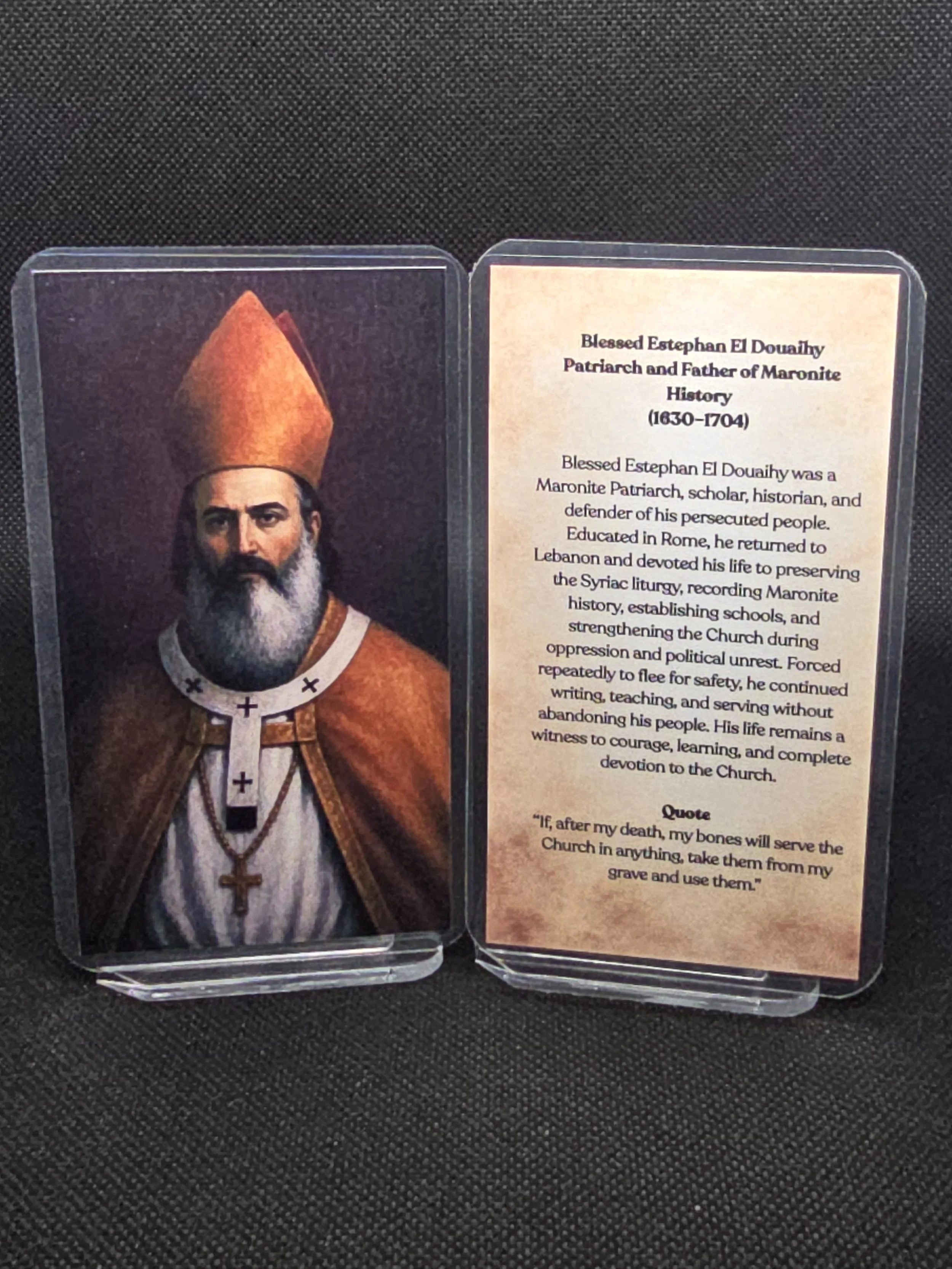
Keep this prayer card in your home as a reminder that learning and prayer can protect a people. Ask Blessed Estephan to pray for your parish.
View Prayer Card