Saint Shushanik: Armenian Born Martyr of Georgia Who Held to Christ Against Her Husband's Apostasy
A fifth century Armenian noblewoman of the Mamikonian family who refused to follow her husband into the Persian religion and whose Martyrdom is the oldest surviving original work of Georgian literature.
At a Glance
- Also known as
- Susanna of Georgia, Shushan, Shoushan, Queen Shushanik; Armenian name Vardeni (UNCERTAIN)
- Lived
- Born in the first half of the fifth century (UNCERTAIN); died about 474 or 475 at Tsurtavi
- Region
- The Georgian and Armenian frontier, Gugark and Lower Kartli, with her tomb traditionally at Metekhi, Tbilisi
- Feast day
- October 17 (Julian) in Georgian and Orthodox calendars; a later Georgian observance on August 28 (Julian); Armenian commemoration in September
- Recognition
- Venerated since antiquity; no formal canonization date is known
- Known for
- Resisting religious coercion by her husband, imprisonment and death; the Martyrdom by Jacob of Tsurtavi
Who Was Saint Shushanik?
Saint Shushanik, also called Susanna, was a Christian noblewoman of the fifth century who lived on the frontier between Armenia and Georgia. She is called a queen in devotion, but she was more exactly the wife of a frontier governor, and she was born into the Armenian Mamikonian family.
Her fame rests on a short book written soon after her death, the Martyrdom of Saint Shushanik, attributed to her priest and adviser Jacob of Tsurtavi. Georgian scholars regard it as the oldest surviving original work of Georgian literature, so she is remembered not only as a saint but as a source of a nation's written voice.
Her story deals with religious pressure inside a marriage and with violence. It should be read with care, and readers who are sensitive to those themes may want to approach it gently.
A Daughter of the Mamikonians
Shushanik was born into one of the great Christian aristocratic families of Armenia. Her father was Vardan Mamikonian, the commander who died at the Battle of Avarayr in 451 fighting Persian pressure against the Armenian Church. Through him she was connected to the family of Saint Sahak the Parthian and of Saint Gregory the Illuminator.
UNCERTAIN: her birth date and birthplace, and her mother's identity, since the surviving traditions do not agree on genealogical details. Her Armenian name is given as Vardeni or Varduhi, and Shushanik is a form of Susanna.
She married Varsken, a powerful governor of the frontier territory of Gugark, and the earliest accounts speak of three sons and a daughter. A modern scholar argues that the marriage took place before 451, but that is a reconstruction and not a recorded wedding date.
Avarayr is among the most remembered battles in Armenian history, and Vardan is honored as a saint in the Armenian Church. To be his daughter was to carry that memory into a marriage across the frontier, and the Martyrdom itself shows that her family name still mattered to the people around her.
The Apostasy of Varsken
The turning point came when Varsken visited the Persian royal court and renounced Christianity. According to the Martyrdom, he took up the king's religion and promised that his wife and children would follow. Because the Persian Empire held great power over the Caucasus, his choice was political as well as religious.
When Shushanik learned of it, she left the palace and went to a church with her children. She refused reconciliation on terms that required giving up her faith, and the account presents her decision as a refusal of coercion and not as a rejection of marriage itself.
A modern scholar places the apostasy around 466, though this is a tentative chronology. Readers should remember that the dialogues in the Martyrdom were written down as a devotional narrative, so not every conversation can be checked.
The narrative notes that the fight was over the faith of the children as much as her own. A mother who brings her sons and daughter before the altar is making a claim about who will shape their lives, and that is why the quarrel grew so bitter.
Imprisonment and Suffering
The Martyrdom describes beatings, chains and confinement in a fortress. A scene at a family meal, where she refused a cup and Varsken answered with violence, is one of the best known. The narrative describes her health failing over a long confinement, which it counts at about six years in some versions, though summaries count the years differently.
Jacob presents her in prison as a woman who kept the daily rhythm of prayer, reading Scripture and the stories of earlier martyrs, fasting and keeping vigil. People came to her for counsel and for her prayers, so her cell became a kind of spiritual center.
She learned that her children had accepted their father's religion and responded with grief and prayer. The sources examined do not tell what became of them, and it would be wrong to invent either their return to the faith or their lasting loss of it.
It is worth saying plainly that no one should read this story as advice to stay in a violent home. The Church honors her courage and her faith, and it also teaches that people in danger should seek safety and help from those who can protect them.
Death and Burial
Jacob records that she died after her long illness and suffering, with bishops, relatives, nobles and common people visiting her. He gives October 17 as the anniversary and notes that it fell on a Thursday. Many sources give the year 475, and one scholar's reconstruction favors 474, so the year is UNCERTAIN.
She asked to be buried at Tsurtavi, the place from which she had been taken. Georgian tradition later places her relics at the Metekhi Church of the Mother of God in Tbilisi, and the Orthodox Church in America dates the translation to 578 under Catholicos Kirion I.
That translation is disputed. The Armenian historian Ukhtanes wrote centuries later that he had visited and venerated her tomb at Tsurtavi, and recent research notes competing traditions about who moved the relics and when. The devotion at Metekhi is real, but the full history of the relics cannot be established.
Pilgrims have long gone to Metekhi, the church on the cliff above the Mtkvari river in Tbilisi, to pray at her tomb. Whatever the history of the relics, the prayer offered there has continued for many centuries.
The Martyrdom of Jacob of Tsurtavi
The Martyrdom of Saint Shushanik is traditionally attributed to Jacob of Tsurtavi, her priest and contemporary. The Georgian National Encyclopedia places the composition between about 476 and 483. The text gives a close and unusual picture of life in a fifth century noble household and of the way clergy, nobles and the Persian court overlapped.
The history of the text is not simple. Surviving manuscripts are later copies, the received text has been revised, and a scholar has suggested that the Georgian and Armenian versions may go back to a lost common source. It is best described as an early and valuable witness, not a pristine eyewitness manuscript.
Shushanik herself left no known writing. She did not found a monastery or a religious order, and her significance is her witness and the memory kept of it.
Politics and the Persian Empire
Shushanik lived during a long struggle between the Christian peoples of the Caucasus and the Sasanian Persian Empire. Persian kings pressed local nobles to accept their religion as a mark of loyalty, and Varsken's choice must be seen in that setting. According to the Georgian Encyclopedia, he was later executed by King Vakhtang Gorgasali, about 482, when the king rose against Persian control.
The Christian writers called the Persian religion fire worship, which reflects the language of Christian polemic and is not a neutral description of Zoroastrian belief. A fair reading keeps the historical conflict in view without turning it into an insult to another religion.
The story also reminds readers that faith in the fifth century Caucasus was tied to land, family and power, and that choosing Christ could cost a woman her home and her children.
Miracles and Devotion
TRADITION: Jacob reports that during her imprisonment people sought her prayers and that the sick were healed, sight was restored and childless families had children. These claims come from an early devotional text and cannot be independently verified. Bishop Ukhtanes also refers to miracles associated with her tomb, which is useful evidence for the growth of her cult.
Her veneration is firmly documented in both Georgian and Armenian Christianity. She appears in medieval liturgical collections and in later Armenian lives of the saints, and an early seventh century letter between the Armenian and Georgian Churches already refers to her.
No modern miracle investigation or officially approved patronage was found. Some readers look to her in cases of domestic abuse or religious coercion, but that is a devotional association and not an official patronage.
Holy Shushanik, you kept faith in a home where faith was forbidden. Pray for those who suffer pressure or violence in their own families, for mothers who weep for their children, and for the Churches of Georgia and Armenia. Ask the Lord to give us courage, patience and a heart that forgives without denying the truth.
This prayer was written for this page and is not an official liturgical text. Georgian and Orthodox services contain hymns for the saint, and one is published in the Georgian prayer collection and by the Orthodox Church in America.
Shushanik in East and West
Shushanik is honored on October 17 in the Julian calendar, which falls on October 30 in the modern civil calendar, and the Orthodox Church in America lists her on that date. Georgian calendars also keep a later feast on August 28 in the Julian calendar, which is September 10, and the Armenian Church remembers her with Saints Febronia and Mariana in September.
She belongs to the Christian history of Armenia and Georgia from before the later separation of their Churches, so no single modern nation can claim her alone. Her Armenian family and Georgian setting are both part of the story.
No feast specific to her has been found in the Roman Catholic universal calendar, but Pope John Paul II named her among the martyrs of Georgia during his visit in 1999. That is a clear sign of Catholic respect, though it is not a formal canonization.
Frequently Asked Questions
Saint Shushanik in Brief
Saint Shushanik was a noblewoman who stayed with Christ when her husband left him, and her story was written down soon enough to give a small nation its first book. Many details of her chronology and relics are uncertain, and the healing stories belong to tradition. She is a witness in both Georgian and Armenian memory.
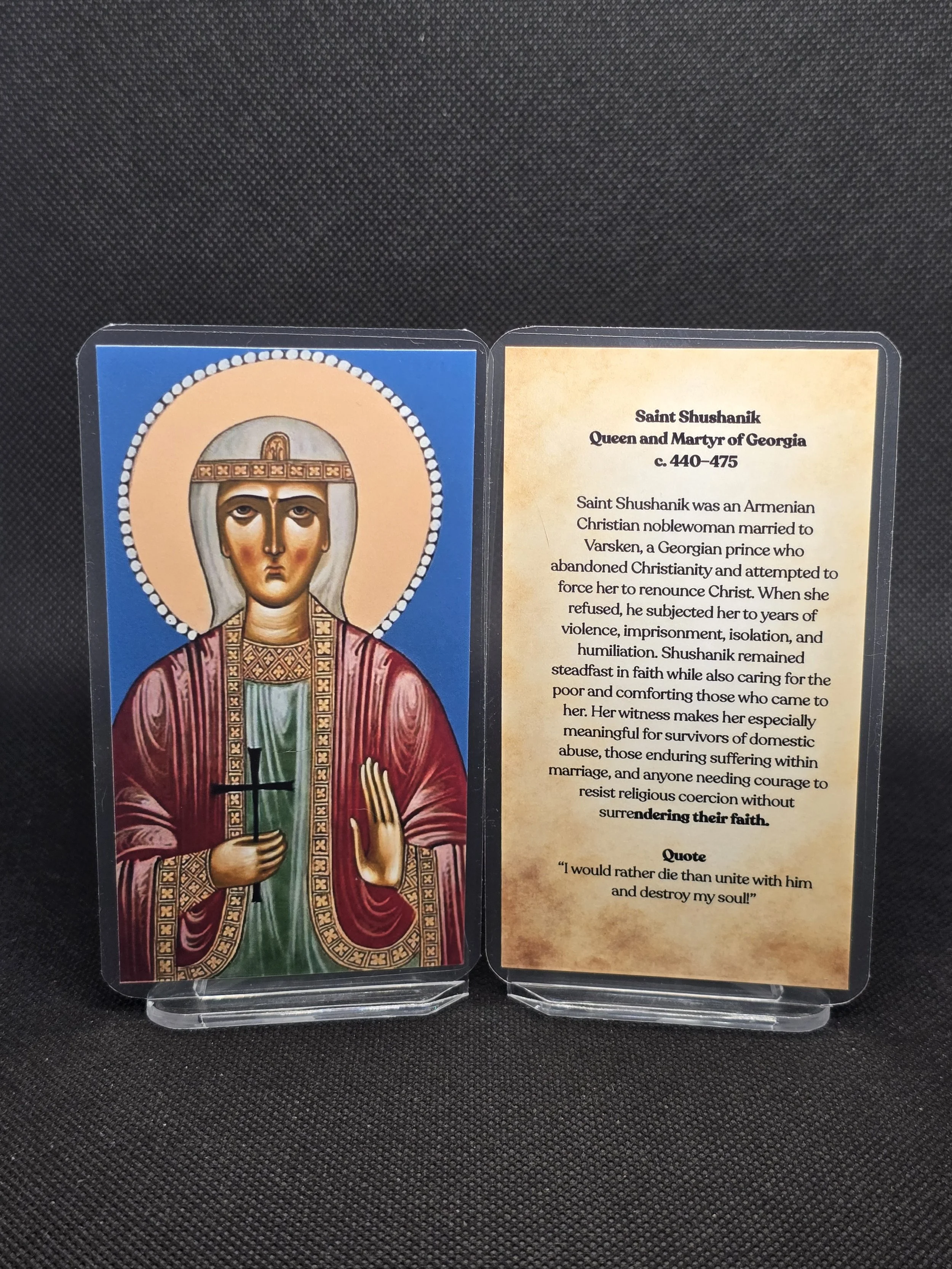
View Prayer Card