Saint Bartholomew the Apostle: One of the Twelve, Traditionally Nathanael of Cana and Martyr in Armenia
One of the Twelve Apostles, known from the Gospels only by name, often identified with Nathanael, and remembered in tradition as a missionary and martyr.
At a Glance
- Also known as
- Bartholomew, Bar-Talmai (son of Talmai); traditionally identified with Nathanael
- Lived
- First century; birth and death dates UNCERTAIN. Tradition places his death in Armenia
- Region
- Galilee (probably), with traditions of Syria, Asia Minor, India, Armenia and later the relics at Lipari, Benevento and Rome
- Feast day
- June 11 in Byzantine Orthodox churches (with Saint Barnabas), August 24 in the Roman Catholic calendar
- Recognition
- Apostle, venerated since antiquity; no canonization date
- Traditional patronage
- Tanners, leatherworkers, bookbinders and others, linked to the tradition of his flaying
- Who Was Saint Bartholomew the Apostle?
- The Name and the Family
- Is Bartholomew the Same as Nathanael?
- Bartholomew in the New Testament
- The Mission to India
- Armenia and the Apostolic Foundation
- Writings Attributed to Him
- The Traditions of His Death
- Relics, Feasts and Devotion
- Bartholomew in the Eastern Churches
- Frequently Asked Questions
Who Was Saint Bartholomew the Apostle?
Saint Bartholomew was one of the twelve apostles chosen by Jesus. His name appears in the lists of the apostles in Matthew, Mark, Luke and Acts, and that is nearly all the New Testament says about him by that name.
Almost everything else comes from later tradition. Churches in the East and West remember him as a missionary who traveled far from Galilee and died as a martyr, but they do not agree on where, when or how. This article keeps the few firm facts apart from the layers of tradition that grew around them.
He is honored by Catholic, Orthodox and Armenian Christians alike, which makes him one of the saints who truly belongs to every part of the Church.
The Name and the Family
Bartholomew is probably not a first name. It most likely comes from the Aramaic Bar Talmai, meaning son of Talmai, so it may have been a family name that stood beside a personal name. Pope Benedict XVI explained this in a general audience on October 4, 2006.
Nothing is known about his parents, his work, his education or whether he was married. The suggestion that he was a Galilean from Cana comes from the later identification with Nathanael, and it should be treated with care.
UNCERTAIN: his birth date and birthplace. Any detailed picture of his childhood belongs to imagination and not to history.
Names of this kind were common in the Jewish world of the first century, and several of the apostles are known by a patronymic such as Bar-Jonah or Bar-Timaeus elsewhere in the Gospels. Seen in that light, the name Bartholomew tells us only that he was remembered as somebody's son, and the personal side of his life remains hidden.
Is Bartholomew the Same as Nathanael?
Many readers identify Bartholomew with Nathanael, the man brought to Jesus by Philip in John 1:43 to 51. The reasoning is circumstantial but strong. In the first three Gospels Bartholomew is listed next to Philip, John's Gospel never names Bartholomew, and the first three Gospels never name Nathanael.
If the identification is right, Bartholomew's calling is the scene in John. Philip says that he has found the one promised in the Law and the Prophets. Nathanael asks whether anything good can come out of Nazareth, and Philip answers, Come and see. When Jesus meets him, Nathanael confesses him as Son of God and King of Israel.
Scholars call the identification plausible but unproved, and some Orthodox liturgical texts connect Nathanael with another apostle. The meaning of the fig tree in the story is also uncertain, and Benedict XVI said so plainly. The safest wording is that Bartholomew is traditionally identified with Nathanael.
Bartholomew in the New Testament
Bartholomew is listed among the Twelve in Matthew 10, Mark 3, Luke 6 and Acts 1. Luke says that Jesus prayed before choosing them, and Acts places Bartholomew with the apostles in Jerusalem after the Ascension.
The Gospels do not tell a separate story of his calling, and they do not record any words of his by that name. If he was Nathanael, he was also among the disciples who met the risen Lord by the Sea of Tiberias in John 21.
That is the whole firm record. It is very short, but it is enough to show that the Church has always seen him as one of the foundation stones of the apostolic company.
The apostles lists themselves are worth reading closely. Bartholomew is always found in the middle of the list, usually beside Philip, and he is never singled out for a speech or a miracle. That silence is typical of many of the Twelve, and it should not be mistaken for unimportance.
The Mission to India
The earliest report of an apostolic mission connected with Bartholomew comes from Eusebius of Caesarea in the early fourth century. He says that Pantaenus, a Christian teacher of Alexandria, traveled to a country called India and found Christians who owned a Gospel of Matthew in Hebrew letters, left there by Bartholomew.
Eusebius passes this on as report and not as eyewitness history, and the Gospel has not survived. The word India was used loosely in antiquity, and it could mean southern Arabia or Ethiopia as well as the subcontinent. The fifth century writer Socrates Scholasticus repeats the tradition, which shows it lasted but does not prove it.
UNCERTAIN: whether Bartholomew ever reached India. Later Eastern accounts also send him to Syria, Asia Minor and Phrygia, often with the apostle Philip and Mariamne, but those are hagiographical narratives.
Other traditions send Bartholomew to places far from Galilee, and Church writers over the centuries have found it natural to imagine the apostles scattering to every corner of the known world. Some of these journeys are likely to be legends that grew with retelling, while others may preserve real memories of early missionaries whose names were lost.
Armenia and the Apostolic Foundation
The Armenian Apostolic Church counts Bartholomew and Thaddeus as the apostles who first preached in Armenia. Its tradition places his martyrdom in the region of Vaspurakan and gives the year 66, while an Orthodox account gives 71. Neither date is independently established.
Scholars separate the older Armenian Christian heritage from later claims about the apostles. Armenia certainly became Christian early, and the fourth century conversion associated with Gregory the Illuminator is much better documented than the travels of Bartholomew.
A tradition can preserve a true religious memory without every detail being historical. The Armenian Church's claim to apostolic roots has been important to its identity for centuries, and it should be respected as such while the evidence is described honestly.
The Armenian account also tells of royal converts, among them Queen Vogouhi and the commander Terentius, who are said to have died as martyrs under King Sanatruk. These stories belong to the Church's devotional history and are not otherwise documented.
Writings Attributed to Him
No authentic writing of Bartholomew survives. A work called the Questions of Bartholomew, sometimes linked to a Gospel of Bartholomew, belongs to later apocryphal literature. Modern scholars generally date it to the third or fourth century.
The Questions contain visionary conversations about Christ, the Virgin Mary, the descent to the dead and Satan. They are interesting for the history of early Christian imagination but they do not give reliable information about the apostle.
Readers who find his name on a text should therefore ask whether it was written in the first century. In his case the answer is no, and the Church has never treated these works as Scripture.
The Traditions of His Death
No early source establishes where, when or how Bartholomew died. The best known tradition says he was flayed alive in Armenia. Other accounts describe crucifixion, beheading or a combination of punishments.
The Catholic Encyclopedia records a tradition that places his death at Albanopolis and blames a ruler named Astyages after the conversion of King Polymius. The Orthodox Church in America preserves a related story set at Alban, which that tradition identifies with Baku. The Armenian Church gives a different place and date in Vaspurakan.
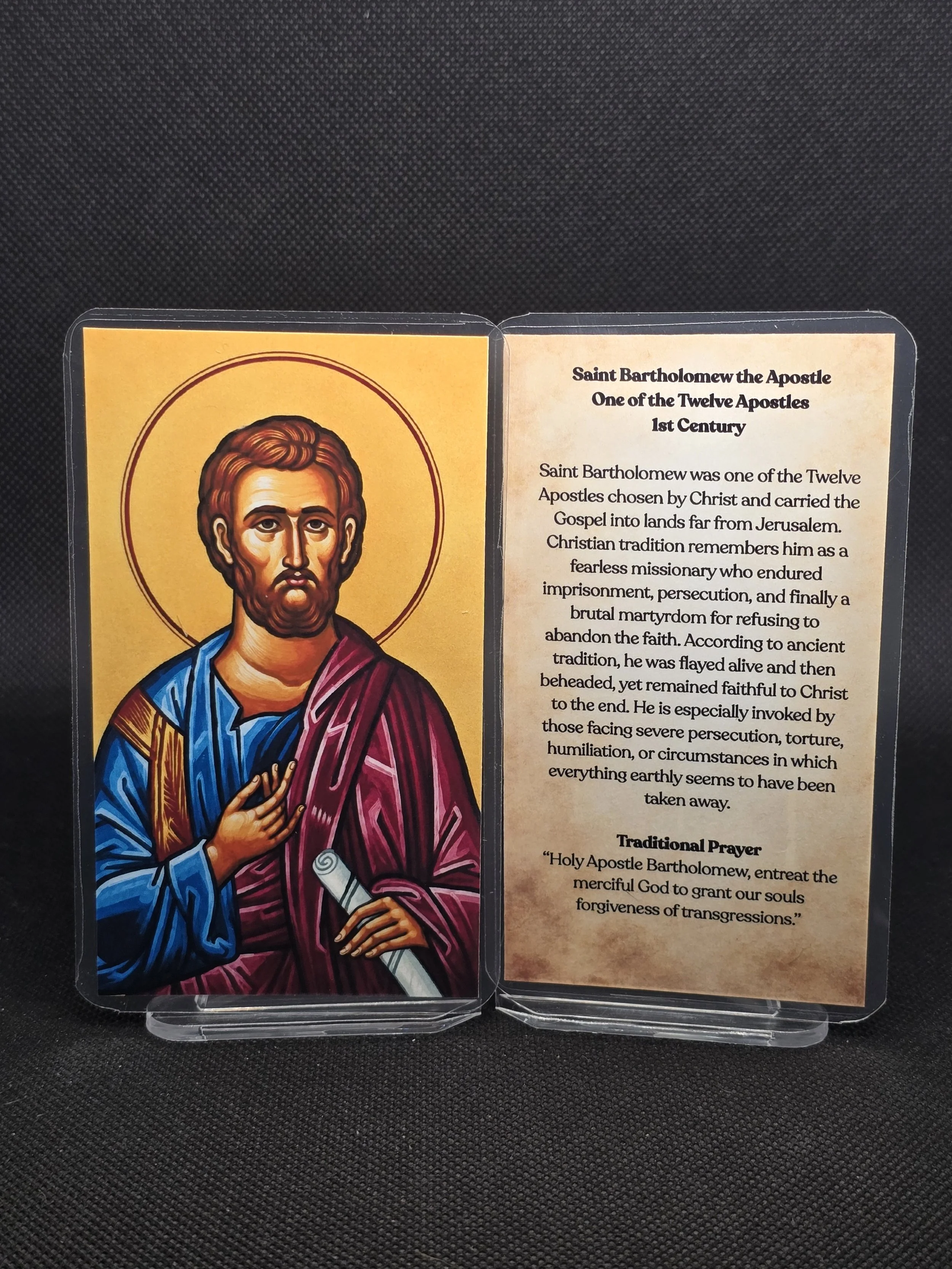
These accounts should not be combined into a single story. Their differences are a sign of separate lines of transmission, and the image of the apostle holding a knife or his own skin comes from this martyrdom tradition. It is well known in art, including in Michelangelo's Last Judgment, but it is not independently established history.
The legend of the flaying has shaped how he is painted and remembered more than any other detail. It is worth saying that this image has comforted many Christians who suffered for the faith, and that its comfort does not depend on proving that every part of the story happened as told.
Relics, Feasts and Devotion
The history of his relics is better recorded than his death, though it begins long after it. Tradition says the apostle's remains came by sea to the island of Lipari, were moved to Benevento in 838 or 839 and were later brought to Rome. A recent scholarly study examines an early ninth century account of the move to Benevento, but even that cannot prove that the relics are the apostle's.
The Basilica of San Bartolomeo all'Isola in Rome claims relics beneath its high altar, and its history connects the foundation with Emperor Otto III. The basilica gives 998 while Benedict XVI gave 983 for the translation, so some details remain disputed.
The Roman Catholic calendar keeps his feast on August 24. Byzantine Orthodox churches keep June 11, together with Saint Barnabas, and mark a translation of his relics on August 25. The Armenian Apostolic Church remembers him with Saint Thaddeus. Traditional stories include the healing of Stachys and the conversion of the family of King Polymius, and they are devotional narratives and not documented events.
The movement of relics across the Mediterranean in the early Middle Ages was a political as well as a religious matter. Rulers and bishops gained prestige by possessing an apostle, and later writers often adjusted the accounts to suit their own city. That is why modern historians approach the relic stories with caution, while still respecting the devotion of those who venerate them.
Holy apostle Bartholomew, you came to the Lord when you were told, Come and see. Pray for us who doubt, for those who bring Christ to distant places, and for all who work with their hands. Ask the Lord to make us honest in heart and faithful to the end.
This prayer was written for this page and is not an official liturgical text. Orthodox and Armenian services contain hymns for the apostle, and those should be used for public worship.
Bartholomew in the Eastern Churches
Bartholomew belongs to the apostolic age, before any division of the Churches, so he is honored by Eastern Catholics, Eastern Orthodox and Oriental Orthodox Christians alike. In Eastern icons he appears among the Twelve, often holding a book or a scroll, and in some images a knife.
The Armenian Church gives him a special place as one of its two founding apostles. Byzantine hymns and the synaxarion repeat the stories of Philip, Mariamne and the apostolic mission, and they are best read as liturgical tradition.
For readers of any Church, the quiet man behind the name is a reminder that most of the apostles are known more by what they did than by what was written about them.
Frequently Asked Questions
Saint Bartholomew in Brief
Saint Bartholomew is one of the Twelve, known by a name and by a call, Come and see. The path from Galilee to Armenia is told by tradition, and it deserves to be received as tradition. What is firm is that he was chosen by Christ and has been honored in every part of the Church.
View Prayer Card