Saint Ignatius Maloyan: Armenian Catholic Archbishop of Mardin and Martyr of 1915
An Armenian Catholic priest trained at Bzommar who became archbishop of Mardin, was arrested during the Armenian Genocide, refused to renounce Christ and was canonized in 2025.
At a Glance
- Also known as
- Ignatius Choukrallah Maloyan, Ignazio Maloyan; baptized Shoukrallah (spellings vary)
- Lived
- Born April 15, 1869 at Mardin (other sources give other April dates, UNCERTAIN); died June 11, 1915 near Karakopru, aged 46
- Region
- Mardin in the Ottoman Empire (now southeastern Turkey), Bzommar in Lebanon, Egypt
- Feast day
- June 11
- Recognition
- Beatified by Pope John Paul II on October 7, 2001; canonized by Pope Leo XIV on October 19, 2025
- Church
- Armenian Catholic Church, an Eastern Catholic Church in communion with Rome
Who Was Saint Ignatius Maloyan?
Saint Ignatius Maloyan was an Armenian Catholic archbishop who was killed in June 1915 during the Armenian Genocide. For most of the twentieth century he was little known outside his own Church. Pope John Paul II beatified him in 2001, and Pope Leo XIV canonized him on October 19, 2025, so the older title Blessed no longer applies.
His life was not dramatic until its final weeks. He was a priest, a preacher, a church administrator and a pastor who spent years in Egypt before being sent home to the troubled diocese of Mardin. What makes him remembered is the way he faced arrest and death with the people he was responsible for.
This article separates three things: what historians document about the destruction of Mardin's Christians, what the Catholic Church has officially recorded about him, and the devotional details that come only from later accounts.
Childhood in Mardin
Maloyan was born in Mardin, then an Ottoman city, and the date given in the Vatican's canonization biography is April 15, 1869. Other sources give a different day in April, so the exact date is UNCERTAIN. The Vatican names his parents as Melkon and Faride.
Mardin was a mixed city. Armenian Catholics, Syriac Catholics, Syriac Orthodox, Chaldeans and Muslims lived near one another, and several languages were heard in its streets. Growing up in that setting probably prepared him for ministry among very different communities.
The records say little about his father's work or the family's income, and it is better not to invent those details. What is recorded is that his parish priest noticed a vocation in him and arranged for him to study away from home.
The Armenian Catholic community of Mardin was a minority within a minority. Its bishops had to deal with the Ottoman authorities, with rival Christian communities and with their own Church leadership in Beirut and Rome. A boy who grew up there learned early how much a bishop depended on trust.
Training at Bzommar
At about the age of fourteen, around 1883, Maloyan entered the Patriarchal Clergy Institute at Bzommar in Lebanon. It was an important center of Armenian Catholic priestly formation, where students studied philosophy, theology, Scripture and the discipline of prayer.
He was ordained a priest in 1896 and took the name Ignatius, after the early martyr bishop of Antioch. The exact day is UNCERTAIN. The canonization booklet links it to the feast of Corpus Christi, an earlier Vatican biography associates it with the Sacred Heart, and one database gives July 12, 1896. The safe statement is that he was ordained in 1896.
Vatican News reports that he came to know several languages, including Armenian, Arabic, Turkish, French, Italian and English. How well he knew each of them is not independently established.
Priest in Egypt
The Vatican biography places his early priestly service mainly in Egypt, in Alexandria and Cairo, between about 1897 and 1910. He ministered to Armenian Catholics living far from their homeland and was known for preaching and for sacramental care.
In 1904 the Armenian Catholic Patriarch Boghos Bedros XII appointed him as an assistant. Poor health, including trouble with his eyes and breathing, made some of his assignments harder.
These years matter because they show a priest used to the quiet daily work of the Church, not someone seeking a place in history.
Egypt had a large and lively Armenian presence at that time, and priests there ran parishes, schools and charities with very little money. The sources give few personal details about these years, so it is better not to add stories that no document supports.
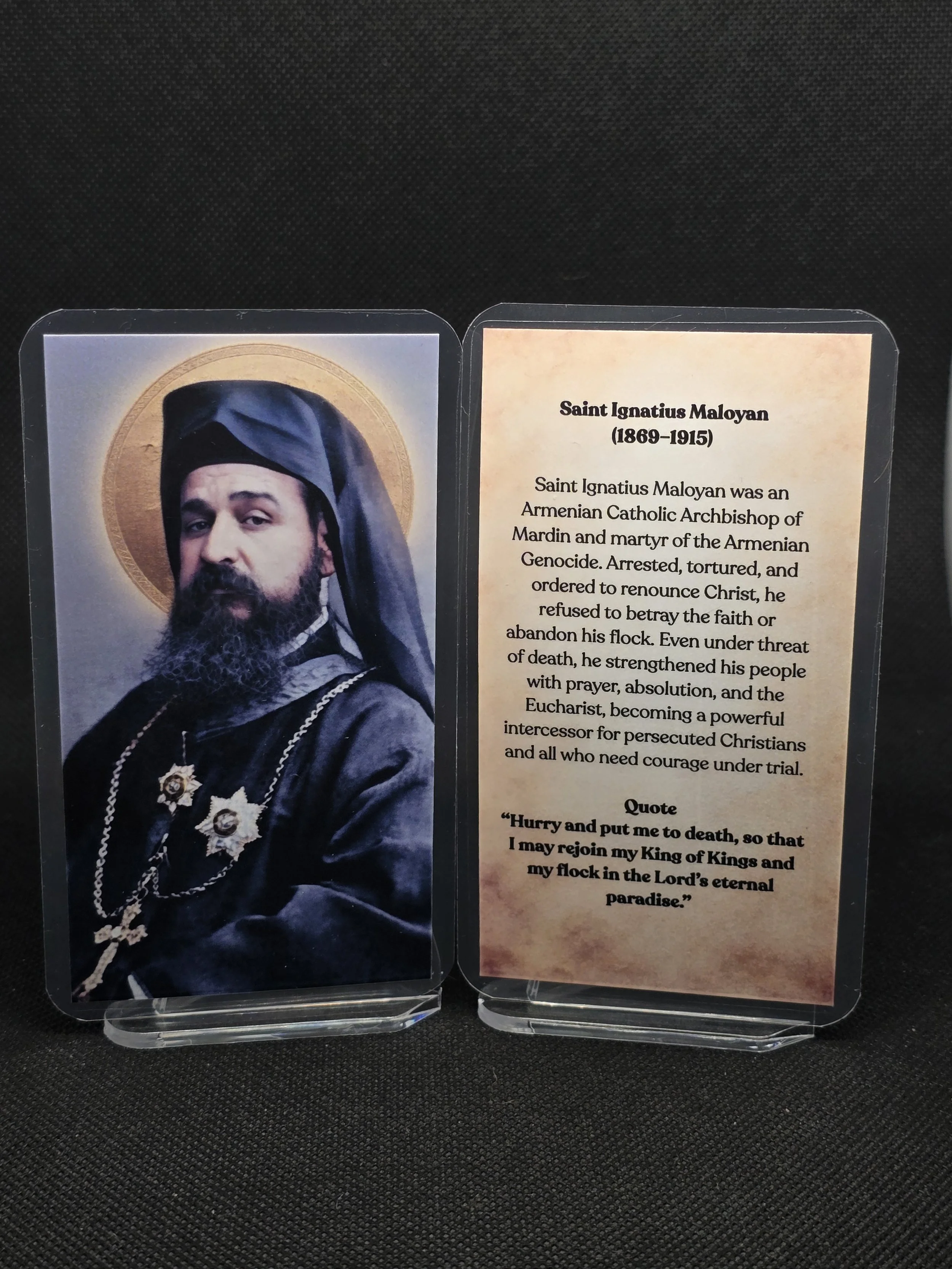
Archbishop of Mardin
The diocese of Mardin was in serious internal difficulty when Patriarch Sabbaghian sent Maloyan to restore order. The synod of Armenian Catholic bishops, meeting in Rome, elected him archbishop of Mardin, and he was consecrated on October 22, 1911. Election and consecration are separate events and should not be confused.
The official canonization biography lists his main work as forming priests, visiting the faithful, reopening schools and restoring churches. He encouraged devotion to the Eucharist and to the Sacred Heart of Jesus.
No new religious order, monastery or charity founded by him could be verified. Restoring institutions is not the same as founding them, and his surviving writings are limited. Vatican News mentions a handwritten letter and a spiritual testament to his priests in May 1915, but there is no complete catalogue or critical edition of his writings.
A bishop sent to repair a divided diocese needs patience more than eloquence. The records suggest that Maloyan went back to Mardin in that spirit, and the church repairs and reopened schools can be read as quiet signs of it.
Mardin in 1915
Maloyan's martyrdom took place during the Armenian Genocide, carried out under the Ottoman Committee of Union and Progress during the First World War. Deportation, dispossession, imprisonment and mass killing were directed mainly at Armenians, and Syriac, Assyrian and Chaldean Christians also suffered terrible violence in the same region.
The Vatican biography reports that on April 30, 1915 soldiers surrounded the Armenian Catholic church buildings in Mardin, claiming that weapons were hidden there. The Dicastery for the Causes of Saints calls the accusation false, and no credible source examined shows that Maloyan took part in any armed plot.
Historians such as Raymond Kevorkian describe a roundup of Mardin's Christian notables, clergy and laymen during June 3 to 5, 1915, and the figure of 1,062 people is given for that wider arrest. An eyewitness report from a Chaldean cleric, dated 1919 and published by the historian Ara Sarafian, is an important independent source.
It is important not to treat Mardin as an isolated story. The same weeks saw arrests and killings in neighboring towns, and many of the dead were Armenian Apostolic, Syriac and Chaldean Christians whose names are not remembered by the wider world.
Arrest and Refusal
Maloyan was arrested on June 3, 1915. Church accounts say that he was interrogated, beaten and imprisoned, and that a police official repeatedly pressed him to renounce Christianity and become a Muslim. According to the Vatican's beatification biography he refused, and the same biography reports torture that included the removal of his toenails.
Historians identify the official concerned as the commissary Memduh, though his name is spelled in several ways. They also stress that the killings were organized by provincial authorities and armed groups, so they were not a private quarrel between a bishop and one policeman.
The Church recognizes his death as martyrdom because of his refusal to abandon the faith. That judgment does not remove the fact that Armenians were targeted as a people. Both truths belong together.
Readers should be cautious with graphic retellings found online. The Vatican biography reports the torture briefly, and it is wiser to rest on the official account and the careful historians than on dramatic details that have no clear source.
The Last Journey and Death
After imprisonment, Maloyan and other Christian prisoners were taken out of Mardin toward the places of execution. The Vatican accounts say the archbishop encouraged his companions, prayed with them and prepared them for death. The canonization booklet describes him taking bread, praying the Eucharistic prayer and giving Communion to the condemned as viaticum, the Eucharist given for the journey through death.
He was killed near Karakopru, and the official Catholic date is June 11, 1915, though historical chronologies place the surrounding killings across June 10 and 11. The number of prisoners in the final convoy is UNCERTAIN. The Vatican gives 447 in one place and 417 in a more recent account, and scholars give other figures for different groups.
TRADITION: the beatification biography preserves a story from a soldier who said he saw a cloud and smelled a fragrance over the prisoners as they received Communion. The witness cannot be identified, so it should be read as devotional testimony and not as established history. Words attributed to Maloyan, including a refusal to deny Christ, come through official Church accounts and not through surviving handwriting. No burial place or authenticated bodily relics are known.
Beatification and Canonization
Pope John Paul II beatified Ignatius Maloyan, together with other servants of God, on October 7, 2001. In his homily the pope spoke of Maloyan's preaching, his sacramental ministry and his service to people in need.
Pope Francis approved the decision to proceed with his canonization on March 28, 2025. Pope Leo XIV then canonized him at Saint Peter's Square on October 19, 2025. The published decree does not describe a particular miracle, and none should be assumed.
His devotion is strongest in Armenian Catholic communities. Schools and parishes have held liturgies and blessed images of him since the canonization, and June 11 is his memorial.
His canonization came more than a century after his death. For many Armenian families it gave public recognition to a grief that had long been carried in private.
Holy martyr Ignatius, shepherd of Mardin, you stayed with your people when danger came and fed them with the Bread of Life. Pray for persecuted Christians, for the families of the genocide victims, and for all pastors who must lead in fear. Ask the Lord to give us courage, mercy and peace.
This prayer was written for this page and is not an official liturgical text. No troparion specifically for Saint Ignatius Maloyan could be verified. The Armenian Apostolic Church has an official service of intercession for the martyrs of the genocide as a group.
Maloyan and the Eastern Churches
Maloyan was an Armenian Catholic from childhood to death. He was not Armenian Apostolic and not Eastern Orthodox. His canonization is a Catholic act, and no individual glorification of him by the Eastern Orthodox Churches could be verified, so it would be wrong to say that he is venerated by all Christians.
The Armenian Apostolic Church canonized the martyrs of the Armenian Genocide as a group on April 23, 2015, and keeps their memory on April 24. That commemoration is separate from Maloyan's June 11 memorial, and it does not name him individually. Still, it shows that Armenian Catholics and Armenian Apostolic Christians remember the same catastrophe and the same martyrs.
For Eastern Catholics he is a reminder of how much their Churches suffered at the end of the Ottoman Empire. For Orthodox readers his significance is mainly historical and spiritual, a witness to pastoral fidelity under persecution.
Frequently Asked Questions
Saint Ignatius Maloyan in Brief
Saint Ignatius Maloyan was a pastor who gave Communion to his fellow prisoners and refused to deny Christ. The documented history of Mardin in 1915 is painful, and the cloud and fragrance are part of devotional tradition. He is remembered with respect for the many others who died beside him.
View Prayer Card