Saint Nilus the Younger: Italo-Greek Monk, Hymnographer and Founder of Grottaferrata
A Greek monk of Byzantine Calabria who married, became a hermit, befriended Latin monks, pleaded for a mutilated antipope and set in motion the founding of Grottaferrata.
At a Glance
- Also known as
- Nilus of Rossano, Nilus of Calabria, Nilus of Grottaferrata
- Lived
- Born about 910 at Rossano (year reconstructed, UNCERTAIN); died in September 1004 near Tusculum, most likely on the evening of September 25
- Region
- Byzantine Calabria, Lombard southern Italy, Montecassino, Gaeta and Grottaferrata near Rome
- Feast day
- September 26
- Recognition
- Venerated since antiquity; no formal canonization date is known
- Known for
- Monastic leadership, manuscript copying, hymns, appeals to rulers and inspiring the Grottaferrata monastery
- Who Was Saint Nilus the Younger?
- Early Life in Rossano
- Marriage, Illness and Conversion
- The Hermit of Mercurion
- Monastic Communities and Public Life
- Among the Latin Monks
- Writer, Copyist and Hymnographer
- The Appeal for John Philagathos
- Grottaferrata, Death and Veneration
- Nilus and the Eastern Churches Today
- Frequently Asked Questions
Who Was Saint Nilus the Younger?
Saint Nilus the Younger was a Greek speaking monk of southern Italy who lived in the tenth century. He is also called Nilus of Rossano after his home town, and the word Younger distinguishes him from an earlier Nilus who is associated with Sinai and with Greek ascetical writing.
His life is known mainly from a Greek Life written soon after his death. Modern scholars treat that Life as a valuable source, while reading its miracle stories with care. Nilus is not a figure of pure legend. He copied manuscripts that still survive, and he moved among emperors, popes and abbots whose names can be checked in other records.
He is best remembered as the spiritual father whose last foundation became the Abbey of Santa Maria di Grottaferrata, a Byzantine monastery near Rome that has kept the Greek liturgy for about a thousand years.
Early Life in Rossano
Nilus was born around 910 in Rossano, a Greek speaking city of Byzantine Calabria. The year is worked out from the age given in his Life and is not independently fixed. The Life says he was the second son of his parents and was dedicated to the service of the cathedral church of the Mother of God, where he received minor orders, probably no higher than reader.
After the death of his parents an older sister helped to raise him. He received a good education in Scripture, the Fathers and Greek letters, and this learning shaped everything that followed.
Some later sources give his baptismal name as Nicholas. Modern scholarship notes that this detail first appears in a text written long after his lifetime, so it is better treated as later tradition than as a contemporary fact. UNCERTAIN: his original name.
Rossano in these years was a place where Greek was the language of church and court, and where the authority of Constantinople was felt through taxes, soldiers and bishops. A boy raised in its cathedral learned to live inside that Byzantine world long before he met Latin monks in the north.
Marriage, Illness and Conversion
Nilus did not begin life as a monk. According to the Life, he married a woman of Rossano and had a daughter, and modern biographers accept this account. His early adult years were those of an ordinary householder in a frontier region.
Around the age of thirty, about the year 940, a serious illness became the turning point. His biographer presents it as the occasion for repentance and for a decision to live as a monk.
The practical details are revealing. He first approached the monks of Mercurion, a monastic district on the border of Calabria and Lucania, but was not given the habit there. One likely reason, suggested by a modern scholar, is that Byzantine rules complicated monastic entry for a man who still held property. He therefore travelled to the Lombard principality of Salerno and received the habit at the monastery of Saint Nazarius.
A man who enters monastic life at thirty, with a wife and child behind him, is not unusual in the history of Eastern monasticism. His Life gives few details about what happened to his family, and it is better not to guess.
The Hermit of Mercurion
Nilus returned to Mercurion and lived among its monks, where he came to know Saint Fantinus the Younger. The friendship is attested not only in the Life of Nilus but also in the early Life of Fantinus, which gives helpful independent support.
He then withdrew to a mountain cave that held an altar dedicated to Saint Michael the Archangel. His days were organized around prayer, the Divine Office, fasting, reading of the Fathers and the copying of books.
The importance of this period is easy to miss. Nilus did not choose solitude as an escape from learning or from people. His later life shows a monk who kept silence, scholarship and care for others closely joined.
Monastic Communities and Public Life
When Muslim raids made Mercurion unsafe, Nilus settled near Rossano around the oratory of Saint Adrian. Disciples gathered, and the place grew into a communal monastery. His disciple Proclus became the first formal superior, because Nilus consistently avoided titles and church office. The common description of Nilus as an abbot is therefore a traditional shorthand and not a precise record.
His Life also shows him taking part in public affairs. During a crisis after the Byzantine defeat at Rametta in 964, he is said to have helped lessen the punishment threatened against the people of Rossano for resisting demands for naval service.
These episodes show a holy man who was trusted by his neighbors because he spoke honestly and wanted nothing for himself.
The story of Proclus is worth remembering. A teacher who steps back so that a disciple can bear the title is a rare thing, and later generations at Grottaferrata would repeat the same pattern, with Nilus as the guide and others as the formal heads of the house.
Among the Latin Monks
About 980 Nilus left Calabria with a group of disciples and entered Lombard territory. He was received in Capua and later hosted by the Benedictines of Montecassino at their dependency of Saint Michael of Valleluce.
The Life describes a notable meeting between Greek and Latin monasticism. The Benedictines invited the Greek monks to celebrate services in Greek, and Nilus composed liturgical poetry in honor of Saint Benedict. Few surviving texts show so clearly two monastic traditions treating one another as brothers.
Nilus later left Valleluce, and the reasons were not only spiritual. Disagreements about monastic discipline played a part, as did the usual pressures of political change in the region.
Writer, Copyist and Hymnographer
Nilus was a working scribe. Three manuscripts in the library of Grottaferrata are identified by scholars as written in his own hand, and they are catalogued by the abbey with the shelf marks B.α.XIX, B.α.XX and B.β.I.
He also composed religious poetry and hymns, including an office for Saint Benedict and verses in honor of other saints. His Life mentions letters sent to church and secular leaders, but no independent collection of his letters has survived.
The picture is of a monk whose daily labor was reading, copying and singing. His best known legacy for later generations is a library and a liturgical tradition as much as any single famous saying.
The Appeal for John Philagathos
The most dramatic episode of his old age concerns John Philagathos, a Calabrian Greek who had risen high at court and was set up as the antipope John XVI. In 998 his rival forces defeated him, and he was captured and horribly mutilated.
Nilus travelled to Rome and appealed to Pope Gregory V and Emperor Otto III on behalf of the prisoner. According to the Life, he asked that Philagathos be given into his care. The appeal failed.
It would be a mistake to read this as support for Philagathos's claim to the papacy. It was an act of mercy toward a countryman and fellow Greek, made at personal risk. The Life adds that Otto III later visited Nilus near Gaeta and showed him great respect, while the old monk declined an offer of imperial patronage.
Another detail from the Life is the sense that Nilus, then very old, undertook this journey on foot and in fragile health. Modern readers may think of it as an early example of a monk using his reputation for the good of someone with no power at all.
Grottaferrata, Death and Veneration
In 1004, weakened by age, Nilus left Serperi and moved toward Tusculum. He stopped at the Greek monastery of Saint Agatha, where he gave final instructions about his burial and about the future community. A modern scholar, using the Life and an inscription dated to the Byzantine year 6513, argues that he died on the evening of September 25, 1004. The Church commemorates him on September 26. Older reference works gave 1005, but that date is hard to reconcile with the inscription.
The monastery of Santa Maria di Grottaferrata was begun in 1004 on land given by Gregory, Count of Tusculum. Nilus died in its earliest phase, and his disciple Saint Bartholomew carried the work forward. Pope John XIX consecrated the abbey church on December 17, 1024.
TRADITION: the abbey's own history connects the foundation with an appearance of the Virgin Mary, but this is part of its devotional story and not an independently documented event. UNCERTAIN: the present location of all his relics. Devotion remains strong at Grottaferrata and at Rossano, where he is honored as patron.
Holy Father Nilus, you left the quiet of the mountain to plead for the suffering and refused honors for yourself. Pray for monks and nuns, for scribes and singers, and for all who work for peace between Christians. Ask the Lord to give us meekness, zeal and faith.
This prayer was written for this page and is not an official liturgical text. A troparion to Saint Nilus is printed in the publication of the Byzantine Catholic Eparchy of Lungro, and its sense is that he combined the meekness of Moses, the zeal of Elijah and the faith of Abraham.
Nilus and the Eastern Churches Today
Nilus lived before the formal break of 1054, so describing him as an Eastern Catholic or an Orthodox saint in the modern sense would be anachronistic. What can be said plainly is that he was a Greek speaking Byzantine monk whose monastery is today a Byzantine Catholic community in full communion with Rome, and that Orthodox communities also commemorate him on September 26.
Grottaferrata is one of the few monasteries of the Italo-Greek tradition that never lost its Byzantine rite. Its continuity is an unusual sign that Greek and Latin Christians once lived side by side in Italy, and that cooperation between them has deep roots.
Readers should avoid making him a spokesman for modern ecumenical projects. His importance is simpler. He shows what a holy life looked like in one border region of Christendom, and he treated Latin monks as brothers.
Frequently Asked Questions
Saint Nilus in Brief
Saint Nilus the Younger was a husband and father who became a monk, a hermit who became a counselor of kings, and a copyist and poet whose final foundation still sings the Greek liturgy near Rome. The facts of his life are well attested. The miracles are part of the tradition and should be received with that distinction in mind.
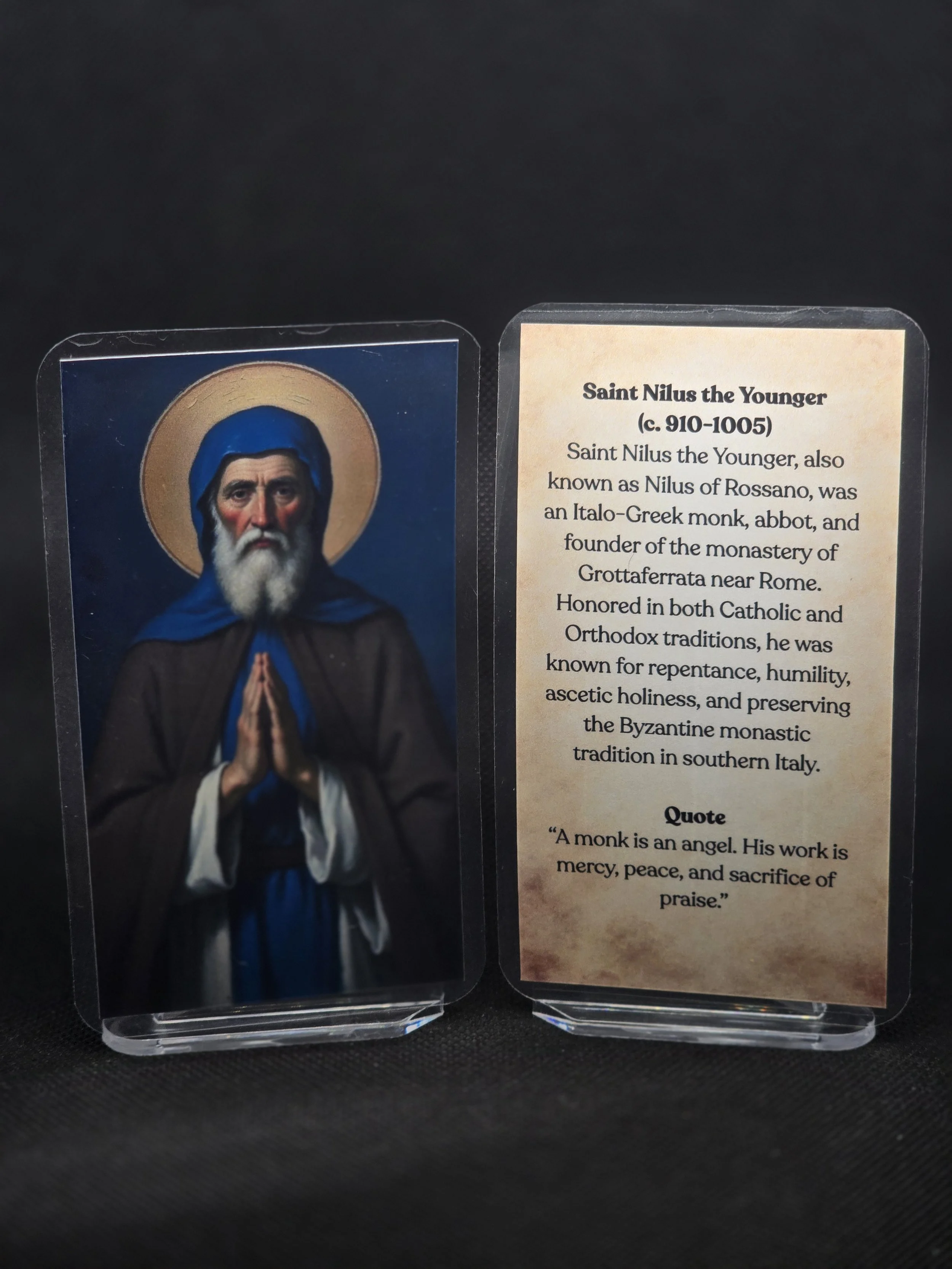
View Prayer Card