Saint Feofil of Kiev: The Holy Fool of the Kyiv Caves and the Kitaiv Hermitage
A priest and hieroschemamonk of nineteenth century Kyiv who lived as a fool for Christ, was restricted by his own metropolitan, and was glorified a century and a half after his death.
At a Glance
- Also known as
- Theophilus of Kiev, Feofil of Kitaiv; born Foma Gorenkovsky
- Lived
- Born October 1788 at Makhnovka (exact day UNCERTAIN); died October 28, 1853 (Julian calendar) at Kitaiv near Kyiv
- Region
- Kyiv, the Kyiv Caves Lavra, Holosiiv Hermitage and Kitaiv Hermitage in present day Ukraine
- Feast day
- October 28 (Julian), which falls on November 10 on the civil calendar for Julian churches; also July 27 for his glorification
- Status
- Glorified by the Ukrainian Orthodox Church on July 27, 1993; church-wide veneration approved by the Russian Orthodox Church in 2016
- Patronage
- None formally established; sought for counsel and prayer in illness and distress
Who Was Saint Feofil of Kiev?
Saint Feofil, in English also called Theophilus, was a monastic priest of nineteenth century Kyiv who lived as a fool for Christ. He wore odd clothing, kept few possessions, spoke in riddles and symbolic acts, and drew visitors who sought his prayers and counsel.
A correction before we begin. Feofil is sometimes called a metropolitan of Kiev. He was not. He was a hieroschemamonk, which means a priest who had also taken the Great Schema. The metropolitan of his day was Filaret Amphiteatrov, a separate man, and the 2016 decree of the Russian Orthodox Church treats the two saints separately.
We rely mainly on an early biography by Father Vladimir Znosko, published in 1906, which draws on recollections, oral tradition and some monastic records. We use it carefully. Throughout we mark devotional accounts as TRADITION and unclear points as UNCERTAIN.
Childhood and Family
Feofil was born as Foma Andreevich Gorenkovsky in October 1788 at Makhnovka, in the Kyiv region. His father, Andrei, served in the church there, and his mother is named Euphrosyne in Znosko. He is described as the elder of twin sons, and his brother was called Kallinik. These details come from a biography written long afterward, and no baptismal records are reproduced.
TRADITION: Znosko tells that the infant would not take milk, that his mother came to fear him as an unnatural child under the influence of superstitious neighbors, and that there were attempts to drown him, ending with a mill wheel that stopped. We tell this as a story handed down and not as a documented event. It is also a reminder of how fearful rural superstition could be.
The accounts say he passed through the households of a miller, a priest and a church elder, and was orphaned at about seven. An uncle who was a monk of the Brotherhood Monastery in Kyiv then cared for him. He studied in the circle of the Kyiv Mohyla Academy, but his education ended when his uncle died and support stopped.
Singer, Novice and Monk
In 1810 he is recorded as a reader or cantor at Chyhyryn and then as a sexton at Obukhiv. In 1812 he entered the Kyiv Brotherhood Monastery as a novice, where he baked bread, worked in the kitchen, helped in church and rang bells. Znosko treats these humble tasks as the foundation of his monastic discipline.
The standard chronology is clear and agrees between Znosko, the Russian Biographical Dictionary and the Kyiv Theological Academy. He was tonsured a monk on December 11, 1821, and given the name Feodorit. He was ordained a hierodeacon on September 30, 1822, and a hieromonk on February 6, 1827. He received the Great Schema on December 9, 1834, and the name Feofil.
UNCERTAIN: The historic grave inscription, which Znosko reproduces, gives January 6, 1827 for his ordination and December 9, 1824 for the Schema. The biography and later institutional accounts support the other dates, but the cause of the discrepancy cannot be settled without original records.
The Turn to Holy Foolishness
After he was made steward of the Brotherhood Monastery, Feodorit longed for a more hidden life. He asked permission to withdraw to caves linked by tradition with Saint Theodosius of the Kyiv Caves, near Lisnyky. The request was refused.
The biographies treat this as the turning point. He did not gain an office. He chose a way of life that accepted humiliation, misunderstanding and the loss of ordinary religious standing. It was an ascetic choice and not a promotion.
Holy foolishness in Slavic Christianity is called yurodstvo. It uses apparent absurdity and voluntary disgrace to confront pride, and to separate reputation from holiness. It rests on Saint Paul's words about being fools for Christ, and it has a long history in the Christian East.
Life as an Elder
Accounts describe him in patched or mismatched clothes, living in deliberate disorder and mixing different foods in a single dish. He was often seen with a Psalter. One well known tradition shows him traveling about Kyiv in a small cart drawn by an ox, sometimes sitting with his back to the animal while he prayed.
An English language Orthodox biography says that he made stockings and wove cloth, giving them to others, including icon painters. This homely work went along with his prayer and with his meetings with pilgrims.
He is linked with the Kyiv Caves Lavra, the Holosiiv Hermitage and the Kitaiv Hermitage. The Russian Biographical Dictionary places him at Holosiiv by late 1844 and records his move to Kitaiv on April 29, 1849. He wrote no known books or letters. What we know of his words comes from other people's memories.
The Restriction Under Metropolitan Filaret
His behavior often troubled his superiors. In 1845 he was described as obedient, orderly, meek and humble. By 1848 his superiors judged him obstinate and unsuitable for ordinary duties. These reports are better historical evidence than many of the miracle stories, even though they survive in a later publication.
On October 20, 1848, after an examination ordered by Metropolitan Filaret, a report concluded that Feofil could not celebrate the services correctly and in good order. Filaret forbade him to take part in priestly celebration, though he allowed him to receive Communion on set conditions.
A serious biography should not leave this out, and it should not exaggerate it. There is no record that he was defrocked. The surviving account documents a restriction on his ministry and not a deposition from the priesthood. Znosko also describes tension with the superior at Kitaiv over his visitors and manner, but he writes as a friend of Feofil, so we read that carefully.
Prophecies and Wonders
TRADITION: He is credited with foretelling the founding of a monastery of the Holy Trinity, a hermitage of the Transfiguration, and the Protection Convent in Kyiv. The Kyiv Theological Academy preserves these accounts, but we found no contemporary written prophecies. He should not be called the founder of those places because of them.
TRADITION: A well known story has him act out a warning to the emperor with an anthill, later linked with the Crimean War. The chronology needs care. Feofil died in 1853, and the siege of Sevastopol began in October 1854, so this must be a prediction told afterward, if it happened at all. We cannot verify the encounter.
TRADITION: Stories speak of his reading the sins of visitors and of a meal made of grass and stones that fed a company. They belong to the literature of clairvoyant elders and cannot be tested. They do show how people remembered him.
Death and Burial
Znosko reports that he moved briefly to Holosiiv on April 23, 1853 and returned to Kitaiv on July 15. He died at Kitaiv on October 28, 1853, by the Julian calendar then used in the Russian Empire. The Gregorian date in that year was November 9. November 10 is today's civil date for the Julian feast, not the exact Gregorian anniversary.
TRADITION: His biographer says that he arranged his cell, asked for candles and incense, and had an attendant announce his departure, and tells of a fragrance and a vision. These are devotional testimony, not verified events.
He was buried beside the north wall of the Holy Trinity church at Kitaiv, near the grave of the ascetic Dosithea. Pilgrims continued to come to the grave, asking for memorial services and reporting answers to prayer.
Glorification and Relics
The Ukrainian Orthodox Church glorified him on July 27, 1993, under Metropolitan Volodymyr, and his relics were then made available for veneration. In 2016 the Bishops' Council of the Russian Orthodox Church authorized church-wide veneration. He is among the saints honored by the Kyiv Theological Academy.
The relics were reported moved in 2009 from the Holy Trinity church to the Church of the Twelve Apostles at Kitaiv. A 2024 Academy publication names that church as their place. We have not independently confirmed their current location.
TRADITION: Accounts describe the remains as incorrupt, which is a devotional claim and not a scientific finding. A story from Znosko tells of a Greek physician with gout who was healed after dreams that led him to the grave. We have found no medical record for it.
Holy Feofil, you chose to be counted a fool so that Christ alone might be honored. Pray for those who are misunderstood, for those who serve in obscurity, and for all who are troubled in mind or spirit. Ask the Lord to give us humility and a love that does not seek reward.
This prayer was written for this page and is not an official liturgical text. The Orthodox Church publishes its own troparion and kontakion for his feast.
Why Feofil Matters, East and West
Feofil represents a late flowering of holy foolishness. Scholars such as Sergey Ivanov have studied the difficulty of telling real religious witness from the literary conventions that surround such saints. We should not treat his behavior as evidence of mental illness, nor as proof of miracles. It was a chosen way of life, as his biographers understood it.
He should be named plainly as an Orthodox saint. We found no authorized Catholic feast for him, and no commemoration in the Ukrainian Greek Catholic calendar. Pope John Paul II's letter Orientale Lumen encourages Eastern Catholics to value the monastic heritage of the East, and that gives a fair way to study him without suggesting a Catholic canonization.
His life also carries a warning. A man whom some called a saint was judged difficult and unfit for liturgical duties by responsible authorities. Both judgments belong to his story, and it is honest to hold them together.
Frequently Asked Questions
Pray With Saint Feofil
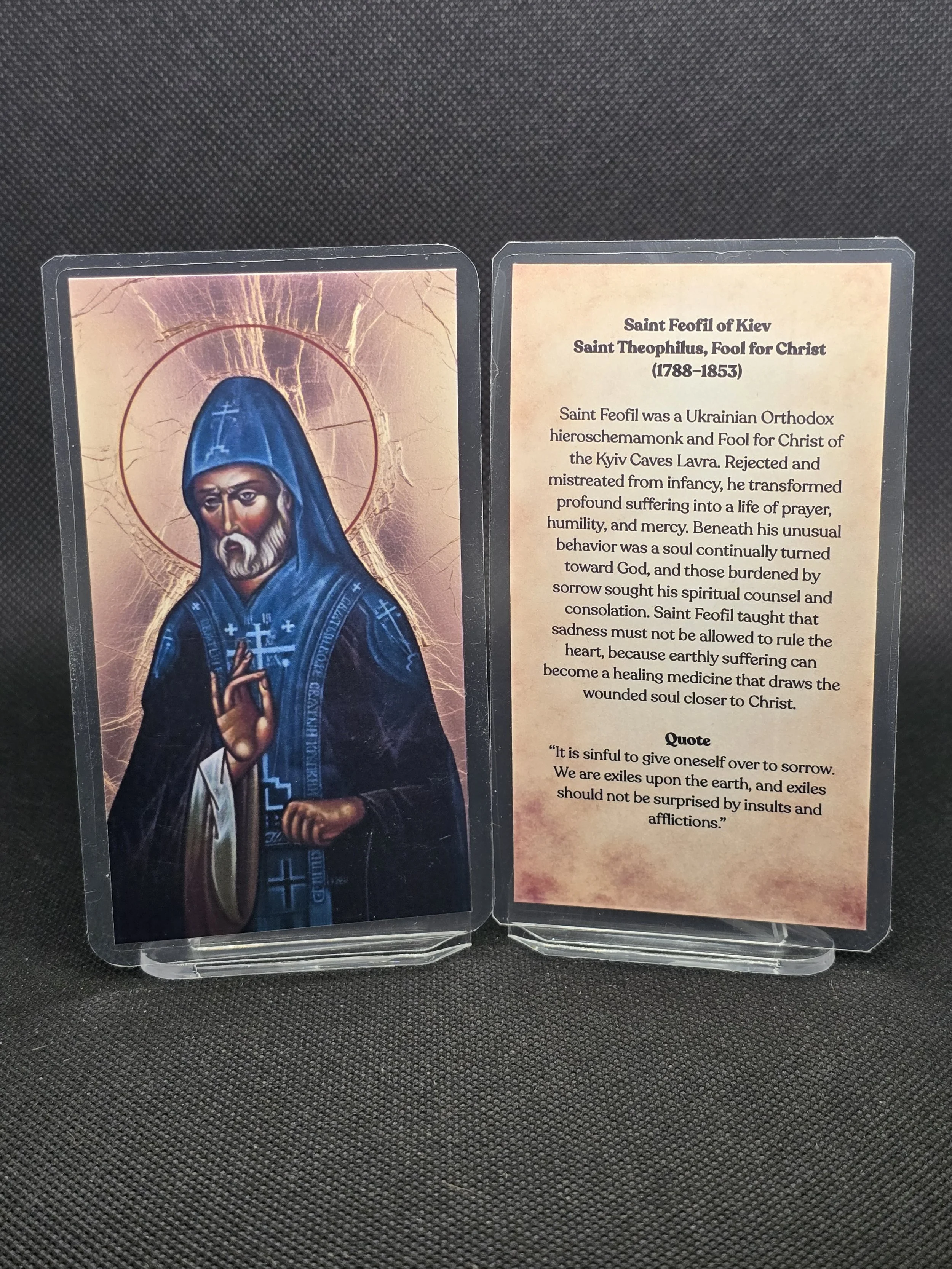
Keep his prayer card near you when you pray for those who are misunderstood, and for anyone who serves quietly and without thanks.
View Prayer Card