Saint Isidora of Tabenna: The Fool for Christ Who Hid Her Holiness in the Convent Kitchen
A nun of the Egyptian desert who accepted contempt, scraps and cruelty rather than be praised, and whom a hermit named the spiritual mother of everyone present.
At a Glance
- Also known as
- Isidora of Tabennisi, Isidora the Fool, Blessed Isidora
- Lived
- UNCERTAIN. Traditionally the fourth century; a death around 365 is repeated in devotional books but is not in the earliest source
- Region
- A women's monastery of the Pachomian communities in the Egyptian Thebaid, traditionally linked to Tabenna
- Feast day
- May 1 in the Greek tradition and May 10 in the Orthodox Church in America; no universal Roman feast verified
- Status
- Venerated through Eastern liturgical use; no dated canonization or glorification
- Patronage
- None formally established; associated with humility and hidden holiness
Who Was Saint Isidora of Tabenna?
Saint Isidora is remembered as an Egyptian nun who hid her spiritual maturity under the appearance of foolishness. She is said to have taken the dirtiest work in a large convent, to have eaten scraps, to have endured mockery and rough treatment, and to have been recognized at last by a visiting hermit.
Her story is told in the Lausiac History of Palladius of Helenopolis, written around 419 to 420. It is among the earliest surviving Christian accounts of a person who pretended madness for the sake of humility, and it stands near the beginning of the tradition of holy fools.
We have to be careful about what is actually known. In the standard Greek text the nun is not named. The name Isidora appears in a Latin translation and in later versions. We mark the story as TRADITION where it depends on the narrative or on later retelling, and as UNCERTAIN where the evidence runs out.
The Source and the Name
The ancient source is the Lausiac History, a collection of stories about the monks and nuns of Egypt that Palladius gathered after years in the desert. The English translation of W. K. Lowther Clarke places the story in chapter 34, while other editions number the chapters differently.
UNCERTAIN: The Orthodox Encyclopedia notes that Palladius does not name the nun in the usual Greek account, and that Isidora appears in the Latin and in later recensions. Identifying the nun with Saint Isidora is therefore traditional and not documented in the earliest text. The Bollandists also express reserve about the name.
There are also errors in modern retellings. One Orthodox biography calls her a sixth century nun while giving her death as about 365, and the two statements cannot both be right. The fourth century setting is the one that fits Palladius and the history of Pachomian monasticism.
Origins and Family
We know almost nothing about her childhood, her parents, her education or her social rank. Palladius begins with a virgin who is already living in a women's monastery, and he does not tell us how she came there or whether she had been married.
She is called Egyptian because her monastic life is placed in Egypt. That is a safe statement about where she lived, but her birthplace, native language and ethnicity are not recorded. Her conversion to Christianity is also undocumented, and we do not know whether she was raised in the faith.
The community belonged to the movement begun by Saint Pachomius, who organized monks in large houses under a common rule, with shared prayer, meals, obedience and work. Women's houses were part of that movement, and Pachomius's sister Maria is associated with the founding of one. That gives context but does not show that Isidora ever met her.
The Convent at Tabenna
Palladius describes a women's community of about four hundred sisters, living across a river from a men's monastery. Priests and deacons could enter for the sacraments, but ordinary movement between the houses was restricted. This was an organized house with a rule and a daily schedule, not a loose group of hermits.
It matters for her story, because she was not outside the discipline of the house. She lived within it and chose an unusual form of asceticism inside it. The kitchen, in a Pachomian monastery, was a real place of work and obedience, and its tasks were part of the spiritual life.
Palladius is also honest that monasteries had troubles. The chapter before this one tells of a false accusation and its tragic consequences. The ancient writers did not present convents as free from conflict.
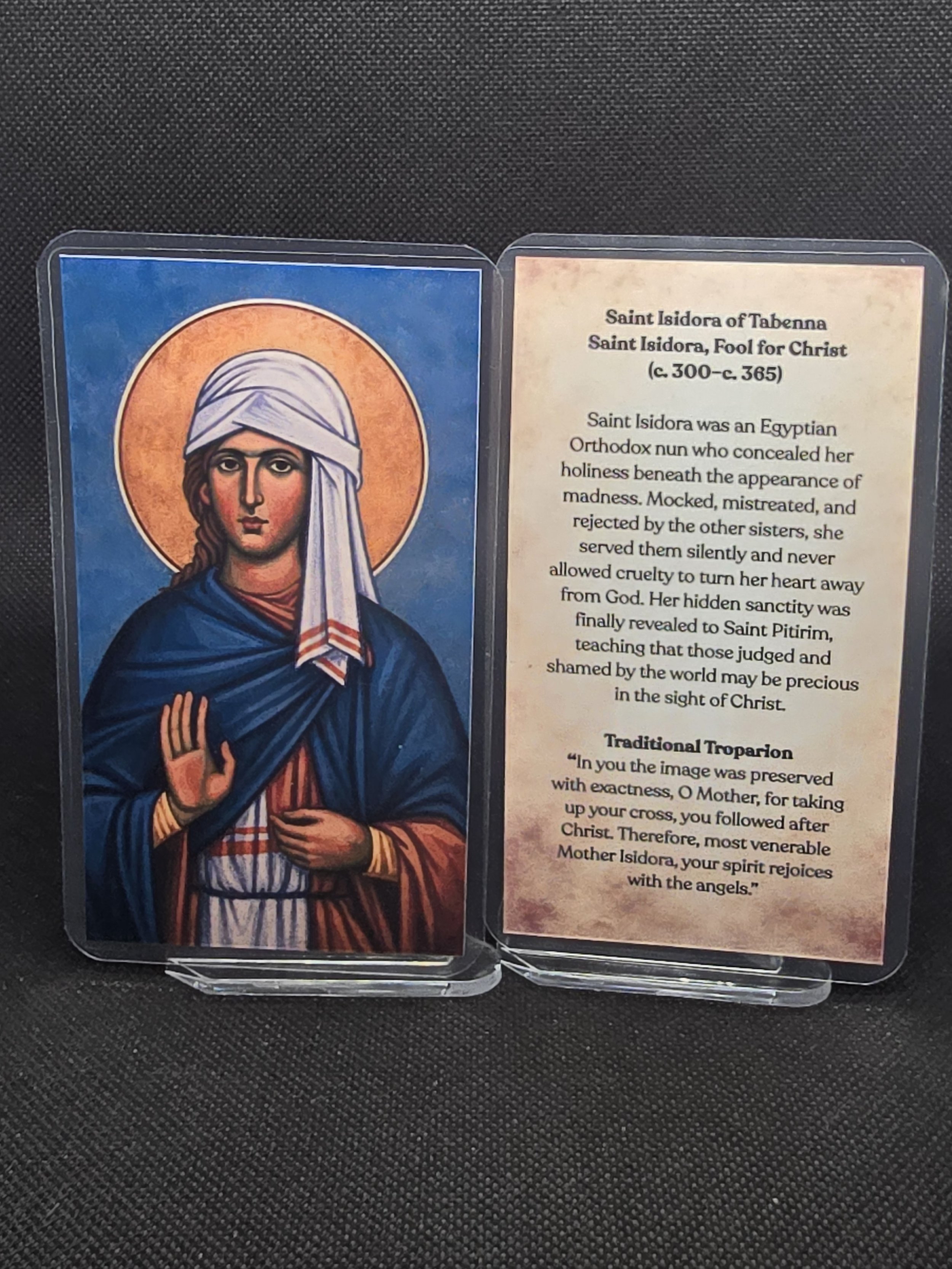
The Fool in the Kitchen
TRADITION: In Palladius's story the nun pretended to be possessed or mentally disturbed. She wrapped a rag around her head instead of the usual veil, worked in the kitchen, and did not sit at table with the sisters. She is said to have lived on the scraps left after the meal. Her sisters regarded her as foolish and gave her the roughest tasks.
TRADITION: According to the narrative, some of the sisters later admitted that they had thrown dirty washing water on her and had struck her. In some translations they also confessed to putting mustard on her nose. These details are in the ancient narrative and are not merely invented by modern writers.
She does not answer back. She does not complain or retaliate. The text presents this as spiritual endurance, and it also lets us see a failure of charity in a house of consecrated women, which is part of why the story has lasted.
The Hermit Piteroum
TRADITION: An angel appeared to the desert hermit Piteroum, also spelled Pitirim, and told him to go to the women's monastery, where a woman lived who had more spiritual maturity than he. The hermit obtained permission to enter and asked to see all the sisters.
When they assembled, the woman he looked for was not there. They told him about a simple one who stayed in the kitchen. When he saw her, he recognized the rag on her head as the sign the angel had named. He bowed down to her and asked for her blessing, and she bowed down to him.
He told the sisters that she is a spiritual mother, an Amma, to him and to them. The sisters fell at her feet and confessed how they had treated her. In the story, a respected male hermit receives a blessing from a woman everyone had dismissed.
Departure and Silence
Palladius ends the account with a surprise. The sisters now honored her and asked her forgiveness, and she could not bear it. A few days later she disappeared. No one knew where she went or how she died.
UNCERTAIN: The death date around 365 that is repeated in devotional books cannot be confirmed from Palladius, who says her death and whereabouts were unknown. Later claims that she became a hermit in a known place are also not supported by the earliest account.
No grave, tomb or relics have been established. Palladius describes the usual burial of the Tabennesiot women, but that cannot apply to her, since she had already left. Her silence at the end is part of the lesson. She goes where praise cannot follow.
Was She Mentally Ill?
Palladius presents her behavior as chosen, a pretense taken up for humility. That is the narrator's interpretation, and we have no independent evidence about her mind. The historian Derek Krueger, who studies the story as an example of concealed sanctity, cautions that the narrative offers little basis for judging her actual condition.
A careful reader should therefore describe the religious interpretation without claiming certainty about her psychology. It would be wrong to use this story to say that mental illness is a mask for holiness, or that people who are suffering in mind are secretly holy. The story is about one woman's chosen humility.
It is also not an endorsement of enduring abuse. Palladius treats the sisters' cruelty as something requiring confession and repentance. We would add that anyone who is being mistreated, or who is struggling with mental distress, deserves real help and not admiration for suffering in silence.
The Beginning of Holy Foolishness
The Greek word salos, meaning a fool, appears in Palladius's account in connection with this nun. The term later came to describe a class of ascetics whose outward behavior hid their holiness. Saint Symeon of Emesa became a prominent example in the sixth century.
Sergey Ivanov's study of holy fools places this anonymous nun near the start of the tradition and follows the later growth of her identity through the figures called Onesima and Isidora. The literary tradition developed after Palladius, and its later elaborations should not be taken as independent evidence for her life.
Her story also draws on Saint Paul. Palladius links her conduct with the warning that the wisdom of this world is foolishness before God, from the First Letter to the Corinthians. In the same spirit, the First Book of Samuel says that the Lord looks at the heart.
Holy Isidora, you served in silence and sought no praise. Pray for those whose work goes unseen, for those who are mocked or ignored, and for all of us who judge too quickly. Ask Christ to give us humble hearts and open eyes.
This prayer was written for this page and is not an official liturgical text. The Orthodox Church in America publishes the official troparion and kontakion for her feast.
Isidora in East and West
In the Greek tradition she is kept on May 1. The Orthodox Church in America keeps her on May 10 and publishes a troparion and kontakion. The difference between these dates is not simply a matter of the Julian and civil calendars, so we give both. The Bollandists discuss her under May 1 in the Acta Sanctorum, with reservations about her identity.
We could not verify a universal feast in the Roman calendar, or a place in the current Roman Martyrology. We also did not find a Maronite commemoration, and we do not claim one. A French Catholic calendar resource lists May 1 as a local feast. For Eastern Catholics she is best understood as part of the shared heritage of Egyptian asceticism.
Her message is a quiet one. Holiness often lives in unnoticed work, and those who are recognized are not always those who deserve to be. Her story also asks the question that Palladius asks of the sisters, whom do we dismiss, and what are we missing in them?
Frequently Asked Questions
Pray With Saint Isidora
Keep her prayer card near you when you pray for those whose work is unseen, and for anyone who has been mocked or overlooked.
View Prayer Card