Saint Justina of Antioch: The Steadfast Virgin Martyr of Nicomedia Who Resisted Sorcery Through Prayer
A young woman who, in the old story, would not give up her vow to Christ, whose steadiness led a famous magician to repent, and who is remembered with Saint Cyprian on October 2.
At a Glance
- Also known as
- Justina of Nicomedia, Virgin Martyr Justina, Justa in some texts
- Lived
- UNCERTAIN. Traditionally martyred at Nicomedia in 304; no reliable birth date or record survives
- Region
- Antioch (or Damascus in one Orthodox tradition) and Nicomedia in Bithynia, according to the legend
- Feast day
- October 2 in the Byzantine calendar, with Cyprian and Theoctistus (October 15 on the civil calendar for Julian churches); September 26 in the older Roman calendar
- Status
- Venerated since antiquity; no dated canonization; not kept in the 1969 General Roman Calendar
- Patronage
- Traditionally invoked for purity of heart and steadiness against temptation; no formal patronage decree found
Who Was Saint Justina?
Saint Justina is remembered as a young Christian woman who held to her vow of virginity against pressure, deceit and a magician's spells, and who finally died a martyr at Nicomedia. In the Eastern churches she is kept on October 2 together with Saint Cyprian and Saint Theoctistus.
In the story it is Justina who converts, in a sense, the sorcerer. She is already a Christian when it begins. Her calm prayer is what turns Cyprian away from his old life, and she is the quiet centre of the whole narrative.
We must be honest about the sources. Her biography comes from a group of late antique narratives that scholars regard as legend. The Catholic Encyclopedia treats the received account as legend or allegory, though real martyrs may stand behind it. We label the story TRADITION and the open questions UNCERTAIN.
Justina is easy to read past, because Cyprian's dramatic conversion takes up so much of the story. But the older accounts are clear about who acts and who is acted upon. She is the one who stays still, and the stillness is what changes the outcome.
Family and Childhood
TRADITION: The Conversion of Cyprian names her father as Edesius and her mother as Cledonia, though spellings vary in the manuscripts. They are pagans living in Antioch. The Greek Orthodox Archdiocese of America speaks instead of a woman from Damascus.
UNCERTAIN: These two cities show how different local traditions may have merged. We cannot say which, if either, was her home. The names of her parents, and of the people who figure in her early story, cannot be checked.
We do not know her age, her education or her family's standing. Later writers call her beautiful and virtuous, and sometimes of good family, but those descriptions belong to the literary tradition and not to any record.
Hearing the Gospel at the Window
TRADITION: In the Conversion, Justina first hears Christian teaching while sitting at a window, as a deacon named Praulius preaches nearby. She is convinced, believes, and then persuades her parents. They are said to have had a dream in which Christ appeared with angels about him, and in the end the whole family was baptized by a bishop named Optatus.
The fifth century empress Aelia Eudocia, who retold the story in Greek verse, also preserves the preaching of Praulius. A scholarly article on her poem discusses this passage. That shows the detail was circulating by the fifth century, though it does not prove it happened.
UNCERTAIN: Praulius and Optatus are known to us only from this literature. We should treat them as characters in the story until another source names them.
The Vow and the Suitor
TRADITION: A young man called Aglaidas, also written Agladius or Aglaias, wished to marry her. Justina refused because she had given herself to Christ. In one version he tries to carry her off, and she resists him with the sign of the cross.
Humiliated, he went to the famous magician Cyprian and asked for help. The story is, among other things, about the freedom of a woman to refuse an unwanted marriage. The text is firm that coercion, whether physical or spiritual, cannot take a vow away from a person who will not surrender it.
TRADITION: In some versions Aglaidas himself later accepts Christianity. This detail is not found in every telling.
It is worth noticing that the story gives her no weapon and no learned argument. Her strength is a decision made beforehand and kept through prayer, which is why Eastern Christians have remembered her as a model of quiet courage.
The Struggle of Prayer
TRADITION: Cyprian summoned spirits against Justina, one after another, each more powerful than the last. She did not argue or fight. She prayed, fasted and made the sign of the cross, and every attempt failed.
TRADITION: The Confession describes sickness and famine in her household and in Antioch after the failed spells, and says they ceased when she prayed. In the climax, the devil admits that he cannot overcome the power of Christ whom Justina invokes. This is the turning point for Cyprian.
These episodes belong to the Conversion and the Confession. They express the story's message, that spiritual struggle is met by prayer and not by contest of power. They cannot be verified as events.
A Community of Women
TRADITION: After Cyprian's conversion, Justina is said to have joined a community of consecrated women. Some versions make her the superior, and the Antioch patriarchate records a tradition that she was a deaconess. The Orthodox Church in America likewise calls her the superior of a monastery.
UNCERTAIN: No foundation document, identified building or independent record confirms that appointment. We cannot say that a specific convent existed. Her influence in the story is that of example, as a woman who kept faith, helped bring a sinner to repentance and encouraged other Christians.
No writings can be attributed to her. The Confession is in Cyprian's voice, and scholars attribute it to an anonymous author. We do not claim any letter, sermon or treatise for Justina.
The Sources and Their Problems
The story is preserved in three Greek works, the Conversion, the Confession and the Martyrdom. The Orthodox Encyclopedia, drawing on Bollandist work, suggests that the cycle began around 350 and grew in the fourth century and after. These are proposed dates of composition and not dates from her life.
The earliest securely datable witness is Gregory of Nazianzus, in Oration 24, delivered in 379. He tells of a magician who tries to seduce a Christian virgin and ends by being converted, but he confuses the legendary Cyprian with Cyprian of Carthage. Some versions of the martyrdom name Diocletian as the persecutor and others name Claudius, which shows how freely the story was revised.
The persecution under Diocletian was real, and Christians did suffer in Nicomedia. That does not prove that this particular trial took place. The safest view is that we have a venerated martyr, surrounded by a legend, whose real history we can no longer recover.
Trial, Martyrdom and Burial
TRADITION: Justina and Cyprian were arrested in the persecution attributed to Diocletian and brought before an official named Eutolmius. She was beaten and he was tortured. The story also tells of an attempt to destroy them in a cauldron of heated pitch and wax, which did not harm them.
TRADITION: They were sent to Nicomedia and beheaded near the River Gallus. A Christian named Theoctistus embraced Cyprian and was executed with them. The date September 26, 304 is traditional and cannot be confirmed.
TRADITION: The bodies were left unburied until Christians, sometimes described as travelers or sailors, carried them to Rome, where a woman named Rufina buried them. We tell this as a story handed down and not as a report.
Relics and Other Saints Named Justina
Several places claim relics. Rome has a medieval tradition tying an altar at the Lateran to the martyrs, and the Orthodox Encyclopedia records twelfth century evidence for relics said to be theirs. Meniko in Cyprus keeps relics attributed to Cyprian and Justina. The Orthodox Church in America also names a relic of her head at the monastery of Panagia Panachrantou on Andros.
Piacenza in Italy has a strong cult of a Saint Justina, but medieval records are hard to read. It is difficult to know whether they concern Justina of Antioch, Justina of Padua or another martyr of that name. Justina of Padua has a separate Western cult, with her day on October 7. They are traditionally treated as different saints.
UNCERTAIN: None of the relic traditions can be traced by a documented chain to a martyr of the year 304. Several of them together cannot prove where her remains lie.
If you visit any of these places, it is wise to treat the relics as objects of devotion and to leave the question of identity open, as the best scholars do.
Holy Justina, steadfast in prayer, you trusted Christ when you were pressed and deceived. Pray for those who are tempted or afraid, for young women who face pressure, and for all who must keep a promise they have made to God. Ask the Lord to give us calm hearts and clear minds.
This prayer was written for this page and is not an official liturgical text. The Orthodox Church publishes the official troparion and kontakion for October 2.
Justina in East and West
In the Byzantine calendar she is kept on October 2. The Orthodox Church in America and the Greek Orthodox Archdiocese publish hymns for the day, including a kontakion for the virgin martyr Justina. A Ukrainian Greek Catholic eparchy lists the feast, so her veneration is not limited to the Orthodox. We do not claim that every Eastern Catholic church keeps it.
In the West her day was September 26. She was not kept in the General Roman Calendar after 1969, and a scholarly reference reports that she is absent from the Roman Martyrology of 2001. This reflects historical doubt about the legend and not a judgment that no martyr existed. We are glad to keep her memory.
In Orthodox icons she is shown holding a martyr's cross, often beside Cyprian dressed as a bishop. What the tradition offers is clear and gentle. It is a model of prayer under pressure, and of respect for a person's own choice to give herself to God.
Frequently Asked Questions
Pray With Saint Justina
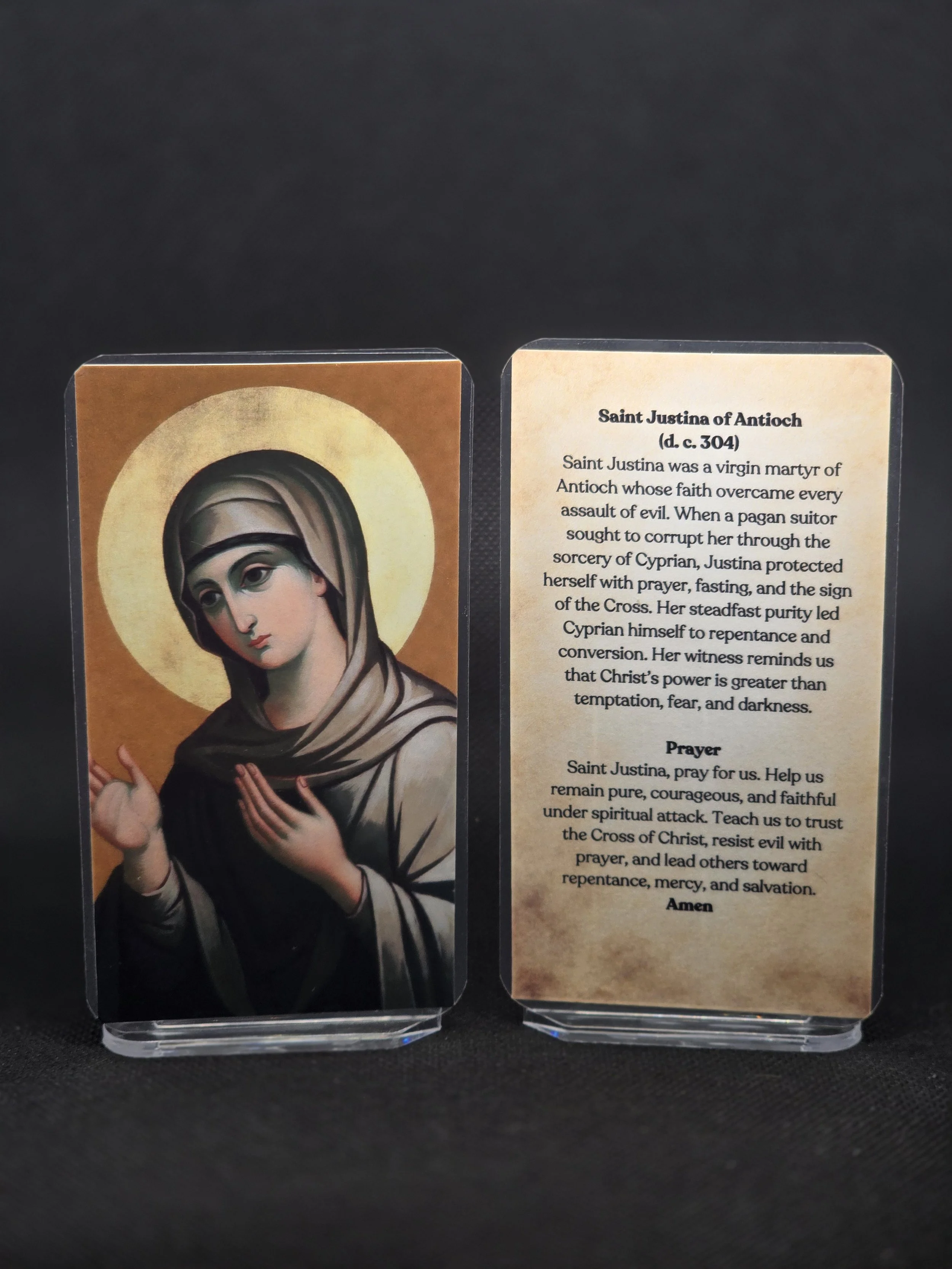
Keep her prayer card near you when you pray for young people under pressure, and for anyone who needs steadiness in temptation.
View Prayer Card