Saint Cyprian of Antioch: The Legendary Sorcerer Who Became a Christian Martyr Beside Saint Justina
A saint of the Eastern and older Western calendars whose story of repentance is well loved, and whose historical existence scholars treat with real caution.
At a Glance
- Also known as
- Cyprian the Magician, Cyprian the Sorcerer, Hieromartyr Cyprian
- Lived
- UNCERTAIN. Traditionally martyred at Nicomedia on September 26, 304; no reliable birth date or record survives
- Region
- Antioch in Syria and Nicomedia in Bithynia, according to the legend
- Feast day
- October 2 in the Byzantine calendar (October 15 on the civil calendar for Julian churches); September 26 in the older Roman calendar
- Status
- Venerated through ancient liturgical use; no dated canonization; removed from the General Roman Calendar in 1969
- Patronage
- Traditionally invoked against sorcery and spiritual harm; no formal patronage decree found
- Who Was Saint Cyprian of Antioch?
- Origins and the Question of Sources
- Justina and the Failed Spells
- Conversion and the Burning of the Books
- Writings Attributed to Him
- Confusion With Cyprian of Carthage
- The Legend Grows: Eudocia and Modern Scholars
- Arrest and Martyrdom at Nicomedia
- Relics and Veneration
- Cyprian in East and West
- Frequently Asked Questions
Who Was Saint Cyprian of Antioch?
Saint Cyprian of Antioch is remembered as a pagan magician who tried to use his arts against a young Christian woman named Justina, failed, repented, was baptized, became a bishop and died a martyr with her. The story has been told for sixteen centuries and the two saints are still commemorated together on October 2 in the Byzantine calendar.
He is also one of the most difficult saints to write about honestly. Modern scholars generally treat the account as a literary legend and not as reliable biography, and they point out that it has long been tangled with the real life of a different man, Saint Cyprian of Carthage. We say so at the start.
Throughout this article we mark the story with the label TRADITION and any open question with UNCERTAIN. What is secure is the antiquity of the story and of the liturgical veneration. The details of his life are not secure.
Our approach is simple. We tell the story the Church has told, we say plainly what history can and cannot support, and we leave room for prayer. A saint can teach us even when his biography is shrouded in legend, provided we do not claim more than we know.
Origins and the Question of Sources
TRADITION: The legend says Cyprian was born in Antioch to a pagan family and given over to the gods as a child. The Orthodox Church in America tells of training that began at age seven and continued to age thirty, with journeys to Greece, Egypt and Babylon. These ages and places belong to the narrative and cannot be checked.
UNCERTAIN: No reliable record names his parents or his family. Some later versions even connect him with Carthage or Rome, which shows how unstable the tradition was.
The story is told in three Greek works, a Conversion, a first person Confession and a Martyrdom. Scholars place their writing in the fourth and fifth centuries. Ryan Bailey's 2009 edition of the Confession studies it as a late antique hagiographical romance. A first person voice does not prove that the real Cyprian wrote it.
Justina and the Failed Spells
TRADITION: Justina was a young Christian who wished to dedicate her life to Christ. A pagan suitor, called Aglaidas or Agladius, desired to marry her. She refused, and he asked Cyprian to help him by magic.
The legend describes three attempts to turn her heart by sorcery and by demons. Each failed because Justina prayed, fasted and made the sign of the cross. The number three is part of the story and not a documented fact.
The centre of the story is Justina, not Cyprian. Her steadiness, and not any display of power, is what turns the narrative. That is the point the Eastern hymns keep returning to.
In the Eastern liturgy this episode is not remembered as a triumph over magic as a technique. It is remembered as a woman's faithful prayer and a man's willingness to change his mind in the face of the truth.
Conversion and the Burning of the Books
TRADITION: Cyprian understood that the powers he served could not overcome the protection of Christ. He renounced magic, destroyed his books and sought baptism.
The scene resembles Acts 19:18 to 19, where converts in Ephesus burn their books of magic. The story takes an established Christian pattern of repentance and puts it in a vivid narrative.
TRADITION: Some versions say that a bishop named Anthimus received and taught him, and that Cyprian rose from deacon to priest to bishop. The 1908 Catholic Encyclopedia notes that no bishop of Antioch named Cyprian appears in the known list of bishops, so we cannot present his episcopate as history.
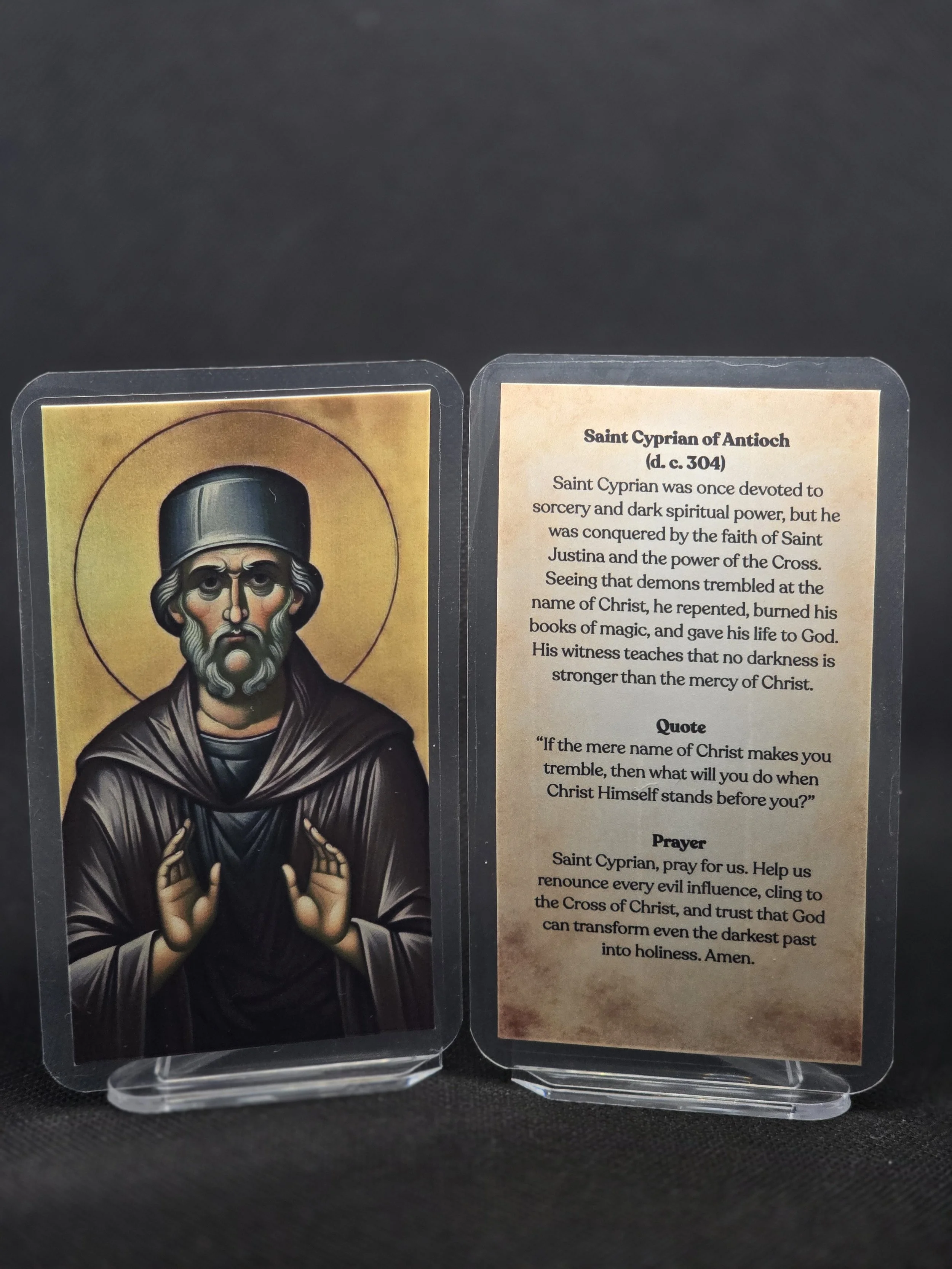
Writings Attributed to Him
The Confession of Cyprian presents itself as his own testimony, but it is a literary work and not an authenticated writing. No letters, treatises or foundations can be assigned to Cyprian of Antioch.
Under his name there also circulated protective prayers. Daniel Vaucher's 2025 study of the so called Prayer of Cyprian traces Greek, Latin and vernacular versions across the Middle Ages. Its original author and date cannot be established, and the link to the historical Cyprian is not supported.
A caution for readers. Some versions of that prayer picked up superstitious features and were criticized by church authorities, including the Inquisition. Anything sold today as a Prayer of Saint Cyprian should not be assumed to be an authentic ancient Christian prayer. We have chosen to write a short new prayer for this page.
Confusion With Cyprian of Carthage
The strongest historical fact about the legend is that it was confused with another man. Cyprian of Carthage was a real bishop and writer who was martyred in 258, and his letters and treatises survive. They have nothing to do with sorcery.
Gregory of Nazianzus, in his twenty fourth oration, usually dated to 379, speaks of a Cyprian whose story mixes features of the bishop of Carthage with the magician legend. The poet Prudentius repeated part of the confusion around the beginning of the fifth century.
This shows that the story was in circulation by the late fourth century. It does not show that a separate magician bishop of Antioch existed. A story can be old without being true, and we should keep those two questions apart.
The Legend Grows: Eudocia and Modern Scholars
In the fifth century the empress Aelia Eudocia wrote a poetic retelling of the story. The first book survives and part of the second, while the last book, about the martyrdom, is lost. A 2023 study in the Cambridge Classical Journal shows how deeply the poem draws on Homer, which marks it as sophisticated literature and not eyewitness testimony.
Recent scholarship, including a monograph on Greek portraits of Cyprian published by the University of California Press, looks at how an account of Cyprian of Carthage developed into the portrait of the magician of Antioch. We have used the publisher's description and not read the whole book, and we say so.
The responsible conclusion is that his historical existence is uncertain. The Church has kept his memory because the story teaches repentance, not because every detail can be proved.
Arrest and Martyrdom at Nicomedia
TRADITION: During the persecution of Diocletian, Cyprian and Justina were arrested and brought before an official usually named Eutolmius. They refused to deny Christ, and the legend lists severe tortures, including scourging, hooks and heated vessels, before they were taken to Nicomedia.
TRADITION: There they were beheaded. The martyr Theoctistus, also called Theognitus, is said to have confessed Christ and died with them. The year 304 and the day September 26 are the traditional dates, and neither can be independently shown.
We are describing a legend, not reporting a court record. It is worth remembering that the persecution under Diocletian was real and that many Christians did suffer. The story belongs to the way later Christians honored them.
Relics and Veneration
TRADITION: The bodies lay unburied for six days, then Christian sailors took them to Rome, where a woman named Rufina buried them. Later claims connect relics with the Lateran basilica and with Piacenza. The Acta Sanctorum collects and examines these stories.
Relics said to belong to Cyprian or Justina are venerated at Mount Athos, in Cyprus, in Greece and in Romania. In Bucharest, a relic described as his right hand is kept at the Zlatari church. UNCERTAIN: None of these claims can be traced by a documented chain of custody to a martyr of the year 304.
No formal canonization can be dated. His recognition came through the spread of the legend and of its liturgical celebration, which is the usual path of early martyrs in the East.
Lord Jesus Christ, you are stronger than every power that frightens us. Through the prayers of your servants Cyprian and Justina, give us the courage to turn away from every evil, and the humility to repent when we have gone astray. Keep us in your peace and in your truth.
This prayer was written for this page and is not an official liturgical text. The Orthodox Church publishes the official troparion for October 2.
Cyprian in East and West
In the Byzantine calendar Cyprian and Justina are kept on October 2, and the Greek Orthodox Archdiocese and the Orthodox Church in America publish hymns that praise his renunciation of sorcery, his ministry and his martyrdom. Byzantine Catholic parishes also keep the commemoration. We could not show that every Eastern Catholic church has the same feast, and we do not claim it.
In the West, September 26 was their day in the older Roman calendar. They were removed from the General Roman Calendar in 1969 because of the historical difficulties we have described. That does not forbid private devotion, but it explains why they are better known in the East.
For both East and West the saints offer a plain lesson. Evil is not defeated by trying to control spiritual powers. It is defeated by trusting Christ, as Justina did, and by repentance, as Cyprian is said to have done.
Frequently Asked Questions
Pray With Saints Cyprian and Justina
Keep their prayer card near you when you pray for those who feel fear, and for anyone who wishes to turn back to God.
View Prayer Card