Saint Gerasimos of Cephalonia: Noble Pilgrim, Founder of the Omala Monastery and Patron Saint of the Island
A nobleman's son from the Peloponnese who became a monk on Athos, a pilgrim to Jerusalem and a hermit in a cave, then founded the convent in the Omala Valley that still draws pilgrims.
At a Glance
- Also known as
- Gerasimos Notaras, Gerasimos the New Ascetic, Gerasimus of Kefalonia
- Lived
- UNCERTAIN. Born around 1506 to 1509 in Trikala, Corinthia; died August 15, 1579 at Omala, Cephalonia
- Region
- Peloponnese, Mount Athos, the Holy Land and the Ionian island of Cephalonia, then under Venetian rule
- Feast day
- August 16 for his repose (August 29 on the civil calendar for Julian churches) and October 20 for the uncovering of his relics (November 2 on the civil calendar for Julian churches)
- Status
- Glorified as a saint by a synod of the Ecumenical Patriarchate under Cyril Lucaris in July 1622
- Patronage
- Patron and protector of Cephalonia; invoked for healing and for those troubled in mind or spirit
- Who Was Saint Gerasimos?
- Birth and the Notaras Family
- Studies and Vocation
- Athos, Jerusalem and the Holy Land
- Arrival in Cephalonia and the Cave
- The Monastery at Omala
- Teacher and Spiritual Father
- Island Under Venice
- Death, Relics and Glorification
- Miracles, Devotion and the Eastern Catholic View
- Frequently Asked Questions
Who Was Saint Gerasimos?
Saint Gerasimos of Cephalonia is one of the best loved saints of the Ionian islands. Born into a noble family of the Peloponnese, he gave up an easy life for monastic poverty, traveled to Mount Athos and Jerusalem, and in the end settled on the island of Cephalonia, where he founded a convent in the Omala Valley.
He is remembered as a teacher, a spiritual father to the nuns he gathered, and a healer. Today his body rests in a reliquary at the monastery, and thousands come each August and October to honor him. The great church of the island is his, and his name is among the most common on Cephalonia.
We separate what the sources support from what is tradition. Points that scholars cannot settle are marked UNCERTAIN, and legends are marked TRADITION. Gerasimos left no writings, so everything we know comes from later biographies, church records and local memory.
Birth and the Notaras Family
Gerasimos was born at Trikala in Corinthia, in the Peloponnese, to a family named Notaras. His parents are named Demetrios and Kale in the Orthodox biographies. They are described as devout and as giving their son a solid religious education.
UNCERTAIN: The year of his birth is given as 1506 in many accounts, 1509 in the Great Synaxaristes and about 1508 in a Greek biographical encyclopedia. No contemporary birth record fixes it. A later family tradition makes him a descendant of Loukas Notaras, the Byzantine official who died after the fall of Constantinople in 1453. The Notaras connection is well attested, but the exact line of descent needs documents we do not have.
UNCERTAIN: His baptismal name is sometimes given as George. A detailed Greek biography says that his secular name is unknown, so we treat George as a proposal and not a fact.
Studies and Vocation
Biographies describe a boy who learned the Scriptures and the services of the Church thoroughly. As a young man he traveled beyond his home region to continue his studies and to look for a monastic life.
TRADITION: Some narratives say his family wished him to marry or to take a position in the world, and that he refused. The basis for this is weaker than the evidence for his family and his later monastery, but it fits the pattern in saints' lives where a young man of rank chooses poverty.
There is no dramatic conversion from unbelief in his story. The sources show a Christian who grew gradually into a life of prayer, fasting and obedience, which is typical of Eastern monasticism in the centuries after the fall of Constantinople.
Athos, Jerusalem and the Holy Land
His monastic formation is linked with Zakynthos, Constantinople and Mount Athos. The Orthodox Church in America says he became a monk on Zakynthos and received the Great Schema on Athos, while other lives place his tonsure on Athos itself. UNCERTAIN: The order of these events is not settled.
He is said to have visited Mount Sinai, Antioch, Damascus, Alexandria and Egypt, and to have spent time in Jerusalem. In Jerusalem he reportedly served as a lamp lighter at the Church of the Holy Sepulchre, a humble task for a man of noble birth. These journeys come from hagiography and not from travel records, so the sequence and length are uncertain.
He was ordained deacon and then priest by Patriarch Germanus of Jerusalem, whose long patriarchate lasted into 1579. Some accounts say Gerasimos spent about twelve years in the Holy Land and sometimes withdrew to solitude near the Jordan. UNCERTAIN: The total time in the East is not independently confirmed.
Arrival in Cephalonia and the Cave
After leaving the Holy Land he passed through Crete and Zakynthos and came to Cephalonia. A local parish synaxarion dates his arrival to about 1555. UNCERTAIN: The year rests on a local source.
He first lived in a cave in the Lassi district near Argostoli, devoted to prayer and fasting. Tradition says this period lasted about five years. Like most hermits, he sought God in silence first, and only later turned to building a community.
The cave shows the way that Eastern saints often moved between solitude and service. He did not remain a hermit forever. The next step was to take on the care of others.
The Monastery at Omala
Around 1560 or 1561 Gerasimos received land with an older church in the Omala Valley. A church linked heritage site reports that the local priest Georgios Valsamos formally gave the monastery property and its estates to him in 1561. Gerasimos repaired the church, which was dedicated to the Dormition of the Mother of God, and gathered a community of nuns. He called it New Jerusalem.
This convent became the center of his work. He combined prayer with the practical care of a community, supervising farming, building and the supply of water for the surrounding district. A monastery history credits him with three large trees, three major wells and thirty seven smaller ones. We treat these exact figures as TRADITION unless documents or archaeology support them.
The same convent is active today. The women who live there continue the life he began, and the monastery remains the main shrine of the island.
Teacher and Spiritual Father
A Greek parish synaxarion says that Gerasimos taught children to read and write Greek and that the record of his burial calls him a teacher. That is valuable evidence that his work reached beyond the convent walls, although the burial record itself would need to be examined to confirm the wording.
We have no writings from him. His teaching survives in the memory of his disciples, in the early biography and in the hymns composed in his honor. A study by the scholar Nil Ozlem Pektas describes an early printed volume that contained a short life supported by witnesses, the synodal decision about his glorification and a liturgical canon. Those are important sources about him, but they are not his own works.
His reputation for helping people who suffered in mind and spirit grew while he lived and increased after he died. We should be careful here. Mental illness is not the same as demonic possession, and the old accounts reflect the language of their time.
Island Under Venice
Cephalonia returned to Venetian rule in the early sixteenth century and remained under Venice throughout his life. This meant a Greek Orthodox population living in a state governed by a Roman Catholic power. The religious relationship was complicated, with Venice often more interested in stability than in forcing conversions, and with tensions between Orthodox and Latin institutions.
Later Orthodox biographies portray Gerasimos as a defender of Orthodoxy against Latin influence, and his hymn calls him a protector of the Orthodox. This wording is part of his liturgical reception, but it does not document any particular confrontation in his lifetime.
We should not read later quarrels back into his life. A convent that kept Orthodox worship alive on a Venetian island was a witness of faith, and that is the safest way to say it.
Death, Relics and Glorification
Gerasimos died on August 15, 1579, the feast of the Dormition, at his monastery. Some short calendar entries give a different year, but the 1579 date has the better support. TRADITION: He is said to have foreseen his death, gathered the nuns, and given them final counsel and a blessing.
He was buried near the church. The first opening of the grave is placed in October 1581, about two years later, and an early account records that the body was found intact. UNCERTAIN: The dates are inconsistent, with October 20, 1581 and October 29, 1581 both given for the first opening and October 20, 1582 for a second. The body was reburied after an objection and later uncovered again. Modern research names the Orthodox metropolitan Gabriel Severus as the person who ordered the reburial. The roles of the different parties are uncertain, so it would be misleading to present this as a plot by Catholics.
In July 1622 a synod of the Ecumenical Patriarchate under Patriarch Cyril Lucaris glorified him, as the Patriarchate's own historical biography of Cyril records. There was no separate beatification, which belongs to the later Roman system. His relics lie today in the monastery at Omala.
Holy Gerasimos, pilgrim and monk, you left rank and comfort to serve Christ in prayer and in the care of others. Pray for the island that loves you, for nuns and monks, for teachers, and for all whose minds and hearts are troubled. Ask the Lord to bring us comfort, healing and peace.
This prayer was written for this page and is not an official liturgical text. The Orthodox Church publishes the official troparion and hymns for his feast.
Miracles, Devotion and the Eastern Catholic View
TRADITION: Reports of healing, especially of those troubled in mind or spirit, are central to his devotion. TRADITION: When the grave was opened the body was said to be intact and fragrant. TRADITION: A woman said to be afflicted fell into a monastery well and was saved, which is linked to the events that led the nuns to seek the exhumation. These are accounts of belief and cannot be tested as history.
TRADITION: Islanders say he protects Cephalonia, and some recall his name in connection with the great earthquake of 1953. On his feast days the reliquary is carried in procession, and some pilgrims lie along the path so that it passes over them. The Orthodox troparion calls him a healer and a protector, and we do not reproduce it here.
For Eastern Catholics the heritage of Athos and Jerusalem is shared, but we could not verify a universal Eastern Catholic feast or a Roman canonization for him. His glorification is an Orthodox act, and we say so plainly. Catholics and Orthodox can still honor a monk whose life was prayer, teaching and care for the troubled.
Frequently Asked Questions
Pray With Saint Gerasimos
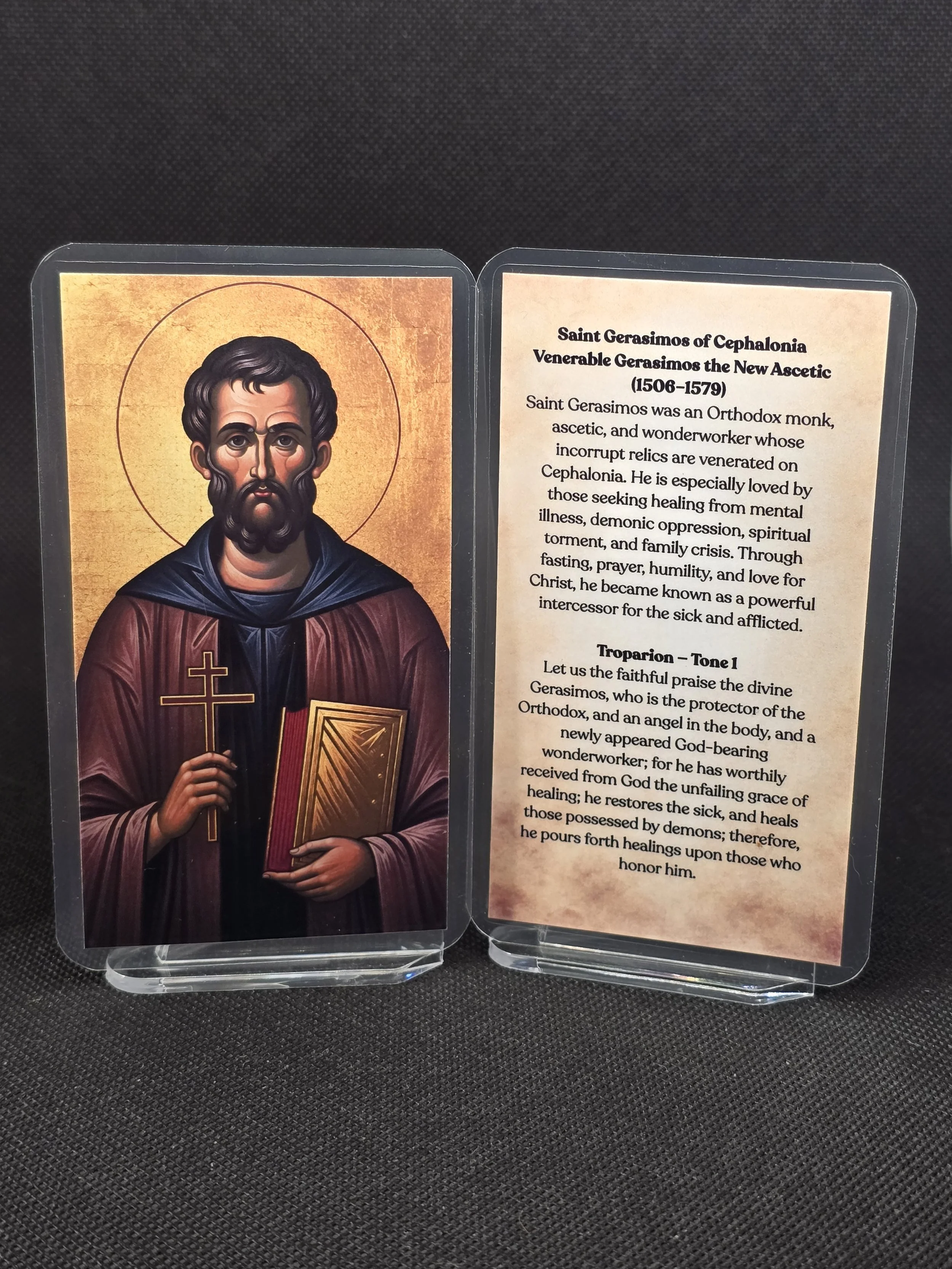
Keep his prayer card near you when you pray for the island of Cephalonia, for nuns and monks, and for anyone troubled in mind or heart.
View Prayer Card