Saint Naum of Ohrid: Disciple of Cyril and Methodius, Enlightener of the Slavs and Healer of Lake Ohrid
The ninth century missionary who carried Slavonic letters from Moravia to Bulgaria, founded a monastery on the shore of Lake Ohrid, and is remembered as a healer of troubled minds.
At a Glance
- Also known as
- Nahum of Ochrid, Naum the Wonderworker, Naum of Preslav
- Lived
- UNCERTAIN. Born around 820 to 850; died December 23, 910 (one scholar gives 906)
- Region
- Great Moravia, the First Bulgarian Empire, and Ohrid in present day North Macedonia
- Feast day
- December 23 (January 5 on the civil calendar for Julian churches) and a summer feast on June 20 (July 3); he is also named among the Seven Saints on July 27 in some calendars
- Status
- Venerated since the early tenth century; no formal canonization date
- Patronage
- Traditionally invoked for healing, especially of troubled minds; no formal patronage decree found
Who Was Saint Naum?
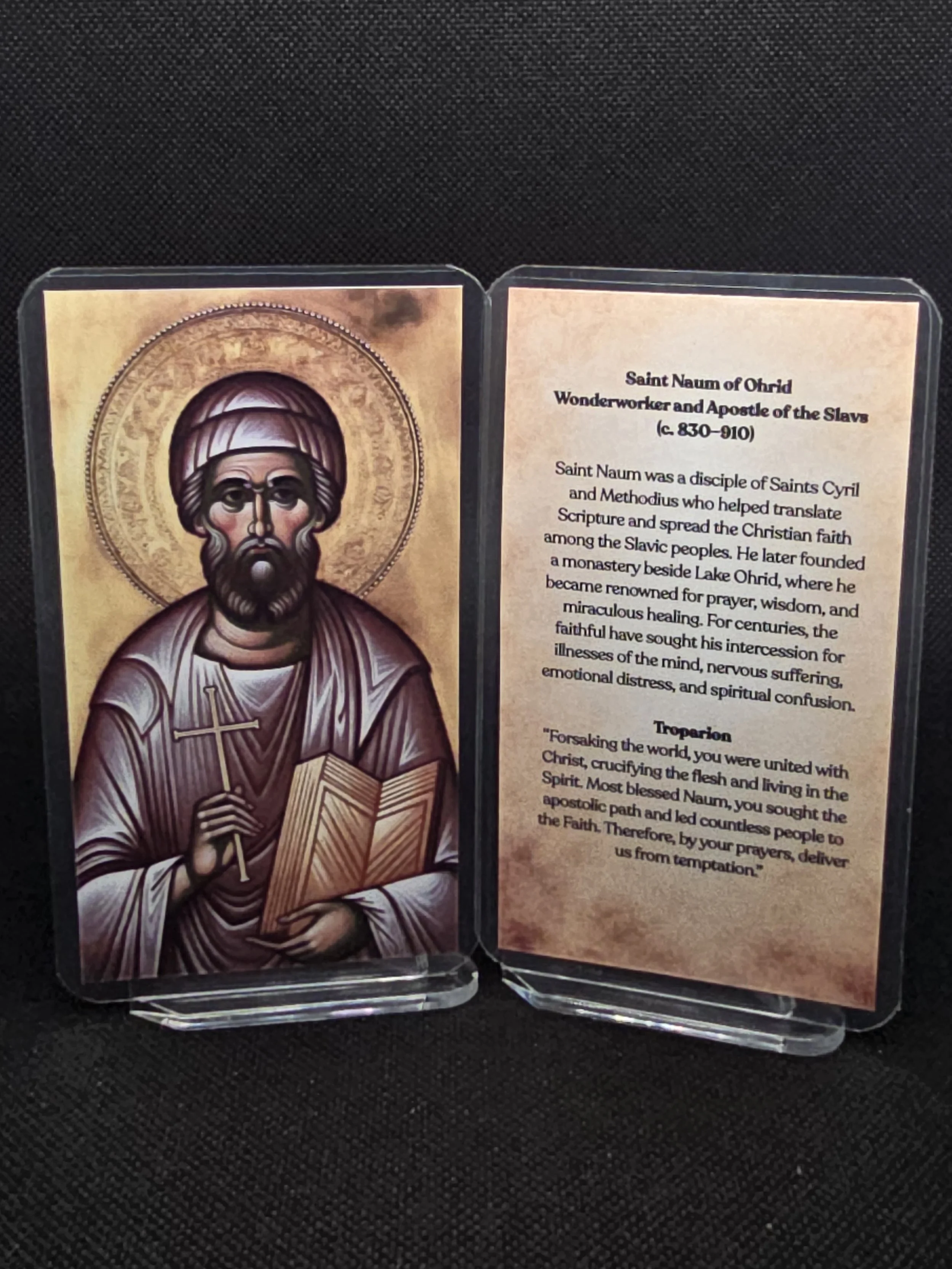
Saint Naum is one of the disciples of Saints Cyril and Methodius who carried the Slavonic Christian tradition south after the mission in Moravia was broken up. He taught in Bulgaria, helped train a Slavonic speaking clergy around Ohrid, and founded the monastery on the southern shore of Lake Ohrid that still carries his name.
He is honored as an enlightener of the Slavs and a wonder worker. Pilgrims still travel to his tomb, especially those who suffer in mind or spirit. The traditions around him are lively, and so we mark them with the label TRADITION. We also mark points that scholars cannot settle as UNCERTAIN.
A note on the feast. We were asked about July 23, but no calendar we consulted gives that date for Naum. His main commemoration is December 23, with a summer feast on June 20 in the Julian reckoning, and he is named with the Seven Saints on July 27 in some Catholic and Greek Catholic calendars.
Origins
We know very little about Naum's early life. Birth dates between about 820 and 850 are proposed, but no record fixes one. The Second Slavonic Life links him with Moesia, a historical name for a region of the Balkans, and does not tell us his locality or ethnic background.
His biography calls him the brother, companion and fellow sufferer of Saint Clement of Ohrid. UNCERTAIN: The language may mean a real family relationship, but it can equally express spiritual brotherhood. It does not prove they were blood brothers.
Orthodox accounts describe him as learned in several languages. That is plausible for a disciple of Cyril and Methodius, but we cannot list the languages he knew. The story of his baptism and the origin of his name are not documented.
Disciple of Cyril and Methodius
Naum enters history through the brothers Cyril and Methodius, the Byzantine missionaries who went to Great Moravia around 863 at the request of the ruler there, so that the faith could be explained in the Slavic language. Pope John Paul II recalls this mission and its linguistic aim in his letter Slavorum Apostoli.
The Slavonic tradition places Naum among their disciples, and this is widely accepted. When the brothers went to Rome, Pope Hadrian II welcomed them and approved their Slavonic liturgical books, and some of their followers were ordained. Later lives say Naum was among them, but the Vatican account does not name him, so his ordination in Rome is a tradition and not a documented fact.
Cyril died in Rome on February 14, 869. Methodius continued the work and died on April 6, 885. Pope John VIII had renewed support for the Slavonic liturgy in 880, but after Methodius died the disciples suffered severe persecution in Moravia.
Exile and Arrival in Bulgaria
Driven out of Moravia, the disciples made their way east. The early lives place Naum with Clement and Angelarius, traveling by way of Belgrade and finding support from the Bulgarian ruler Boris Michael. The usual dating is about 885 or 886.
It was a painful turning point. The collapse of the mission in Moravia ended one project and, unexpectedly, helped spread Slavonic learning across the Balkans.
Scholars connect Naum with the Pliska and Preslav literary circles, where Christian texts were translated, copied and passed on in Slavonic. We cannot say which texts he personally translated.
Teaching at Ohrid
When Clement was given episcopal duties around 893, Naum continued the educational work in the southwest, around Ohrid and Kutmichevitsa. The Ohrid school trained clergy and produced manuscripts for communities that worshiped in Slavonic.
This was not only a matter of preaching. Christianity grew because teachers were trained and institutions were built, and the movement helped make Slavonic a written language able to carry Scripture, theology and liturgical texts.
It is often said that Naum invented the Cyrillic alphabet or that he was the writer known as Chernorizets Hrabar. There is not enough evidence for either claim. One standard reference calls the identification with Hrabar a hypothesis and not an established fact.
The Monastery on Lake Ohrid
Naum founded the monastic community on the southern shore of Lake Ohrid, in what is now North Macedonia. The first church was dedicated to the Holy Archangels. UNCERTAIN: The First Slavonic Life supports a date around 900, while the Second gives 905, and the earlier account is usually preferred.
Excavations beneath the present church found an earlier building with three apses, which supports an early medieval foundation and resembles the church tied to Saint Clement at Ohrid.
Naum is traditionally credited with translating Scripture and church books from Greek. Specific translations cannot usually be assigned to him. The firmer evidence is hymnography. A medieval canon in honor of Saint Andrew the Apostle contains an acrostic with Naum's name, and scholars regard the attribution as secure, though the date and place of composition are debated.
Politics, Languages and Modern Claims
Naum lived when Byzantine, Roman, Frankish and Bulgarian interests competed. Slavonic worship was criticized by those who preferred Latin, but it would be wrong to cast this as Orthodox against Catholic. Cyril and Methodius worked with Byzantine authorization while seeking Roman approval, and Rome approved their books.
The Second Slavonic Life speaks warmly of Rome and does not use the Moravian persecution to build a polemic against the Latin Church. We should not read later quarrels back into the ninth century.
Naum worked in the medieval Bulgarian state, and his monastery stands in present day North Macedonia. His importance to Bulgarian and Macedonian religious history is real, but modern national categories should not be imposed on a ninth century monk.
Death and Burial
The usual tradition gives December 23, 910, as the day Naum died, at the monastery near the lake. The historian Francis Dvornik gave 906, and we note the difference. Some accounts say he took the Great Schema near the end of his life. UNCERTAIN: The sources do not tell us when he first became a monk.
Tradition says Clement buried him. Excavation found an early tomb beside the original church, and the relics were later placed in a more elaborate burial chapel. Study of remains from the tomb supports their antiquity, but cannot prove whose they are.
His First Slavonic Life, generally dated before 969, shows that Naum was already honored as a saint within about sixty years of his death. That is the nearest thing we have to a canonization, and it is a growth of veneration and not a formal decree.
Healer of Troubled Minds
Naum is remembered as a healer, especially of mental and spiritual affliction. These reports are evidence of the way he was venerated, but they cannot be tested as medical facts. Saint Nikolai Velimirovich tells of a Muslim man from Resen who gave a bell to the monastery in 1926 in thanks for his brother's recovery. It shows that his devotion crossed religious lines.
TRADITION: In a well known story, a bear killed a farmer's ox, and Naum made the bear take the ox's place and work beside the surviving animal. Scholars note that versions of the tale were written down in the nineteenth century and that similar animal stories are told of other saints, so we do not treat it as an event from his lifetime.
TRADITION: Visitors say that if you put your ear to his tomb you can hear his heartbeat. It is a pilgrimage belief and not a scientific claim. The monastery remains a place of prayer for pilgrims from many backgrounds.
Holy Naum, disciple of Cyril and Methodius, you carried the Gospel in the language of the people and gave your life to teaching. Pray for teachers and translators, for monks and for pilgrims, and for those whose minds are troubled. Ask Christ to give us peace and clear understanding.
This prayer was written for this page and is not an official liturgical text. The Orthodox Church in America publishes the official troparion and kontakion for his feast.
Naum in East and West
For Orthodox Christians Naum stands for the beginning of Slavonic worship, teaching and monastic life. The Orthodox Church in America publishes a troparion and kontakion for December 23 in the fourth tone, which praise his withdrawal from the world and his missionary work. We do not reproduce them here.
For Eastern Catholics he belongs to a time when East and West still sought communion in spite of political strain. Pope John Paul II called the mission of Cyril and Methodius a model of shared Christian heritage. Slovak Greek Catholics commemorate him among the Seven Saints on July 27. We do not claim that every Eastern Catholic church has a separate feast for him.
A simple way to honor him is to pray for those who translate, teach and copy the Gospel, and for anyone whose mind is troubled.
Frequently Asked Questions
Pray With Saint Naum
Keep his prayer card near you when you pray for teachers, for travelers and for anyone whose mind is weary.
View Prayer Card