Saint John of God: The Portuguese Soldier and Shepherd Who Became Founder of the Hospitaller Brothers
A former soldier and book seller who opened his home to the sick and the abandoned of Granada, and whose work grew into a worldwide order of hospital brothers.
At a Glance
- Also known as
- Joao Cidade, Juan Ciudad, Joao de Deus, Juan de Dios
- Lived
- March 8, 1495 to March 8, 1550 (the birth date is the traditional one)
- Region
- Montemor-o-Novo in Portugal; Oropesa and Granada in Spain
- Feast day
- March 8 in the Roman Catholic calendar
- Status
- Beatified 1630; canonized 1690; a layman and not a priest
- Patronage
- Hospitals and the sick (1886); nurses (1930); traditionally booksellers and firefighters
- Who Was Saint John of God?
- A Boy from Montemor-o-Novo
- Soldier, Shepherd and Book Seller
- Conversion at Granada
- From Public Penance to Practical Love
- The House by the Fish Market
- His Letters and the Order That Followed
- Trials and the Archbishop
- Death and Canonization
- Stories Told About Him
- Frequently Asked Questions
Who Was Saint John of God?
John of God is the saint of hospitals. He was born in Portugal, grew up in Spain, worked as a shepherd and a soldier, and found his calling in Granada in his forties. He opened a small house for the sick, carried some of them there on his own back, and begged from door to door to feed them. He died in 1550, and the brothers who took up his work became a religious order that now serves in many countries.
He is also a good saint for anyone who is afraid of being sent away. His hospital took in people who were rejected elsewhere. The story of his own confinement in a hospital as a madman shaped how he cared for others.
His life is better documented than many saints' lives. We have six letters and an early biography by Francisco de Castro, published in 1585. We use those sources and mark pious stories as TRADITION and uncertain details as UNCERTAIN.
A Boy from Montemor-o-Novo
John was born in Montemor-o-Novo, near Evora, in 1495. Tradition gives March 8 as the day, which is also the day of his death, and independent birth records have not been found. Castro describes the family as neither rich nor poor, and does not securely name the parents.
According to Castro, a cleric took the boy of about eight to Oropesa in Spain, and he grew up in the household of a livestock manager, Francisco Cid, working as a shepherd. UNCERTAIN: The Catholic bishops of the United States note that the circumstances of his leaving are unclear, and that he may have gone willingly.
Castro also says that when John returned to Portugal he learned that his mother had died soon after he left and that his father had become a Franciscan in Lisbon. These details come from Castro alone, and we attribute them to him and do not present them as confirmed family history.
Soldier, Shepherd and Book Seller
As a young man John joined an infantry company and took part in campaigns of the wars between France and the emperor Charles V, including the fighting at Fuenterrabia. Castro tells of a bad fall from a horse and of a close brush with execution when supplies disappeared under his watch. He later served in another expedition against the Turks. The dates for these years, roughly the 1520s and 1530s, should be treated with caution.
After he left the army he traveled in southern Spain and went to Ceuta in North Africa, where he supported a poor Portuguese family. He then turned to selling religious books and pictures, first in Gibraltar and then in Granada, which is why he is called the patron of booksellers.
The long years of drifting matter for his story. He was not a man who found a calling at twenty. He was a man who found it at forty-three, after a lot of living.
Conversion at Granada
The turning point came in Granada. According to the Hospitaller chronology, on January 20, 1539, the feast of Saint Sebastian, John heard the preacher Saint John of Avila. Castro independently names the feast, the preacher and the place.
John was overcome with sorrow for his sins. He gave away his goods, ran through the streets crying for mercy and confessed in public. People thought he had lost his mind, and he was taken to the Royal Hospital of Granada and confined there. Castro describes harsh treatment of patients in that place, including beatings.
UNCERTAIN: We cannot offer a modern diagnosis from these accounts. Castro read the episode as radical repentance, not as a clinical history. What the sources do show is that the experience left John with a lasting resolve to treat the sick and the mentally troubled with kindness.
From Public Penance to Practical Love
John of Avila guided him away from violent acts of penance and toward the plain work of helping others. John went on pilgrimage to the shrine of Our Lady of Guadalupe in Extremadura, and then went back to Granada to care for the poor who had no one.
It is easy to overlook this change. Extreme public self-punishment can be a dangerous path, and the Church has not held it up as the model. The saint's mature life shows something quieter and more useful, which is steady care for real people with real needs.
If you or someone you know is in this kind of distress, a doctor or a trusted pastor is the right person to ask for help.
The House by the Fish Market
The Hospitaller Order dates the first hospital to 1539, while one United States bishops' biography places the beginning of the work in 1538. UNCERTAIN: Sources differ, but his work was well established by the end of the decade.
Castro says that John rented a house near the fish market, put in cheap beds and brought in the sick who had nowhere else to go. He took in the physically ill, the disabled, the mentally disturbed, widows, orphans, the unemployed and women who wanted to leave prostitution. He carried those who could not walk.
He paid for all of this by begging for food, money, clothing and medicine. Priests, physicians and charitable women supported him. This was not just handing out alms. He ran a working house with places to sleep, arrangements for care and help for people who could not look after themselves.
His Letters and the Order That Followed
John was no theologian, but six letters survive, written to Luis Bautista, to Gutierrez Lasso and to the Duchess of Sessa. One of them, dated January 8, 1550, sends concern for a friend's toothache together with spiritual counsel. The letters stress gratitude, charity and trust in providence.
He left no written rule. After his death the brothers who shared his work were approved as a community by Pope Pius V in 1572, and Pope Sixtus V raised them to the status of an order in 1586. Both steps came after John died.
It would be wrong to say John invented hospitals or was the first to care for the mentally ill kindly. Hospitals and charitable houses had existed for centuries. His contribution was a particular way of organizing open, personal care, and a community to carry it on.
Trials and the Archbishop
John was laughed at after his conversion, mistreated in confinement and viewed with suspicion. Later, some complained that his hospital took in troublesome and disreputable people. Castro tells of complaints to Archbishop Pedro Guerrero, and says that John defended his patients and that the archbishop allowed him to continue.
Money was a constant worry. The hospital lived on gifts, and John went into debt to pay for care. His letters and his first biographer both show that these were real financial pressures and not only symbols.
Granada had come under Christian rule in 1492, and its people still included Muslims and their descendants. Castro records that Moriscos took part in mourning John at his death, which says something about his reputation across social lines.
Death and Canonization
John was ill when, according to Castro, he waded into the flooded River Genil to try to save a boy who had been swept away. The cold water worsened his sickness. Castro says the boy drowned, while some later summaries say he was saved. The earlier account should take priority unless other evidence appears.
He was cared for in the house of Ana Osorio and handed the hospital to his companion Antón Martín. Castro describes him rising from bed, kneeling with a crucifix and dying in prayer on March 8, 1550. The details of the last scene are early testimony and cannot be independently confirmed.
He was buried in the church of Our Lady of Victory, and his body was later moved to the hospital church. It now rests in the Basilica of Saint John of God in Granada, built between 1737 and 1759. Urban VIII beatified him in 1630 and Alexander VIII canonized him in 1690. Leo XIII named him patron of hospitals and the sick in 1886, and Pius XI named him patron of nurses in 1930.
Saint John of God, you opened your house to those whom no one wanted. Pray for the sick, for those who nurse them, and for all who work in hospitals. Pray also for those who are lost in mind or spirit, and teach us to serve them with patience and without fear.
This prayer was written for this page and is not an official liturgical text. The traditional Roman collect for his feast is available in the Roman Missal.
Stories Told About Him
TRADITION: Castro relates that John rushed into a burning hospital in Granada, carried out the sick and came out almost unhurt. The old Roman collect for his feast refers to the fire. The biography gives witnesses, but the miraculous reading is a devotional claim and not something history can confirm.
TRADITION: Later lives say the Christ Child appeared and gave him the name John of God. The Vatican City State's account says the people were already calling him by that name. Another tradition says the angel Raphael helped him in his work. Castro also reports that his body stayed kneeling after death, and later accounts say it was found well preserved.
John of God was a Roman Catholic religious in the Latin Church, and we found no universal feast for him among the Eastern Catholic or Orthodox churches. Readers of the East may still find his example familiar: repentance, humility, hospitality and service to the sick, as in the Gospel of Matthew where Christ says that what is done for the least is done for him.
Frequently Asked Questions
Pray With Saint John of God
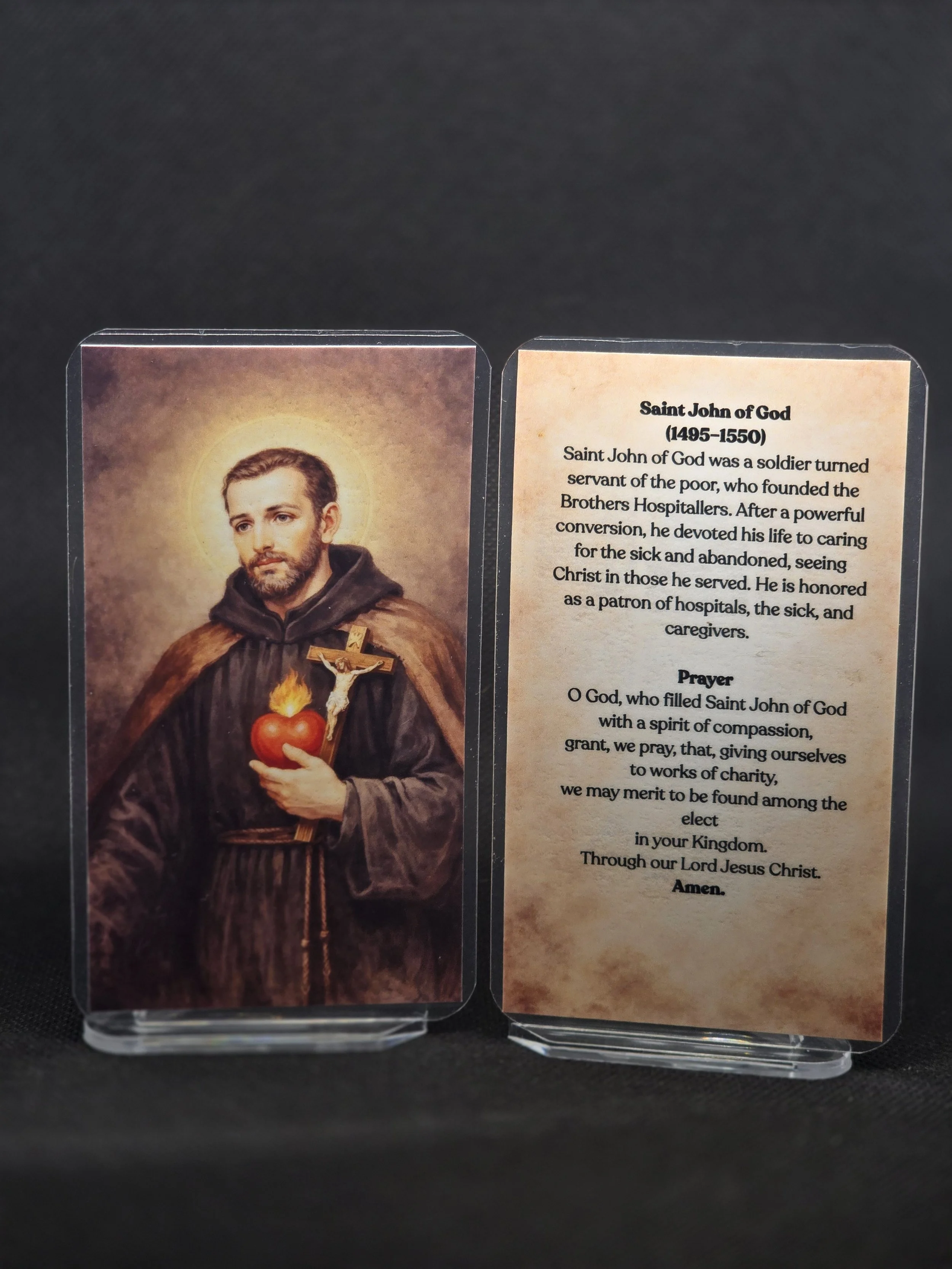
Keep his prayer card near you when you pray for the sick or for those who care for them.
View Prayer Card