Saint Hermolaus of Nicomedia: The Priest and Martyr Who Taught Saint Panteleimon
The elderly priest of Nicomedia remembered as the spiritual father of the physician Panteleimon, and as a martyr of the Great Persecution.
At a Glance
- Also known as
- Hermolaos, Ermolao, Hieromartyr Hermolaus
- Lived
- UNCERTAIN. Traditionally died about 304 or 305 at Nicomedia
- Region
- Nicomedia in Bithynia, now Izmit in Turkey
- Feast day
- July 26 in the Orthodox and Byzantine Catholic calendars, with Hermippus and Hermocrates; July 27 in the older Roman Martyrology
- Status
- Venerated since early centuries; no formal canonization date
- Patronage
- Counted among the Holy Unmercenaries by the Greek Archdiocese; no formal patronage established
Who Was Saint Hermolaus?
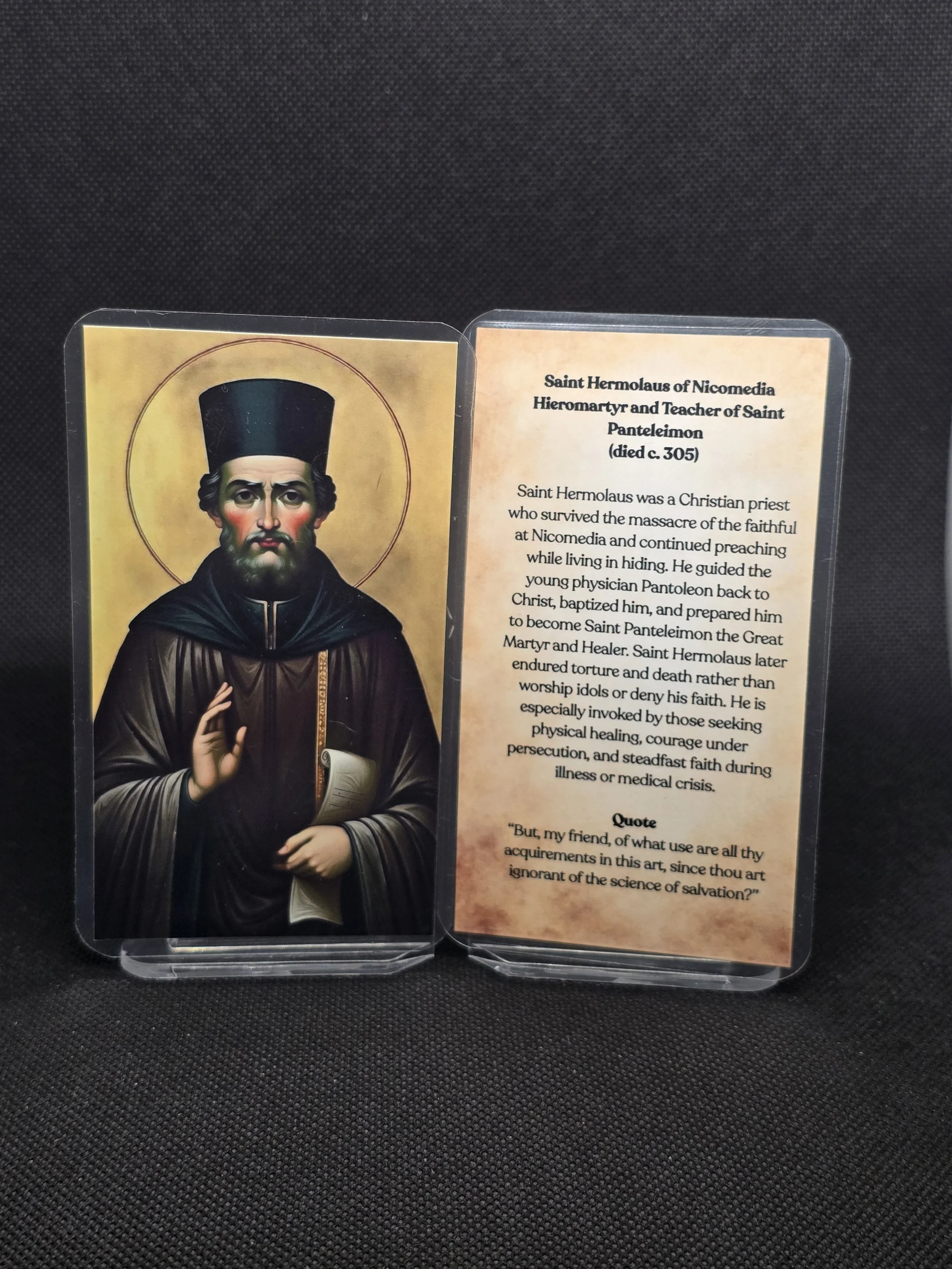
Saint Hermolaus is remembered in two ways. He is the priest who taught the young doctor Pantoleon, later known as Saint Panteleimon the Healer, and he is a martyr who died at Nicomedia in the Great Persecution. Almost everything the Church says about him comes from the stories told about Panteleimon.
That means we must be careful. The persecution is well documented. Hermolaus himself is known mainly through tradition. We label stories as TRADITION and open questions as UNCERTAIN, so that you can honor the saint without mistaking a pious story for a court record.
He is a priest, not a bishop, and the Church calls him a hieromartyr, a priest who died for Christ. He is honored on July 26 in the East, one day before Panteleimon.
Nicomedia and the Great Persecution
Nicomedia in Bithynia was an imperial city and, for a time, the residence of the emperor Diocletian. It was one of the first places where the Great Persecution began in 303. Eusebius of Caesarea, who lived close to those events, records the destruction of churches, the burning of the Scriptures and the arrest and execution of clergy there. He names Bishop Anthimus among the martyrs.
These events give the story of Hermolaus a credible setting. But Eusebius does not name Hermolaus. We have no contemporary letter, record of arrest or inscription that mentions him by name.
UNCERTAIN: We do not know his birthplace, parents, age or education. The tradition often pictures him as an elderly priest, but that is part of his image as a spiritual father and is not a recorded fact.
Nicomedia also matters for a larger reason. Within about a decade the persecution was ended by the Edict of Milan in 313, and Christians who had met in hidden houses began to worship in public. A priest who taught quietly at the height of the persecution stands near the point where one age ended and the next began, and that is part of why later generations kept his name.
We cannot say how much of that hope the first hearers of his story felt. It is enough to see that the Church has long found comfort in the idea that a small act of teaching, done at great risk, can change the life of someone who goes on to heal many others.
The Priest in Hiding
TRADITION: Eastern accounts say that Hermolaus and two fellow priests, Hermippus and Hermocrates, survived the destruction of a Christian congregation at Nicomedia and lived in hiding while they continued to teach. The Orthodox Church links this with the martyrs of Nicomedia remembered on December 28, said to number twenty thousand.
That number is a tradition. Eusebius confirms that many Christians were killed in the city, but he does not give the figure or describe the burning of a single church in the way later synaxaria do. We therefore treat the escape of the three priests as tradition and the number as UNCERTAIN.
The Greek Orthodox Archdiocese calls Hermippus and Hermocrates fellow priests. The older Roman Martyrology calls them brothers, but does not say they were related to Hermolaus.
Teacher of a Young Physician
TRADITION: According to the story in Panteleimon's life, Hermolaus noticed a young medical student named Pantoleon passing the house where he was hiding. Pantoleon had been taught the faith by his mother, Eubula, but had drifted from it after her death. He was studying under a physician named Euphrosynus.
Hermolaus invited him in and began to speak of Christ. The young man returned again and again to listen. A well known episode tells of Pantoleon praying over a child killed by a snake and seeing the child restored, after which he asked Hermolaus for baptism.
These episodes come from the passion of Panteleimon and are not independent testimony. The important theme is clear. Hermolaus is the one who shaped a healer's faith, and through him the Church sees healing as a form of love and not only a profession.
Arrest and Trial
TRADITION: When Panteleimon's Christian activity drew the attention of the authorities, he was asked who had taught him. He named Hermolaus, and the priest was arrested together with Hermippus and Hermocrates. The three refused to deny Christ or to sacrifice to the gods.
The tradition places the trial under the emperor Maximian. UNCERTAIN: The emperor involved is not secure, and a standard Catholic account of Panteleimon admits that Galerius may be the better historical candidate.
The Catholic Encyclopedia calls the extraordinary episodes in Panteleimon's martyrdom legendary. We should read the accounts of Hermolaus's trial in that light. They tell us what the Church remembers, but they are not a transcript.
Martyrdom
TRADITION: Orthodox accounts say that Christ appeared to Hermolaus and told him that he would die the next day. During the interrogation an earthquake is said to have thrown down a pagan temple, and the emperor, enraged, ordered the punishment of the three priests. They were beheaded.
The year is usually given as about 305 in Orthodox sources, and the Byzantine Catholic liturgical material gives 304. Neither date is independently confirmed.
Another story, found in the Catholic Encyclopedia article on Panteleimon, says that Christ appeared in the likeness of Hermolaus to strengthen Panteleimon during his tortures. It is a charming image of the bond between the teacher and his disciple. We repeat it only as tradition.
The Relic at Calci
In the church of Saints John and Hermolaus at Calci, near Pisa, a Byzantine silver reliquary has long been identified as holding the arm of Saint Hermolaus. It is kept there as evidence that the saint was honored in Latin Italy in the Middle Ages.
UNCERTAIN: Scholars who have studied the Greek inscriptions on the reliquary have raised the possibility that one inscription may refer to Panteleimon, whose original name was Pantoleon, and not to Hermolaus. That would mean the attribution became confused in the course of its history. The question is not settled in either direction.
We therefore say only this. The reliquary is real, the devotion it witnesses is old, and the identity of the relic inside it cannot be confirmed.
Panteleimon and Hermolaus Together
Hermolaus is almost always seen beside Panteleimon. In icons and hymns he is the teacher and the young doctor is the pupil, and the two feasts fall on consecutive days, July 26 and July 27. The pairing says something about how the Church thinks of holiness. It is handed on from one person to another.
The tradition also says Hermolaus was present at the start of the healer's Christian life, while Panteleimon outlived him and was martyred a day later in the feast calendar. Most scholars treat the long passion of Panteleimon as heavily legendary, with a historical core about a physician martyred at Nicomedia. If so, the figure of Hermolaus may belong either to that core or to the later development of the story, and we cannot tell which.
UNCERTAIN: The Greek passion of Hermolaus is cataloged as BHG 2173, and the Latin as BHL 3858. These are catalog numbers for texts about him, not writings by him. We have found no authentic work from his own hand.
The simple lesson of the pairing is still worth keeping. Panteleimon is remembered for his healing, and Hermolaus for the quiet fatherly work that came before it.
Hermolaus in the Liturgy and in the Church
The Orthodox Church and the Byzantine Catholic churches commemorate Hermolaus on July 26 with Hermippus and Hermocrates. The hymns praise his priesthood, his teaching and his willingness to die. The older Roman Martyrology placed him on July 27 with Panteleimon. The revised Roman Martyrology keeps Panteleimon on that date but does not list Hermolaus separately, which does not mean the Church has declared him never to have been a saint.
The Greek Orthodox Archdiocese counts him among the Holy Unmercenaries, the healers who served without payment. There is no reliable evidence that Hermolaus himself practiced medicine. His link to healing is through the man he taught.
Our sources do not show a separate Maronite feast or a universal devotion in all the Eastern Catholic churches, and we do not claim one.
Holy Hermolaus, priest and martyr, you taught a young physician the way of Christ and gave your life for him. Pray for priests and teachers, for mentors and spiritual fathers, and for those who care for the sick. Ask our Lord to strengthen us to confess him in every trial.
This prayer was written for this page and is not an official liturgical text. The official troparion and kontakion for his feast are published by the Orthodox Church in America and by the Byzantine Catholic Metropolitan Cantor Institute.
Praying With Saint Hermolaus Today
His memory is kept on July 26. Priests, catechists, teachers and mentors may ask his prayers, as may anyone who is trying to bring a younger person to faith. He is also a gentle companion for those who care for the sick.
A simple practice is to remember a person who first taught you to pray, and to give thanks for them. That fits what the tradition says about him better than any elaborate custom.
The hymns for the feast are in the fourth tone, and the Orthodox Church in America and the Byzantine Catholic Metropolitan Cantor Institute publish the official English texts. We do not reproduce them here.
Frequently Asked Questions
Pray With Saint Hermolaus
Keep his prayer card near you when you pray for a teacher, a priest or a mentor, and ask for his help.
View Prayer Card