Saint Job the Much-Suffering: The Righteous Man of Uz and Icon of Patient Faith Through Loss
The righteous sufferer of the Old Testament, honored in the Orthodox and Byzantine Catholic calendars on May 6 and in the Roman Martyrology on May 10.
At a Glance
- Also known as
- Righteous Job, Job the Long-Suffering, Prophet Job
- Lived
- UNCERTAIN. No reliable dates exist for his life
- Region
- The land of Uz, whose location is uncertain (Edom and northern Arabia are often proposed)
- Feast day
- May 6 (Orthodox and Byzantine Catholic); May 10 in the Roman Martyrology
- Status
- Venerated since ancient times; no formal canonization or glorification date
- Patronage
- Traditionally invoked for patience, illness, grief and undeserved suffering; no formal patronage decree found
- Who Was Saint Job?
- A Righteous Man in the Land of Uz
- The Testing
- Honest Prayer and the Voice from the Whirlwind
- Was Job a Real Person?
- The Wife and the Friends
- Family, Genealogy and Lifespan in the Greek Tradition
- The Testament of Job
- Job in the Liturgy and in the East
- Praying With Saint Job Today
- Frequently Asked Questions
Who Was Saint Job?
Job is the righteous man whose story fills one of the great books of the Old Testament. He loses his wealth, his children and his health, argues honestly with his friends and with God, and in the end is vindicated and restored. The Church honors him as Righteous Job the Much-Suffering, and in the East he is also called a prophet.
His story is unlike most saints' lives. There is no birth record, no martyrdom and no tomb. What we have is a book, two short references in other parts of Scripture, and centuries of Christian reflection. We therefore separate what Scripture says from what later TRADITION adds, and we mark open questions as UNCERTAIN.
The most important point is simple. Job is remembered for how he suffered, not for miracles he worked. That makes him a companion for anyone who has lost something they cannot get back.
A Righteous Man in the Land of Uz
The Book of Job begins by naming him as a blameless and upright man in the land of Uz. The location of Uz is UNCERTAIN, although Edom and northern Arabia are often suggested. The book gives no parents, no birth year and no genealogy.
It describes him as prosperous and respected. He had seven sons and three daughters, thousands of animals and many servants, as the narrative reports in Job 1:2 to 3. These are the figures of the story and not independent records.
His goodness is not only private piety. He offers sacrifice on behalf of his children, and in Job 29 he remembers defending the widow, the orphan, the poor and the blind. In Job 31 he describes a life of honest dealing, hospitality and generosity.
The Testing
The turning point comes in the opening scenes. Satan challenges Job's sincerity, suggesting that he is faithful only because he is protected and prosperous. God allows a test, with limits (Job 1:6 to 12 and 2:1 to 6).
Disaster follows. His livestock are taken and his children die when a great wind destroys the house in which they are gathered. Job grieves, yet he worships God and does not blame him. A second trial leaves his body covered with painful sores, and his wife urges him to curse God and die. He refuses.
Three friends, Eliphaz, Bildad and Zophar, come to console him. They begin well, sitting with him in silence for seven days and nights. The comfort ends when they begin to explain his suffering.
Honest Prayer and the Voice from the Whirlwind
The friends hold that suffering must be punishment, and so they conclude that Job has sinned. Job rejects this. He laments his birth, questions God's justice and insists on his innocence. The book does not hide how raw his speech becomes.
The turning point is God's answer from the whirlwind in chapters 38 to 41. God does not hand Job a tidy explanation. He points him to the vastness of creation and the limits of human understanding, and Job responds with humility.
At the end, God rebukes the friends for misrepresenting him and says that Job has spoken rightly (Job 42:7 to 8). Job prays for them, and his fortunes are restored. Pope Francis noted in a general audience on May 18, 2022 that Job's protest is a real expression of faith and not a rejection of God.
UNCERTAIN: In Job 19:25 to 27 Job speaks of a living redeemer. Christian tradition reads this as pointing to resurrection and to Christ, but the Hebrew is difficult and ancient translations differ, so the original sense is disputed.
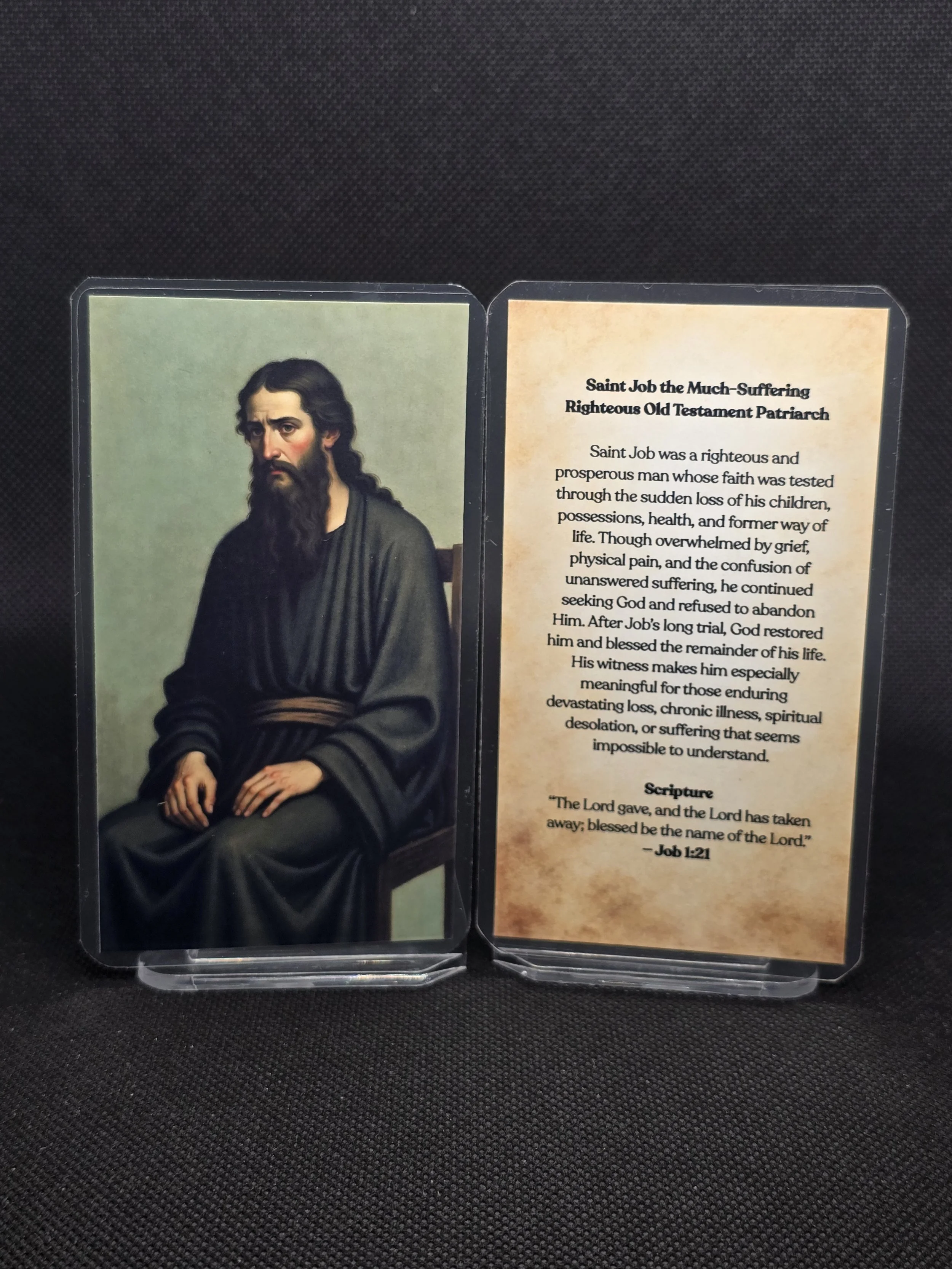
Was Job a Real Person?
Ezekiel 14:14 and 20 name Job beside Noah and Daniel as an example of righteousness, and James 5:11 holds up his endurance. These passages show that Job was known to the biblical tradition. They do not by themselves prove that every event in the book happened.
Older Catholic scholarship defended his historical existence while admitting that the book is highly literary. Many modern scholars describe the prose frame as the story of a traditional or legendary righteous figure, around whom a great wisdom poem was built. The United States bishops' introduction dates the book between the seventh and fifth centuries before Christ, and one scholar argues for the Persian period.
Those dates concern the writing of the book, not Job's lifetime. History and theology ask different questions, and the Church can honor Job and read his book as inspired without settling every question about his life.
The Wife and the Friends
Job's wife speaks only once in the Hebrew book, when she tells him to curse God and die. Many readers have judged her harshly. It is fairer to see a woman who has also lost her children and her security, and who cannot bear to watch her husband suffer. Job answers her gently, saying that we receive good from God and must also receive trouble.
The three friends are more complicated. They come out of real loyalty, travel a long way and sit in silence for a week, which is a model of how to be with someone in grief. Their failure is that they then explain. They defend a tidy theory that suffering follows sin, and the book treats this as a serious error.
The younger voice of Elihu appears in chapters 32 to 37 and speaks of God as a teacher who uses suffering to open the ear. The Lord does not mention him in the final verdict, and scholars debate whether his speeches were added later. We note the question and do not try to settle it here.
Family, Genealogy and Lifespan in the Greek Tradition
The Hebrew text says that after his restoration Job lived another 140 years (Job 42:16), and that his three new daughters were named Jemimah, Keziah and Keren-happuch. It also says he gave them an inheritance along with their brothers.
The Greek Septuagint adds a longer ending that is not in the Hebrew. It identifies Job with Jobab, a king of Edom, names his father as Zare and his mother as Bosorrha, and says he lived 170 years after his trials, 240 in all. Orthodox accounts, including the Prologue from Ohrid, follow versions of these figures, and the totals differ among them.
UNCERTAIN: Genesis 36:33 names Jobab as the son of Zerah of Bozrah, but it does not say that this king is the Job of Uz. The Greek addition is evidence of an ancient way of reading the story and not proof of royal ancestry.
The Testament of Job
A non canonical work, the Testament of Job, was written around the turn of the era. It gives Job's wife the name Sitis and adds stories about her poverty and suffering, and it describes Job destroying an idol's temple before Satan attacks him. It also tells of heavenly sashes given to his daughters.
These stories help us see how Job's story grew in Jewish and Christian circles, but they are not part of the Book of Job and should not be taken as history. The Bible speaks of the daughters' inheritance, not of sashes.
Job's tomb is also claimed in several places, including a shrine near Salalah in Oman and sites in the Hauran region of Syria. These are pilgrimage traditions. We found no evidence of an authenticated burial or relics.
Job in the Liturgy and in the East
Job is commemorated on May 6 in the Orthodox and Byzantine Catholic calendars, with hymns that praise his courage and steadfastness. In the Roman Martyrology his memory falls on May 10, but that is not a universal memorial in the General Roman Calendar.
Readings from Job are heard in Holy Week services in the Orthodox Church. The Church sets his undeserved suffering beside Christ's voluntary Passion. That is a comparison and not an equation. Job is a righteous man, while Christ is the sinless Redeemer.
In the West, Gregory the Great's Moralia on Job treated him as a figure of Christ, of the suffering Church and of the believer under trial, and it shaped medieval theology. In icons Job is shown afflicted, sometimes on the ash heap, with his wife and friends.
Righteous Job, you lost everything and still turned to God. Pray for those who grieve, for the sick, and for all who cannot understand their pain. Teach us to pray honestly and to be gentle with those who suffer, and ask Christ to give us hope in the resurrection.
This prayer was written for this page and is not an official liturgical text. The Orthodox Church in America publishes the official troparion and kontakion for his feast.
Praying With Saint Job Today
His memory is kept on May 6. Job is a natural friend for people in grief, serious illness or confusion about why something has happened. He gives permission to pray honestly.
The simplest way to keep his memory is to read a part of his book, such as chapter 1 or the answer in chapter 38, and to sit with someone who is suffering without explaining it away.
His story also warns against a tempting habit. Job's friends were wrong to assume that those who suffer must be guilty, and the Church asks us not to repeat their error.
Frequently Asked Questions
Pray With Saint Job
Keep his prayer card near you in times of loss, and ask his prayers for those who suffer.
View Prayer Card