Saint Luke the Evangelist: Physician, Companion of Paul and Traditional Author of the Third Gospel and Acts
The Gentile physician remembered as Paul's faithful companion, the storyteller of mercy, and in Eastern tradition the first painter of the Mother of God.
At a Glance
- Also known as
- Loukas (Greek), Lucas (Latin), Apostle and Evangelist Luke
- Lived
- UNCERTAIN. Birth and death dates are unknown
- Region
- Antioch in Syria by early testimony; ministry with Paul around the Mediterranean; traditional death in Greece
- Feast day
- October 18 in the Roman Catholic, Orthodox and Byzantine Catholic calendars
- Status
- Venerated since the early Church; no formal canonization date
- Patronage
- Physicians, surgeons, painters, iconographers and artists
- Who Was Saint Luke?
- What the New Testament Says
- Early Church Testimony About His Origin
- The Gospel and Acts
- One of the Seventy?
- The First Painter of the Mother of God
- Death and Burial
- Relics at Constantinople, Padua, Thebes and Prague
- Luke in the East and the West
- Praying With Saint Luke Today
- Frequently Asked Questions
Who Was Saint Luke?
Saint Luke is the evangelist who gave the Church the stories of the Annunciation, the Good Samaritan and the Prodigal Son. Christian tradition names him as the author of the third Gospel and of the Acts of the Apostles, a physician, and a companion of Saint Paul.
We know less about his personal life than readers expect. The New Testament names him only a few times, and neither of his books names its author. Early Church witnesses supply a little more, and later tradition supplies a great deal. This article keeps those three layers separate: the New Testament, the early Church testimony, and the TRADITION that grew afterward. We also mark open questions as UNCERTAIN.
Luke is honored in both East and West, and on the same day, October 18. For that reason he is a shared saint, not a Western one or an Eastern one.
What the New Testament Says
Luke is named three times. In Philemon 24 he is among Paul's fellow workers. In Colossians 4:14 he is called the beloved physician. In 2 Timothy 4:11 Paul writes that only Luke is with him. Philemon is generally accepted as written by Paul, while the authorship of Colossians and 2 Timothy is debated by scholars.
Acts contains the passages in which the narrator suddenly says we, in Acts 16:10 to 17, 20:5 to 21:18 and 27:1 to 28:16. Tradition reads them as Luke's own memories of traveling with Paul, including the dangerous voyage to Rome.
UNCERTAIN: Some scholars think the author used an earlier travel record or a literary convention instead. The we-passages are important evidence, but they do not by themselves prove who the narrator was.
Early Church Testimony About His Origin
Irenaeus of Lyons, writing around 180, identifies Luke as Paul's companion and says he set down the gospel Paul preached. The Muratorian Fragment, usually dated to the late second century though its date is disputed, also names Luke as the author of the third Gospel and describes him as one who had not seen the Lord in the flesh.
Eusebius, in the early fourth century, says Luke was from Antioch and a physician. Jerome repeats this in On Illustrious Men, written about 392 to 393. Antioch was a major center of early Christianity, as Acts 11 shows.
UNCERTAIN: We have no ancient source for his parents, his birthplace within the city, his education or his marital status beyond a later prologue. Colossians 4 lists Luke after a group described as of the circumcision, and that has led many to conclude that he was a Gentile. That is a reasonable reading but not a statement of the text.
The Gospel and Acts
The Gospel and Acts share a dedication to Theophilus in Luke 1:3 and Acts 1:1, and they share language, theology and structure. Most scholars agree that one author wrote both, though they dispute whether that author was Paul's companion. Many date the Gospel to about 80 to 90, partly because of its relation to Mark. Some defend an earlier date.
The Gospel carries some of the best known passages in Scripture: the Annunciation, the Magnificat, the Good Samaritan, the Prodigal Son, Zacchaeus and the repentant criminal on the cross. It keeps returning to mercy, prayer, the poor, women, the Holy Spirit and the offer of salvation to the Gentiles.
Acts tells of Pentecost, the conversion of Cornelius, the council at Jerusalem and Paul's journeys, and it ends with Paul preaching in Rome under guard. The ending does not tell us when the book was written.
UNCERTAIN: It is often said that Luke got his stories about Mary from Mary herself. The Gospel says that she treasured these things in her heart, but it does not say that Luke interviewed her. That is a devotional possibility and not a recorded fact.
One of the Seventy?
Eastern tradition counts Luke among the Seventy sent out in Luke 10 and sometimes names him as the unnamed companion of Cleopas on the road to Emmaus. These identifications are not found in the New Testament.
They also sit awkwardly with the Gospel's own preface, in which the writer appears to distinguish himself from the original eyewitnesses. The early Muratorian testimony likewise treats him as someone who did not see the Lord in the flesh. We therefore present the Seventy and Emmaus as pious tradition.
That does not make them worthless. They show how deeply the Church wanted its evangelist to belong to the circle of the first disciples.
The First Painter of the Mother of God
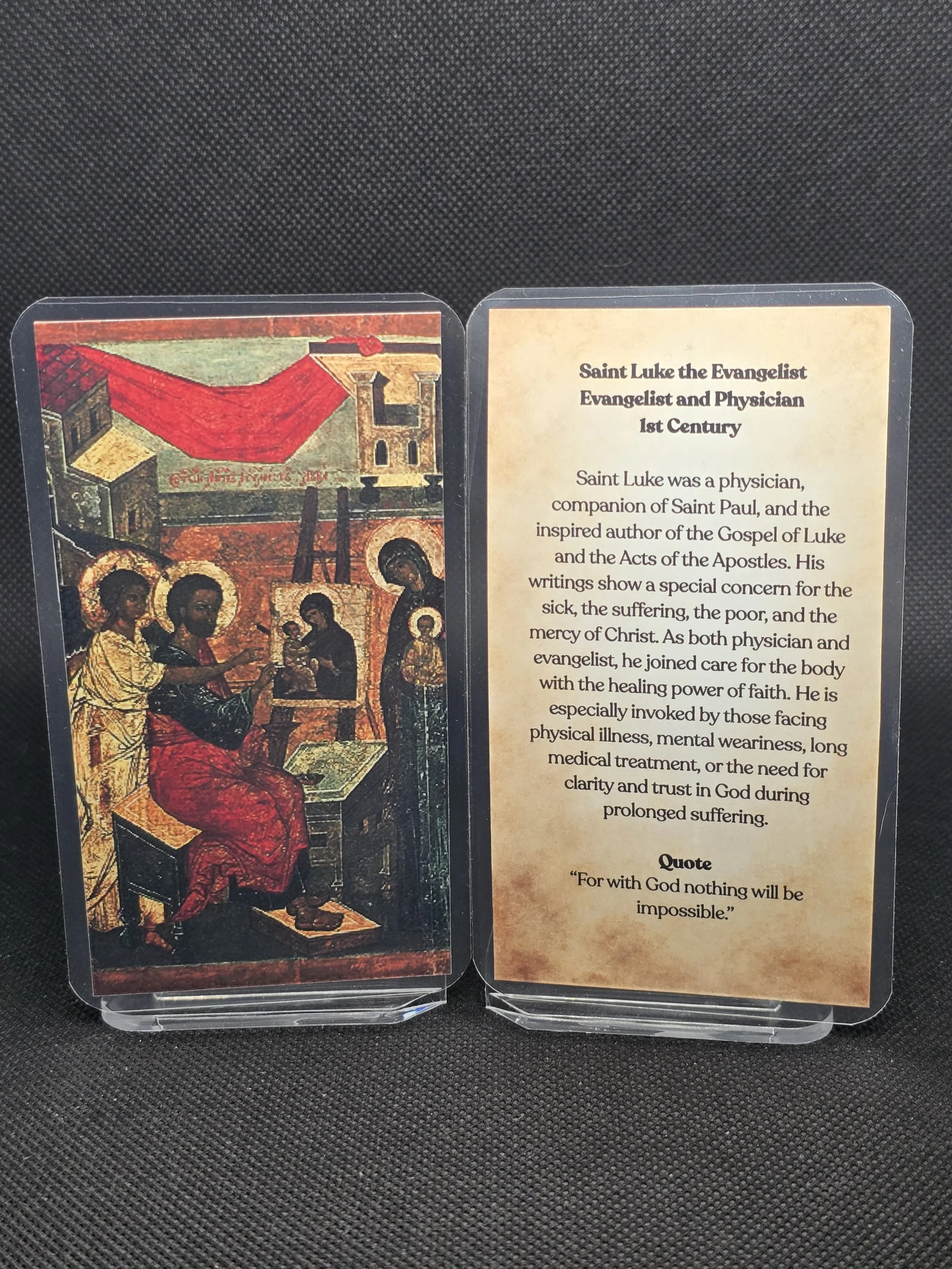
The best known tradition about Luke in the East is that he painted the first icon of the Theotokos holding Christ. The Hodegetria, the Mother of God who points the way, became the type most closely tied to this story.
The earliest surviving literary notice is usually linked to Theodore the Reader in the early sixth century, who connects a Constantinople image with the Empress Eudocia. Scholars have questioned how the attribution to Luke entered that account, and recent academic work has studied how Luke came to be called an artist at all.
TRADITION: Orthodox sources add that the Virgin blessed Luke's icons. UNCERTAIN: No surviving painting can be shown to come from his hand. The story matters for what it teaches. If the Word truly became flesh, then the Church can depict him, and Luke became its symbol for that conviction.
Death and Burial
We do not know when or how Luke died. An ancient prologue to the Gospel, whose date and transmission need caution, says he was unmarried and childless and died in Boeotia at the age of 84. Other traditions speak of martyrdom, sometimes at Thebes. Catholic sources acknowledge that the accounts disagree.
It is therefore wrong to say flatly that Luke was hanged, crucified or killed. The honest statement is that early tradition places his death in Greece, that some sources say he died in old age and others say he was martyred, and that none of this can be checked.
His veneration does not depend on resolving the question. The Church has honored him as an Evangelist since early times.
Relics at Constantinople, Padua, Thebes and Prague
Jerome reports that Luke's bones, together with relics of Saint Andrew, were brought to Constantinople in the reign of Constantius II. Later tradition places his body at the Basilica of Santa Giustina in Padua. How and when the remains reached Padua is UNCERTAIN, and Pope John Paul II acknowledged that gap in a message of October 17, 2000.
In September 1998 the sarcophagus at Padua was opened. A genetic study published in the Proceedings of the National Academy of Sciences in 2001 found that the DNA was compatible with a Syrian origin, but it could not exclude a later substitution. Radiocarbon work gave a date range from 72 to 416, much too wide to identify any person.
Other claims exist. A rib was returned to the traditional tomb at Thebes in Greece, and a skull is venerated at Saint Vitus Cathedral in Prague. These are claims of ecclesial custody and have not been scientifically identified. In 2000 the Orthodox Archbishop of Thebes asked for part of the Padua relics, a documented moment of shared devotion between East and West.
Luke in the East and the West
In the Orthodox Church and the Byzantine Catholic churches Luke is Apostle and Evangelist, and his feast is October 18. His Gospel gives the Church the Annunciation, the Magnificat and the Presentation, which are central to Byzantine worship and devotion to the Mother of God, and Acts gives the account of Pentecost and the mission.
His place in the history of sacred art makes him specially dear to the East. In the West he is the patron of physicians and artists, and the winged ox, his symbol, goes back to Irenaeus, who linked the ox with the priestly opening of the Gospel in the temple scene with Zechariah.
Luke's real gift is his writing. The details of his later life are uncertain, but the mercy of his Gospel is plain on every page.
Holy Luke, physician and evangelist, you wrote of the mercy of Christ for the poor, the sick and the lost. Pray for doctors, nurses and artists, and for all who tell the Gospel in word or in image. Ask our Lord to heal us and to make us merciful.
This prayer was written for this page and is not an official liturgical text. The official hymns for his feast are published by the Orthodox Church in America.
Praying With Saint Luke Today
His feast is October 18. Physicians, nurses and artists often ask his prayers on that day. Reading a passage from his Gospel, such as the Good Samaritan or the Prodigal Son, is the simplest way to keep it.
You can also pray for those who care for the sick, remembering that Luke is called the beloved physician. His example joins healing of the body with care for the whole person.
The Apolytikion for his feast is in the third tone and asks his intercession for forgiveness of sins. We do not reproduce it here. The Orthodox Church in America publishes the official English text.
Frequently Asked Questions
Pray With Saint Luke
Keep his prayer card near your Bible and ask his help for those who heal and those who create.
View Prayer Card