Saint Alphonsus Liguori: The Neapolitan Lawyer Who Became Bishop, Founder of the Redemptorists and Doctor of the Church
A brilliant young lawyer of Naples who gave up his career for the priesthood, founded a missionary congregation for the neglected poor, and taught confessors to unite truth with mercy.
At a Glance
- Also known as
- Alphonsus Maria de Liguori, Alfonso Maria de' Liguori
- Lived
- September 27, 1696 to August 1, 1787, aged 90
- Region
- Marianella near Naples, Scala, and Sant'Agata de' Goti and Pagani in southern Italy
- Feast day
- August 1 in the current Roman calendar (August 2 in the traditional Roman calendar)
- Status
- Venerable 1796, beatified 1816, canonized May 26, 1839, Doctor of the Church March 23, 1871
- Patronage
- Confessors and moral theologians (proclaimed 1950); also invoked by sufferers of arthritis in devotional use
- Who Was Saint Alphonsus Liguori?
- A Noble Family in Naples
- The Lawyer of Naples
- The Call at the Hospital
- Evening Chapels and the Shepherds of Scala
- Founding the Redemptorists
- Teacher of Moral Theology
- Bishop, Illness and the Crisis of His Congregation
- Death, Relics and Recognition
- Eastern Christians and Saint Alphonsus
- Frequently Asked Questions
Who Was Saint Alphonsus Liguori?
Alphonsus Liguori was a lawyer, a priest, a missionary, a bishop, a writer, a composer of hymns and the founder of a religious congregation. He lived for ninety years in southern Italy, in a century when Europe was changing quickly and the Church was often pressed by governments. He is remembered above all as a teacher of confessors, a man who held that the truth of the moral law and the mercy of God must always be kept together.
His life is unusually well documented. We have his own books, his letters, Redemptorist records and an early biography by a member of his community who knew him. That means this article can separate history from tradition more clearly than for many older saints. Where a story is a pious tradition, or where sources disagree, we say so with the labels TRADITION and UNCERTAIN.
He is a Roman Catholic saint, and we will say plainly what that means for Eastern readers. Our section on Eastern Christians looks at the connection that can actually be shown and avoids claims that cannot.
A Noble Family in Naples
Alphonsus was born on September 27, 1696, at Marianella, near Naples, into a noble family. His father, Giuseppe de' Liguori, was an officer in the royal navy, and his mother, Anna Maria Caterina Cavalieri, was known for her religious seriousness. The household was devout and also very conscious of rank, and the father expected his eldest son to make a name for himself in the world.
UNCERTAIN: Biographies disagree about the size of the family. One older source calls him the eldest of seven children and the Vatican's saints' office calls him the first of eight. We therefore avoid giving a number.
He was educated by private tutors in letters, languages, philosophy, law and music. On January 21, 1713, at the age of sixteen, he received his doctorate in civil and canon law. Music stayed with him all his life, and he later wrote hymns that ordinary people could sing.
The Lawyer of Naples
As a young man Alphonsus practiced law in Naples and became known for his skill. He also took part in works of charity, including visits to the sick at the Hospital for Incurables, and he joined a lay confraternity that cared for the gravely ill. His later turn to the priesthood was not the discovery of faith by a worldly man. It was the narrowing of an already devout life toward one single aim.
TRADITION: Later biographies say he never lost a case in eight years at the bar. The Catholic Encyclopedia itself warns that this may be an exaggeration, so we say only that he was a successful lawyer.
The turning point came in 1723, after a major case went against him. UNCERTAIN: Accounts differ on why he lost. One older story says he overlooked a key document, and Redemptorist writers stress the injustice of the process. What is certain is that he left the courts disillusioned and began to seek another path.
The Call at the Hospital
TRADITION: According to the early biography, on August 28, 1723, while at the Hospital for Incurables, Alphonsus felt himself called to leave worldly ambition and give himself fully to God. He then offered himself in a church associated with the redemption of captives. These are spiritual experiences reported in the tradition and cannot be checked from outside.
The ordinary facts are clear. His father resisted, and the son persisted. After years of study and prayer Alphonsus was ordained a priest on December 21, 1726, and joined the clergy of Naples.
The sources describe a man who did not drift into religious life. He weighed it, bore the cost, and chose it.
Evening Chapels and the Shepherds of Scala
As a young priest he preached among the poor of Naples. Together with lay helpers he took part in the Evening Chapels, gatherings of prayer, instruction and mutual help for working people. Laypeople carried a large part of the teaching, which makes the movement a notable early example of lay involvement in the Church's mission.
In 1730, tired from ministry, he went to Scala near Amalfi. There he met shepherds and rural families who had almost no access to preaching or the sacraments. Their poverty of instruction moved him to plan a missionary community for abandoned country people.
He was helped and also challenged by Bishop Tommaso Falcoia and by Maria Celeste Crostarosa, a religious woman whose spiritual vision shaped the foundation of a contemplative order for women.
Founding the Redemptorists
On November 9, 1732, at Scala, Alphonsus founded the Congregation of the Most Holy Redeemer, known as the Redemptorists. Its work was missions: simple and direct preaching, confession and instruction for people the parishes did not reach. Papal approval came from Benedict XIV in 1749, after years of disputes about leadership and the rule.
It is fair to credit Maria Celeste Crostarosa as the principal foundress of the contemplative Redemptoristine nuns, whose order began in 1731. Alphonsus assisted at its start, but the historical record does not support crediting both communities only to him.
The congregation grew slowly and with real hardship. The Kingdom of Naples long withheld the civil recognition it needed, even after the pope had approved it.
Teacher of Moral Theology
Alphonsus's most important scholarly work is the Moral Theology. It began as notes on a manual by the Jesuit Hermann Busenbaum, appeared in 1748, and was greatly expanded in 1753 to 1755, with further revisions in his lifetime. It deals with conscience, sin, virtue, the sacraments and the duties of different professions.
He is linked with equiprobabilism, a method for reasoning in cases of real doubt that tried to avoid both harsh rigorism and careless laxity. His position developed over time, so it is misleading to treat his late view as identical to his first. His criticism of Jansenist severity was real, and he was also criticized by those who found him too mild.
His devotional works reached ordinary readers: Visits to the Blessed Sacrament, The Glories of Mary in 1750, Preparation for Death in 1758, The Great Means of Prayer in 1759 and The Practice of the Love of Jesus Christ in 1768. His spirituality centers on the Incarnation, the Passion, the Eucharist and Mary. He also wrote the Italian Christmas hymn Tu scendi dalle stelle.
Bishop, Illness and the Crisis of His Congregation
In 1762 he was named Bishop of Sant'Agata de' Goti, a post he accepted reluctantly. He improved the training of clergy, reformed communities and cared for the poor, and he worked to feed the hungry in the famine of 1763 to 1764. Severe illness from 1768 left him disabled, with the bent neck seen in many portraits, and the pope allowed him to resign in 1775.
His last years were darkened by a crisis. In 1780 a government-approved revision of the congregation's rule, called the Regolamento, was accepted by Alphonsus. Rome did not consider that it preserved the institute, and the houses in the Papal States and those in Naples were divided. Rome recognized the Papal States communities in 1781 as the continuation of the approved congregation, and the separation lasted until after his death, ending in 1793.
He was not excommunicated and did not leave the Church. UNCERTAIN: Traditional accounts say he did not understand the changes and had been misled by advisers. The early biography by Antonio Tannoia is invaluable but later historians found it limited on the internal conflicts, so we avoid assigning blame to named individuals.
Death, Relics and Recognition
Alphonsus died on August 1, 1787, at Pagani. The early biographies describe a long period of anxious scruples near the end, followed by greater peace. We treat these as spiritual testimony, not as clinical fact.
His remains rest in the basilica at Pagani. He was declared Venerable in 1796, beatified by Pius VII in 1816 and canonized by Gregory XVI on May 26, 1839. Pius IX named him a Doctor of the Church on March 23, 1871, and Pius XII proclaimed him patron of confessors and moral theologians on April 26, 1950. John Paul II venerated the relics at Pagani on November 12, 1990.
TRADITION: Early biographies report that in September 1774 he fell into a long trance at Arienzo and was present, in some way, at the death of Pope Clement XIV in Rome. They also describe ecstasies, healings and knowledge of hidden things. These are claims of tradition. We report them without asking you to treat any single one as historically demonstrated.
Saint Alphonsus, you left the courts to serve the poor and taught that mercy and truth belong together. Pray for confessors and for all who guide consciences. Pray for those who suffer in body or in spirit, and help us to pray without growing weary.
This prayer was written for this page and is not an official liturgical text. For his own words, see his works, such as Visits to the Blessed Sacrament.
Eastern Christians and Saint Alphonsus
The connection that can be shown runs through the Redemptorists. In 1906 a Belgian Redemptorist, Father Achille Delaere, was allowed to serve Ukrainian immigrants in Canada in the Byzantine rite. In 1913, with the support of Metropolitan Andrey Sheptytsky, a Ukrainian Byzantine Catholic branch of the congregation was established. Among its members was Blessed Vasyl Velychkovsky, a bishop who suffered under Soviet persecution.
That does not make Alphonsus an Eastern saint. We found no universal feast for him in the Byzantine, Syriac, Armenian or Alexandrian Catholic calendars, and no sign that any Orthodox synod has glorified him. Alphonsus was a Roman Catholic bishop who defended Catholic positions in his writings.
There is still a shared spiritual language to notice: repentance, the Name of Jesus, constant prayer and mercy toward sinners. These are themes, and not proof that Eastern churches adopted his Latin methods.
Frequently Asked Questions
Pray With Saint Alphonsus
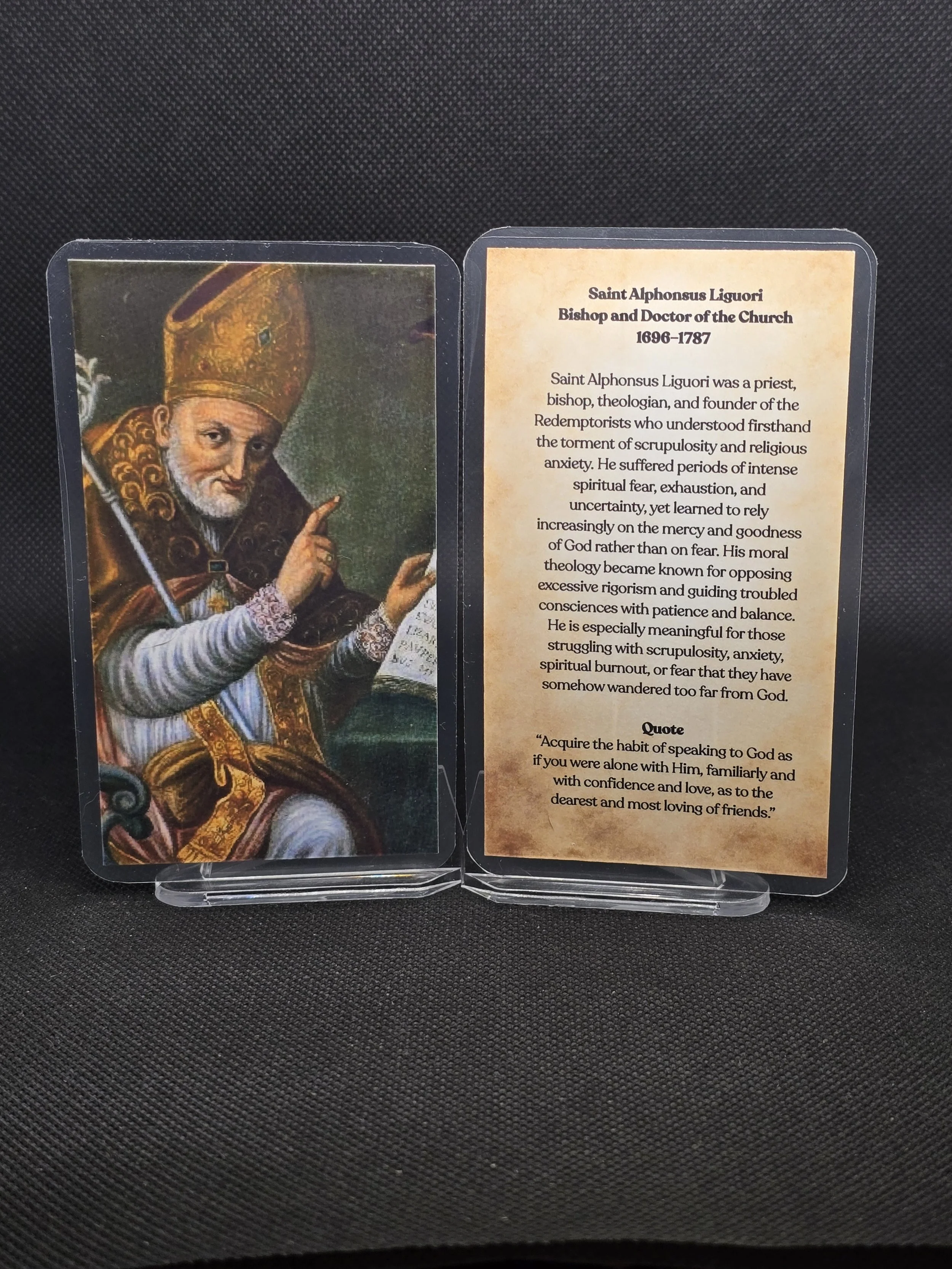
Keep his prayer card near your place of prayer, and ask his help for those who hear confessions and for anyone weighed down by scruples.
View Prayer Card