Saint Stylianos of Paphlagonia: The Hermit Honored as Protector of Children
A holy monk of Asia Minor whose icon shows him holding an infant, and whose prayers parents have asked for sick children for many centuries.
At a Glance
- Also known as
- Stylianus, Saint Stylian, Venerable Stylianos the Monk
- Lived
- UNCERTAIN. Sources place him between the fourth and early seventh centuries
- Region
- Paphlagonia, on the Black Sea coast of Asia Minor (now Turkey)
- Feast day
- November 26 (December 9 on the civil calendar for churches that keep the Julian calendar)
- Status
- Venerated in the Byzantine calendar and named in the traditional Roman Martyrology; no formal canonization date
- Patronage
- Children, infants, parents and couples hoping for a child
- Who Was Saint Stylianos?
- A Name That Is Easy to Confuse
- Early Life and the Gift of an Inheritance
- The Monk and the Cave
- A Hermit and His Love for Children
- The Alypius Question
- Death and Relics
- Hymns and Icons
- What He Means for Catholic and Orthodox Readers
- Praying With Saint Stylianos Today
- Frequently Asked Questions
Who Was Saint Stylianos?
Saint Stylianos of Paphlagonia is one of the most familiar faces in an Orthodox home. In his icon he is an old, bearded monk holding a swaddled infant in his arms. For many centuries, parents have placed that icon beside the bed of a sick child, and couples who longed for a baby have asked his prayers.
He is a hermit of Asia Minor. We know that he is honored in the Byzantine calendar on November 26 and that he appears in the traditional Roman Martyrology. We do not know with certainty when he lived or where he was born, and his story overlaps with that of another saint who shares his feast day.
This article keeps the honest evidence apart from tradition. We mark stories as TRADITION and open questions as UNCERTAIN. That is not meant to weaken devotion. It is meant to help you see what the Church actually hands down in his name.
A Name That Is Easy to Confuse
There are two people whose names are easy to mix up with him. The first is Stylianos Zaoutzes, a Byzantine court official of Armenian descent who served Emperor Leo VI in the late ninth century and whose daughter Zoe became the emperor's wife. He was a layman and statesman, and he is documented in a scholarly reference of Byzantine persons. He has nothing to do with the hermit.
The second is Saint Alypius the Stylite, an ascetic also linked to Paphlagonia and honored on November 26. Alypius is remembered as a pillar saint, and Stylianos is remembered as a cave dweller. It is worth keeping the two apart, because the similarity of names, place and feast day has led to confused biographies.
We will return to Alypius below, since a respected scholar thought the two may be connected.
Early Life and the Gift of an Inheritance
Where he was born, who his parents were and when he lived are UNCERTAIN. The Greek Orthodox Archdiocese places him in the later sixth and early seventh centuries, while the Orthodox Church in America gives a wider range that begins in the fourth century. A diocesan biography even admits that his link to Paphlagonia may come partly from the tradition that his relics were kept there.
TRADITION: The best known account says he was born to wealthy parents who left him a large inheritance, and that after their death he gave it away to the poor. Another modern description says his family was poor, but the older tradition favors the wealthy family, so we offer that version as a tradition and no more.
Nothing reliable tells us whether he married or had a family. What the tradition insists on is the choice he made: he gave up security for the sake of Christ, and the care of the poor was part of that choice from the start.
The Monk and the Cave
TRADITION: After giving away his possessions, Stylianos entered a monastery. His zeal is said to have stirred the jealousy of some of the brothers, and he withdrew from the community to live in a cave in the wilderness, where he devoted himself to prayer and fasting. The Orthodox Church in America tells the story this way, and the synaxarion adds that an angel fed him there.
These stories show what the Church teaches about him, and not a verified chronicle. We could find no monastic record that confirms the quarrel or the cave.
What stands out is the way solitude and love of neighbor are joined. Visitors came to the hermit for prayer and advice. He is remembered as someone who left the world without ever ceasing to care about the people in it, and above all about its youngest members.
A Hermit and His Love for Children
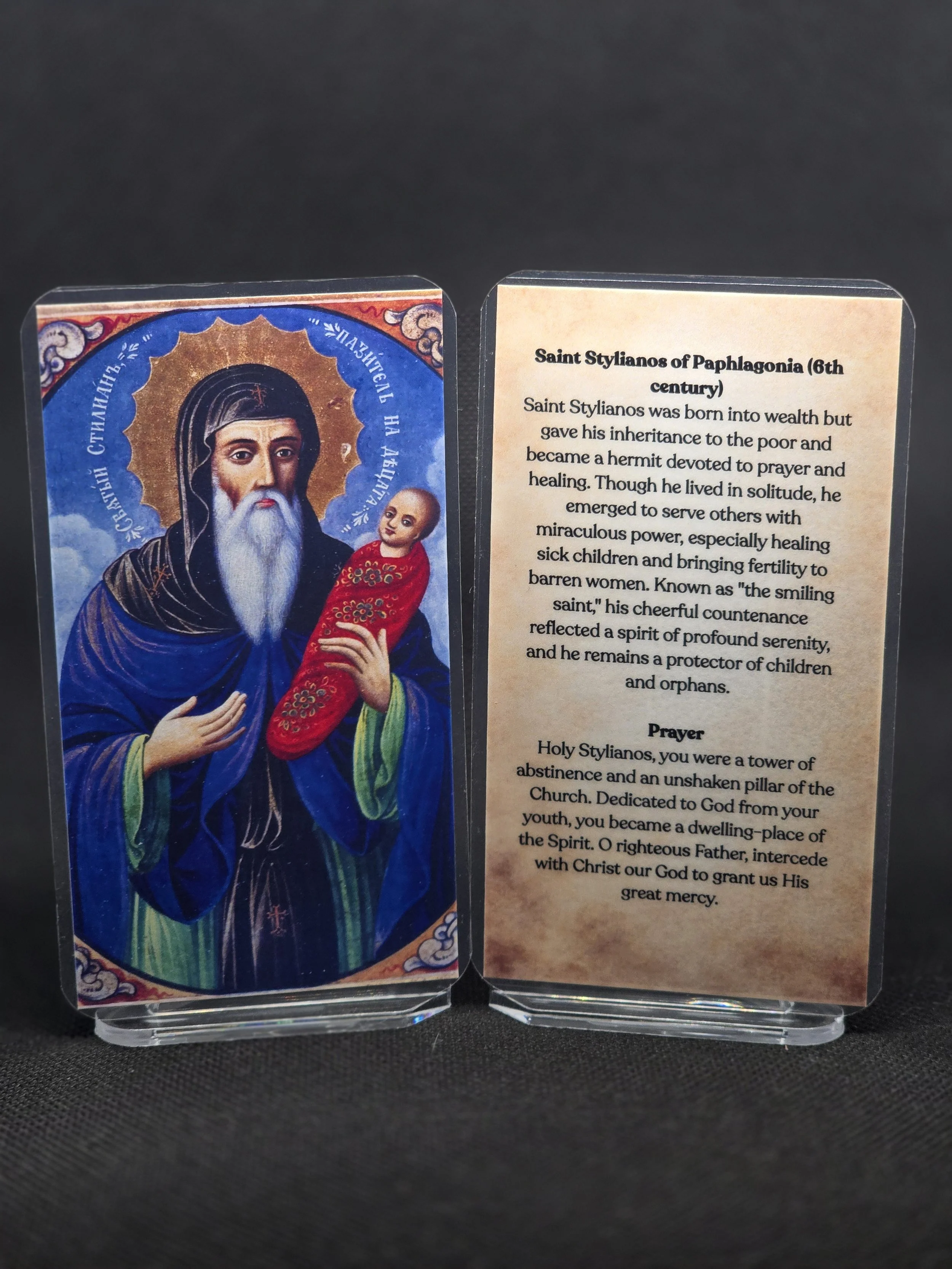
The feature that sets Stylianos apart is his link with children. TRADITION says that parents came to him when their children were ill, and that he prayed for them and many recovered. After his death, families kept asking for his prayers, often setting his icon near the bed of a sick child.
A diocesan source in Greece describes him as a man of peace who was especially tender toward little ones, and humility is said to have been central to his teaching. We cannot trace any of the sayings attributed to him to a text he wrote or dictated, so we speak of his teaching in general terms and do not quote words as his.
In art he holds an infant, and sometimes a scroll about the protection of children. The child is a symbol of his patronage and not the portrait of a particular baby. We also note that the tradition links his prayers to children who recovered and to couples who later had children after loss or long waiting. It does not claim that he raised the dead.
The Alypius Question
The most important scholarly puzzle in his story was raised by the Bollandist Hippolyte Delehaye, who wrote on the pillar saints in 1923. He noted that Stylianos and Alypius share a name pattern, a connection to Paphlagonia, a monastic profession and the same feast day, and he suggested that Stylianos may be a doubling of the cult of Alypius. He also criticized the old Roman Martyrology for mixing details from the two.
This is a hypothesis, not a proof that Stylianos never lived. The Byzantine liturgical books continue to honor the two saints separately, and that separate veneration is itself a fact of history. But it is the kind of fact that tells us about worship, not necessarily about origins.
There is a practical lesson. A Norwegian Catholic directory entry on Stylianos includes a bishop named Theodore, a pillar, a female relative named Maria and communities formed around a stylite, and those details match the story of Alypius. We have left them out. Anyone telling the story of Stylianos on a pillar is telling the story of someone else.
Death and Relics
TRADITION: Orthodox biographies say Stylianos died peacefully after a life of asceticism, and that his face shone and an angel came to receive his soul. We have no contemporary witness, tomb inscription or dated record. November 26 is the day he is commemorated and not necessarily the day he died.
Relics attributed to him are kept in several Greek monasteries. One is a skull at the Monastery of the Holy Trinity at Saika in the Agrafa region, which was reported stolen in 2011 and later recovered. Others are named at Damastas, Leimonos, Dadiou and Kato Xenias. These claims belong to the history of devotion, and we have found no independent study of the remains.
No original grave or archaeological find has been confirmed. The Church recognizes him through its calendar and prayers, not through a formal act of canonization that anyone has recorded.
Hymns and Icons
The Greek Orthodox Archdiocese and the Orthodox Church in America publish his troparion in the third tone, and a kontakion that likens him to the prophet Samuel, who was dedicated to God in childhood. The hymns speak of restraint, holiness and intercession, and they do not tell a long story of his life. The two churches differ slightly on the tone of the kontakion, which is a good reminder that texts have a history too.
We do not reproduce the hymns here, so that you can read the official English texts at the source. If you are praying them, it helps to know that the language of the third tone is the language of a pillar of self-control and a dwelling of the Holy Spirit.
In icons he is shown as an old monk with a white beard, holding a baby wrapped in swaddling bands. It is a quiet image: a man who gave up everything and keeps a child safe in his arms.
What He Means for Catholic and Orthodox Readers
For Orthodox Christians his place is secure. He has a feast, hymns, an icon type and a strong family devotion. For Catholics he appears in the traditional Roman Martyrology as a hermit of Paphlagonia, but that is not a universal feast in the present General Roman Calendar, and we found no evidence that every Eastern Catholic church commemorates him.
The spiritual theme is easy to grasp. Withdrawal from the world is not the opposite of love for the neighbor, and the most hidden people can be the most generous intercessors. His story also shows why we separate historical scholarship from liturgical tradition. The Church's constant veneration is documented, even when historians cannot reconstruct every part of his life.
If you pray for a child who is ill, or for a baby who has not yet come, he is one of the saints the Church has long offered you as a companion.
Holy Stylianos, you gave up your possessions and kept children close to your heart. Pray for our children, for the sick and the abandoned, and for parents who long for a child. Ask Christ our God to guard the little ones with his mercy and to teach us your gentleness.
This prayer was written for this page and is not an official liturgical text. The Greek Orthodox Archdiocese and the Orthodox Church in America publish the official hymns for his feast.
Praying With Saint Stylianos Today
His feast is November 26. Many families keep his icon in a child's room, and some parents light a small lamp before it when a child is unwell. A simple prayer in your own words is enough.
You can also remember all children who are in danger, hungry or without a home, and the parents who care for them. That fits his example better than any custom.
As always, we add a practical word: prayer goes together with a doctor's care. If a child is ill, call a doctor first and pray as you go.
Frequently Asked Questions
Pray With Saint Stylianos
Keep his icon or prayer card near a child's bed, and ask for his prayers for the little ones in your life.
View Prayer Card