Saint Juliana Falconieri: The Florentine Servite Woman Remembered as Mother of the Mantellate
A devout woman of medieval Florence, honored as the spiritual mother of the Servite sisters and remembered for a tender story of the Eucharist at her death.
At a Glance
- Lived
- Traditionally about 1270 to 1341, Florence. Exact dates are UNCERTAIN
- Beatified
- July 26, 1678, by Pope Innocent XI
- Canonized
- June 16, 1737, by Pope Clement XII (one scholarly source gives June 12)
- Feast day
- June 19 in the Servite calendar (some older sources give June 12 for her death)
- Burial
- Basilica della Santissima Annunziata, Florence
- Known for
- Servite spirituality, the Mantellate, a Eucharistic story at her death
- Who Was Juliana Falconieri?
- Florence and Her Family
- The Call to the Servants of Mary
- The Mantellate and the Question of a Foundress
- Florence in Conflict
- Her Death and the Story of the Host
- Relics, Beatification and Canonization
- Devotion Then and Now
- A Word for Eastern Christians
- Honoring Her Today
- Frequently Asked Questions
Who Was Juliana Falconieri?
Saint Juliana Falconieri is remembered as the spiritual mother of the Servite sisters, the women who followed the way of life of the Order of the Servants of Mary. She belongs to medieval Florence, a city of rich merchants, powerful families, and fierce rivalry. Her devotion to prayer, to the poor, and to Our Lady made her a model for generations of women religious.
She is a Latin Catholic saint, and we are plain about that on a site that mostly speaks of the East. We could find no Orthodox or Eastern Catholic calendar commemoration for her. We include her story because her prayer card is part of the collection, and because the questions her life raises about history and tradition are worth looking at together.
And there are real questions. The best modern study of her life, an article by Franco Andrea Dal Pino in the Italian biographical dictionary, shows that the earliest detailed accounts were written long after she died, and that some documents used in her canonization were later judged to be false. This article therefore marks tradition as TRADITION and open points as UNCERTAIN.
Florence and Her Family
The traditional biography says she was born in Florence about 1270, the daughter of Chiarissimo Falconieri and a mother named Ricordata, who were wealthy and pious and no longer young. Modern writers sometimes give about 1271. No contemporary birth record has been found, so these details are UNCERTAIN.
Tradition says that Saint Alexis Falconieri, one of the Seven Holy Founders of the Servite Order, was her uncle. Dal Pino notes that surviving medieval documents about Alexis do not clearly show he belonged to the Falconieri family, so the relationship is UNCERTAIN.
Later accounts describe a young woman of great beauty who refused offers of marriage and cared nothing for fine clothes. These are the stories of a developed hagiography. The city around her is better documented than her childhood: Florence in her day had many lay people who joined confraternities and orders to live lives of prayer and charity, and she belongs in that world.
The Call to the Servants of Mary
The earliest important account of Juliana comes from a Servite writer named Paolo Attavanti, who wrote around 1465 to 1467 in a book on the origins of the Order, and gave a longer story in a work printed in 1494. Both were written more than a century after her death.
TRADITION: In the later story she was about fifteen when she heard Alexis preach about the Last Judgment and asked to wear the habit of the Servants of Mary. Older lives say that Saint Philip Benizi, then head of the Order, received her into the Third Order around 1285. Dal Pino doubts that Alexis preached publicly, since he seems to have been a lay brother, and he doubts that a formal tertiary profession of that kind existed so early.
A more careful picture is that Juliana, or a devout Florentine woman remembered under her name, took up a life of penance, prayer and charity linked to the Servites, while still living outside a monastery. The Servite Order's own liturgical texts say as much: that she lived as a laywoman who followed Servite spirituality.
The Mantellate and the Question of a Foundress
The women connected with the Servites were called the Mantellate, from the mantle they wore. Their life combined Marian devotion, penance, attendance at services and care of the sick and poor. The later lives stress that Juliana gathered companions in a common house around 1305, after her mother died, and became their superior.
Here the experts urge caution. The Servite International Liturgical Commission states that Juliana did not herself found a convent or community. Dal Pino points to earlier women attached to the Order, and to a Florentine will of 1327 that planned a monastery under Servite protection, though it does not prove one was built.
The best summary is that Juliana is rightly honored as a spiritual mother of the Servite sisters, and that the later communities looked back to her as their model. Whether she founded a particular house is not established. No authentic writings by her survive, and the claim that she wrote the rule of the Mantellate is UNCERTAIN.
Florence in Conflict
Juliana's Florence was torn by the rivalry of the Guelfs, who looked to the Pope, and the Ghibellines, who looked to the Emperor. Later Servite accounts picture Juliana and her companions as peacemakers, who prayed for reconciliation while the city quarreled. That fits the ideals of medieval religious movements, though no specific act of hers can be confirmed.
Her traditional life includes severe fasting and long prayer, and some biographies describe fasting on certain days of the week and a diet of bread and water on Saturdays. These are features of the received hagiography and not a documented schedule. We mention them with a gentle word of caution, as we do for all the saints: severe fasting is something to admire from a distance and not to copy without wise guidance.
A different kind of difficulty concerns her biography itself. Early lists and pictures of the Florentine Servites sometimes name another holy woman, Blessed Giovanna of Florence, instead of Juliana, and a woman named Guiduccia, a daughter of Chiarissimo Falconieri who aided the Servites and was buried in 1340, appears in the records. Scholars have asked whether stories about several Florentine women were combined. The evidence does not settle it.
Her Death and the Story of the Host
The best known story about Juliana concerns her death, traditionally in Florence in 1341. She is said to have been so ill in her stomach that she could not keep down any food, and she longed to receive Holy Communion. According to Attavanti, she asked that the consecrated Host be laid on a cloth upon her breast. The Host disappeared, and she died soon after with a look of great peace.
A Servite publication explains that placing the Eucharist upon the breast of a dying person who could not swallow it was a known practice of medieval devotion. That helps us read the story: it speaks of a woman whose longing for Christ was met in a way that the Church has always called a gift.
Later tellings add that a mark in the form of the Host, or of the crucified Christ, appeared on her chest after death. That detail grew up after Attavanti, and it is not backed by a contemporary report. The date of her death is also uncertain. June 19 is the usual feast, while the 1910 Catholic Encyclopedia and an Italian encyclopedia of 1933 give June 12.
Relics, Beatification and Canonization
Her body is venerated in the Basilica della Santissima Annunziata in Florence, in the chapel linked to the Falconieri family and now devoted to the Blessed Sacrament. The cult grew within the Servite Order over the centuries, and her image with a Host over her heart became familiar.
Pope Innocent XI beatified her on July 26, 1678, and Pope Clement XII canonized her on June 16, 1737, according to the Vatican's records. One scholarly source gives June 12 for the canonization, and we follow the Vatican date. Older accounts also credit Pope Benedict XIII with an earlier stage of approval.
Dal Pino reports that the canonization process leaned partly on documents later shown to be false, including a supposed account of her death written soon after it. That does not undo the canonization, which is a fact of the Church's history. It does mean that those documents cannot serve as independent proof of the events they describe.
Devotion Then and Now
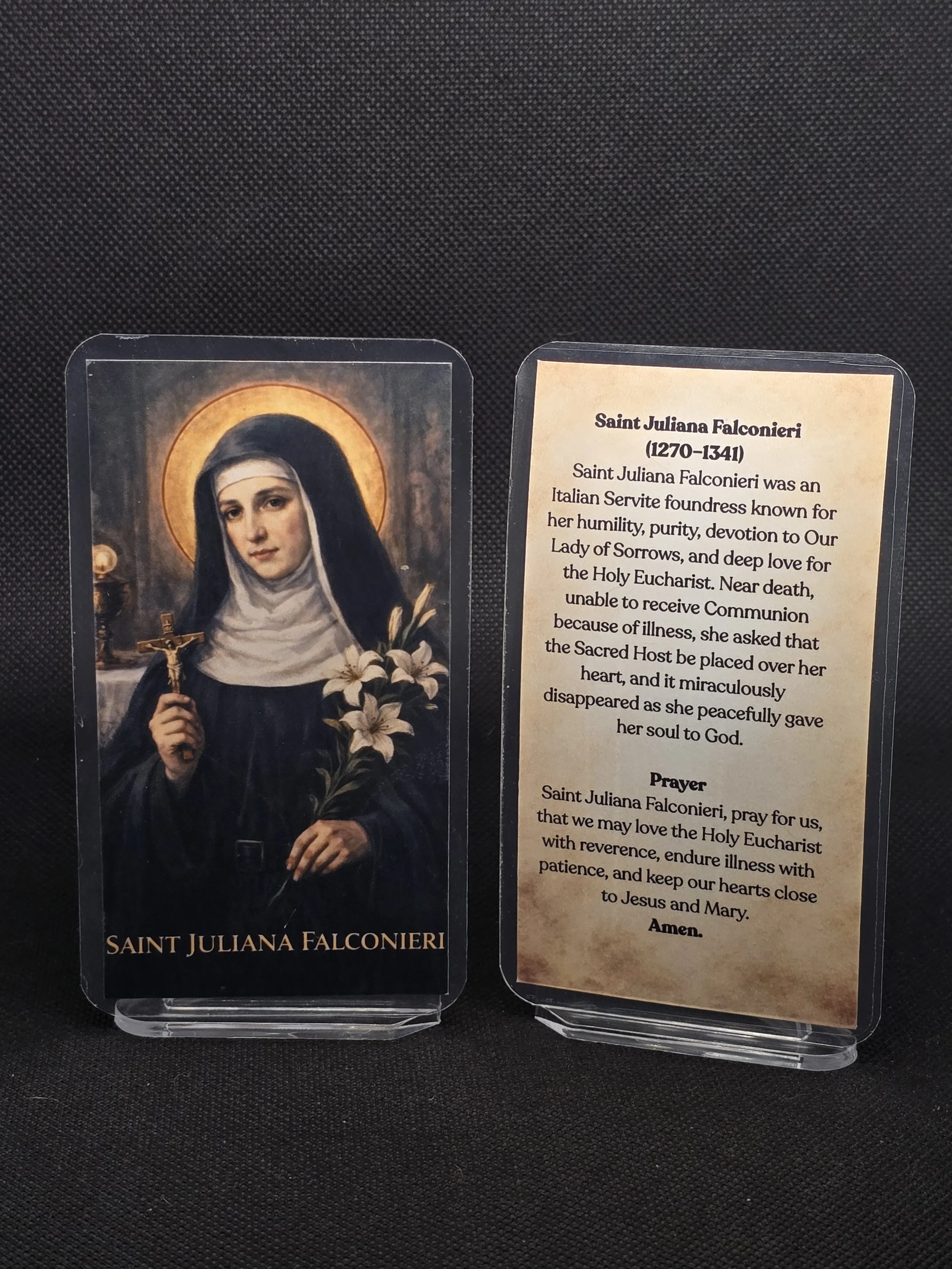
Juliana is shown in the dark habit of a Servite with a Host over her heart, a picture of her love for the Eucharist and her place in the Servite family. People ask her prayers in bodily illness and for a peaceful Christian death. We found no papal decree naming her patron of a particular group.
Some popular biographies tell of her tending people with infected wounds. A university source records this as a popular story and not a proven event. We pass it on in that spirit, as a sign of how the Church has remembered her care for the sick.
The Servite Order keeps June 19 as her feast, and for its nuns and sisters it is a solemnity. She appears in the Roman Martyrology but is not on the present General Roman Calendar. For many Catholics, she is a quiet saint whose message is simple: a woman who loved Christ, served the poor and trusted that he would meet her at the end.
A Word for Eastern Christians
We found no Orthodox commemoration of Juliana, no Byzantine troparion for her and no Eastern Catholic office. She is a Latin Catholic saint of the period after the separation of East and West, and we do not suggest otherwise.
Still, some of her themes will be familiar to Eastern readers. Her life joined prayer and charity, her devotion to the Mother of God echoes a wider Christian love for Mary, and her story of longing for Communion touches on themes that Eastern pastoral theology also knows, such as the desire to receive Christ at the hour of death. These are points of comparison, not evidence of shared veneration.
Her life as a laywoman who lived an ascetical life outside a monastery may also interest readers of Eastern spirituality, where the boundary between monastic and lay prayer is often a gentle one.
Saint Juliana, humble servant of Mary, you loved Christ in the Eucharist and cared for the poor. Pray for the sick and the dying. Ask the Lord to strengthen us with his Body and his peace, now and at the hour of our death.
This prayer was written for this page and is not an official liturgical text. The Servite Order publishes the official prayers for her feast.
Honoring Her Today
If you wish to honor her, you can keep her prayer card near where you pray, pray for the sick and dying, and ask for her prayers when you prepare for Communion. The collect of her Mass, which we paraphrase in the prayer below, asks that we be strengthened by the Sacrament at the hour of death.
You can also remember the Servite sisters, who still care for the sick and serve in schools and parishes around the world, and give thanks for women whose names the world has never recorded.
As with every saint, we encourage honest curiosity. Learning what is certain about Juliana and what is tradition does not take anything away from her. It lets us love the saint who is actually there.
Frequently Asked Questions
Pray With Saint Juliana
Keep her prayer card by your bed or in your prayer corner, and ask for her prayers for those who are ill or approaching death.
View Prayer Card