Saint Ezekiel Moreno: The Augustinian Recollect Missionary Bishop of Pasto and Patron of Cancer Patients
A Spanish friar who served in the Philippines and Colombia, died of cancer in 1906 and is now invoked by those who face the same illness.
At a Glance
- Born
- April 9, 1848, Alfaro, La Rioja, Spain
- Died
- August 19, 1906, Monteagudo, Navarre, Spain, of cancer
- Order and office
- Augustinian Recollect; Apostolic Vicar of Casanare; Bishop of Pasto, Colombia
- Beatified
- November 1, 1975, by Pope Paul VI
- Canonized
- October 11, 1992, by Pope John Paul II in Santo Domingo
- Feast and patronage
- August 19 (Augustinian calendar); invoked by cancer patients
- Who Was Ezekiel Moreno?
- Childhood in Alfaro
- A Friar and a Missionary
- Back to Spain and On to Colombia
- Bishop of Pasto
- Politics, Liberalism and the Church
- His Writings and Letters
- Illness and Death
- Beatification, Canonization and the Miracles
- Devotion Today and a Word to Eastern Readers
- Frequently Asked Questions
Who Was Ezekiel Moreno?
Saint Ezekiel Moreno was a Spanish friar of the Augustinian Recollects who spent most of his working life far from home, first in the Philippines and then in Colombia. He became a bishop, wrote a great deal and defended the Catholic Church in a country torn by political conflict. He died of cancer at the convent where he had first become a friar, and today he is remembered above all as a patron for people facing the same disease.
This is a Latin Catholic saint, and we say so plainly on a site that mostly speaks of Eastern Christians. He has no feast in the Orthodox churches or in the Eastern Catholic calendars that we could find, and we do not claim that he does. We include his story because a prayer card of him is part of the collection and because he belongs to the wider family of missionary and pastoral saints that Eastern readers meet in many places.
His life is also well documented. We have official Church records, the writings he left behind and detailed studies by historians of his own order. Where the sources disagree about a date or detail, we mark it UNCERTAIN, and where a story comes from devotional memory we call it TRADITION.
His story also asks us to hold two things together. A saint can be sincerely devoted to Christ and the poor, and also be a man of his time whose public judgments can be questioned. The Church's tradition of canonization has always made room for that distinction.
Childhood in Alfaro
Ezekiel was born on April 9, 1848, in Alfaro, a town in the La Rioja region of Spain, and was baptized the next day. His parents were Felix Moreno, a tailor, and Josefa Diaz. He was one of six children, and his older brother Eustaquio also became an Augustinian Recollect and influenced his vocation. The family was devout and not wealthy.
As a boy he attended the local school, studied some Latin, sang in the church choir and helped the Dominican nuns as an altar server and sacristan. His father died in January 1864. He was offered the chance to study for the diocesan priesthood, but he chose the missionary life of the Recollects.
TRADITION: His order tells of an episode in which he skipped a local celebration to stay with a sick companion. It fits the kind of person he became, but we have not found a contemporary document that confirms it, so we offer it as a story told by his community.
A Friar and a Missionary
He received the Augustinian Recollect habit at Monteagudo in Navarre on September 21, 1864, and made his religious profession on September 22, 1865. The order was heavily involved in the Philippines, and the young friar expected to serve there. After studies in Spain he traveled to Manila, where he was ordained a priest on June 3, 1871.
UNCERTAIN: His biographer Angel Martinez Cuesta gives June 2 for the ordination. The official Vatican decrees say June 3, and we follow them.
In the Philippines he worked on Palawan in 1872, on Mindoro from 1873 to 1876, and on Luzon from 1876 to 1885. His work was the ordinary work of a missionary priest: Mass, preaching, catechism for children, the sacraments and visits to the sick in remote communities. This all took place within Spanish colonial rule, and an honest account should remember that context.
Back to Spain and On to Colombia
In 1885 he returned to Spain and became responsible for the community and the novitiate at Monteagudo. He stressed mental prayer, the Divine Office, devotion to the Eucharist and the Sacred Heart. His biographer reports that during a food shortage in 1887 the community fed hundreds of people, citing a testimony given in 1897. We keep the report attributed to that testimony.
In late 1888 he went to Colombia to help rebuild the Recollect province of Our Lady of Candelaria, which had been weakened by earlier political upheavals. He worked to restore community life and to strengthen the missions of Casanare.
The Holy See set up the Apostolic Vicariate of Casanare in 1893. Ezekiel became its first vicar and was consecrated a bishop on May 1, 1894. He organized catechesis and pastoral work among scattered populations, including Indigenous communities, and started educational and charitable projects.
Bishop of Pasto
He was appointed Bishop of Pasto in December 1895 and took up his duties in 1896, according to detailed research by his order. Some official Vatican documents give slightly different dates for his move to Pasto, so we note that the chronology is UNCERTAIN in the details while the story itself is clear.
As bishop he visited parishes, supervised clergy, promoted religious instruction, visited hospitals and gave charitable help, and encouraged religious communities and missions. His own letters show a man concerned with conscience, prayer and perseverance, and more than 400 of his spiritual letters survive.
He also wrote pastoral letters, circulars and sermons. They give historians an unusually direct view of his thought, and they are the source of the debate about his politics that we turn to next.
Politics, Liberalism and the Church
The most debated part of his life is his fierce opposition to political and religious liberalism in Colombia. In the nineteenth century, quarrels over the Church's property, schools and role in public life were tied up with elections and civil war. Ezekiel stood firmly with the Church and with the conservative side. In 1898 he published a work usually titled Either with Jesus Christ or Against Jesus Christ, which argued that Catholicism and liberalism as he understood it could not be reconciled.
Historians describe him as a leading representative of ultramontane Catholicism in Colombia, meaning a strong emphasis on papal authority and resistance to secular movements seen as hostile to the Church. Even a sympathetic biographer within his own order notes that his upbringing, the history of anticlericalism and events in neighboring Ecuador led him to read papal teaching in an especially strict way.
Colombia fought the War of a Thousand Days from 1899 to 1902, and some scholars argue that his polemics added to the divisions of the time. Others stress that he saw himself as defending believers against anti-clerical movements. It would be unfair to blame one bishop for a civil war, and it would also be unfair to pretend that his words were mild. His canonization recognized his holiness, his missionary labor and his pastoral care. It did not declare every political judgment he made to be correct.
His Writings and Letters
Ezekiel left a large written record. It includes pastoral letters, diocesan circulars, sermons, polemical publications and spiritual correspondence. A pastoral letter published at Pasto in 1896 answered a liberal publication called Evangelical Voice, and a collection of his pastoral letters and other writings was edited by Toribio Minguella and published in 1908. His letters were later gathered by Angel Martinez Cuesta.
The letters are the most personal part of the record. They deal with conscience, duty, perseverance, suffering and prayer, and show a man who gave careful spiritual direction to individuals as well as writing against his opponents. Many readers find them warmer than his public polemics.
Because we can read his own words, we do not have to rely only on devotional biography. That is a gift to the historian, and it is part of why an article about him needs to show both the pastor of the letters and the controversialist of the pamphlets.
Illness and Death
In 1905 he developed painful sores on his nose and mouth, which were diagnosed as malignant cancer. He reluctantly left Colombia for treatment in Spain. He had surgery in Madrid, but the disease continued, and he went home to the convent at Monteagudo.
He died there on August 19, 1906, at the age of 58. The order has published a record of his death and burial, which names nasopharyngeal cancer as the cause and records his burial on August 22. His remains are venerated in the convent church at Monteagudo.
His long suffering is the reason that people with cancer have turned to him. It is worth saying that he was not a martyr. He is honored as a bishop and a confessor of the faith, and the early Church's phrase for such a person is a witness by life, not by blood.
Beatification, Canonization and the Miracles
The diocesan inquiry into his holiness began at Pasto in 1910. Pope Paul VI beatified him on November 1, 1975, and Pope John Paul II canonized him on October 11, 1992, in Santo Domingo, during the commemoration of five hundred years since the first evangelization of the Americas. The date of the beatification appears as November 5 in one Vatican document and November 1 in others, and the later and better supported date is November 1.
The healing accepted for the canonization is described in the Vatican decree. A woman from Buesaco, Colombia, named Maria Jesus Nanez de Diaz, aged 47, had a painful mass in her breast in 1986. She did not have a biopsy. A relic of Ezekiel was placed on her head and prayers were said. She reported that she dreamed he told her she was healed, and that the swelling and pain were gone when she woke. Medical consultants judged the recovery sudden, complete, lasting and inexplicable by science. Because there was no biopsy, the exact diagnosis was never established, so we do not call it proven cancer.
TRADITION and UNCERTAIN: His order describes his body as incorrupt. We have not found an independent examination that would let us say how far this is the case, so we report the claim and do not certify it.
Saint Ezekiel, missionary and bishop, you carried your own illness with patience and served the poor and sick. Pray for those who are suffering from cancer and for those who care for them. Ask the Lord to give them strength, courage and peace, and to grant us all a trust in his mercy.
This prayer was written for this page and is not an official liturgical text. The Vatican and the Augustinian Recollects publish official prayers.
Devotion Today and a Word to Eastern Readers
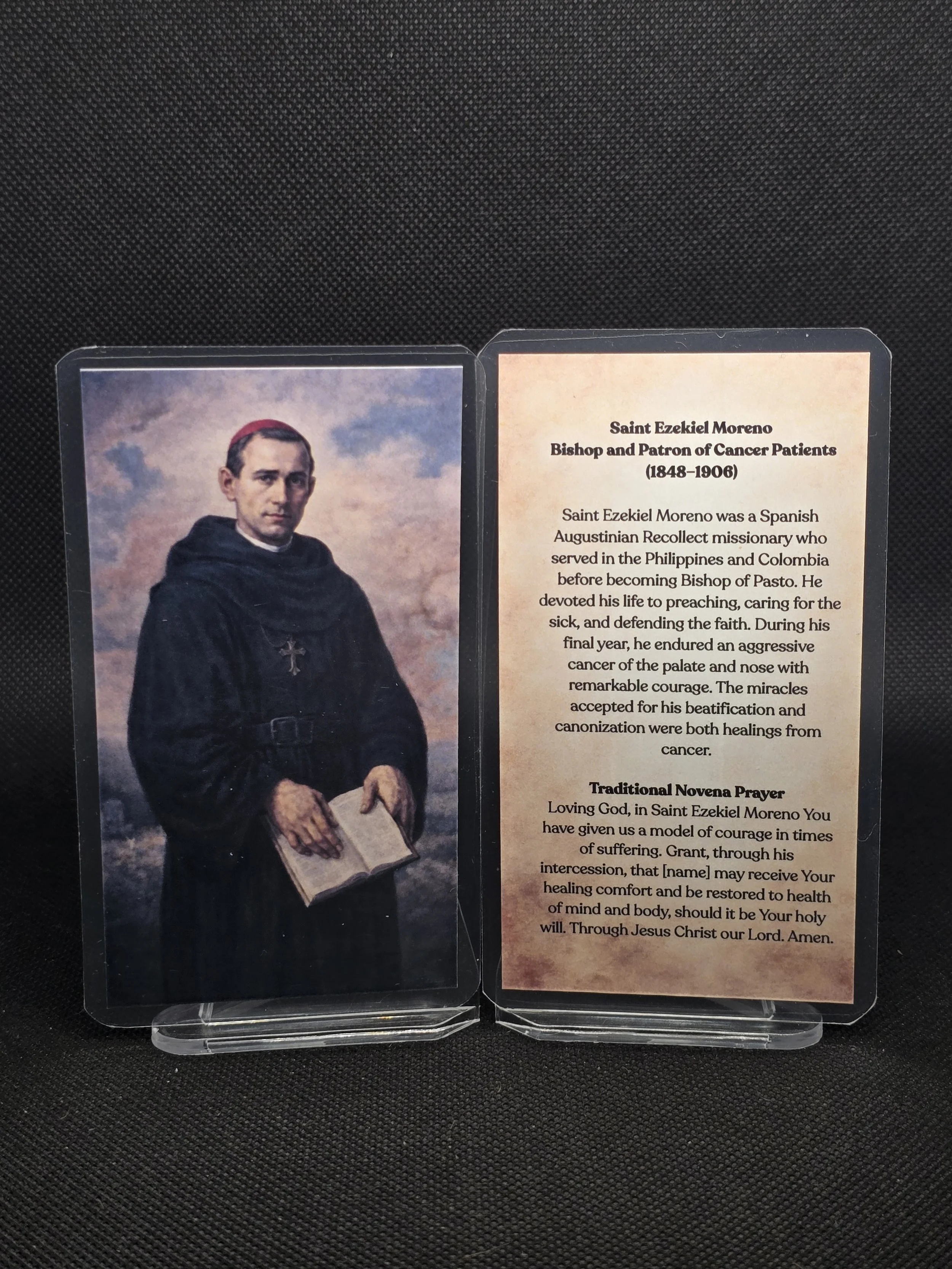
He is especially honored by people living with cancer, and by their families and caregivers. A foundation in Colombia carries his name and works for seriously ill patients who are poor, and the Augustinian Recollect Sisters of the Sick take their inspiration from him. The patronage of cancer patients is a devotional custom that grew from his own illness and from reported healings. We found no separate decree naming him patron.
For Eastern Catholic and Orthodox readers, the sources show no Eastern commemoration and no connection to Byzantine monastic practice. What they can share with him is a recognizable pattern of Christian life: a prayerful missionary who served the poor and sick and who bore illness with patience. We offer him as a fellow witness and not as an Eastern saint.
His feast is August 19. If you know someone who is ill, a short prayer to him costs nothing, and it never replaces the care of doctors.
If you visit Monteagudo, you can pray at the convent church where his remains rest, and where he began and ended his religious life. For most of us a quiet prayer at home will do, and the intention is simple: for the sick, for those who nurse them and for the courage to bear what we cannot change.
Frequently Asked Questions
Pray With Saint Ezekiel
Keep his prayer card near a sick bed or in a chaplain's bag, and ask for his prayers for those who are ill.
View Prayer Card