Saints Cosmas and Damian: The Unmercenary Physician Brothers Who Healed Without Payment
Two early Christian healers, honored in East and West, whose three stories, healing shrines and famous camel have made them the patrons of doctors.
At a Glance
- Also known as
- The Holy Unmercenaries, the Physician Saints, Anargyroi
- Lived
- Traditionally third to early fourth century; birth and death dates are UNCERTAIN
- Feast days
- November 1 (Asia Minor pair), July 1 (Roman pair) and October 17 (Arabian pair) in the Byzantine calendar; September 26 in the Roman calendar (formerly September 27)
- Places
- Early cult at Cyrrhus in Syria; shrines in Constantinople and Rome
- Status
- Venerated since antiquity; no formal canonization date exists
- Patronage
- Physicians, surgeons, nurses, pharmacists and the sick
- Who Were Cosmas and Damian?
- The Earliest Evidence
- Three Pairs, Three Stories
- Healing Without Payment
- The Eggs and the Camel
- The Roman Basilica and the Western Cult
- The Miracle of the Transplanted Leg
- Death, Martyrdom and Relics
- Why They Matter to Eastern and Western Christians
- Honoring Them Today
- Frequently Asked Questions
Who Were Cosmas and Damian?
Saints Cosmas and Damian are the best known of the Holy Unmercenaries, the physician saints who healed the sick without taking payment. The Greek word anargyroi means those without silver. Every major tradition about them agrees on this one point: they practiced medicine as a work of charity, taking to heart the words of Christ to his disciples, freely you have received, freely give.
They are venerated in both East and West. Byzantine Christians keep their memory on several days, Roman Catholics on September 26, and one of the oldest churches in the Roman Forum is dedicated to them. Hospitals, medical schools and doctors all over the world have looked to them as patrons.
The history behind them is more tangled than their popularity suggests. There are three different life stories, three feast days in the Byzantine calendar and many miracles. Scholars have long asked whether they describe one pair of saints or several. This article keeps the safer evidence apart from tradition, marks stories as TRADITION and open questions as UNCERTAIN, and tells you what the earliest witnesses actually say.
The Earliest Evidence
The strongest early evidence is not a life story but a shrine. In the fifth century Theodoret, bishop of Cyrrhus in northern Syria, refers to a martyr shrine of Cosmas and Damian in his letters. Cyrrhus appears to be the center of their earliest cult, which fits the fact that their relics were said to be kept there.
The sixth century gives us two more witnesses. The historian Procopius describes how Emperor Justinian repaired the walls of Cyrrhus and notes that the remains of the saints were kept nearby. In another passage he describes their church beside the Golden Horn in Constantinople, where sick people came by boat seeking help through the saints. The Chronicle of Edessa adds that in 457 a bishop named Nonnus set up a martyr shrine to them inside the city's hospital.
So the cult is real, early and tied to healing. What these writers do not give us is a biography. The details of birth, family and death come from later narratives, which is why the rest of this article is careful in how it speaks.
Three Pairs, Three Stories
Byzantine tradition honors three pairs of brother physicians with the same names. The first, commemorated on November 1, are the brothers of Asia Minor, raised by a devout widow named Theodota. TRADITION says their father was a pagan who died when they were children, and that their mother gave them a Christian education that included medicine. This account says they died in peace.
The second pair, remembered on July 1, are the physicians of Rome. TRADITION places them under the emperor Carinus, who ruled from 283 to 285, and says that they were killed out of jealousy by a former teacher. The third pair, remembered on October 17, are the brothers of Arabia or Cilicia, who with three companions named Leontius, Anthimus and Euprepius were beheaded for refusing to sacrifice to the gods. Their trial is placed at Aegeae in Cilicia before a governor named Lysias.
UNCERTAIN: whether these are three independent pairs or three versions of one early cult is the central problem. The stories share names, places and episodes, and a Syriac account even mixes the Roman and Asian narratives. Scholars generally read the three stories as a development of the tradition around an earlier cult. That does not make the liturgical commemorations false. It means we should not claim that six separate physicians have been identified.
Healing Without Payment
Whatever their origin, the heart of the devotion is their charity. In the Asia Minor account they treated the poor, the very sick and even animals, combining medical skill with prayer and instruction in the faith. In the Arabian story they travel from place to place, curing illness and speaking of Christ.
We should be modest about what this tells us historically. The texts do not describe any particular treatment, and they do not tell us what training the brothers had. What they preserve is an ideal: that knowledge and skill are gifts, and that a person who has them is called to put them to use for those who cannot pay.
The Eastern Church sings this ideal in its hymns. The troparion of the November 1 feast asks the holy unmercenaries and wonderworkers to heal our infirmities, and recalls that what they freely received they freely give.
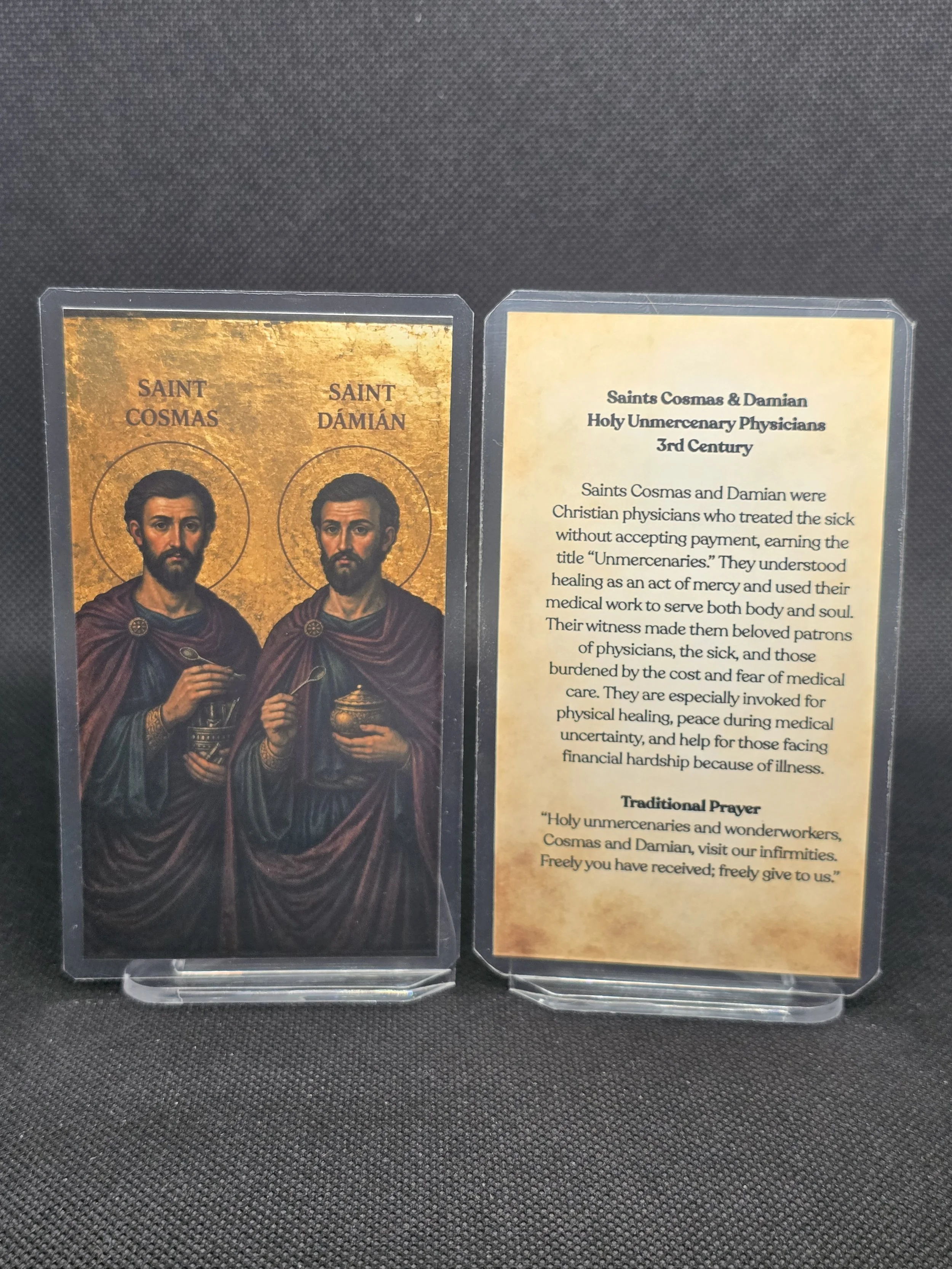
The Eggs and the Camel
Every old healer has a story that tests the rule, and the story of Cosmas and Damian is a charming one. According to the Asia Minor account, a woman named Palladia was cured of a serious illness through their prayers, and in gratitude she offered Damian three eggs in the name of the Holy Trinity. Out of reverence for that name he accepted them.
His brother Cosmas was horrified. He believed Damian had broken their rule against any payment and asked that they not be buried together. After their deaths, the story says, a camel they had once healed spoke aloud and explained that Damian had taken the eggs only for the sake of the Trinity, and the brothers were laid in one grave.
This is a tradition, with no independent confirmation. But the story makes a real point. The difference between a payment demanded and a gift offered in thanks is one that every honest healer has to think about, and the Church preserved the story to teach it.
The Roman Basilica and the Western Cult
In Rome the devotion was strong by the sixth century. Pope Felix IV, who served from 526 to 530, built a basilica dedicated to the two saints from ancient buildings near the Forum. Its apse mosaic shows Christ with Saints Peter and Paul presenting the two physicians, a sign of how high they stood in the Western Church.
From Rome their cult spread through Western Europe. They were named in the Roman Canon of the Mass, and over the centuries they became patrons of physicians and surgeons, and later of medical schools and guilds. The Medici of Florence, who were famous for their ties to medicine, held them in special honor.
The Roman feast was kept on September 27 for centuries. After the calendar reform of 1969 it was moved to September 26, and it is now an optional memorial in which they are named as martyrs. September 27 is now the memorial of Saint Vincent de Paul. Western tradition sometimes calls them twins, but the sources do not establish that, and even the Vatican's own notice acknowledges the uncertainty.
The Miracle of the Transplanted Leg
The most famous Western story about Cosmas and Damian is the miracle of the leg. In the version retold in the thirteenth century Golden Legend, a church servant suffering from a diseased leg had a dream in which the saints replaced it with a healthy leg taken from a man who had recently died. When he awoke, he was healed.
The scene was painted by Fra Angelico and many other artists, and it is often called the first transplant. It is nothing of the kind. It is a medieval miracle story, with no support in the ancient sources, and it is notably absent from the Eastern hagiography of the saints. Historians of medicine and art treat it as a window into medieval thinking about healing and the body.
We tell it because it is part of the saints' story in Western art and devotion, and because it shows what people hoped for from their physician saints. We do not tell it as history.
Death, Martyrdom and Relics
The accounts of how the brothers died cannot be reconciled. The Asia Minor story says they died in peace, the Roman one says they were murdered, and the Arabian one says they were executed. The older Catholic Encyclopedia gave a date of 287 and connected the martyrdom with the persecution of Diocletian, but that general persecution began in 303, so 287 should not be repeated as a known date.
The Roman account also says that Carinus was cured and converted after meeting them. Scholars call this alleged conversion a legend, and there is no reliable evidence for it. The Arabian account contains the escapes from drowning, fire and other punishments that are familiar from later martyrdom literature, which is a clue to how it was composed.
Relics are claimed in several places, including Cyrrhus, Rome and the Pantokrator Monastery on Mount Athos. The sources do not give a complete chain of custody, so we cannot say which relics belong to which tradition. Their status as saints comes from ancient veneration and not from a formal canonization.
Why They Matter to Eastern and Western Christians
For Orthodox Christians and for Byzantine Catholics, the feast on November 1 is a living part of the liturgical year. The Orthodox Church in America and the Greek Orthodox Archdiocese publish the hymns, and the Ruthenian Byzantine Catholic liturgical resources of the Metropolitan Cantor Institute list the feast as well. For Latin Catholics they are present in the calendar on September 26.
The theology behind their veneration is clear and simple. Healing of the body and healing of the soul belong together in the Eastern Christian view, and a physician who works freely for the sick is doing something close to the heart of the Gospel. This is why the Byzantines built healing sanctuaries in their name.
A note of care. We have found no evidence for a separate Maronite feast of these saints, and we do not claim one. What can be said is that they are one of the clearest examples of a devotion shared by East and West.
Holy physicians Cosmas and Damian, you healed freely what you freely received. Pray for the sick, for those who care for them, and for all who cannot pay for help. Teach us to share what we have been given, and ask Christ the true physician to heal our bodies and our souls.
This prayer was written for this page and is not an official liturgical text. The Orthodox Church in America publishes the official troparion and kontakion for the November 1 feast.
Honoring Them Today
If you work in medicine, or care for someone who is ill, their feast days are a natural time to pray. A short prayer for doctors, nurses, pharmacists and caregivers, and for those who cannot afford care, is a fitting way to keep the memory of what they stood for.
Their example also reaches those who are not clinicians. The call to give freely what has been given to us applies to every skill we have, whether it is cooking, teaching, building or listening. Many people find that asking for the prayers of Cosmas and Damian helps them to remember it.
As with all the healing saints, devotion to them goes hand in hand with good medical care. The Church that honors them also encourages us to seek treatment and to be grateful to those who provide it.
Frequently Asked Questions
Pray With Cosmas and Damian
Keep their prayer card where you work, or where you care for someone who is sick, and ask for their prayers for those who heal and those who need healing.
View Prayer Card