Saint Charalambos: The Aged Priest-Martyr of Magnesia and Protector Against Plague
A very old priest of Asia Minor, remembered for standing before a Roman emperor and for the prayers that Greeks and Romanians have raised against epidemics for centuries.
At a Glance
- Also known as
- Haralambos, Charalampus, Charalampius; Hieromartyr, Priest-Martyr
- Lived
- Traditionally died about 202 AD (some sources say 203), under Emperor Septimius Severus. Birth year is UNCERTAIN
- Feast day
- February 10 (February 23 on the civil calendar for churches that keep the Julian calendar)
- Place
- Magnesia in Asia Minor; the long Passion also names Antioch of Pisidia. Exact location is UNCERTAIN
- Rank
- Priest in most Greek sources; bishop in many Russian sources
- Relics and devotion
- A skull venerated at the Monastery of Saint Stephen, Meteora; invoked against plague and contagious disease
- Who Was Saint Charalambos?
- Early Life and Family
- A Priest, or a Bishop?
- Vocation and Arrest
- Persecution Under Severus
- The Passion: What Tradition Tells
- Death, Burial and Relics
- Protector Against Plague
- Why He Matters to Catholic and Orthodox Readers
- The Feast Day and How to Keep It
- Frequently Asked Questions
Who Was Saint Charalambos?
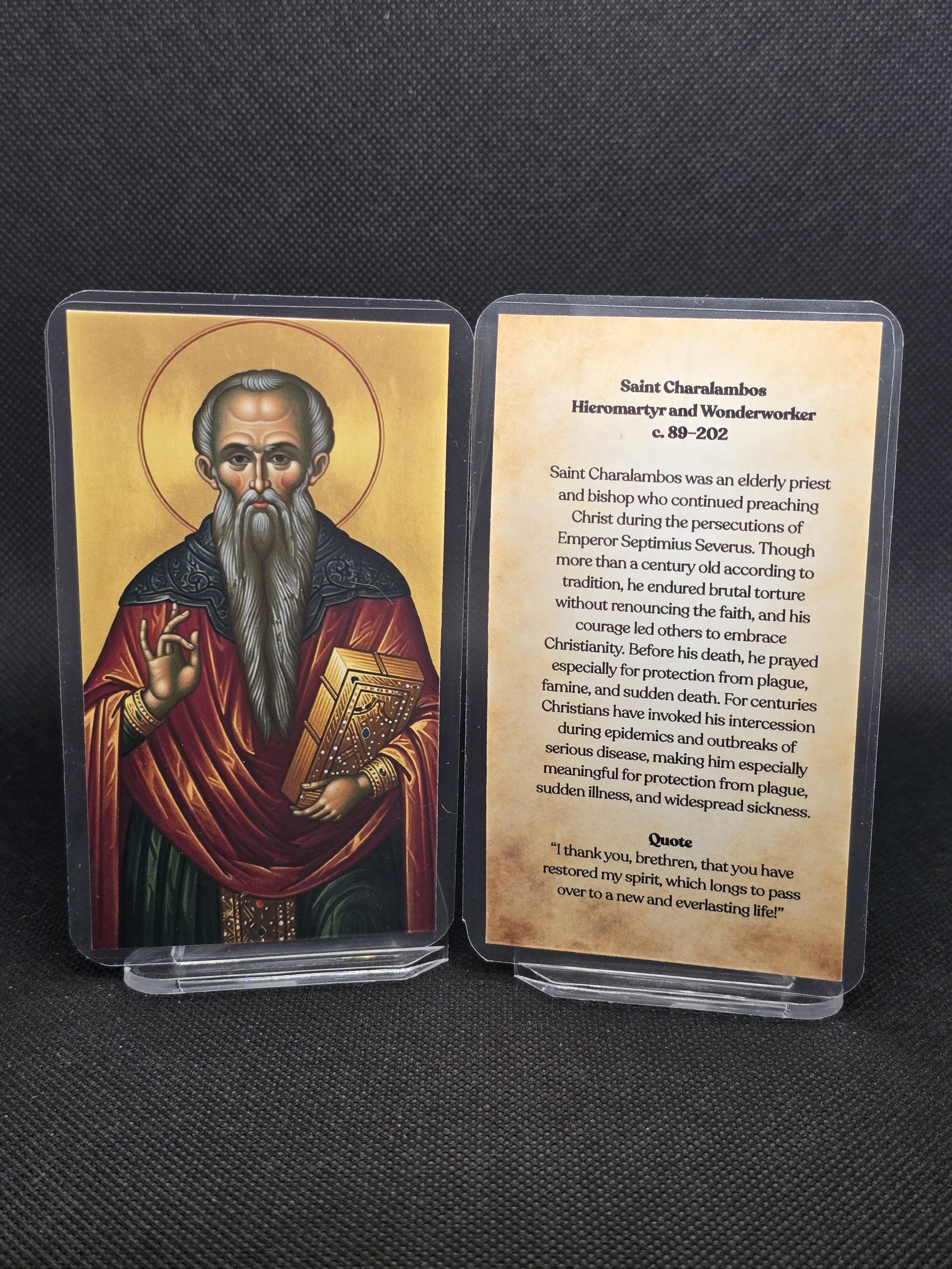
Saint Charalambos is one of the oldest and most widely loved martyrs of the Christian East. Greek and Romanian Christians in particular know him as an extremely old priest who refused to deny Christ in front of a Roman emperor, and as a saint to ask for help when sickness spreads through a town or a herd. His icon often shows an elderly man with a white beard, sometimes with a plague figure under his feet.
He is remembered in both the Eastern and Western Churches. The Roman Martyrology records his feast on February 10 together with his companions, and the Byzantine liturgical books keep a full set of hymns for the day. A Byzantine manuscript made around the year 1000, the Menologion of Basil II, already lists him with his fellow martyrs.
The honest difficulty is that the story we have is late. The long account of his martyrdom, usually called his Passion, was written by an unknown author at an uncertain date, and it differs in important ways from the shorter notices in liturgical books. This article therefore marks tradition as TRADITION and open questions as UNCERTAIN. The saint is real to the Church's memory even where the historian cannot confirm each scene.
For a modern reader the name itself is a clue to his reputation. Charalambos is usually explained as meaning radiant with joy, and the hymns for his feast play on that picture of a light shining in darkness. Whether or not that explanation is the original sense of the name, it fits the way he has been honored: as a calm and cheerful witness, not a grim one.
Early Life and Family
We know almost nothing reliable about his childhood, his parents or his education. A later tradition places his birth around 89 AD, in some accounts at Antioch of Pisidia in what is now Turkey, but that year is not a record. It is simply worked out backward from a reported age at death of 113.
Even that age is not stable. The long Passion preserved by the Bollandists in the Acta Sanctorum says 113. Greek Orthodox calendar notices give 103 in one place and 107 in another. These numbers show how the story grew in the telling, and they warn us not to build a chronology on them.
In one scene of the Passion he tells the emperor that he never married and has given his whole life to Christ. That belongs to the anonymous narrative, so we offer it as TRADITION. No names of parents or relatives have come down to us.
If you are looking for a human anchor in the story, it is this: he is remembered as someone who lived a long life in service of a small Christian community. Even if the number of years is exaggerated, the memory behind it is of an elder, and elders have always had a special place in Eastern Christian devotion.
A Priest, or a Bishop?
One of the most useful things to know about Charalambos is that the Church has remembered him in two ways. In Greek hagiography and in much iconography he is a priest, and the older Passion in the Acta Sanctorum also calls him a priest. Many Russian and other Orthodox accounts call him a bishop of Magnesia.
The title hieromartyr, a priest who was a martyr, fits the first picture. The 2004 Roman Martyrology names him and his companions without giving him an episcopal title. For that reason, the safest description is priest and martyr, with the note that some traditions honor him as a bishop.
None of this changes how the faithful pray to him. It does show why a careful biography cannot just copy the first notice it finds. Neither his ordination nor his office can be checked against a contemporary document.
Vocation and Arrest
According to the Greek liturgical tradition, Charalambos gave himself to Christ from his youth. The hymns of the Byzantine books describe a man purified by prayer and devoted to teaching. They are poetry, so we read them as the Church's praise and not as a diary.
The main story pictures him as a priest serving the Christians of Magnesia, preaching to them and encouraging them to hold fast. His teaching drew converts and the notice of the authorities. The Passion names a governor called Lucian and an official called Lucius, who arrested him and ordered him to sacrifice to the gods.
He refused. The narrative then moves into torture, miracles and conversions of those who tormented him. TRADITION also says he was brought before the emperor. The existence and offices of Lucian and Lucius have not been confirmed by independent records, so they should be treated as characters of the Passion.
Persecution Under Severus
The traditional date puts his martyrdom under Septimius Severus, who ruled from 193 to 211. That is a period when Christians really did suffer. The historian Eusebius, in the sixth book of his Ecclesiastical History, describes martyrdoms in Egypt in those years, including the death of Leonides, the father of Origen. Eusebius does not mention Charalambos.
Scholars also debate how the persecution worked. A recent article by James Corke-Webster argues that the old idea of a single edict of Severus forbidding conversion is not well supported, and that other Roman laws may have been used against Christians. So we can say persecution under Severus is attested, while a specific decree is disputed.
Sources disagree further among themselves. One Greek Orthodox calendar notice connects Charalambos with Alexander Severus, who reigned from 222 to 235, which cannot be reconciled with a death in 202. The Magnesia in the story may be Magnesia on the Maeander or the one near Mount Sipylus, and some Orthodox references say Thessaly. The Bollandist editors admitted this uncertainty, and so do we.
A final caution on method. When a Passion and a liturgical hymn disagree, the temptation is to merge them into one smooth biography. We have chosen not to. A hymn praises, a Passion edifies, and a historian asks for evidence. Keeping the three apart lets each do its own work.
The Passion: What Tradition Tells
The long Passion is full of wonders. The two officials who tortured him are said to have suffered injuries and then been healed through his prayers, and several soldiers and three women are said to have come to faith and died with him. The Roman Martyrology names companions Porphyrius, Daucus and three women, while the Byzantine books use the form Dauctus.
Other episodes include the healing of a man who had been troubled for thirty five years, a young man raised from the dead and a dead wooden post that turned into a living tree when Charalambos leaned on it in a widow's house. These are traditional stories, and none can be independently verified.
The final scenes are the best known. After torture he was condemned to the sword. TRADITION says that, while waiting, he prayed that those who honored his memory would be spared famine, disease and calamity, that Christ appeared to him and promised to hear him, and that he gave up his soul before the executioner struck. The Byzantine Catholic books simply say he died by the sword, so the exact manner of his death is UNCERTAIN.
Notice what the stories are trying to say. The healed torturers speak of forgiveness, the converted soldiers speak of the power of a witness, and the flowering post speaks of life coming out of what seems dead. Those are the lessons the first hearers were meant to take, and they remain good lessons whether or not each scene happened as told.
Death, Burial and Relics
The Passion says a woman named Galina, described as the emperor's daughter who had come to faith, recovered his body and buried it with honor. Her identity is a problem. The well known family of Septimius Severus includes his wife Julia Domna and his sons Caracalla and Geta, and no imperial daughter named Galina has been found. We keep her as a figure of the story.
The best known relic is a skull venerated at the Monastery of Saint Stephen at Meteora in Greece. How it came there is uncertain: one monastery history names a gift from a Wallachian prince in 1398, while other accounts give 1412 or 1413 and raise a problem with the identity of the donor. Other relics are venerated in Greek and Romanian churches.
Veneration of relics is a sign of long devotion, not a laboratory result. We offer these traditions with respect and without claiming scientific authentication.
Protector Against Plague
Charalambos is most strongly associated with protection from plague, cholera and other contagious illness, and with the health of livestock. Greek and Romanian Christians have long carried his relics and icons in procession in times of sickness. A Greek parish in Luton records local traditions of help during outbreaks in Zakynthos in 1728 and Tripi in 1753. Romanian sources recall prayers during the plague of 1812 to 1814 and a relic procession in Bucharest in 2021.
These are records of devotion. They tell us how people prayed and what they believed, and they should not be presented as proof that an epidemic ended by miracle.
Icons sometimes show the saint holding a figure of plague on a chain or trampling it. That is symbolic language for his intercession. It also reflects a clear human truth: when disease arrives, people look for a protector, and they have long looked to this old priest.
There is one more point of pastoral good sense. In many parishes the prayers for his feast are offered for the whole community and not just for individuals, which reflects the older way of thinking about plague as a threat to a town and not only to one household. That shared prayer is part of what the devotion has meant.
Why He Matters to Catholic and Orthodox Readers
For Orthodox Christians Charalambos is the priest who stays at his post under pressure, and a steady intercessor for the sick. His hymns praise his resistance to idols and his healing prayer.
For Eastern Catholics, his commemoration is part of the shared Byzantine inheritance. The Ruthenian Byzantine Catholic liturgical resources published by the Metropolitan Cantor Institute carry his Vespers hymns and his troparion and kontakion for February 10. The Roman Martyrology also commemorates him, so Latin Catholics can recognize him as well. A note of precision: that is a martyrology listing, not an obligatory feast in the General Roman Calendar.
Themes that run through the tradition are perseverance, forgiveness of enemies, pastoral care and prayer for the sick. Those themes are supported by the hymns, even though the individual miracles in the long Passion remain unverified.
His example also speaks to those who care for the sick. A priest who stays with his people when it is dangerous, who gives comfort and refuses to leave, has been a model for pastors, chaplains and caregivers in every age of illness.
Holy Charalambos, faithful priest and martyr, you stood before the powerful and did not deny Christ. Pray for the sick and for those who care for them. Ask the Lord to heal our bodies, strengthen our hearts and keep our homes and communities in his mercy.
This prayer was written for this page and is not an official liturgical text. The Orthodox Church in America publishes the official troparion and kontakion for his feast.
The Feast Day and How to Keep It
His feast is February 10. For churches that follow the Julian calendar, that day falls on February 23 on the civil calendar, so you may see either date. Parishes often bless water, anoint the sick with prayer or pray for the health of the community on this day.
If you wish to honor him at home, keep his icon or prayer card where you pray, remember anyone who is ill, and pray for doctors and nurses and for the safety of those who care for the sick. A simple prayer is enough.
We would add the practical reminder that prayer to a saint supports medical care and does not replace it. The same Church that honors Charalambos also honors the physician saints and urges us to seek good treatment.
If you visit a Greek or Romanian church on February 10, you may find his icon on a stand in the middle of the nave and a line of people waiting to venerate it. You do not need to know every detail of his Passion to join them. It is enough to ask for his prayers and to remember someone who is suffering.
Frequently Asked Questions
Pray With Saint Charalambos
Keep his prayer card near your bed, your desk or your sick room, and ask for his prayers for those who are unwell.
View Prayer Card