Saint Xenia of Saint Petersburg: The Fool for Christ Who Walked the City in Her Husband's Clothes
A widow who gave away everything, lived among the poor of an imperial capital and became one of Russia's best loved intercessors.
At a Glance
- Also known as
- Blessed Xenia, Xenia Grigorievna Petrova, Saint Ksenia of Petersburg
- Lived
- Eighteenth century Russia; birth and death dates are disputed (see below)
- Feast days
- January 24 on the Church calendar (February 6 on the civil calendar for churches using the Julian calendar); also May 24 (June 6) and September 11 (September 24) for her glorifications
- Glorified
- September 24, 1978 (Russian Orthodox Church Outside of Russia); June 6, 1988 (Moscow Patriarchate)
- Burial
- Smolensk Orthodox Cemetery, Saint Petersburg
- Devotional associations
- Widows, the poor, job seekers, families in trouble, the city of Saint Petersburg
- Who Was Xenia of Saint Petersburg?
- Early Life, Marriage and Family
- Widowhood and the Turning Point
- The Years of Wandering and Prayer
- What Holy Foolishness Means
- The Puzzle of Her Dates
- Prophecies and Wonder Stories
- Death, Burial and a Grave That Became a Shrine
- Glorification and Feast Days
- Why She Still Matters
- Frequently Asked Questions
Who Was Xenia of Saint Petersburg?
Saint Xenia of Saint Petersburg is one of the best loved saints of the Russian Church, and one of the least documented. She was a lay woman, a widow, who gave up her home and her place in society and spent the rest of her life on the streets of the imperial capital, dressed in old clothes and answering to a dead man's name. The Church remembers her as a fool for Christ, a person who accepted ridicule and poverty for the sake of humility.
What we can say with confidence is limited but real. She existed, she was known in the poorer districts of Saint Petersburg, she was buried in the Smolensk Cemetery, and within a few decades of her death people were visiting her grave in large numbers. Almost everything else, including the standard dates of her life, comes from stories written down long after she died.
This article keeps those layers apart. Where a detail rests on the earliest printed accounts or on historical research, we say so. Where it comes from devotional tradition, we mark it as TRADITION. Where scholars disagree, we mark it as UNCERTAIN. None of that lowers her place in the Church's prayer. It simply lets you see what kind of evidence stands behind the saint you are praying with.
Early Life, Marriage and Family
Her birthplace, her parents and her childhood are unknown. Her patronymic, Grigorievna, suggests that her father was named Gregory, and the traditional story places her in a comfortable household in Saint Petersburg. No baptismal or marriage record has been found.
TRADITION: She married Andrei Feodorovich Petrov, a court singer who held an officer's rank. Accounts differ on his position. Some Orthodox sources call him a major, while Russian historical writing describes him as a court chorister with the rank of colonel. It is wiser to say only that he served at court and was connected to the army or to its ranks.
UNCERTAIN: Even her name is not perfectly fixed. An account published in 1845 by the writer Yevgeny Grebyonka calls her Aksinya Ivanovna and her husband Andrei Petrovich. The later, now standard name, Xenia Grigorievna Petrova, comes from the hagiographical tradition. The couple is remembered as childless, and the sources give no sign of any children.
The traditional account says the couple lived on the Petrograd Side of the city, near the present Bolshoy Prospect. That locates her in a real neighborhood, among real streets, even if the household details come to us through later storytellers.
Widowhood and the Turning Point
Her turning point was the death of her husband. TRADITION: Andrei died suddenly after a social gathering, without confession or Holy Communion, and Xenia was shaken by fear for his soul. A different early account suggests he may have died of typhus, so the circumstances of his death remain UNCERTAIN.
The traditional story says that she was about twenty six when she became a widow. She gave away her belongings, and tradition says she gave her house to a woman named Paraskeva Antonova so that it might shelter the needy. Relatives are said to have questioned her sanity, and officials are said to have concluded that she understood what she was doing.
Then came the act that defines her image. She put on her husband's uniform and asked to be called by his name, Andrei Feodorovich. The story is usually read as a spiritual act: she wanted to carry him before God, to repent in his place and to bury her own old identity. Those who tell it are not saying that it is a model for others to imitate. They are saying that a grieving woman found a way to make her whole life a prayer for the dead.
The Years of Wandering and Prayer
Xenia owned nothing and lived in no fixed home. She is remembered as moving through the poorer parts of the city, accepting only small coins, and passing on whatever she was given to people who needed it more. Merchants and tradespeople on the Petrograd Side are said to have welcomed her, because shops she visited seemed to do better.
TRADITION: By night she went out to the fields beyond the city and prayed on her knees, bowing in turn to each of the four directions. The story adds that police who suspected something suspicious about her night walks followed her and found only a woman at prayer. This tale comes from later hagiography, not from a surviving police report.
TRADITION: When the stone church at the Smolensk Cemetery was being built, she carried bricks up to the masons at night, so that the workers found their stock had been moved up the scaffolding by morning. The church is historical and was consecrated in 1790, but her part in it is a tradition. Some biographies also say that she spent about eight years away from the city learning from experienced ascetics, and name Saint Theodore of Sanaxar. That is UNCERTAIN and has not been independently established.
What Holy Foolishness Means
Holy foolishness, in Russian yurodstvo, is one of the strangest forms of Christian holiness. A fool for Christ takes on the appearance of madness or social failure in order to destroy pride and to speak a hard truth to a comfortable world. The name comes from Saint Paul's words in his first letter to the Corinthians that the wisdom of this world is foolishness before God, and that some are called to be fools for Christ's sake.
In Russia the vocation had deep roots and was usually held in awe, but it was never entirely comfortable for people around the saint. A fool could be mocked, driven off or locked up. Xenia is said to have endured teasing, mud and stones from street children and from adults who did not understand her.
It is also worth being honest about the limits of what we can know. A critical account from 1847 describes her as tall and sometimes sharp tempered when harassed, which does not match the small, gentle old woman in later icons. We should not read back a modern diagnosis, either to explain her away or to rule one out. The Church's reading is that her oddness was chosen, and that behind it lay prayer, poverty and love for the poor.
The Puzzle of Her Dates
Popular books say that Xenia was born around 1731 and died around 1803. Those dates are repeated so often that they feel certain, but they are not. Her old gravestone inscription says that she was widowed at twenty six, wandered for forty five years and lived to seventy one. Those figures are a tradition, and they do not by themselves fix a calendar year.
The scholarly Orthodox Encyclopedia, in an article by the historian Sergei Firsov, proposes a very different timeline: a birth around 1720 to 1725 and a death around 1791 to 1796. A key piece of evidence is a petition of 1797 to Emperor Paul I that speaks of an event in 1766 in a way that suggests she was already dead. The Saint Petersburg Encyclopaedia keeps the older figures, with her life running from about 1731 to about 1803.
The record cannot settle the question, because early cemetery records were lost in the great flood of 1824. The honest summary is that she lived in the eighteenth century in Saint Petersburg, probably for about seventy years, and that no exact birth or death year should be printed as established fact.
Prophecies and Wonder Stories
Around Xenia a whole body of stories grew up, and they are an important part of why she is loved. They should be read as the Church's memory of her, not as court records. In one, she urged people to bake pancakes, a food of mourning, just before the death of Empress Elizabeth. In another, she is said to have wept over bloodshed shortly before the killing of the imprisoned Ivan VI. The deaths are historical events, but the prophecies attached to them are tradition.
Some of the tales are domestic and touching. A young woman was sent toward a funeral where she met the widower she would marry. A household was kept from eating honey that proved to be spoiled. A bride was said to have been saved from a marriage to a fraud after praying at Xenia's grave. Scholars who study the chapel's history treat that last one as a legend.
What these stories share is a pattern. Xenia appears at a moment of danger or grief, says something that seems like nonsense, and is understood later. They show the kind of person her neighbors took her to be: someone who saw trouble coming and who cared for ordinary people at the edge of ruin.
Death, Burial and a Grave That Became a Shrine
Xenia was buried at the Smolensk Orthodox Cemetery in Saint Petersburg. Her grave is the one fact on which every account agrees. Within a few decades people were coming to it with petitions, and by the 1820s visitors were reportedly carrying away handfuls of earth and chips of the gravestone as keepsakes.
A chapel was eventually built over the grave. The present historic chapel was built in 1901 and 1902 to a design by the architect Alexander Vseslavin. During the Soviet period it was a contested place. Authorities were troubled by the handwritten notes visitors left, asking for jobs, reconciliation and help with legal trouble. The chapel was closed in 1940, reopened in 1947, closed again by 1962 and returned to the Church in 1987.
That story matters. The devotion did not depend on a state, a publisher or a parish program. It continued through decades of official hostility because people kept coming, and because they believed that she answered. We have not found a reliable report of a formal examination of her remains, so we do not describe her relics beyond the burial site itself.
Glorification and Feast Days
The Russian Orthodox Church Outside of Russia glorified Xenia on September 24, 1978, after collecting testimonies of her intercession. The Moscow Patriarchate glorified her on June 6, 1988, at the Local Council held for the millennium of the Baptism of Rus. So it would be inaccurate to say that she was canonized only in 1988. There were two stages in two parts of the Russian Church.
Her main feast is January 24 on the Church calendar. For churches that keep the Julian calendar, that day falls on February 6 on the civil calendar, which is why you will see both dates. Churches on the Revised Julian calendar keep it on civil January 24. Her glorifications are also commemorated, on May 24 (June 6) and September 11 (September 24).
A word for Catholic readers. She was glorified by Orthodox churches, and we have found no listing of her in the General Roman Calendar or in the official calendar of an Eastern Catholic church. We honor her here as part of the shared Eastern Christian tradition and as a figure many Catholics admire, without claiming a Catholic feast that we cannot document.
Holy Blessed Xenia, you gave up your home and your name and walked among the poor in prayer. Remember those who grieve, those without work and those without shelter. Ask Christ our God to give us humility, steady hearts and open hands, and to have mercy on the souls of our departed.
This prayer was written for this page and is not an official liturgical text. The Orthodox Church in America publishes the official troparion and kontakion for her feast.
Why She Still Matters
Today Saint Xenia is invoked by widows, by people who have lost a job, by those who cannot find a home and by families in trouble. Scholars who study her modern devotion, such as the anthropologists Jeanne Kormina and Sergey Shtyrkov, point out that many of her devotees are women facing economic uncertainty and loss, and that Xenia is felt to understand them.
Her example also teaches something about prayer for the dead. Whatever the truth of her husband's last hours, the heart of her story is a woman who did not stop loving him, and who turned that grief into a life of repentance and charity. Eastern Christians pray for the departed constantly, and her life is a quiet picture of that habit.
Finally, she is a reminder that holiness in the Eastern Church is not limited to monks, bishops and kings. A married laywoman with no office and no writings became one of the most visited saints of her city. If you are praying for work, for a home, for a lost spouse or for a friend who is hard to love, she is a companion who knew all of those worries from the inside.
Frequently Asked Questions
Walk With Saint Xenia
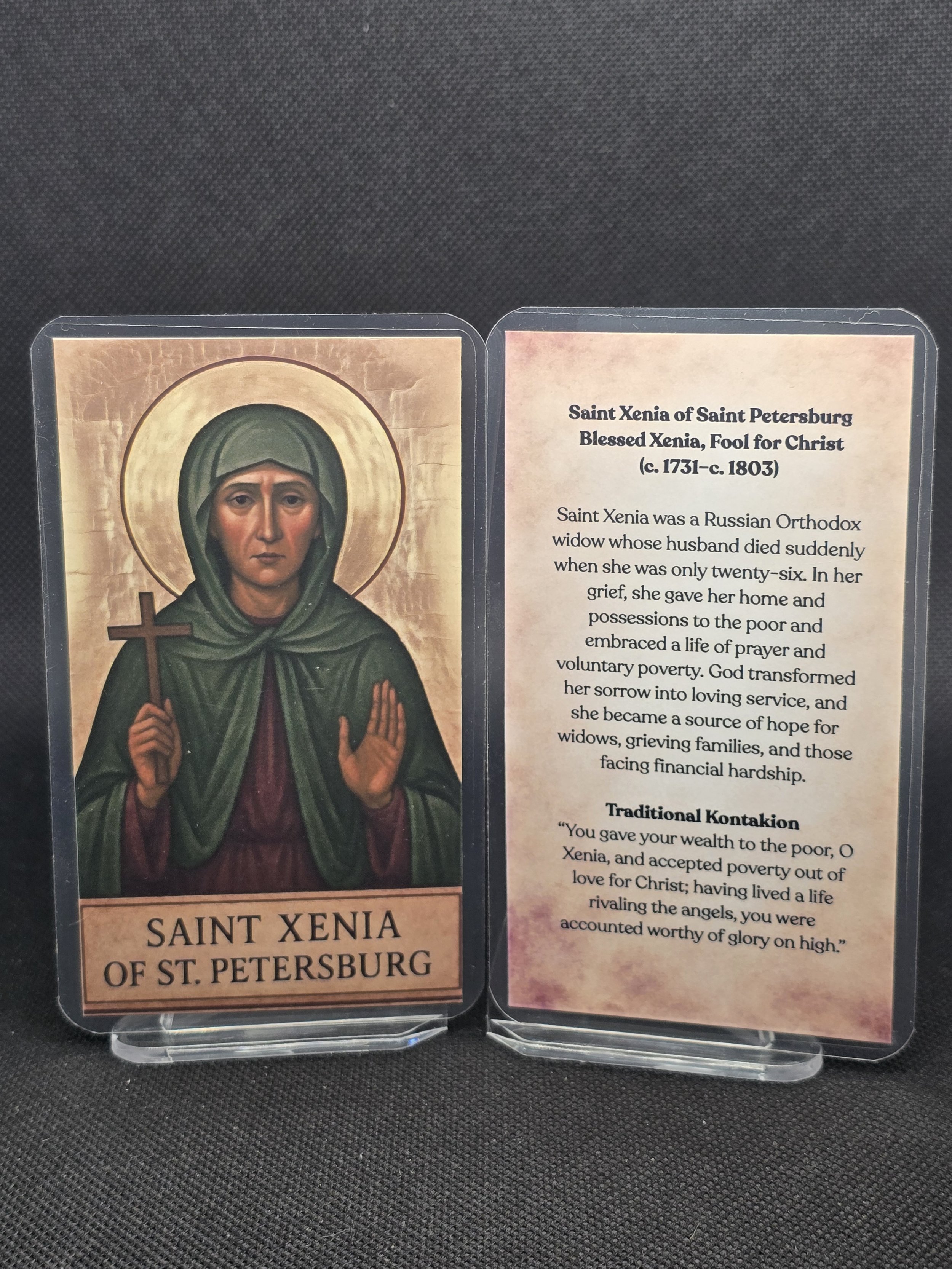
Keep her prayer card near your desk, your door or the empty chair of someone you miss, and ask her for the simple things: work, a roof, comfort and mercy for the dead.
View Prayer Card