Evagrius Ponticus: The Desert Monk Who Mapped the Eight Thoughts and the Road to Prayer
A learned churchman from Pontus who left Constantinople for the Egyptian desert, wrote some of the most influential teaching on prayer and temptation, and remains a figure of both deep influence and real controversy.
At a Glance
- Also known as
- Evagrius of Pontus, Evagrius the Solitary
- Role
- Deacon, desert monk and spiritual writer
- Lived
- About 345 to 399; died at Kellia, Egypt (dates uncertain)
- Feast day
- No feast in the Roman or Byzantine calendars; an Armenian commemoration is reported
- Status
- Not formally canonized; his name was linked to condemned Origenist teachings
- Best known for
- The eight tempting thoughts and teaching on prayer
Who Was Evagrius Ponticus?
Evagrius Ponticus was a fourth century churchman who became a monk in the Egyptian desert and one of the most influential teachers of Christian prayer. He was born in Pontus, in what is now Turkey, trained by great bishops, and then gave up a promising career to live as a hermit at Kellia, a monastic settlement in Egypt. There he wrote short, sharp books on temptation, discernment and contemplative prayer.
He is a complicated figure and this article does not hide that. Evagrius is not formally canonized by the Roman Catholic Church or listed in the standard Byzantine Orthodox calendar. After his death, some of his speculative ideas were linked to the teachings of Origen that the Church condemned. At the same time, his practical writing on prayer and the struggle with thoughts has shaped monks and lay people for sixteen centuries.
The sections below keep clear which parts are well documented, which come from tradition, and which are disputed. Readers who love his teaching should also know the controversy, and readers who know the controversy should not forget how much good he taught.
The Sources
The main biography is in the Lausiac History of Palladius, chapter 38. Palladius knew Evagrius personally and admired him. His account includes spiritual stories and some details that cannot be checked, so it must be read as an affectionate portrait and not a modern biography. A Coptic version of the same account differs in some small points.
More evidence comes from the letters of Gregory of Nazianzus, from the church historian Socrates Scholasticus, and from Jerome, who criticized Evagrius sharply. Jerome's judgments were polemical and cannot be taken as neutral. The most useful modern collection is the Guide to Evagrius Ponticus, edited by Joel Kalvesmaki, which gathers the ancient testimonies.
Evagrius left a large body of writing. Some of it survives in Greek, some only in Syriac, Armenian or other languages, because his Greek works were later copied under other names to protect them. Modern studies by scholars such as William Harmless, Robert Sinkewicz and Columba Stewart have made it possible to see his work clearly again.
A Learned Young Man From Pontus
Evagrius was born about the year 345 in Ibora, in the Roman province of Pontus. Palladius says his father was a chorepiscopus, a rural bishop, while the Coptic account calls him a priest. His mother's name and his childhood are unknown, and there is no reliable evidence that he ever married.
His family had enough standing to give him a strong education in rhetoric, philosophy and Scripture. He came under the influence of the great Cappadocian Fathers. Basil of Caesarea is said to have ordained him a reader, and Gregory of Nazianzus became his main teacher and made him a deacon. The details and dates of these steps are somewhat disputed. An older reference attributes his ordination to Gregory of Nyssa, but Palladius and Socrates name Gregory of Nazianzus, which is more likely.
He went with Gregory to Constantinople and took part in the church life around the Council of 381, where he became known as a skilled defender of the Nicene faith. After Gregory left, he stayed in the city and worked with its new bishop, Nectarius. By any standard he was a rising star of the Church.
The Flight From Constantinople
Palladius tells us that Evagrius fell into a dangerous attachment with a married woman of high rank in the capital. Fearing scandal and a fall, he decided to leave. The basic fact of his departure is accepted, but the reasons rest mainly on Palladius, and it is best told briefly and with care.
Palladius adds a vision. Evagrius dreamed that he was arrested and imprisoned, and an angelic figure made him swear to leave the city. This part is TRADITION, a story told to explain his decision. He went to Jerusalem, where he met Melania the Elder and Rufinus of Aquileia, two leaders of the monastic life in the Holy Land.
There he suffered a serious illness, and Melania urged him to commit himself fully to the monastic life. Around 383 he traveled to Egypt. He first lived at Nitria and then moved to Kellia, probably about 385, where he stayed for the rest of his life. The story shows a man who knew his own weakness and took a drastic step to answer it.
Life at Kellia
At Kellia, Evagrius became a student of the Egyptian monks, above all the two men named Macarius, Macarius the Egyptian and Macarius of Alexandria. He joined a way of life of silence, manual work, fasting and prayer. Palladius says he copied books for a living and spent long hours in his cell.
He brought something new to the desert. Trained in philosophy and theology in the Cappadocian world, he began to put into writing the practical wisdom of the monks in an orderly way. He did not found an order or write a rule, but he became an influential teacher in the settlement.
Palladius reports that his health weakened in his last years and that he eased his severe diet. He received Holy Communion in church at Epiphany shortly before he died, probably in 399. The exact day and his age at death are uncertain. The Greek text gives fifty-four, while an older Coptic version gives about sixty. His burial place is not known.
The Eight Thoughts
His most lasting contribution is his teaching on the logismoi, or tempting thoughts. In his book the Praktikos, chapter 6, he lists eight: gluttony, impurity, avarice, sadness, anger, acedia, vainglory and pride. This list later shaped the Western teaching on the seven capital sins, though Evagrius did not himself invent the sevenfold list.
He taught that a thought can arrive without being a sin. The harm comes when a person agrees with it and feeds it. So the monk must watch his mind, name the thought, and answer it with prayer and with Scripture. His Antirrhetikos, or Talking Back, collects Bible verses to use against particular temptations, and survives mainly in translation.
He also spoke of apatheia, a freedom from the rule of disordered passions. He did not mean coldness. For Evagrius it made room for real love and prayer. Many readers today find his psychological insight remarkably modern, and it is part of why his work has returned to wide use.
Teaching on Prayer
His book On Prayer, a collection of 153 short chapters, is among the finest short texts on prayer from the early Church. For centuries it was copied under the name of Nilus of Ancyra, which is how much of it survived in Greek. Modern scholars recognize it as the work of Evagrius.
The book teaches that prayer is a progress from purification of the heart to a quiet attention to God. He urges simplicity, patience and humility, and warns against chasing visions or special experiences. This emphasis on quiet, attentive prayer is one reason that later Eastern Christian writers on prayer, though not always directly, drew on his ideas.
Evagrius also wrote the Gnostikos, a guide for the experienced teacher, and the Kephalaia Gnostika, or Gnostic Chapters, in six collections of one hundred sayings each. The last of these is the most advanced and the most debated of his works.
The Origenist Controversy
Evagrius belonged to a circle of monks who admired Origen of Alexandria. Some of the ideas linked to his advanced writings concern the preexistence of souls, a fall from an original spiritual unity, and the final restoration of all things. Many Church Fathers rejected these ideas, and after his death the quarrel over Origenism divided the Egyptian monks, with Theophilus of Alexandria and Jerome among the critics.
The status of the condemnation is more complicated than it is often told. The Second Council of Constantinople in 553 is traditionally linked with the condemnation of Origen, Didymus and Evagrius. But Evagrius is not named in its surviving formal anathemas. Some scholars, such as Leszek Misiarczyk, suggest he was condemned at a local synod around that time. Later councils, including the Third Council of Constantinople in 680 and 681, do list his name with Origen and Didymus.
Scholars also disagree about how far the most controversial ideas truly belong to Evagrius. A Syriac version of his Gnostic Chapters preserves the boldest claims, but some experts doubt that it reflects his original text. The fair conclusion is that real doctrinal problems exist in the tradition around him, and that it would be wrong either to dismiss all of his writings as heretical or to deny that the objections were real.
Is He a Saint?
This is a question where honesty matters. Evagrius is not canonized by the Roman Catholic Church, and he is not in the standard Byzantine Orthodox calendar. There is no known formal canonization or glorification date. We could not verify an established troparion in his honor.
The Armenian Apostolic Church is reported to commemorate him among the Holy Fathers of Egypt during Advent, and some Armenian liturgical sources call him Saint Evagrius. The exact date of that commemoration is not fixed in the same way as a feast in the Byzantine calendar, and readers should check with an Armenian source for the current year.
The Church can still use his writings with care. Popes have quoted his teaching on prayer and on vainglory in public talks, which shows ongoing respect for his practical wisdom. It is not a reversal of the earlier condemnations and not a canonization.
Lord Jesus Christ, you know the thoughts that rise in our hearts before we speak them. Give us the grace to watch over our minds with patience, to turn from every thought that leads away from you, and to rest in simple prayer. Through the example of those who sought you in the desert, teach us humility, quiet and love. Amen.
This is a short original prayer written for this page. It is not an official liturgical text. No established hymn addressed to Evagrius could be verified.
Why He Matters to Eastern Christians
Evagrius gave Eastern monks a language for the inner life. His ways of watching thoughts, resisting temptation and praying with attention became part of the tradition of the Christian East, sometimes directly and sometimes through works circulated under other names. He should not be called the founder of hesychasm, but he is one of its distant ancestors.
The Syriac and Armenian churches played a special role in preserving his writings, and some of his works survive only in their translations. In that way, he is part of the heritage of the whole Christian East, including communities that rarely appear in Western accounts.
For Eastern Catholic and Orthodox readers, Evagrius also teaches a useful lesson. A Christian can value the real spiritual wisdom of an early writer while still holding to the Church's judgment about speculative doctrines. We can learn from his teaching on prayer without adopting every idea attributed to him.
Frequently Asked Questions
Pray With Evagrius
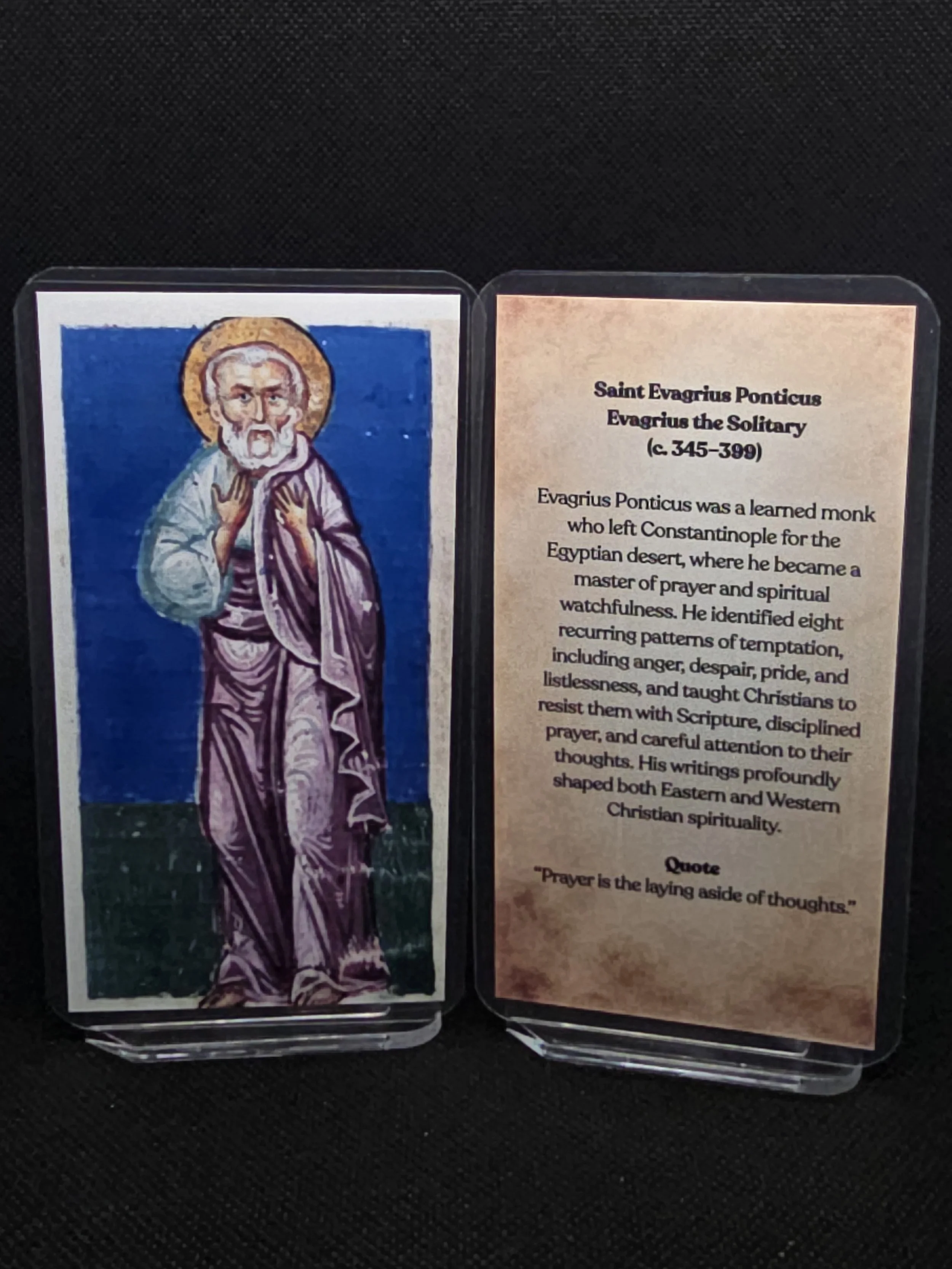
Keep a prayer card of Evagrius Ponticus as a reminder to watch the heart and to pray with attention and patience.
View Prayer Card