Saint Moses the Ethiopian: From Robber Chief to Desert Father of Mercy and Humility
A formerly enslaved man from Africa who led a band of robbers, turned to Christ at Scetis in Egypt, became a priest and spiritual father, and taught that no one should judge another.
At a Glance
- Also known as
- Moses the Black, Abba Moses, Moses the Strong, Moses the Robber
- Role
- Desert father, priest and penitent
- Lived
- About 330 to 407; died at Scetis, Egypt (dates uncertain)
- Feast day
- August 28 (Orthodox and Roman Martyrology); 24 Paoni, about July 1 (Coptic)
- Devotional patronage
- Invoked for repentance, nonviolence and the peoples of Africa
- Main sources
- Palladius, Lausiac History 19; Sozomen; Sayings of the Desert Fathers
- Who Was Saint Moses the Ethiopian?
- The Sources and What They Tell Us
- Enslaved, Dismissed, and a Robber
- Conversion and the Long Struggle
- The Basket With Holes
- Priest, Teacher and Spiritual Father
- Humility in the Face of Prejudice
- Martyrdom at Scetis
- Devotion and Legacy
- Why He Matters to Eastern Christians
- Frequently Asked Questions
Who Was Saint Moses the Ethiopian?
Saint Moses the Ethiopian, also called Moses the Black, is one of the best loved figures of the Egyptian desert. He is remembered as a man with a violent past who became a monk at Scetis, was ordained a priest and grew into a respected spiritual father. His story is a powerful picture of repentance as a long road of change rather than a single moment.
The historical core of his life is credible. Two early writers, Palladius and Sozomen, both report that he was a Black man of Ethiopian origin who lived as a robber before entering monastic life. Beyond that, many details are known only from later stories and sayings. This article marks the later material as TRADITION and notes where dates or facts are UNCERTAIN.
Moses is honored in the Orthodox, Catholic and Coptic traditions alike. He belongs to the shared inheritance of Christians from the time before the great divisions, and his sayings are still read in monasteries and homes around the world.
The Sources and What They Tell Us
The earliest account is in the Lausiac History of Palladius, written in the early fifth century, chapter 19. Palladius describes Moses as an Ethiopian, a former slave and a robber who became a monk of great strength and discipline. The church historian Sozomen, writing in the fifth century, preserves a similar account, though he may depend on Palladius or on a related tradition.
A second source is the Sayings of the Desert Fathers, a collection compiled after the lifetimes of many of its subjects. It preserves short teachings and stories about Abba Moses. These are valuable for the spirit of his teaching, but individual episodes cannot be treated as exact records. A later Coptic source, the Synaxarium, offers a fuller sacred biography but is not as early.
Scholars such as Lucien Regnault, in the Coptic Encyclopedia, and William Harmless, who has written on the destruction of Scetis and the memory of the desert fathers, help set the chronology. They note that the dates usually given are traditional and that some stories may refer to other monks named Moses. One such case is an Abba Moses mentioned by John Cassian, who may or may not be the same man.
Enslaved, Dismissed, and a Robber
Palladius says that Moses was a Black Ethiopian who had been enslaved in the household of a government official. He was dismissed because of his conduct and then became the leader of a band of robbers, feared for his great strength. Nothing is recorded about his parents, his birthplace or how he came to be enslaved. The ancient word Ethiopian did not mean the same as the modern nation of Ethiopia.
One well known story from Palladius says that Moses once crossed the flooded Nile with a sword in his teeth to take revenge on a shepherd whose dogs had barked and given him away. Unable to find the shepherd, he killed some of the flock and swam back. Palladius gives this as a story told about Moses, and it should be treated as an early tradition and not as a verified event.
Cassian's mention of an Abba Moses who entered monastic life because he feared punishment for a murder may or may not refer to the same person. Likewise, the Coptic Synaxarium says that Moses prayed to the sun and asked the true God to reveal himself. This detail is not in Palladius and is best read as the later Coptic way of telling his search for God. These details are TRADITION and UNCERTAIN.
Conversion and the Long Struggle
The turning point of Moses's life was his entrance into the monastic community at Scetis in the Egyptian desert. Palladius reports that he felt remorse for his earlier life, though he does not name the incident or give the date. Later Coptic tradition says that Saint Macarius the Great instructed and baptized him, and this is TRADITION.
The best supported spiritual guide in his life is Isidore. Palladius describes how Moses sought his help after severe temptations, especially to the old habits of his former life. Isidore encouraged him to persevere and told him that such habits would grow weaker when they were no longer fed. Moses took up fasting, manual labor and long nights of prayer.
Palladius reports a period of six years of night prayer and says that Moses eventually received assurance and returned to Holy Communion with confidence. These details come from an early monastic biography, but their exact dates cannot be checked. What stands out is that the story shows a slow, patient struggle, not a sudden and total change. Readers should not take the severe ascetic practices as a model for themselves.
The Basket With Holes
The most famous story about Moses concerns a gathering of monks called to judge a brother who had sinned. According to the Sayings of the Desert Fathers, Moses at first refused to come. When he was urged, he arrived carrying a basket with holes, filled with sand, which ran out behind him as he walked.
When asked what he was doing, Moses explained that his own sins were running out behind him where he could not see them, and yet he had come to judge the sins of another. The monks, hearing this, forgave the brother. This is a teaching story from the sayings, and its exact details cannot be verified, but it expresses the heart of Moses's spiritual authority.
His authority did not come from a spotless past. It came from his honest knowledge of his own failures and his refusal to condemn others. A person who has been forgiven much, the story suggests, learns to be slow to judge. This is why Moses became a model for confessors and spiritual guides, and why he is loved by those who struggle with their own past.
Priest, Teacher and Spiritual Father
Palladius and Sozomen both report that Moses was ordained a priest and that he left disciples. Palladius gives the number of disciples as about seventy, while the later Coptic Synaxarium speaks of five hundred. The two numbers cannot be easily reconciled, and the larger figure should be attributed to the later tradition. His priesthood is among the better supported details of his life.
According to the Coptic Encyclopedia, his reputation for hospitality brought so many visitors that, on the advice of Macarius, he withdrew to Petra for greater quiet. A saying also tells of a cloud that brought water there after he prayed for his guests. This is TRADITION. There is no reliable evidence that he founded a monastery or wrote a rule.
No authenticated book by Moses survives. His teaching is preserved mainly in the Sayings, including the well known counsel to go and sit in your cell and let the cell teach you everything. A set of Seven Chapters sent to Abba Poemen is also attributed to him, but his authorship of it is UNCERTAIN. Taken together, they stress humility, silence, patience and care for one's neighbor.
Humility in the Face of Prejudice
Several stories in the Sayings show that Moses met prejudice because of his dark skin. In one account, a monk is said to have remarked on his appearance, and Moses answered with silence and humility. In another, Moses is told to leave an assembly, and he goes without protest. These stories were written down long after his life, and the exact words cannot be confirmed.
They are important because they show how people in the ancient Church spoke about race and spiritual worth. The tales use images of dark and light, and readers today should be careful not to draw the wrong conclusion. The point of the stories is not that dark skin signifies sin. It is that a person's worth is measured by the state of the soul and not by appearance.
For many Christians of African descent, Moses has become a powerful sign that the Church has always included people of every race. He is a reminder that holiness has no color and that the Gospel is for every nation. At the same time, the sources remind us that prejudice has long troubled the Church, and that it takes humility to face it honestly.
Martyrdom at Scetis
Palladius and Sozomen say that Moses died at about the age of seventy-five. The traditional death year of 407 matches a historical attack on Scetis by raiders called the Mazices, which devastated the monastic settlement. The link is plausible but not certain, since the early accounts do not directly connect his death to that date.
According to the Sayings, Moses foresaw that raiders were coming and told the monks to flee. When they asked whether he would go too, he said that he had long awaited this day and refused, recalling the words of Jesus that those who take the sword will perish by the sword. The raiders came and killed him and those who stayed with him. This is traditional, and the number of companions differs among the accounts.
A brother who had hidden is said to have seen angels place crowns on the heads of the slain. The Church honors this as a martyrdom, though the sources do not show that his killers demanded he renounce Christ, and their motives remain UNCERTAIN. His relics are venerated at the Monastery of the Virgin Mary, called Baramous, in Wadi El Natrun in Egypt, although the identification rests on tradition.
Devotion and Legacy
Moses is honored on August 28 in the Orthodox calendars and in the Roman Martyrology, and on 24 Paoni, about July 1, in the Coptic Church. He has no formal date of canonization, as is true of most saints of the early Church. His veneration grew from the memory of those who knew him and from the monks who passed on his sayings.
Devotionally, he is invoked as a patron of repentance and nonviolence, and of the peoples of Africa. These are expressions of love, not official designations by the Church. The Byzantine hymns also honor him as a healer, but there is no investigated collection of miracles attributed to him.
Whatever one decides about each story, the picture is clear and moving: a violent man laid down the sword, learned to forgive himself with honesty, and taught others not to judge. That message has made Moses a companion to anyone who feels the weight of a difficult past.
Lord Jesus Christ, you called your servant Moses out of violence into mercy and made him a father to many. Through his prayers, free us from the habits that bind us, teach us to remember our own failings before we speak of another's, and give us hearts that welcome the weary. Make us peacemakers and bring us to your kingdom. Amen.
This is a short original prayer written for this page. It is not an official liturgical text. The traditional troparion of Saint Moses is published by the Orthodox Church in America.
Why He Matters to Eastern Christians
Moses belongs to the common monastic heritage of the early Egyptian desert, the roots of Eastern Christian spirituality. His sayings appear in the monastic collections read throughout the Christian East, and his feast is kept by the Orthodox on August 28 and by the Coptic Church on 24 Paoni.
Eastern Catholic readers share this heritage. The sources examined here do not show that every Eastern Catholic Church keeps a separate feast for him, but his teaching and his story are part of the common patrimony that the Churches of East and West hold together.
His message speaks directly to the Eastern understanding of repentance as a lifelong movement of the heart. In the Eastern tradition, the struggle with the passions, the care for the brother and the refusal to judge are central, and Moses embodies all three.
Frequently Asked Questions
Pray With Saint Moses
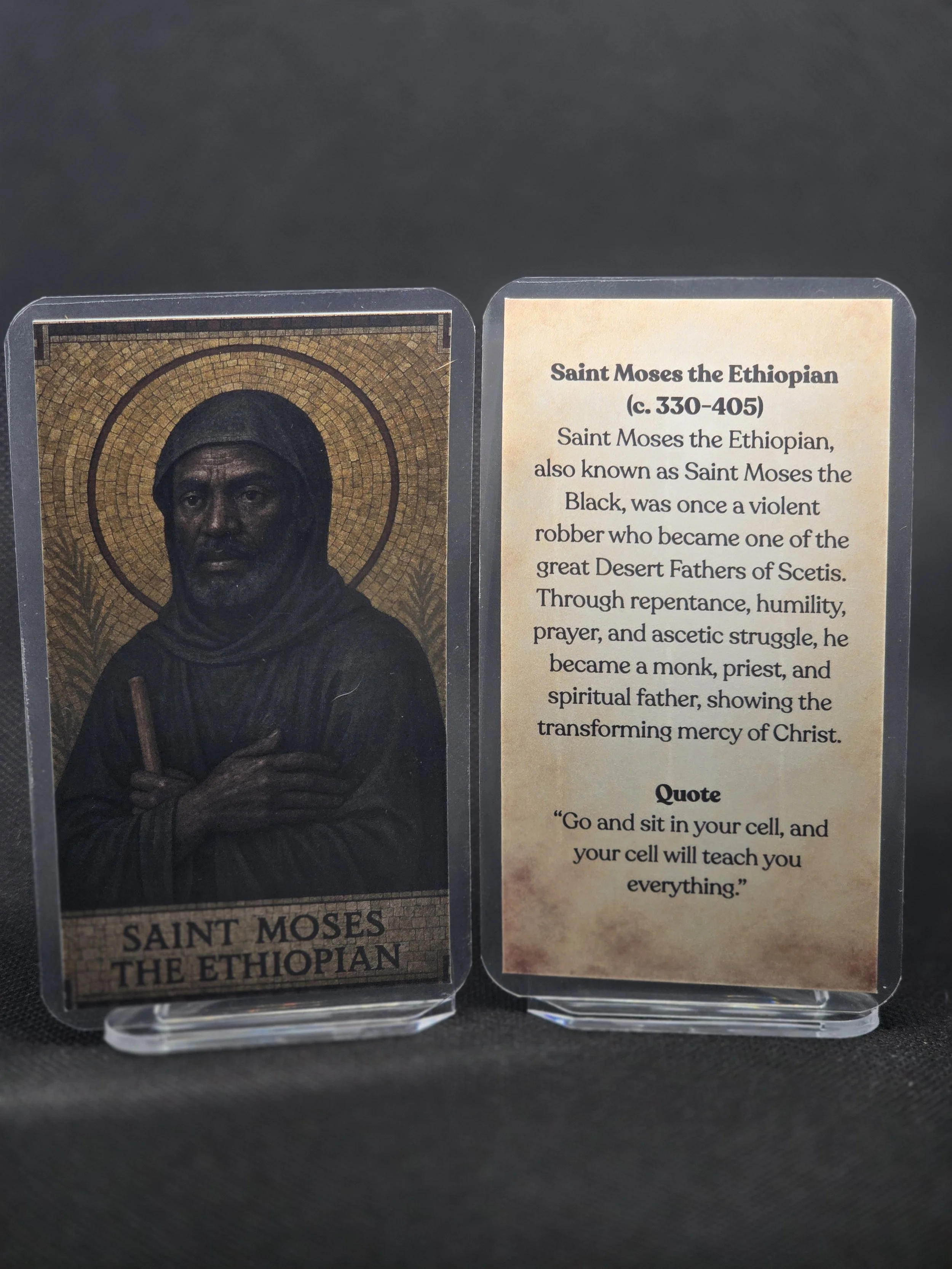
Keep a prayer card of Saint Moses the Ethiopian as a reminder that no past is too heavy for mercy and that no one should judge another.
View Prayer Card