Saint Simeon Stylites the Elder: The Pillar Saint of Syria Who Prayed Above the Crowds
A Syrian shepherd who became the first famous pillar saint, spent decades praying on a tall column near Antioch, and still taught, counseled and prayed for the thousands who came to see him.
At a Glance
- Also known as
- Symeon Stylites, Simeon of the Pillar, Shem'un the Stylite
- Role
- Monk, ascetic and first great pillar saint
- Lived
- Born about 388 to 392; died 459 (birth uncertain)
- Feast day
- September 1 (Byzantine); January 5 (older Roman Martyrology); July 27 (Syriac)
- Birthplace
- Sisan, near Nicopolis in the Syria and Cilicia borderlands
- Shrine
- Qal'at Sim'an, northern Syria
- Who Was Saint Simeon Stylites?
- The Sources: Theodoret, the Syriac Life and the Greek Life
- A Shepherd Boy in Syria
- Monastery and Early Austerities
- Up on the Pillar
- A Teacher and Counselor
- Controversies and Difficult Questions
- Death, Burial and Relics
- Stories of Wonders
- Why He Matters to Eastern Christians
- Frequently Asked Questions
Who Was Saint Simeon Stylites?
Saint Simeon Stylites the Elder was a fifth century monk from northern Syria who became famous for living on top of a tall pillar. The Greek word stylos means pillar, so a stylite is a pillar dweller. Simeon was the first stylite to become widely known, and his way of life attracted pilgrims from across the Roman world.
Unlike many holy figures of the ancient Church, Simeon is unusually well documented. A bishop and writer named Theodoret of Cyrrhus knew him and wrote about him while he was still alive. Other early sources include a Syriac Life and a Greek Life attributed to Antonius. These later texts add many stories that need careful reading, and this article marks them as TRADITION where appropriate.
The picture that emerges is of a man of extreme discipline who did not shut himself away from others. From his pillar he taught, advised, settled disputes and prayed for the people who gathered below. He was strange to many of his contemporaries, and the sources record both admiration and criticism.
The Sources: Theodoret, the Syriac Life and the Greek Life
Our best source is Theodoret, bishop of Cyrrhus, who wrote about Simeon in his Religious History, chapter 26. Theodoret says he visited Simeon and heard him speak about his own life. This makes his account a near contemporary report, though Theodoret was also a defender of ascetic heroes and shaped his portrait to make a point.
The Syriac Life, translated into English by Frederick Lent in 1915, and the Greek Life attributed to Antonius preserve additional material, including many miracle stories. The later historian Evagrius Scholasticus, writing in the sixth century, describes Simeon's life and the transfer of his body. Scholars compare these texts and notice where they differ, which is why a careful biography shows the differences instead of blending them into one story.
Modern studies include Robert Doran's collection of translations, The Lives of Simeon Stylites (1992), and the work of scholars who study the archaeology of Qal'at Sim'an. French archaeological research has described the great sanctuary built after his death. Together these sources let us separate firm facts from the legends that grew up around him.
A Shepherd Boy in Syria
Simeon was born in the countryside of the Syrian and Cilician borderlands, in a village called Sisan near Nicopolis. The year is uncertain. Many sources place his birth between about 388 and 392, while a Syriac reference work gives about 380. His family is described as Christian and of modest means, connected with sheep herding.
Later Orthodox tradition names his father as Sisotian and his mother as Martha. These names appear in devotional biographies and should not be treated as verified records. Martha is herself honored in Byzantine liturgical tradition. Little reliable information survives about his siblings, education or youth.
According to Theodoret, who heard the story from Simeon himself, the young man once entered a church and heard the Gospel Beatitudes read aloud. Struck by the promises made to the poor and the persecuted, he asked how to live them and was drawn toward the solitary life. This turning point is reported by a firsthand listener, though its details cannot be independently checked.
Monastery and Early Austerities
After first joining local ascetics, Simeon entered a monastery, which Theodoret calls Teleda or Tell Ada. He is said to have remained there for about ten years. His fasting and self-imposed hardship grew steadily more extreme, and eventually the community leaders became alarmed.
Theodoret says that Simeon tied a rough palm-fiber rope tightly around his body, so tightly that it cut into the flesh. When the wound was discovered, the superiors feared that the other monks might copy practices beyond their strength, and Simeon was asked to leave. He withdrew to a dry cistern, from which he was later brought back, though he did not stay long.
He then settled at Telanissos, near the hill where his pillar would stand. There he spent three years in a small hut and attempted very long Lenten fasts. One report says that a priest found him barely responsive after a forty day fast. This is an ancient testimony and not a medical fact. It should also be said plainly that such practices are not an example for Christians to imitate, and the early writers themselves debated their wisdom.
Up on the Pillar
The decisive change was his move onto a pillar. Theodoret explains that crowds were pressing in on Simeon, touching his clothes and seeking healing, and that he wanted to escape the constant contact. A raised platform gave him distance from the crowd without cutting him off from them.
Theodoret records pillars of increasing height: six, twelve, twenty-two and finally thirty-six cubits. Using an eighteen inch cubit this is about fifty-four feet, although ancient cubits varied in length, so the exact height is UNCERTAIN. His time on pillars is generally dated from about 422 or 423 until his death in 459, which gives roughly thirty-six or thirty-seven years.
The pillar had a small platform with a railing, large enough for him to stand, bow and sleep in a limited way. Food and visitors reached him by ladder and by the help of disciples. The sufferings of standing and fasting were real. Theodoret mentions an ulcer on his foot, and the sources do not hide the physical cost of his life.
A Teacher and Counselor
Simeon was not simply a hermit watching the world from a distance. Theodoret describes a daily rhythm of prayer through the morning and early afternoon, followed by instruction of the crowds and attention to their petitions. He taught about repentance, judgment, prayer and detachment from possessions. Rich and poor alike were received.
His reputation reached far beyond Syria. Theodoret says that Arab tribes, Persians, Armenians and even visitors from the western Mediterranean came to see him. Not all of these claims can be separately verified, but the large Christian sanctuary built after his death shows how widely his cult spread.
He also addressed bishops and rulers. Theodoret records that Simeon communicated with the emperor and encouraged church leaders to care for their people. A well known detail is that an observer once began to count his bows in prayer and gave up after more than a thousand, with the number 1,244 reported. This tells us what an ancient witness reported, not a daily rule.
Controversies and Difficult Questions
Simeon's way of life drew criticism from the start. Theodoret defended it by comparing it to the strange symbolic actions of the biblical prophets, but even his account shows that many found it excessive. Reading about Simeon means keeping admiration for his prayer alongside honest questions about the harm that extreme practices can cause.
He lived through the controversies that followed the Councils of Ephesus in 431 and Chalcedon in 451. Several letters are attributed to him, and some were clearly used by both sides. The scholar Charles Torrey studied them in 1899 and found problems with several. A Syriac reference work considers a letter accepting Chalcedon to be probably genuine, while others are doubtful. His own doctrinal statements are therefore UNCERTAIN.
Another difficult matter is a letter attributed to Simeon that opposed imperial measures protecting Jewish synagogues. The core report has some support, but the detail that he forced the emperor to dismiss an official is much less credible. This episode reflects hostility toward Jews found in parts of late antique Christianity, and it should be named honestly rather than presented as a model of holiness.
Death, Burial and Relics
Simeon died on his pillar in 459. The best supported year is 459, but the exact day is uncertain. The Catholic Encyclopedia gives September 2, while Antiochian tradition points to September 1 and also acknowledges some doubt about whether the year might have been 461. A tradition from the Greek Life says his disciples at first did not realize he had died because he remained motionless, standing in prayer. This is TRADITION.
His body was carried in a great procession to Antioch. Evagrius reports that he himself saw Simeon's preserved head there. The Catholic Encyclopedia describes a dispute between Antioch and Constantinople over the relics, with Antioch receiving the main portion. Their later movements and present location are UNCERTAIN.
The great sanctuary of Qal'at Sim'an was built around the pillar after his death. Its ruins in northern Syria, with a cross shaped church, an octagonal central space, a baptistery and a monastery, still stand as one of the grandest early Christian pilgrimage complexes. Simeon did not found it himself, but it shows how deeply he was loved.
Stories of Wonders
The sources contain many stories of healing and prophecy. Theodoret himself describes the healing of a paralyzed man brought by an Arab leader and says he was present. He also credits Simeon with foretelling drought and famine. These are ancient testimonies, not independently verified miracles.
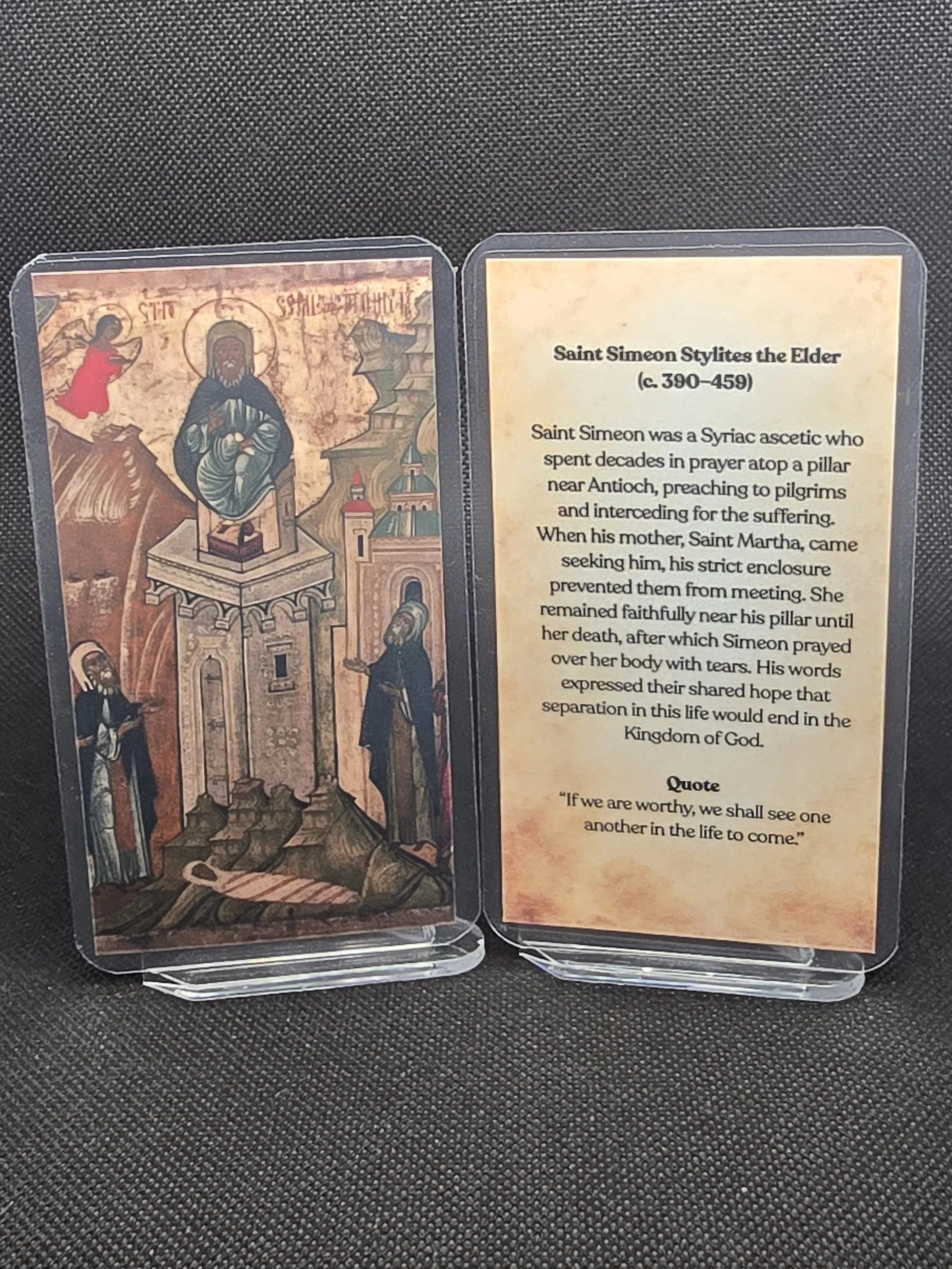
A well known tradition tells of Simeon's mother, Martha, who is said to have come to see him after long years but was not permitted to approach. She died there, and Simeon is said to have been allowed a final farewell. Another story says that elders ordered him to come down from the pillar to test whether his life was humble or proud. When he agreed to obey, they let him remain. Both are devotional accounts and their historical details are uncertain.
These stories show what the faithful wanted to say about him: that endurance and obedience belong together, and that a person who gave up so much stayed close to his mother and to the people. Readers should treat them as stories of faith rather than records.
Lord Jesus Christ, you gave your servant Simeon patience to pray through long years and a heart open to those who came to him. Through his prayers, give us steadfastness in prayer, humility before wise counsel, and gentleness toward everyone we meet. Keep us from pride and from harsh judgment, and bring us to your kingdom. Amen.
This is a short original prayer written for this page. It is not an official liturgical text. The traditional troparion of Saint Simeon is published by the Orthodox Church in America.
Why He Matters to Eastern Christians
Simeon is part of Eastern liturgical life. The Byzantine Orthodox and Byzantine Catholic Churches commemorate him on September 1, which is also the start of the Church year, and the Orthodox Church in America publishes his troparion, which praises his patient endurance. The Antiochian Orthodox Patriarchate also honors him. The Syriac Church remembers him on a different day, July 27, according to a Syriac reference work.
He is a distinctly Syrian saint, and the Eastern Churches of that land see in him a figure of their own heritage. A Melkite Catholic parish in the United States is reported to honor him as its patron. A specific Maronite liturgical commemoration could not be verified and is not claimed here.
His life reminds Eastern Christians that withdrawing from the world and caring for the world can go together. From the pillar, Simeon prayed for people and gave them counsel. At the same time, his example is not a call to copy his bodily extremes. The Church honors his love of God and endurance, and urges the faithful to seek moderation and wise guidance.
Frequently Asked Questions
Pray With Saint Simeon
Keep a prayer card of Saint Simeon Stylites as a companion for patient prayer and a reminder to listen to wise counsel.
View Prayer Card