Saint Paul of Thebes: The First Hermit, the Raven's Bread and the Meeting With Anthony
A young Egyptian who fled persecution into the desert, lived for decades in a hidden cave beside a palm tree and a spring, and was buried by Saint Anthony with the help of two lions, as told by Saint Jerome.
At a Glance
- Also known as
- Paul the First Hermit, Paul the Anchorite, Anba Paul
- Role
- Hermit and desert father of Egypt
- Lived
- Traditionally about 227 to 341 (dates uncertain)
- Feast day
- January 15 (Byzantine); January 10 (current Roman Martyrology); 2 Amshir, about February 9 (Coptic)
- Patronage
- Hermits and ascetics; patron of the Order of Saint Paul the First Hermit
- Main source
- Life of Paul the First Hermit by Saint Jerome, about 375
- Who Was Saint Paul of Thebes?
- The Source: Jerome's Life of Paul
- Youth and Flight From Persecution
- The Hidden Cave
- Anthony Learns of Paul
- The Raven and the Bread
- Death and Burial
- Relics, Monasteries and the Pauline Order
- Devotion and Iconography
- Why He Matters to Eastern Christians
- Frequently Asked Questions
Who Was Saint Paul of Thebes?
Saint Paul of Thebes is honored in the Catholic, Orthodox and Coptic traditions as the first Christian hermit. According to the account of Saint Jerome, he withdrew into the Egyptian desert as a young man to escape persecution and stayed there for the rest of his long life, unseen by the world until Saint Anthony the Great found him shortly before his death.
This article is honest about what can and cannot be known. Almost everything we are told about Paul comes from a single short work written by Jerome decades after Paul was supposed to have died. Historians disagree about how much of it reflects real memory and how much is literary and spiritual composition. The Church's veneration of Paul is real and old, even if the details of his biography cannot be confirmed.
The sections below mark the story as TRADITION where it comes from Jerome or later devotion, and as UNCERTAIN where dates or details are disputed. What emerges is a portrait of a figure who has shaped Christian ideas of solitude, poverty and trust in God for more than sixteen centuries.
The Source: Jerome's Life of Paul
The principal source is the Life of Paul the First Hermit, written in Latin by Saint Jerome, usually dated to about 374 to 376, though estimates vary. Jerome was then a young scholar living in the Syrian desert. He wrote for readers in the West who knew Anthony from the Life by Saint Athanasius but knew little of other desert ascetics.
Jerome himself admits that he is filling a gap. He explains at the start that Anthony was widely thought to be the first of the desert monks, and he argues that Paul had come before him. He also says that the years between Paul's flight and his death are not known, so he concentrates on the beginning and the end of the story.
Modern scholars are divided. Some, such as Ewa Wipszycka, regard Jerome's Paul as largely a literary creation. The older Catholic Encyclopedia was more open to a genuine tradition behind the text. The Coptic Encyclopedia notes that later accounts depend on Jerome. Athanasius does not mention Paul at all, which is one reason for caution. The title of first hermit therefore expresses a tradition, not a proven historical fact.
Youth and Flight From Persecution
According to Jerome, Paul came from a wealthy Christian family in the Lower Thebaid of Egypt. He received a good education in Greek and Egyptian learning and was known for a gentle and devout character. His parents died when he was about sixteen, leaving him and his married sister to share the inheritance. None of this can be independently checked, and the names of his family are not recorded.
The story places these events in the time of the Decian persecution, which began in the year 249, with Valerian's persecution mentioned as well. Jerome says that Paul's brother-in-law, greedy for his property, planned to denounce him to the authorities as a Christian. Warned of the danger, Paul left his home and went into the desert.
A different tradition appears in the Coptic Synaxarium, which describes Paul as an Alexandrian whose brother Peter disputed their inheritance. In that version he sees a funeral procession, realizes the emptiness of wealth and leaves the world. The two versions differ in important ways, which shows how the story grew in different Christian communities. The persecutions themselves are real history, but Paul's own experience of them is uncertain.
The Hidden Cave
Jerome says that Paul at first meant only to hide for a time. As he went deeper into the mountains he found a cave closed by a stone. Inside was an enclosed space with a palm tree and a spring of fresh water. Jerome presents this as the moment when a flight from danger became a settled vocation of prayer.
The palm gave him food and leaves from which he made his clothing. The spring gave him water. Jerome describes a life of unbroken prayer, poverty and trust in divine providence. This is TRADITION. There is no independent testimony for how Paul lived, and no writings of his have been established as authentic.
Jerome shapes the story as a spiritual lesson. A man who escapes a human threat comes to love solitude for its own sake. The image of the cave, the palm and the spring is rich in biblical echoes, recalling Elijah in the wilderness and the Psalms that speak of God's care for those who rely on him alone.
Anthony Learns of Paul
The central scene of the Life comes near the end. Anthony, who is about ninety years old in the story, is troubled by the thought that he is the first monk of the desert. In a revelation he is told that there is another, deeper in the wilderness, who is better than he. Anthony sets out to find him. Paul is said to be 113 years old at this point. These ages belong to the narrative and are UNCERTAIN as chronology.
On the way Anthony meets strange creatures that Jerome draws from classical myth, including a centaur and a satyr. Scholars see these episodes as a literary way of showing that the old pagan world has been overcome by Christ and has nothing left to offer but questions.
When Anthony reaches the cave, Paul at first keeps the door closed, then opens it. The two embrace and greet each other by name, though they have never met. They speak of the world and of the Church, and then they sit together. Jerome stresses their humility and mutual respect. The meeting is a picture of unity between two forms of solitary life.
The Raven and the Bread
The most famous detail is the raven. Jerome says a raven had brought Paul half a loaf of bread each day for many years. On the day Anthony arrived the raven brought a whole loaf. Paul saw this as a sign of God's generosity to both of them. The two then argued humbly over who should break the bread and, in the end, broke it together.
The image comes from the Bible. A raven fed the prophet Elijah by the brook Cherith, and Jerome clearly wants his readers to hear that echo. Paul is painted as a new Elijah, fed by God in the wilderness. This is TRADITION and cannot be verified, but it has shaped the way Paul is shown in icons and paintings for centuries.
The scene is also a gentle reminder of the theme of hospitality. In the desert, where there is almost nothing, the arrival of a guest brings an increase, not a loss. Many later desert stories repeat this idea that a person who shares what little they have receives more than they gave.
Death and Burial
Paul, according to Jerome, knew that his death was near. He asked Anthony to go back to his own monastery and bring the cloak that Athanasius had given him, so that he might be wrapped in it. Anthony set out. On the way he saw in a vision Paul's soul rising to heaven among angels, prophets and apostles, and he hurried back.
He found Paul dead, kneeling as if in prayer. Anthony wrapped the body in the cloak and chanted psalms, but he had nothing to dig a grave. Jerome says two lions came from the desert and dug the ground with their paws, then waited for Anthony's blessing and left. This is TRADITION and is one reason lions appear in the pictures of Paul.
Anthony took Paul's tunic of woven palm leaves and wore it on the great feasts of Easter and Pentecost. Jerome ends with a pointed contrast: some people own marble floors and golden houses, while Paul had nothing and now possesses heaven. The year of Paul's death is traditionally about 341, and some calendars give 342. It is UNCERTAIN.
Relics, Monasteries and the Pauline Order
Paul's relics have a complex medieval history. Orthodox tradition describes their transfer from Egypt to Constantinople and from there to Venice, and a medieval account places their arrival in Hungary in 1381. A part of his head is traditionally associated with Rome. These reports belong to the documented history of medieval devotion, but they do not prove a chain of custody back to Paul's burial. The authenticity of the relics is UNCERTAIN.
In Egypt, the Coptic Orthodox Monastery of Saint Paul, near the Red Sea, preserves a cave church that tradition links with the hermit. The monastery is a real and historic community that has lasted many centuries. Archaeology cannot confirm that Paul himself lived in that cave.
In medieval Hungary, scattered hermits were gathered into a religious order in the thirteenth century under Blessed Eusebius of Esztergom. The order took Paul as patron and is known as the Order of Saint Paul the First Hermit, or Pauline Fathers. It received papal approval in 1308. Paul did not found the order himself. His name was adopted many centuries after his traditional lifetime.
Devotion and Iconography
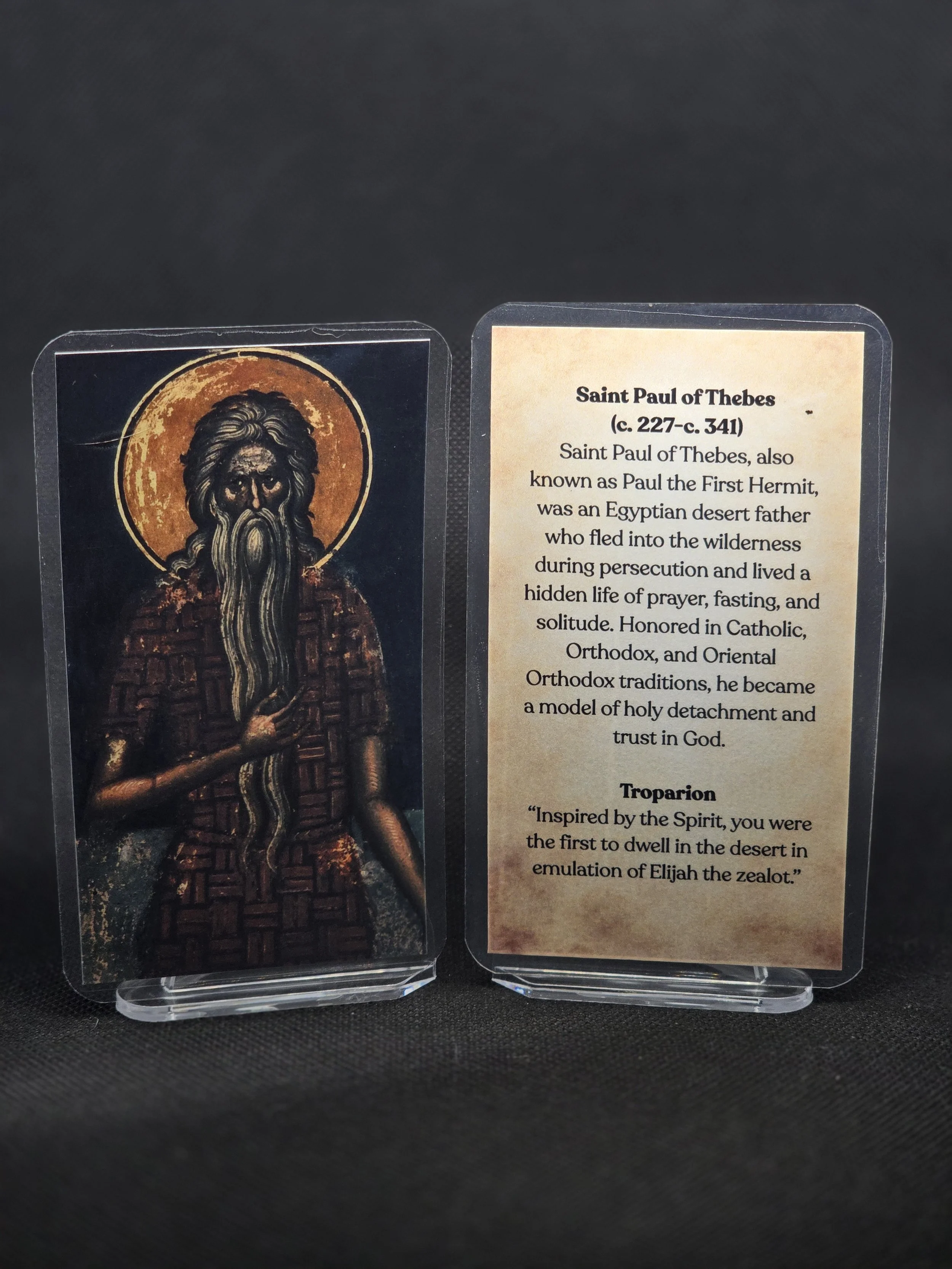
Paul is commonly shown as a very old man in a garment of woven palm leaves. A raven with bread often appears beside him, and sometimes two lions. In some paintings, Paul and Anthony sit together sharing the loaf. These symbols all come from Jerome's story and make him easy to recognize.
He is invoked as a patron of hermits and ascetics, and the Pauline Fathers honor him as their spiritual father. He is not known to have established a rule or to have taught disciples, and he is not remembered as a priest or bishop. His message is wordless: a life given wholly to God in a hidden place.
John Cassian names Paul together with Anthony in his Conferences when discussing the origins of the solitary life. This shows that Paul's story was part of how early Christians understood monasticism, though it does not independently confirm Jerome's account.
O God, who fed your servant Paul in the wilderness and made his hidden life a lamp for your Church, teach us to trust you in poverty and silence. Through his prayers, give us hearts that seek you above all things, hospitality toward every guest, and peace in the quiet of our own days. Amen.
This is a short original prayer written for this page. It is not an official liturgical text. The traditional troparion of Saint Paul is published by the Orthodox Church in America.
Why He Matters to Eastern Christians
Paul is directly part of Eastern liturgical life. The Byzantine Orthodox Church commemorates Venerable Paul of Thebes on January 15, and the Orthodox Church in America publishes hymns for his feast, in which he is compared to Elijah and remembered for his meeting with Anthony. The troparion, in the third tone, ends with a petition asking him to entreat Christ God to grant us great mercy.
The Coptic Orthodox Church honors Anba Paul on the second day of the month of Amshir, normally February 9, and keeps the monastery that bears his name. Among Eastern Catholics, the Maronite calendar is also reported to include him in early January. Different calendars place his feast on different days, which is common for very ancient saints.
For Eastern readers, Paul stands at the headwaters of the monastic tradition that shaped so much of Eastern Christian spirituality. His life reminds us that holiness is not measured by public achievement. A person unknown to the world, praying alone and trusting God, can be counted among the great saints.
Frequently Asked Questions
Pray With Saint Paul
Keep a prayer card of Saint Paul of Thebes as a companion for quiet prayer and trust in God's provision.
View Prayer Card