Blessed Christina the Astonishing: The Medieval Mystic of Sint-Truiden Who Prayed for the Dead
An orphaned shepherd girl of the Low Countries who, according to her biographer, died, rose from her coffin and spent her life in strange and costly prayer for the souls of the departed.
At a Glance
- Also known as
- Christina Mirabilis, Christina of Sint-Truiden
- Role
- Mystic, penitent and intercessor for the dead
- Lived
- Born about 1150; died 1224 near Sint-Truiden, in present day Belgium
- Feast day
- July 24 in most sources (June 23 in one older reference)
- Patronage
- Devotionally invoked for the souls of the dead and for those with mental illness
- Main source
- Life by Thomas of Cantimpre, written in 1232
- Who Was Christina the Astonishing?
- The Sources: Thomas of Cantimpre and Others
- Orphan and Shepherd Girl
- The Death and the Return
- A Life of Strange Penance
- Prayer for the Souls in Purgatory
- Her Death and Her Resting Place
- Veneration and Approval
- Lessons From an Unusual Saint
- Why She Matters to Eastern Christians
- Frequently Asked Questions
Who Was Christina the Astonishing?
Christina the Astonishing, in Latin Christina Mirabilis, is one of the strangest and most discussed holy figures of the Middle Ages. She lived in the twelfth and early thirteenth centuries in the region of Liege, in what is now Belgium. Her story, as her first biographer tells it, is full of marvels: a death and return to life, flights through the air, and a life of extreme penance offered for souls in purgatory.
She is usually called Blessed Christina rather than Saint. Her cult was local and gradually approved, and she is named in the Roman Martyrology of 2004 on July 24 as a Blessed. She was never part of the mainstream Eastern calendars. Her story belongs to the Latin West, and especially to the lively religious world of the Low Countries.
Reading about Christina asks for patience and care. Almost everything we know about her comes from one source written after her death, and that source belongs to a literary style that loved wonders. This article follows the tradition, marks what is uncertain, and does not hold her up as a model for imitation in every respect.
The Sources: Thomas of Cantimpre and Others
The main source is the Life of Christina written by Thomas of Cantimpre in 1232, only a few years after her death. Thomas was a Dominican scholar and writer who gathered stories of holy women of the region, and he says he drew on accounts from people who knew her, including nuns who had lived with her. An English translation by Margot King and Barbara Newman, published in 2008, made the text widely accessible.
There is also a brief earlier mention in the writings of Jacques de Vitry, a contemporary churchman who admired the holy women of Liege. Beyond these, no writings of Christina herself survive. We hear her only through the voice of others who admired her, and who shaped her story to teach lessons about penance, purgatory and trust in God.
Modern scholars, including Rachel Smith in her study Excessive Saints and Cordelia Spencer-Hall in her work on medieval saints and their bodies, treat the Life as a valuable witness to medieval devotion. It tells us what her admirers believed and wanted others to learn. It cannot be read as a plain medical or biographical report, and so the details below are labeled as tradition where that is the honest thing to do.
Orphan and Shepherd Girl
According to Thomas, Christina was born around 1150 in Brustem, a village near Sint-Truiden. She was orphaned young and left with two older sisters. The three girls had to make their own way, and Christina worked as a shepherd, spending long days alone in the fields. The year of her birth is approximate and rests on the later account.
The Life says that in her early twenties she suffered a severe illness, or what appeared to be a seizure, and was thought to have died. This episode is told as the turning point of her life. The age and date are uncertain, and popular retellings often say she was twenty one, with the event placed about 1182. These details should be treated as approximate.
Her years as a shepherd matter for the story because they place her among ordinary poor people. She was not a noblewoman or an abbess. Thomas presents her as someone with no worldly standing whom God nevertheless chose, which fits a common medieval theme of the lowly being exalted.
The Death and the Return
The most famous episode in the tradition is her death and revival. Thomas says that she was laid out in church for her funeral, and that during the Mass she rose up and flew to the roof beams. The congregation fled in terror, and only her sister remained. The priest ordered her to come down, and she did. This story belongs entirely to the realm of tradition and cannot be verified.
She then described what she had experienced. According to the Life, her soul had been taken to the places of punishment, to purgatory and to heaven, and she was offered the choice to stay with God or to return to earth and suffer on behalf of souls in purgatory so that they might be freed sooner. She chose to return. This vision is the foundation of the rest of her story and of her later reputation.
Whatever one thinks of the details, the story expresses a real conviction of medieval Christians: that the living can help the dead by prayer, fasting and sacrifice. The Church continues to teach that we can pray for the faithful departed, and that is the genuine heart of the devotion, apart from the unusual form it takes in the legend.
A Life of Strange Penance
After her return, Christina is said to have lived in ways that astonished her neighbors, which is how she earned her name. Thomas describes her climbing trees and towers to escape the smell of human beings, which she said was unbearable, and praying in hiding places. She was said to float or levitate, to endure fire and freezing water without harm and to avoid contact with others.
Her family and neighbors thought her mad or possessed. The story tells of attempts to restrain her with chains and confinement, and of her escapes. In one tale she is chased and takes refuge in a church, and in another she is found in a baptismal font at Wellen. These accounts are told as signs of sanctity and also as signs of her suffering, and cannot be confirmed as events.
It is important to speak plainly about one point. The extreme self-injury described in the sources is not a model of holiness for anyone today. The Church honors Christina for her love of the dead and her trust in God, and does not ask the faithful to harm their bodies. Readers who struggle with mental distress should seek real help, and may ask her prayer without imitating her methods.
Prayer for the Souls in Purgatory
Everything in Christina's story points toward her prayer for the departed. In the Life, she is shown suffering willingly so that souls in purgatory might be released. This belief, that the Church on earth can help the Church in purification, was deeply important in the Latin West and remains part of Catholic teaching.
The Life also records that people sought her prayers and her counsel. One well known example is Count Louis II of Looz, a nobleman who is said to have confessed his faults to her in a general way and received her spiritual encouragement. Since Christina was a laywoman, this was not sacramental confession, and it is best understood as an exchange of spiritual counsel.
She was connected with other holy women of the region, including Lutgard of Aywieres, Mary of Oignies and Jutta of Borgloon. These women formed a kind of spiritual network in the Low Countries. Christina is also credited in the Life with a prophecy linked to the battle of Steppes in 1213, a detail that again rests on the account of her biographer.
Her Death and Her Resting Place
Christina died in 1224 at the convent of Saint Catherine in Sint-Truiden, where she had spent her last years. The exact day is uncertain. Most sources give July 24, and that is the date in the Roman Martyrology, but one older reference, the Enciclopedia Cattolica of 1950, gives June 23. Because of this, it is wise to say that her feast is celebrated on July 24 while acknowledging the difference.
The Life reports that she appeared to die a second time and again returned briefly, an episode connected with her friend, the sister Beatrice. Whether or not one accepts such stories, they show the reverence in which her last days were held by the community around her.
Her relics were moved within Sint-Truiden over the centuries. They were taken to the convent of the Nonnemielen around 1231, later came into the care of the Redemptorists, and are now reported to rest in the treasury of the Church of Our Lady in Sint-Truiden. Because relic histories are often complicated, that last detail should be taken as a report rather than a certainty.
Veneration and Approval
Christina's cult was local and long lived. She was honored in Sint-Truiden and the surrounding region, and her name appeared in martyrologies and in the lists of holy persons of the Low Countries. A local source attributes a confirmation of her cult to Pope Pius IX in 1857, which would explain her title of Blessed. This detail is reported locally and should be read with some caution.
She is sometimes called a patron of people with mental illness, and also of the souls in purgatory. These are devotional associations that grew up over time, not formal declarations of the Church. It is also important not to diagnose her. Medical explanations offered by modern writers are guesses, and the sources do not allow certainty about what she suffered.
Her story has been the subject of much recent scholarship, partly because it raises hard questions about holiness, the body and the way communities treat those who seem strange. For believers, it remains a reminder that God can work in lives that do not look conventional, while the Church always asks for discernment.
Lessons From an Unusual Saint
Christina's story is not easy to summarize in a few moral lessons, but several themes stand out. The first is compassion for the dead. Whether or not one takes her flights and visions literally, the idea that the faithful on earth can serve the departed through prayer is a gentle and consoling one.
The second theme is the dignity of the poor and overlooked. A girl with no family and no wealth became a figure that bishops, priests and counts took seriously. Her story challenges easy assumptions about who matters in the Church.
A third theme is the need for wisdom. Her neighbors often misunderstood her, and she sometimes suffered because of that. A mature reading of her life holds together reverence for her love of God with honesty about the harm that extreme practices can cause.
Eternal rest grant unto them, O Lord, and let perpetual light shine upon them. Through the prayers of Blessed Christina, who loved the souls of the departed, comfort those who mourn, grant mercy to those who have died, and teach us to pray for one another with patience and a gentle heart. May they rest in peace. Amen.
This is a short original prayer written for this page, built on a traditional petition for the dead. It is not an official liturgical text.
Why She Matters to Eastern Christians
Blessed Christina belongs to the Latin West. She has no place in the calendars of the Orthodox Church or the Byzantine Catholic Churches, and we know of no Eastern commemoration for her. She should not be confused with Saint Christina of Bolsena, a martyr who is also honored on July 24 and who appears in other traditions.
Even so, Eastern Christians may find points of recognition. The prayer for the departed is central to Eastern worship, in the memorial services and the offerings made on behalf of the dead. The Eastern tradition also honors holy fools and ascetics whose lives seemed strange to their neighbors, and in that respect Christina can be compared as a theme, though not claimed as part of that tradition.
Reading her story can therefore be a way of seeing shared Christian convictions in a different culture. East and West alike pray for the dead, honor penitents and ask for the prayers of those who have gone before us.
Frequently Asked Questions
Pray With Blessed Christina
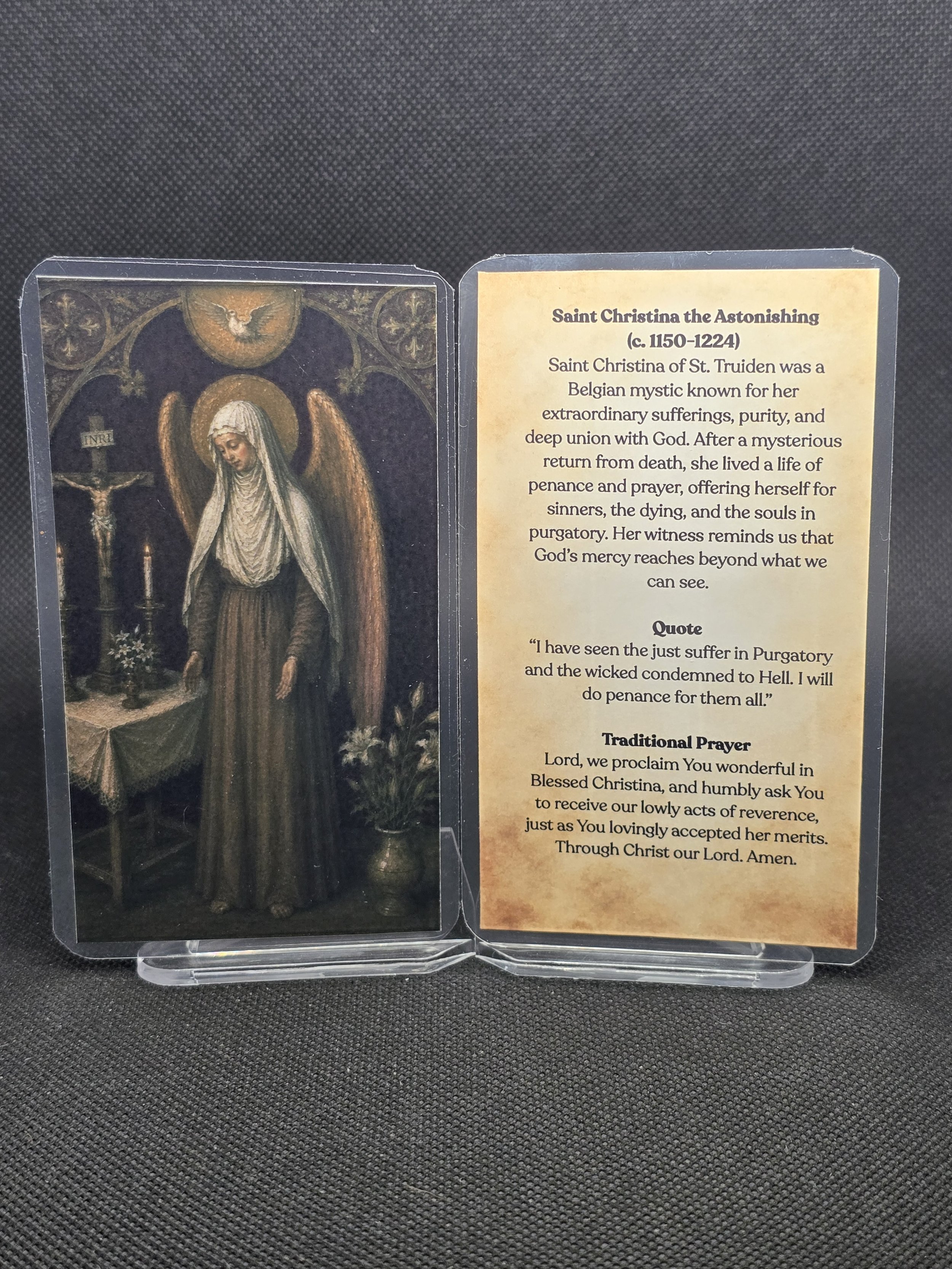
Keep a prayer card of Christina the Astonishing as a reminder to pray for the faithful departed and to treat the strange and overlooked with respect.
View Prayer Card