Saint Faith of Conques: The Child Martyr of Agen, Her Golden Reliquary and the Prisoners She Freed
A young girl put to death for refusing to worship the Roman gods, a gold statue that has watched over pilgrims for a thousand years, and a book of miracles that shows how medieval Christians prayed to their saints.
At a Glance
- Also known as
- Foy, Sancta Fides, Faith of Agen
- Role
- Virgin and martyr
- Lived
- Roman Gaul, late 3rd to early 4th century (dates uncertain)
- Feast day
- October 6 in the Western calendar
- Patronage
- Prisoners, captives and pilgrims
- Shrine
- Abbey church of Sainte-Foy, Conques, France
- Who Was Saint Faith?
- The Sources: What We Actually Know
- The Passion of Saint Faith
- When Did She Die? An Honest Note on Dates
- The Tomb at Agen and Her Early Cult
- The Relics Come to Conques
- The Majesty of Sainte Foy
- The Book of Miracles
- Pilgrims, Prisoners and a Lasting Patronage
- Why She Matters to Eastern Christians
- Frequently Asked Questions
Who Was Saint Faith?
Saint Faith is one of the best loved young martyrs of medieval Europe. She is known in French as Sainte Foy and in Latin as Sancta Fides, which simply means "faith." According to the tradition, she was a girl of Agen, in Roman Gaul, who was put to death during the persecutions of the late third or early fourth century because she would not offer sacrifice to the pagan gods.
Almost nothing about her can be checked in the way a modern historian would like. We do not know her birth date, her family, or the exact year of her death. What we have is a very old devotion, a written account of her passion, and a shrine that drew pilgrims for centuries. The story told here follows the tradition and marks where it cannot be confirmed.
Her cult grew far beyond Agen. A monastery at Conques, in the hills of southern France, came to hold her relics and built one of the great Romanesque churches around them. From there her name spread across Europe, and chapels dedicated to Sainte Foy appeared in France, Spain, England and beyond.
The Sources: What We Actually Know
The oldest evidence for Faith is her place in early Western martyrologies, the lists of saints venerated on particular days. Her name appears under October 6 in the Martyrologium Hieronymianum, a very early compilation, and the commemoration continued in later works such as the martyrology of Ado of Vienne and, eventually, the Roman Martyrology. This shows that Christians in Gaul honored her from a very early period.
The detailed story of her trial and death comes from a Latin passion text. Like many passions of this kind, it was written well after the events and shaped by the conventions of the genre: a brave young Christian, a stern governor, cruel tortures that fail, and a final triumph. Scholars treat such texts carefully. They may preserve a core memory, but the speeches and the marvelous details are likely to be later embellishment.
The best known source for her later cult is the Book of the Miracles of Saint Faith, written by Bernard of Angers in the early eleventh century. It tells us little about her life but a great deal about how people prayed to her. Modern English readers can meet it in the translation and study by Pamela Sheingorn, The Book of Sainte Foy, published in 1995.
The Passion of Saint Faith
According to the tradition, Faith was a young Christian of Agen, said to be about twelve years old, though that age comes from the legend and cannot be verified. The Roman governor, called Dacian in the story, was carrying out the imperial orders against Christians, which the text places in the time of the emperors Diocletian and Maximian. Faith was arrested and brought before him.
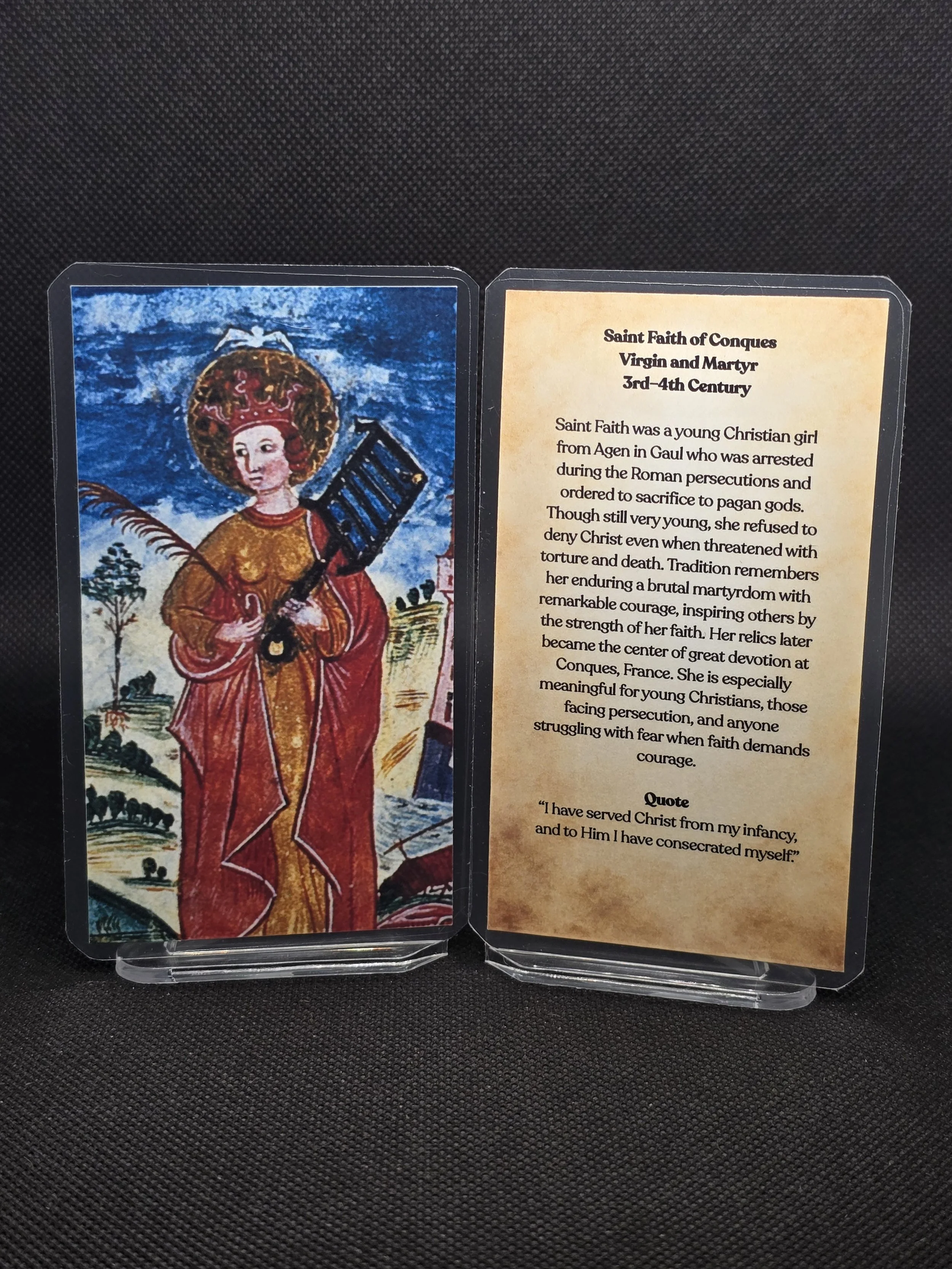
When she was told to sacrifice to the gods, she refused. The passion says she was threatened and then tortured. The best known detail is that she was laid on a bronze bed or gridiron over a fire, an image that links her story to that of Saint Lawrence. The details of the tortures vary between versions and belong to the realm of pious tradition rather than documented history.
The account ends with her beheading. The text also ties her story to Saint Caprasius of Agen, who is said to have hidden in a cave nearby, been moved by her courage and then given himself up as a martyr. This link appears in the later literature and, again, should be read as tradition. What is consistent is the theme: a very young person faces the power of an empire and does not give way.
When Did She Die? An Honest Note on Dates
Readers often want a firm year, and here we have to disappoint them. Different sources give different answers. The diocese of Agen speaks of about the year 290. The tradition kept at Conques has long preferred 303, the year the great persecution under Diocletian began. Some older sources give 287. The variation reflects how little reliable information survives.
The same caution applies to her age. "About twelve" is how the legend usually presents her, and it fits the picture of a child martyr that medieval preachers loved. It may be accurate, or it may be a way of stressing her innocence. Both the exact date and the age should be treated as uncertain.
This is not a reason to dismiss her. The Church has honored martyrs for whom only the name and the place of witness are securely known. What matters in the devotion is not a precise chronology but the conviction that a young Christian of Agen gave her life rather than deny Christ, and that she was remembered with gratitude.
The Tomb at Agen and Her Early Cult
Tradition says that Christians buried Faith near the place of her death, and that a church rose over her tomb. A basilica at Agen is attributed to Bishop Dulcidius in the sixth century, which would mean that her cult was already well established by that time. As with many details of early Christian Gaul, the evidence is thin, but the pattern of a shrine growing over a martyr's grave is entirely typical.
In these early centuries the local church of Agen was her guardian. People prayed at her tomb, kept her feast on October 6 and handed down her story. She was one of several martyrs honored in the region, and her name was invoked by those in trouble, especially, as the later miracle stories show, by people who were imprisoned or in danger.
The cult of local martyrs was an important part of how Christian communities understood themselves. A saint was a patron, a protector and a friend who stood close to God and could be asked for help. The shrine of Faith belonged to this world, and it gave her story a physical home that later events would move to another place.
The Relics Come to Conques
In the ninth century the story shifts to the abbey of Conques, high in the rugged Rouergue region. The monks there wanted a major saint to draw pilgrims and strengthen the community. According to the account preserved at Conques, her relics were brought from Agen to the abbey in the year 866 by a monk who had gone to Agen and secretly taken them. The monastic tradition calls this a holy theft.
Whether it was truly theft is debated. Some modern scholars suggest the relics may have been moved for safekeeping at a time of Viking raids, or that the story of a secret removal grew up later to explain and justify the transfer. The year 866 is the traditional date, and the details of how the relics left Agen cannot be settled with certainty.
What is not in doubt is the result. Conques became the great home of her cult. The abbey grew in wealth and fame, and by the eleventh and twelfth centuries a magnificent Romanesque church had been built there. Faith, an almost unknown girl from Agen, had become the heavenly patron of one of the most important pilgrimage stops in France.
The Majesty of Sainte Foy
The most famous object connected with her is the Majesty of Sainte Foy, a statue-reliquary made of gold and silver over a wooden core, studded with gems, cameos and enamel. It shows a figure seated on a throne, staring forward with large, calm eyes. Art historians date its making to the ninth and tenth centuries, with additions in later periods, and it is among the oldest surviving statues of its kind in Europe.
Several features make it unusual. The head is thought to be a reused late Roman male face, adapted for the statue, and the whole figure is a patchwork of precious elements given by pilgrims over the years. Tradition holds that the statue contains part of her skull. It is still kept at Conques in the abbey treasury, where visitors can see it today.
The Majesty is not a portrait of a twelve year old girl, and was never meant to be. It is a sign of glory, showing the martyr as a heavenly queen who receives gifts and gives protection. It also reminds us that for medieval Christians relics and images were not mere souvenirs but places where the saint was felt to be present and active.
The Book of Miracles
Bernard of Angers, a scholar trained in the cathedral school at Chartres, visited Conques in the early eleventh century. He arrived somewhat skeptical about the local devotion, especially the habit of venerating the golden statue, which seemed to him close to the old idols. By his own account, the stories he heard and the wonders he saw changed his mind, and he wrote them down in the Liber Miraculorum Sancte Fidis.
The collection includes healings, rescues and warnings. In one famous story a blind man named Guibert has his sight restored through her intercession. Other tales speak of prisoners whose chains fell away. The shrine at Conques was said to be filled with iron chains and shackles left by freed captives as thank offerings, and this is the root of her reputation as a patron of prisoners.
The book also records what scholars call her playful miracles, the jokes or "joca" of Sainte Foy, in which she seems to tease or surprise those who approach her. These stories are charming, but like all miracle accounts they are evidence of belief and devotion rather than proof of events. They show above all how close and personal her presence felt to the pilgrims of that age.
Pilgrims, Prisoners and a Lasting Patronage
Conques stood on one of the routes leading to Santiago de Compostela, so pilgrims on the long road to the shrine of Saint James often stopped to pray before Sainte Foy. This is why she is counted among the patrons of pilgrims, along with prisoners and captives. Her feast on October 6 was kept in many Western churches, and a prayer to her has survived in the Winchester Psalter from about 1150.
Her patronage of prisoners is easy to understand. People who were bound, taken captive in war or held unjustly looked for a heavenly friend who had herself been a prisoner of a hostile authority. The offering of chains at Conques made that trust visible. Even today, those who pray for prisoners, whether guilty or wrongly held, can ask her to stand with them.
Her story also speaks to young people and to anyone facing pressure to give up what they believe. It is, in the tradition, the story of a child who says no to an empire. The Church holds up such witness with great respect, while being careful not to treat the details of the legend as certain history.
Lord Jesus Christ, you gave your servant Faith the courage to confess you in her youth. Through her prayers, comfort those who are in prison, free those who are held unjustly, protect pilgrims on the road, and give strength to the young who are pressed to deny what they believe. Keep us faithful in small things and great, and bring us to your kingdom. Amen.
This is a short original prayer written for this page. It is not an official liturgical text.
Why She Matters to Eastern Christians
It is important to be plain here: Saint Faith of Agen belongs mainly to the Western, Latin tradition. She is not part of the standard calendar of the Orthodox Church or the Byzantine Catholic Churches, and we could not verify any Eastern feast day for her. Some Byzantine calendars list the Apostle Thomas on October 6, which has nothing to do with her.
Readers should also take care not to confuse her with Saint Faith, the daughter of Saint Sophia, who is commemorated in the Eastern Church on September 17 along with her sisters Hope and Love. They are different people with different stories, even though their names are the same in English.
Still, there is much that Eastern Christians can recognize. The veneration of relics, the honoring of martyrs, the trust in their prayer, and the use of holy images as windows to a living presence are all deeply familiar. Many Eastern Christians also honor saints of the undivided first millennium, when East and West shared a common faith. Learning about Faith can be a way of appreciating the shared inheritance of the whole Church.
Frequently Asked Questions
Walk With Saint Faith
Keep a prayer card of Saint Faith near you as a reminder of courage in youth, care for prisoners and the road of every pilgrim.
View Prayer Card