Saint Zosimas of Palestine: The Priest-Monk Who Carried Communion to Mary of Egypt
A monk who spent a lifetime in Palestinian monasteries and met a hermit woman in the desert who taught him what his years of discipline had not.
At a Glance
- Period
- Traditionally sixth century. Birth and death dates are unknown.
- Death
- Traditionally around 560, at nearly 100 years of age. UNCERTAIN.
- Role
- Priest-monk (hieromonk) in Palestine near the Jordan River
- Feast Day
- April 4 in the Byzantine calendar and in the historical Roman Martyrology
- Known From
- The Life of Saint Mary of Egypt, traditionally attributed to Sophronius of Jerusalem
- Canonization
- No formal date. Recognized by ancient veneration.
- Who Zosimas Was
- The Source: the Life of Mary of Egypt
- A Lifetime in the Monastery
- The Question at Fifty-Three
- The Lenten Custom and the Meeting
- Holy Thursday on the Jordan
- The Burial and the Lion
- His Death and the Question of Relics
- Zosimas in the Liturgy of Great Lent
- Why He Matters to Eastern Christians
- Lessons from the Priest-Monk
- Frequently Asked Questions
Who Zosimas Was
Zosimas of Palestine is one of the most recognizable monks in the Eastern Church, yet almost nothing about him can be verified outside one story. He is the priest-monk who meets Saint Mary of Egypt in the desert, gives her Holy Communion and buries her, and he appears beside her in icons, usually holding the chalice.
He is commemorated on April 4 in the Byzantine calendar and in the historical Roman Martyrology, so he is honored in both East and West. He has no formal canonization date. Like many ancient saints he was recognized through long liturgical veneration.
This article is careful about a basic fact: Zosimas is known chiefly as a character in the Life of Saint Mary of Egypt. His historical existence is possible and his veneration is secure, but the details of his biography belong to a sacred narrative that cannot be independently confirmed. What the Church can document is his place in its calendars and worship. What the story reports is tradition, and it is marked that way below.
The Source: the Life of Mary of Egypt
The story of Zosimas comes from the Life of Saint Mary of Egypt, traditionally attributed to Saint Sophronius, Patriarch of Jerusalem from 634 to 638. Many scholars place the work in the seventh century, and its authorship is disputed. The text says it was passed down orally by the monks of Zosimas's monastery before being written.
Maria Kouli, who translated the Life in the Dumbarton Oaks volume Holy Women of Byzantium in 1996, notes that even the historical existence and chronology of Mary of Egypt cannot be firmly established from the narrative. The same caution applies to Zosimas.
Earlier versions of a similar story exist. In Cyril of Scythopolis's Life of Kyriakos, a monk named John meets a woman living in the desert, and the details differ from the later Life. This suggests a developing Palestinian tradition about desert women ascetics, and it does not independently prove the biography of Zosimas.
There is also a different Zosimas in the sixth century historian Evagrius Scholasticus, a monk of Phoenicia tied to a different story. UNCERTAIN: nothing proves he is the same man, and the two should be kept apart.
A Lifetime in the Monastery
Nothing reliable is known about his parents, birthplace or family. According to the Life, Zosimas was given to a monastery in Palestine soon after he was weaned and was raised there. UNCERTAIN: this detail cannot be verified, although children raised in monasteries were not unusual in the ancient Church, so the general picture is plausible.
He is described as someone formed by fasting, prayer, manual labor, obedience and constant study of Scripture. Other monks came to him for counsel. He became a priest, though the Life gives no date or place for his ordination. The Life does not mention a sinful youth or a dramatic conversion. His struggle, as the story tells it, was the quieter danger that can come after years of faithful practice.
There is no reliable evidence that he founded a monastery, led a community or wrote anything. The Life places him in a monastery under an abbot, and the monastery cannot be located with any certainty.
The Question at Fifty-Three
TRADITION: at the age of 53, after decades of discipline, Zosimas begins to wonder whether any other monk could still teach him anything. The thought is not unbelief or scandal. It is a quiet self-assurance that he has learned all there is to learn.
TRADITION: an angel then appears and tells him to leave his monastery and go to a community near the Jordan, where he will see that there are other roads to holiness he has not yet known. He obeys. The point of the episode is clear. A teacher must be willing to be taught.
The Melkite Catholic reading of the story makes a helpful point. Zosimas need not be read as simply proud. His wish for a teacher could also be an honest hunger for greater holiness, even if his confidence in his own progress was dangerous.
The Lenten Custom and the Meeting
TRADITION: the monastery on the Jordan followed a Lenten custom. After receiving the Eucharist and asking forgiveness of one another, the monks crossed the river at the beginning of the Great Fast and scattered into the desert to pray alone, returning by Palm Sunday. They did not ask one another what they had done in private.
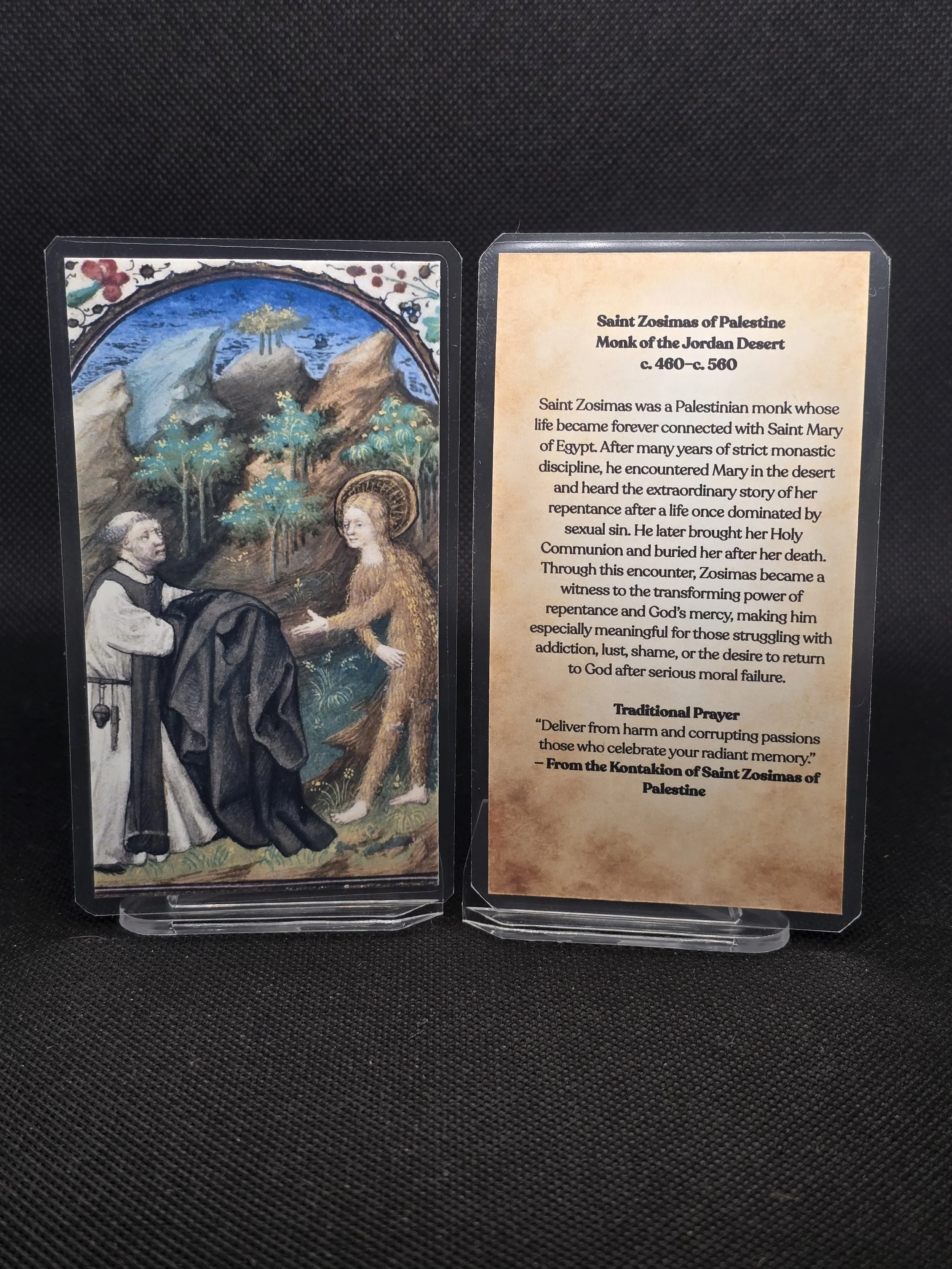
TRADITION: during one of these Lents Zosimas walks for twenty days and sees a figure in the distance. The figure is a woman, naked and burned dark by the sun, who flees from him. He follows. She asks for his cloak so that she can speak with him.
TRADITION: the two bow to each other and ask for a blessing. She greets him by name and knows he is a priest, though they have never met. She asks him to pray for her. He asks the same of her. In the narrative this mutual humility is the turning point. He came looking for a teacher among monks and found one in an unknown woman.
She tells him the story of her life as a young woman of Egypt who lived in sin for many years before a conversion at the doors of the Church of the Holy Cross in Jerusalem, and her 47 years in the desert. She makes him promise to keep her story to himself while she lives. The meeting and its dialogue are tradition and no independent evidence confirms them.
Holy Thursday on the Jordan
TRADITION: Mary tells Zosimas that she has received no Communion in all her years in the wilderness. She asks him to bring her the Holy Gifts the following year, on the evening of the Last Supper, to the bank of the Jordan.
TRADITION: the next Lent, an illness keeps Zosimas from the monks' withdrawal into the desert. He recovers, and on Holy Thursday he brings the Gifts in a vessel along with some food. He sees Mary on the far bank of the river, but there is no boat. She makes the sign of the cross over the water and walks across it to meet him.
TRADITION: Zosimas gives her Communion. She weeps, praises God and tells him to return to their first meeting place the following year. In this story his priesthood is neither a rank nor a display of power. It is a service, the bringing of Christ to a person who has waited for him a long time.
The Burial and the Lion
TRADITION: a year later Zosimas returns to the desert and finds Mary dead. Beside her is an inscription saying her name, that she died on April 1, the night she received Communion, and asking him to bury her. He learns her name only now. In the narrative he cannot dig the hard ground, and a lion appears and digs the grave with its paws.
The lion has a literary precedent. In Saint Jerome's Life of Paul the First Hermit, two lions dig the grave of Paul for Saint Anthony. Kouli notes the similarity as evidence that the later Life was influenced by Jerome. This does not make the story less meaningful as a Christian image of the creation obeying its Maker, but it counts against reading it as a record.
After the burial, Zosimas returns to the monastery and tells the monks what he has seen. The monks hand the story on, and the Life says its author learned it from them. Whether this chain of transmission occurred as described is UNCERTAIN.
His Death and the Question of Relics
The Life says that Zosimas stayed in the monastery near the Jordan until his death at nearly a hundred years of age, peacefully among the brethren. It gives no year, no place of burial and no account of a funeral.
The common date of about 560 is a later estimate and is UNCERTAIN. It is also hard to square with the statements about his birth and age, since different sources place his birth around 460 or near the end of the fifth century, and the numbers do not fit.
There is no reliable record of where he is buried or of any relics. No history of the translation or division of relics could be established. His recognition rests on the calendars. His memory is kept on April 4 in the Byzantine rite and in the old Roman Martyrology, which names him as the Palestinian anchorite who buried Mary of Egypt.
Zosimas in the Liturgy of Great Lent
Zosimas matters to the Eastern Church mostly through Great Lent. In the Byzantine tradition the Life of Mary of Egypt is read in connection with the Great Canon of Saint Andrew of Crete during the fifth week of the Fast, and Mary is commemorated on the fifth Sunday. In that setting Zosimas stands for the priest and the listener, the one who witnesses repentance and brings the sacrament.
The Orthodox Church in America preserves a troparion for him that praises him as the offspring of the wilderness and an angel in the flesh. The complete hymn is published by the OCA. The Melkite Greek Catholic Eparchy of Newton also uses his story in teaching about the Great Fast.
Do not confuse him with other saints of the same name. Zosimas of Solovki was a much later Russian monastic founder who died in 1478 and is commemorated in April on a different day, and Zosimas of Phoenicia is the separate figure mentioned in Evagrius.
Why He Matters to Eastern Christians
Three themes stand out. The first is humility in progress. Years of discipline do not remove the need for repentance and instruction, and a monk of fifty-three can still be taught by a woman he has never met.
The second is the sacramental life. Mary, who is portrayed as having reached a height of solitary holiness, still longs for Communion and asks for a priest to bring it. The story does not set the desert against the Church. It joins them.
The third is that holiness cannot be measured by outward appearances. Zosimas had decades of organized monastic life, and Mary had decades of nearly complete solitude. The Life treats both as real paths to God, and it places the priest at the service of the penitent.
Lord Jesus Christ, you gave your Body and Blood to the weary and the repentant. Keep us from thinking we have learned enough. Send us teachers we do not expect, and give us hearts that listen. Through the prayers of Saint Zosimas, help us to serve the penitent with gentleness and to bring your mercy to those who wait for it. Amen.
This short prayer was written for this page. It is not an official prayer of the Church. The troparion and kontakion of Saint Zosimas are published by the Orthodox Church in America.
Lessons from the Priest-Monk
The first lesson is about the danger of spiritual comfort. Zosimas did nothing wrong in the story's telling, and still he needed to be sent out of his own monastery. People who have long practiced their faith can use the same warning.
The second is that mercy requires listening. When Zosimas meets Mary, the story shows him asking questions, hearing a long confession and keeping a promise of silence. The great skill of a spiritual father in the story is to listen.
The third is honesty about our sources. The Life of Mary of Egypt is read each Lent for good reasons. Its power does not depend on the historian being able to prove each event. The Church can treasure the story and admit that it is a sacred narrative whose history is hard to reach.
The last is the quiet place of the helper. Zosimas does not found a movement or write a book. His whole claim to our memory is that he carried the Eucharist to someone who needed it and buried her with care.
Frequently Asked Questions
The Priest Who Was Taught by a Penitent
Zosimas has no books and no known tomb. He has a chalice in his hands and the memory of a woman in the desert. If his story speaks to you, the prayer card below can keep it near through Lent and beyond.
View Prayer Card