Saints Joachim and Anne: The Righteous Ancestors of God and the Grandparents of Jesus
The parents of the Virgin Mary are named in no Gospel. Their story comes from an ancient apocryphal text, and their veneration is among the oldest and best documented in the Church.
At a Glance
- Names
- Joachim (Ioakeim) and Anne (Anna, Hannah)
- Source
- Protoevangelium of James, second century. Not in canonical Scripture.
- Roman Feast
- July 26, joint memorial
- Byzantine Feast
- September 9, Synaxis of Joachim and Anna. Also July 25 (Dormition of Anna) and December 9 (Conception of the Theotokos).
- Dates of Life
- Unknown. No reliable birth or death dates survive.
- Patronage
- Grandparents, married couples, families and couples hoping for children
Who They Were
Joachim and Anne are honored in the Catholic and Orthodox Churches as the parents of the Virgin Mary and therefore the grandparents of Jesus. In Eastern liturgical language they are the Righteous Ancestors of God, a title that names their place in the family of Christ and says nothing about divinity.
Here is the first thing to say plainly: neither is named in the canonical Gospels. The genealogies in Matthew chapter 1 and Luke chapter 3 do not give the names of Mary's parents. Everything we know about Joachim and Anne by name comes from a later text called the Protoevangelium of James.
That does not make their veneration shaky. The Church has honored them for well over a thousand years, and their feasts are among the oldest Marian related commemorations. This article tells their story as the tradition tells it, marks every point that belongs to tradition, and says where history gives out.
The Protoevangelium of James
The earliest surviving narrative about Joachim and Anne is the Protoevangelium of James, usually dated by scholars to the second half of the second century. It claims to be written by James, but modern scholarship does not accept it as an eyewitness account. It is a pseudonymous work written long after the events it describes.
It draws heavily on the Old Testament. The story of a childless couple praying for a child closely resembles Abraham and Sarah in Genesis, and above all Hannah and Elkanah in the first book of Samuel, where Hannah prays for a son and promises to give him to the Lord. Scholars think the author may have shaped Mary's birth story on the model of Samuel's.
Modern study does not conclude that every detail is invented. It says that old tradition, theological reflection and literary shaping are woven together and cannot always be pulled apart. The Catholic Encyclopedia makes the same balanced point: it warns against treating the book as reliable history, but also against assuming no genuine memory can survive in apocryphal writing.
The Western Church was more cautious than the East about the text. Later works, including the Gospel of Pseudo-Matthew and the Gospel of the Nativity of Mary, passed on and expanded the same material.
Family and Origins
Nothing certain is known about the births, parents, childhoods or marriage of Joachim and Anne. The Protoevangelium introduces Joachim as a wealthy and generous Israelite who gives freely to the Temple. Anne is his wife, distressed because they have no children.
TRADITION: later Eastern hagiography describes Joachim as a descendant of King David through the tribe of Judah, and Anne as the daughter of a priest named Matthan, of the tribe of Levi. The Orthodox Church in America preserves these details in its liturgical lives of the saints. A detail repeated in a Church's life of a saint is not the same as independently documented history.
TRADITION: some accounts place their home in Nazareth in Galilee. Another old tradition places it near the Pool of Bethesda in Jerusalem, and the Church of Saint Anne there honors that spot as the birthplace of Mary. UNCERTAIN: neither place can be proved, and the two traditions should not be merged into one itinerary.
Childlessness and Prayer
TRADITION: in the story's opening, Joachim brings his offering at a feast and is rebuked by a man named Rubim, who reminds him that he has no offspring in Israel. Hurt, Joachim checks the genealogies and recalls how Abraham received a son in old age. He then withdraws to the wilderness and fasts for forty days and nights, praying for mercy. Later versions name his accuser Reuben, but the earliest text does not say so clearly.
TRADITION: meanwhile Anne mourns both her childlessness and her husband's absence. Her servant Judith urges her to stop grieving. Anne puts on her wedding garments and goes into the garden, and sitting under a laurel she sees a nest of birds and laments that even the birds can bear young. Her prayer echoes Sarah. This scene is one reason for Anne's later patronage of women hoping for a child.
TRADITION: an angel tells Anne her prayer has been heard and that she will conceive. She promises to dedicate the child to God, boy or girl. Joachim also receives an angel's message telling him to come home. The couple reunite, and a daughter is born, named Mary.
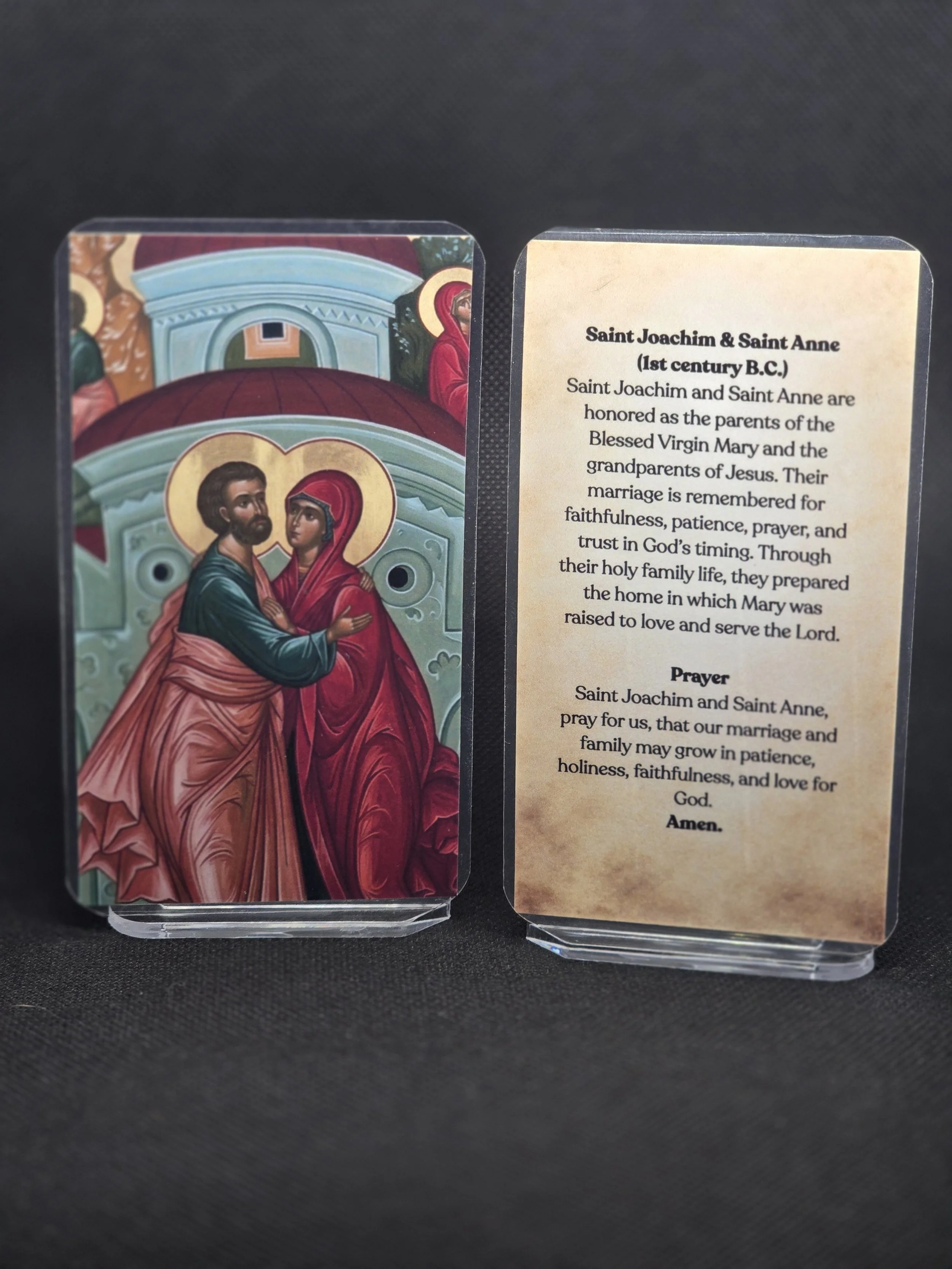
TRADITION: in the early text, Anne waits at a gate and embraces Joachim as he returns. The later identification of the spot as Jerusalem's Golden Gate is an elaboration. Many paintings show the Golden Gate meeting as if the location were certain, and it is not.
Raising Mary
TRADITION: after Mary's birth, Anne keeps her in a protected space in the house, with great attention to ritual purity. When Mary turns one, Joachim holds a feast and invites the priests to bless her. The text also places a hymn of thanksgiving on the lips of Anne, a literary composition within the story and not a surviving writing of Anne.
TRADITION: at age three, according to the Protoevangelium, Mary's parents bring her to the Temple in Jerusalem in fulfillment of Anne's vow. Young women with lamps accompany her, and a priest receives her. The narrative has her remain there until age twelve. These ages are specific claims of the apocryphal story, not confirmed history.
The episode became the feast of the Entrance of the Theotokos into the Temple on November 21 in Byzantine churches. The existence of the feast shows how deeply the story entered Christian worship. It does not provide independent historical confirmation of the Temple narrative.
Neither Joachim nor Anne is known to have founded an institution, written a book, held a Christian office or conducted a public ministry. No surviving writing is reliably attributed to them. Their place in the Church rests on who they were to Mary and Jesus and on the faith the tradition ascribes to them.
Their Deaths and Burial
The dates, places and circumstances of their deaths are not historically established. There is no evidence that either was persecuted or died as a martyr.
TRADITION: the Orthodox Church in America's account for September 9 says Joachim died at age 80 and Anne two years later at age 70. Its account for July 25 gives Anne's age at death as 79. The two ages disagree, which is a reminder that these figures are devotional memory and not records.
A long Jerusalem tradition places their graves near the site of the Church of Saint Anne, a Romanesque building from the twelfth century. The building preserves a tradition. It cannot authenticate any tomb.
Relics and Shrines
Several places claim relics of Saint Anne. The Orthodox Church in America lists relics at monasteries on Mount Athos, including Stavronikita, Koutloumousiou and the Skete of Saint Anne. The Shrine of Sainte-Anne-de-Beaupre in Quebec documents the arrival of relics attributed to Anne in 1670, 1892 and 1960, the last from the Basilica of Saint Paul Outside the Walls in Rome.
These transfers have recorded ecclesiastical histories. They do not prove that the remains belonged to the Anne of the tradition, because no unbroken chain of evidence leads back to the first century.
TRADITION: at Sainte-Anne-d'Auray in Brittany, a farmer named Yves Nicolazic reported apparitions of Anne beginning in 1623, and a statue was found on March 7, 1625. These are later private devotional claims and not events from Anne's life. The shrine of Sainte-Anne-de-Beaupre also publishes pilgrim testimonies of healing, which record devotional experience and should not be called medically verified miracles.
The Growth of Their Veneration
Their cult is old and well attested. According to the New Catholic Encyclopedia, a church dedicated to Anne stood in Constantinople around 550 in the reign of Justinian. Eastern commemorations developed early, with September 9 following the Nativity of the Theotokos on September 8, December 9 for the conception of Mary by Anne, and July 25 for the dormition of Anne.
In the West, Pope Gregory XIII extended the feast of Anne to the whole Roman Church in 1584. Joachim's separate Western feast moved among several dates before the two saints came to share the memorial on July 26 in the current Roman calendar.
They have no formal canonization date. Like many ancient saints they were recognized through long liturgical veneration, before the later Roman procedures existed.
TRADITION: some medieval Western legends claim that Anne married three times and had three daughters named Mary, a theory called the trinubium. It was an attempt to explain Gospel family relationships and is a later legend, not part of the early account.
Why They Matter to Eastern Christians
For Byzantine Orthodox and Byzantine Catholic Christians, Joachim and Anne have a settled place in worship. Their synaxis on September 9 comes the day after the Nativity of the Theotokos, so the Church honors Mary's birth and then immediately the parents through whom she came. The feast says that the Incarnation took place within a real human family.
Their importance also appears among the Fathers. Saint John of Damascus praises Joachim and Anne in his homily on the Nativity of the Theotokos, presenting their marriage and parenthood as a divine preparation for Christ's coming. For Eastern Christians this is an inherited liturgical teaching, not an import from medieval Western devotion.
The December 9 feast is distinct from the Catholic dogma of the Immaculate Conception. The Byzantine feast celebrates the conception of Mary by Anne, while the Latin dogma concerns Mary's preservation from original sin. The two should not be confused.
Lord God, you gave Joachim and Anne patience in waiting and joy in a child. Bless every couple who hope for children, every grandparent who prays for a family, and every household that hands on the faith. Through the prayers of your righteous ancestors, give us trust in your timing and gratitude for those who came before us. Amen.
This short prayer was written for this page. It is not an official prayer of the Church. The traditional apolytikion for September 9 is published by the Greek Orthodox Archdiocese of America.
Lessons for Families and Grandparents
The first lesson is perseverance in waiting. Whatever the historical details, the story of Joachim and Anne has comforted couples who long for children for many centuries. They are shown continuing to pray when others reproach them.
The second is the dignity of grandparents. Jesus had grandparents, and the Church has honored them. For families in which grandparents help raise children, Joachim and Anne are natural patrons.
The third is honesty about sources. The Church can honor them with confidence while admitting that the details of their lives rest on a second century apocryphal text. Faith does not need every narrative detail to be historical in order to hold the family of Jesus in reverence.
The last lesson is about gratitude. A child like Mary does not come from nowhere. She comes from parents who prayed and from a people who handed on the faith. The feast of the Righteous Ancestors turns that thought into praise.
Frequently Asked Questions
The Grandparents of the Savior
Joachim and Anne remind us that holiness is handed down through families. If their story speaks to you, the prayer card below can keep their memory in your home.
View Prayer Card