Saint Gerasimos of the Jordan: Desert Abbot, Founder of a Lavra and the Monk Remembered With a Lion
A Lycian monk who helped shape Palestinian monasticism in the fifth century, founded a famous lavra near the Jordan, and became the saint of the wounded lion.
At a Glance
- Origin
- Lycia in Asia Minor. Some sources name Myra. Birth year unknown.
- Death
- Traditionally March 5, 475, near the Jordan River
- Feast Day
- March 4 in Byzantine Orthodox and Byzantine Catholic calendars. March 5 in the Roman Martyrology.
- Role
- Anchorite, abbot and founder of a lavra in the Jordan valley
- Foundation
- Lavra of Saint Gerasimos, traditionally dated to about 455
- Attribute
- A lion, shown with an injured paw or resting at his side
Who Saint Gerasimos Was
Gerasimos of the Jordan was a monk and abbot of the fifth century who founded one of the best known monastic communities of the Judean wilderness. He is remembered in the Byzantine Orthodox and Byzantine Catholic calendars on March 4 and in the Roman Martyrology on March 5, which makes him a saint honored in both East and West.
His historical footprint is real. He appears in the writings of Cyril of Scythopolis, a monastic biographer of the sixth century, and in the collection of stories by John Moschus. Modern scholars and archaeologists treat him as a genuine figure of Palestinian monasticism, and the monastery that bears his name still stands near Jericho.
The most famous story about him, the lion with the wounded paw, is also ancient, but it belongs to the realm of tradition. This article keeps the two apart. What is documented is the monk, his lavra and his role in the controversies of his age. What is tradition is the lion, whose story has been told for about fourteen centuries.
Origins in Lycia
Gerasimos came from Lycia, a coastal region of southwestern Asia Minor in what is now Turkey. The Greek Orthodox Patriarchate of Jerusalem names Myra, the city of Saint Nicholas, as his hometown, but the broader label Lycian is the better established. UNCERTAIN: his birth year is unknown.
Nothing reliable survives about his parents, his siblings, his education or his childhood. Orthodox accounts describe him as religiously inclined from youth, but these statements cannot be tested against independent evidence. A careful biography has to admit that the first half of his life is largely hidden.
According to the later biographical tradition, he became a monk in his homeland and then traveled to Egypt, where he met the ascetic traditions of the Thebaid, the region associated with Anthony and the early desert fathers. UNCERTAIN: the dates and the monasteries involved are not known, so the Egyptian formation belongs to the received biography and not to firm history.
Coming to the Jordan
At some point around the middle of the fifth century, Gerasimos settled in Palestine near the Jordan River. The Orthodox Church in America places his move around 450. Other accounts place it just after the Council of Chalcedon in 451. UNCERTAIN: the exact order of events cannot be reconstructed.
The Judean wilderness was already full of ascetics. Palestine in this period was a place of pilgrimage and of monasticism, with figures such as Euthymius the Great, who gathered disciples east of Jerusalem. Gerasimos joined this world and eventually became one of its leaders.
There is no evidence that he converted from another religion. His vocation grew through withdrawal from ordinary life, steady prayer and then the gathering of other monks around him.
Chalcedon and Saint Euthymius
The Council of Chalcedon met in 451 and defined Christ as one person in two natures, divine and human. The decision was welcomed by many but rejected by others, and Palestine became a center of resistance led by the monk Theodosius, who gained support among monks and in Jerusalem.
Cyril of Scythopolis reports in his Life of Euthymius that Gerasimos at first followed the teaching of Theodosius against the council. After hearing about Euthymius, who accepted Chalcedon, Gerasimos visited him at Rouba, stayed for a considerable time and came to accept the council's definition. This episode is early and carries real historical weight.
It also needs caution. Cyril wrote from a strongly Chalcedonian point of view and was openly hostile to the opposing party. He does not give a detailed statement of what Gerasimos believed before his change of mind. It would be wrong to call Gerasimos a lifelong opponent of Chalcedon, and wrong to assume that every opponent of the council held the same views. Opponents of Chalcedon differed, and the position now held by the Oriental Orthodox churches is not the same as the ancient heresy of Eutyches.
A related figure is Saint Cyriacus the Hermit, a young monk whom Euthymius sent to Gerasimos because he was not yet ready for Euthymius's own harder solitude. Accounts say Cyriacus stayed with Gerasimos for several years, with nine years given in one Greek Orthodox source. That detail comes from the biographical tradition.
The Lavra
Gerasimos's chief achievement was a monastery of a particular kind. A lavra was a community in which hermits lived in separate cells in the wilderness while a central monastery supplied worship, supplies and stability. The Greek Orthodox Patriarchate of Jerusalem dates his foundation to about 455. The scholar Brouria Bitton-Ashkelony dates his monastic rule to after 456. UNCERTAIN: the exact year the institution took its final form is unknown.
The rhythm of life was demanding. For five days of the week the monks stayed in their cells, praying and weaving baskets or mats from palm leaves. They did not cook food or light fires, living on simple provisions such as bread, dates and water. On Saturdays and Sundays they gathered at the central monastery for the Divine Liturgy, Holy Communion and a shared meal, handing in their handiwork and receiving supplies for the coming week.
Accounts describe a community of about seventy monks. That figure belongs to the biographical tradition and should not be treated as a census. The same accounts describe unlocked cells and almost no possessions, so that any visitor could take what he needed.
There is no securely authenticated body of letters, sermons or treatises by Gerasimos, and no complete surviving rule in his own hand. His legacy is the way of life of his monastery, which the later sources describe.
Ascetic Severity and Resistance
TRADITION: the Orthodox Church in America preserves the claim that Gerasimos spent Great Lent without ordinary food until Pascha, receiving only the Eucharist. As with many ascetic reports from the desert, it is testimony about how he was remembered, not a verified account of his diet.
The scholar Yizhar Hirschfeld, discussing an anonymous Life of Gerasimos, describes monks who asked permission to cook food and to use lamps for night prayer. Gerasimos is said to have refused. The story shows that even devoted monks did not always welcome the full severity of the rule. UNCERTAIN: since the episode survives through hagiography, its details cannot be independently reconstructed.
This tension is a familiar part of monastic history. Every strict community has to balance the ideal with the needs of ordinary bodies, and the sources suggest that Gerasimos leaned firmly toward the ideal.
The Lion of the Jordan
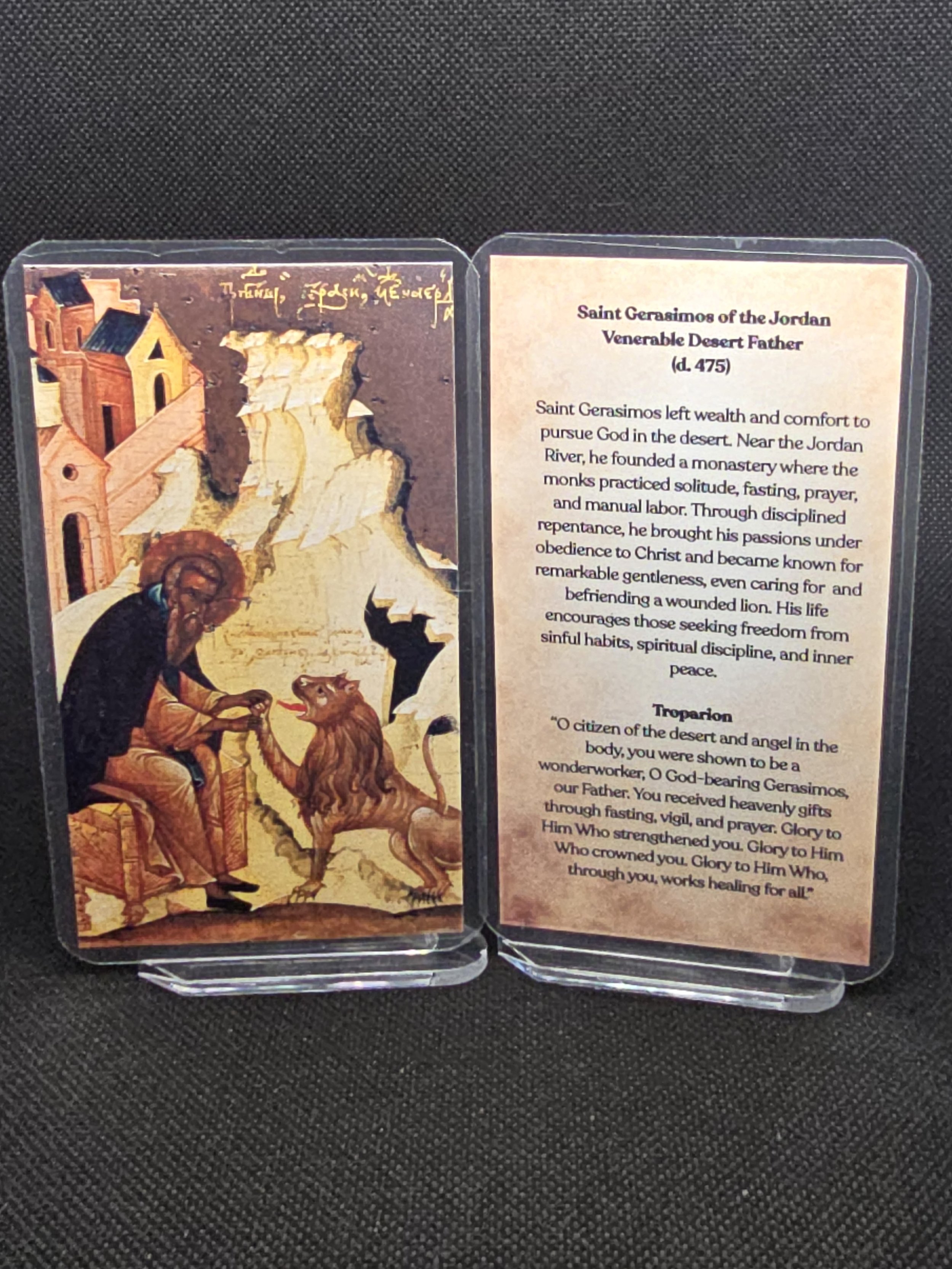
TRADITION: John Moschus, who collected stories of monks in the late sixth and early seventh centuries, preserves the best known account. Gerasimos met a lion by the Jordan with a reed splinter lodged in its paw. He removed it, cleaned the wound and bandaged the foot. The lion would not leave him and began to follow the monk, and Gerasimos fed it and let it stay at the monastery.
TRADITION: the monastery kept a donkey to carry water from the river, and the lion was given the job of guarding it. One day camel drivers passing through took the donkey. The lion came back without it, and Gerasimos assumed the lion had eaten it, so he made the lion carry the water jars. Later the lion recognized the donkey among a passing caravan, drove it back with the merchants' camels and was cleared of blame. The animal was called Jordanes.
TRADITION: after Gerasimos died, the lion looked for him in vain. A monk named Sabbatios led it to the grave, where it mourned and died. Moschus reads the story as a sign of the harmony between humans and animals that existed before the Fall.
The story is ancient but cannot be verified. No outside evidence confirms the lion, its name or its death. Scholars also note that the tale later migrated to Saint Jerome in the Latin West, where Jerome is shown with a lion at his feet. The similarity of the Latin names Gerasimus and Hieronymus may have helped the confusion, and the Gerasimos version is the older of the two.
Death, Tomb and Relics
Gerasimos is traditionally said to have died peacefully on March 5, 475. The date appears in standard Catholic references such as the New Catholic Encyclopedia and in Orthodox sources, although it is not a contemporary civil record.
TRADITION: his death follows that of Euthymius, who died on January 20, 473. A visionary tradition says Gerasimos saw angels carrying the soul of Euthymius and then went to attend the burial. The supernatural element cannot be verified.
The monks buried him, according to the hagiographical tradition. No reliable contemporary account fixes the original grave. Archaeologists working at the site have suggested a cave as a possible tomb, but they treat the identification as uncertain. Modern claims about relics at the monastery also vary, and UNCERTAIN: no continuous record establishes the authenticity of any remains.
Gerasimos has no formal canonization date. He belongs to the ancient period in which saints were recognized by long public veneration, and his cult is attested in the Eastern calendars and in the Roman Martyrology.
The Monastery Today
The monastery associated with his memory stands at Deir Hajla in the Jordan valley near Jericho. It belongs to the Greek Orthodox Patriarchate of Jerusalem and remains a place of pilgrimage, especially in the Easter season. The buildings that stand today reflect substantial rebuilding and restoration, not an unchanged fifth-century structure.
The setting still gives a sense of the original idea. The monastery sits on a plain of the lower Jordan, with desert hills to the west, and the pilgrim can feel the contrast between the solitude of the wilderness and the common worship at the center.
The saint should not be confused with Gerasimos of Kefalonia, a much later Greek ascetic who died in 1579. The two have different lives, different relics and different feast days.
Why He Matters to Eastern Christians
For Orthodox and Byzantine Catholic Christians, Gerasimos is a Venerable Father, one of the great figures of the Palestinian desert. His troparion is sung on March 4, and the Orthodox Church in America publishes the full text of the hymn. His monastery shows the Eastern ideal of balance, with hermit life and common liturgy held together in one community.
His story also appears in modern Orthodox reflection on creation. The Greek Orthodox Archdiocese of America's document For the Life of the World, in section 78, invokes Gerasimos and the lion in a discussion of mercy toward animals. The Church thus uses the story as a picture of gentleness toward the created world.
His involvement with Chalcedon makes him a useful window into ancient divisions. His story reminds us that monks of the Judean desert were not outside the great debates of their day, and that individuals could move from one side to another through conversation and prayer.
Lord Jesus, you called your servants into the wilderness to seek your face. Give us quiet hearts, steady prayer and gentle hands. Teach us mercy toward every creature you have made and patience with those who live and work beside us. Through the prayers of Saint Gerasimos, keep us faithful in solitude and joyful in common worship. Amen.
This short prayer was written for this page. It is not an official prayer of the Church. The full troparion and kontakion of Saint Gerasimos are published by the Orthodox Church in America.
Lessons from the Desert Abbot
The first lesson is that solitude and community can support each other. The lavra gave its monks the quiet of the cell during the week and the shared Eucharist at the weekend. Many people today live between the two needs, and the lavra is an old model for holding them together.
The second is the place of mercy. Even if the lion story is read as a parable, it teaches that holiness includes tenderness toward living creatures. Moschus saw in it a glimpse of the world as it was meant to be.
The third is humility about being wrong. Gerasimos, according to Cyril, held to a position against Chalcedon until he heard Euthymius. The early sources do not shame him for that. They show him changing his mind and becoming a leading Chalcedonian monk.
The last lesson is about honesty with sources. The historical Gerasimos is a founder, a monk and a participant in a controversy. The lion is a story, loved and old, but a story. Keeping the two apart does not diminish the saint. It lets the reader see both what the Church can document and what it has treasured.
Frequently Asked Questions
A Desert Father With a Gentle Story
Gerasimos left no books, but he left a way of life and a story that has kept his memory warm for fourteen centuries. If his example speaks to you, the prayer card below can keep it near.
View Prayer Card